



Why Enterprises End Up With Multiple API Gateways (and What to Do About It)
Why enterprises end up with multiple API gateways, what gateway sprawl costs, the warning signs and four ways to manage them without a migration.

Enterprises end up with multiple API gateways because clouds, acquisitions, teams and new use cases each bring their own, and nobody plans the total. Running several gateways isn't a mistake in itself. The cost comes from managing each one separately: separate catalogs, policies, portals, keys and audit logs.
This is now the normal state. According to Gartner, by 2028 more than 75% of organizations will use two or more API gateways, and Gartner warns that running them without overarching API management leads to API sprawl and shadow APIs.
This guide covers why multiple API gateways happen, what they cost, the warning signs of gateway sprawl and four ways to deal with them.
TL;DR
Multiple API gateways are normal in enterprises, and migrating everything to one is slow and risky.
Count your gateways, portals and policy sets, then decide per gateway whether to keep, standardize or retire it.
For most enterprises, the fastest fix is to federate: keep the gateways that run traffic and put one catalog, one policy layer, one developer portal and one audit trail on top.
What does "multiple API gateways" mean?
An enterprise has multiple API gateways when its APIs run through more than one gateway product or more than one separately managed gateway instance. An API gateway is the runtime component that receives API calls, checks who is calling, applies limits and routes each request to a backend.
"Multiple" covers three different patterns. Each has different costs.
Most large enterprises have all three at once. Our guide to API gateways vs multi-gateway setups explains when each makes sense.
Why do enterprises end up with multiple API gateways?
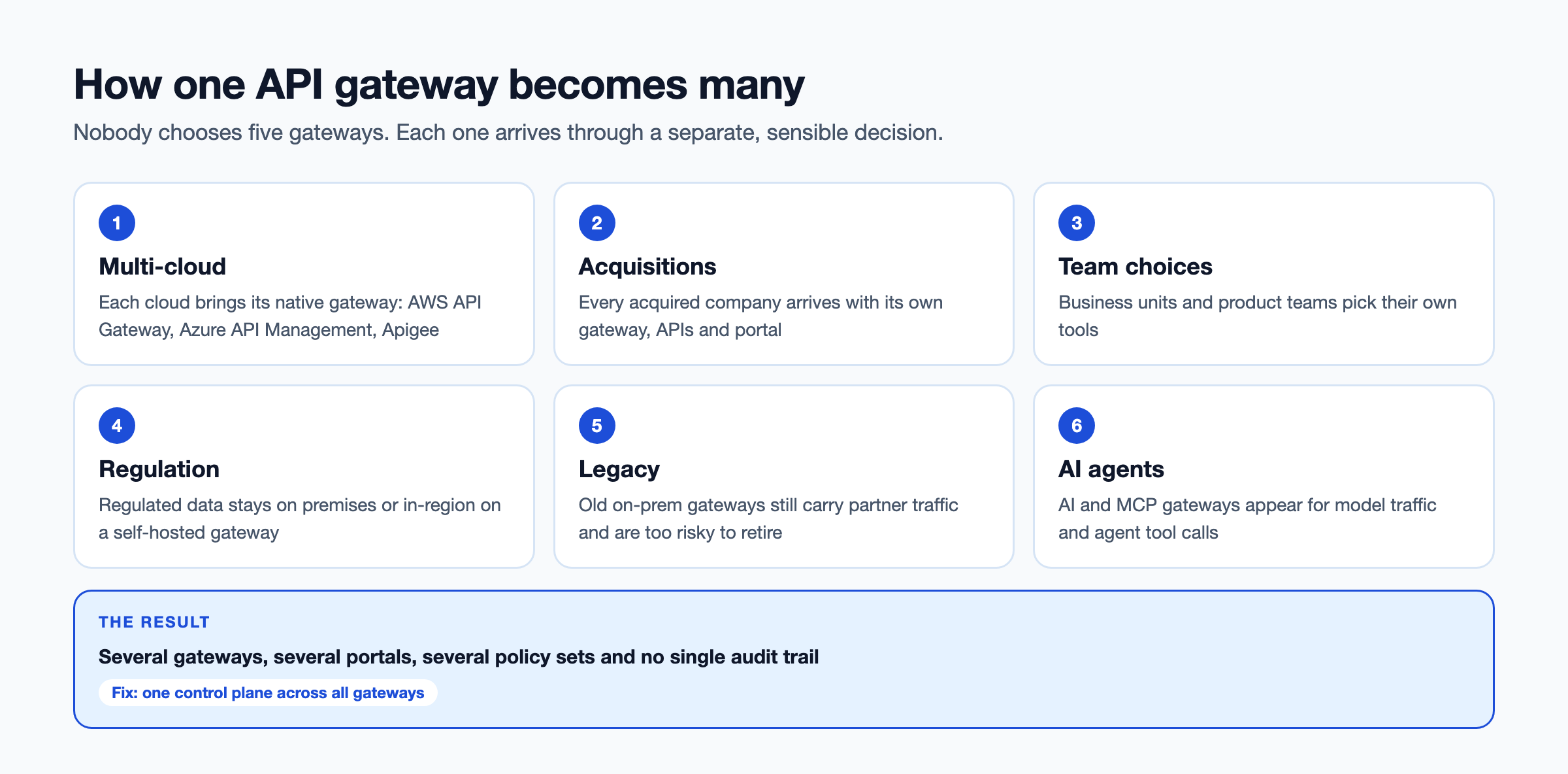
Enterprises end up with multiple API gateways for seven common reasons, and most of them are sensible decisions made one at a time. Nobody chooses five gateways. They choose one gateway five times.
1. Multi-cloud
Each cloud has its own native gateway. Teams on AWS use AWS API Gateway, teams on Azure use Azure API Management, and teams on Google Cloud use Apigee. Using the native option is faster than fighting it, so each cloud adds a gateway.
2. Acquisitions
Every acquired company arrives with its own APIs, gateway and portal. Migrating them is rarely urgent, so they stay. A pattern we see often: a connectivity data platform made several acquisitions in two and a half years and ended up with Azure APIM, AWS and a third hosting setup, with more acquisitions coming. Its question wasn't which gateway to keep. It was how to give developers one experience across all of them.
3. Team autonomy
Business units and product teams pick their own tools. A payments team picks one gateway, a data team picks another. Central platform teams often find out after the gateway is in production.
4. Different jobs
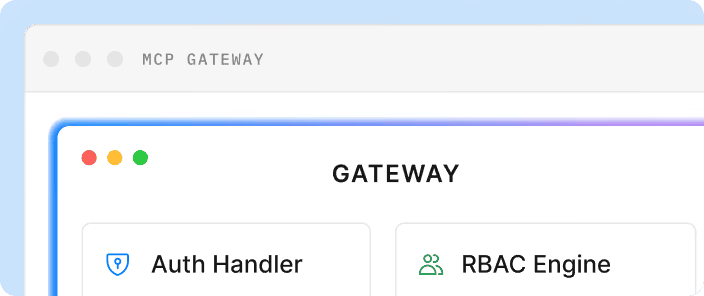
Gateways specialize. An edge gateway handles public traffic. An internal gateway or service mesh handles service-to-service calls. Event gateways handle Kafka. AI gateways handle model traffic, and MCP gateways handle agent tool calls. Our guide to the MCP gateway covers the newest of these.
5. Regulation and data residency
Regulated data often has to stay in a region or on premises. That means a self-hosted gateway next to a cloud gateway, even when both come from the same vendor.
6. Legacy gateways nobody can retire
Older on-prem gateways carry critical partner traffic. Retiring them means retesting every integration, so they stay running, often with no owner and no roadmap.
7. Kubernetes ingress
Platform teams add ingress controllers and service meshes for Kubernetes. These route and secure API traffic too, which adds another layer that behaves like a gateway.
Is having multiple API gateways a problem?
Having multiple API gateways isn't a problem by itself; managing each one separately is. Two well-run gateways with one catalog and one set of policies are fine. Five gateways with five portals and five ways to get a key are not.
Multiple gateways are fine if:
- One team can list every gateway and the APIs behind each
- Policies such as authentication and rate limits follow one standard
- Developers and partners find every API in one place
- Security can get one audit trail across gateways
Multiple gateways are a problem if:
- Nobody can say how many APIs you have
- Partners use different portals depending on which API they need
- The same policy is written by hand in several consoles
- An incident means logging into three tools to trace one call
What does running multiple API gateways cost?
The cost of multiple API gateways is mostly not license fees; it's duplicated work across catalogs, policies, portals, keys and audits. The license line is visible. The rest hides in team time and slower partner onboarding.
Discovery is the hidden one. Postman's 2025 State of the API report found that 34% of teams can't find existing APIs. Every gateway with its own catalog makes that number worse.
How do you estimate your own API gateway cost?
Count three things, then multiply:
- Gateways: How many separately managed gateways run production traffic?
- Policy sets: How many places do you configure authentication and rate limits?
- Front doors: How many portals or processes do partners use to get access?
If any of the three is higher than one, you're paying for the same work more than once. Our guide to inventorying APIs across multiple gateways shows how to get the counts.
What are the warning signs of gateway sprawl?
Gateway sprawl is when gateways multiply faster than anyone can govern them. It's a form of API sprawl, and these eight signs show it has started.
- No one can list every gateway: The answer depends on who you ask.
- API counts are guesses: Each team knows its own, but nobody knows the total.
- Partners have several logins: Access depends on which portal hosts the API.
- Policies drift: The same rule has different values on different gateways.
- Security asks for one audit log: Nobody can produce it without a spreadsheet.
- Duplicate APIs appear: Two teams build the same customer lookup.
- Gateways have no owner: An old gateway still carries traffic, but nobody manages it.
- AI agents get their own path: Agent and MCP traffic bypasses the policies your APIs follow.
What should you do about multiple API gateways?
You have four options for multiple API gateways: consolidate, standardize per use case, federate under one control plane or leave them as they are. For most enterprises, federating gives the most control for the least risk.
Consolidation sounds simplest, but acquisitions and new clouds keep adding gateways faster than migrations remove them. Federation accepts that and fixes the management layer instead. Our guide to control plane vs data plane explains why this split works.
A pattern we see often: an energy services company had several products, each publishing APIs in a different place. What it wanted was a common layer across gateways, not another migration.
How do you manage multiple API gateways without migrating?
You manage multiple API gateways without migrating by leaving runtime traffic where it is and centralizing everything around it: catalog, policies, portal, access and audit. This approach is called federated API management.
- Inventory: Connect to every gateway and pull its APIs, versions and specs.
- Catalog: Put every API in one searchable catalog with owners and tags.
- Common policies: Define standards once and score every API against them.
- One portal: Give developers and partners one place to find APIs, request access and get keys.
- One audit trail: Collect usage and logs from every gateway into one view.
The first two steps are the slowest by hand. Federation platforms such as DigitalAPI automate them by connecting to each gateway and syncing its APIs on a schedule.
Our step-by-step guide to managing multiple API gateways without migration covers each step in detail.
How does a federated API platform help with multiple API gateways?
A federated API management platform turns multiple API gateways into one API program without moving any traffic. The gateways keep running requests. The platform handles discovery, governance, access and analytics across all of them.
DigitalAPI's API marketplace connects to gateways such as Apigee, Kong, AWS API Gateway, Azure API Management, MuleSoft and IBM, and pulls every API into one catalog. Each API gets a governance score from 0 to 100 based on security, style and documentation, so teams see which APIs meet the standard. Partners use one developer portal and one subscription flow, whichever gateway runs the API, and the same specs generate MCP servers so agents follow the same rules.
Teams using DigitalAPI get one view of every API across gateways in weeks, not the years a migration takes. The API marketplace page shows how it works.
FAQs
1. How many API gateways should a company have?
There's no right number. A company should have as many API gateways as its clouds, regions and use cases need, and no more. What matters is that every gateway is visible in one catalog, follows the same policies and feeds one audit trail.
2. Can you use two API gateways together?
Yes. Many enterprises run two or more API gateways side by side, such as a cloud gateway for public APIs and an on-prem gateway for regulated data. They work best when one management layer sits above both, so APIs, policies and access are managed in one place.
3. Is it bad to have multiple API gateways?
Multiple API gateways aren't bad in themselves. They become a problem when each is managed separately, which means duplicated policies, several developer portals, inconsistent security and no single audit trail.
4. What is gateway sprawl?
Gateway sprawl is when an organization's API gateways multiply faster than it can govern them. Signs include nobody knowing how many gateways exist, partners using several portals, policies drifting between gateways and gateways with no owner.
5. What's the difference between an API gateway and API management?
An API gateway handles live API traffic: it authenticates calls, applies rate limits and routes requests. API management is the wider layer around it: the catalog, policies, developer portal, access, analytics and lifecycle. One API management platform can manage several gateways.
6. Should we migrate to one API gateway?
Migrating to one API gateway rarely pays off for large enterprises. It takes years, every integration needs retesting, and new acquisitions or clouds add gateways again. Most teams get faster results by federating existing gateways under one management layer.
7. What is gateway federation?
Gateway federation is managing several API gateways, often from different vendors, through one control plane. Each gateway keeps handling its own traffic, while the catalog, policies, developer portal and analytics are shared across all of them.
Final word
You probably didn't choose multiple API gateways. Clouds, acquisitions and new use cases chose them for you, and more are coming.
The useful question isn't how to get back to one. It's whether you can see, govern and open every API across all of them from one place. Start by counting your gateways, policy sets and front doors this week.
Running APIs across several gateways?
See how DigitalAPI brings every gateway into one catalog and portal.
Dhayalan Subramanian is Associate Director, Product Growth at DigitalAPI, where he leads go-to-market and product growth for the company’s multi-gateway API management platform. His work focuses on helping large enterprises and mid-market cloud companies consolidate APIs across AWS, Azure, Apigee, Kong, MuleSoft, and other gateways into a single control plane for governance, discovery, monetization, and agent consumption.
Dhayalan brings 14+ years of experience across product strategy, enterprise architecture, and engineering leadership. Earlier in his career, he held senior roles at Encora (as Associate Architect and Technical Manager), Mindtree (Technology Lead), Tech Mahindra (Technical Lead), and Primus Analytics, where he designed integration frameworks and delivered enterprise-grade digital platforms for global customers.
At DigitalAPI, he works directly with platform, integration, and developer experience leaders at Fortune 500 organizations to operationalize unified API catalogs, developer portals, and MCP-ready APIs. He writes regularly on API developer experience, API governance, and AI agent architectures.

One email a fortnight. Worth opening.
A short digest of what we're writing, what we're learning from customers, and the handful of links you'd actually want from us. No tracking pixels.