





How to inventory Legacy Internal APIs from multiple gateways?
This guide will navigate the complexities of bringing order to your APIs by easily cataloging them from multiple sources.

TL;DR
1. Effectively inventorying legacy internal APIs is crucial for modernization, risk reduction, and unlocking enterprise value.
2. Legacy APIs often lack documentation and centralized visibility, creating significant operational debt and hindering new development.
3. A modern API catalog centralizes disparate legacy APIs, providing a single source of truth for discovery, governance, and ownership.
4. Success requires continuous automation and a robust metadata model, not one-time manual efforts or gateway-specific solutions.
5. DigitalAPI offers a unified platform to discover, document, govern, and make your entire legacy internal API estate AI-ready, regardless of its original source.
Gain clarity over your legacy internal APIs with DigitalAPI. Book a Demo!
Deep within many enterprises, critical business logic often resides behind a labyrinth of legacy internal APIs. These invaluable connections, built over years, power core operations but frequently exist without centralized documentation, clear ownership, or consistent governance. As organizations push for digital transformation and AI-driven automation, the lack of visibility into these foundational services becomes a significant impediment. Understanding and effectively inventorying your legacy internal APIs is no longer optional; it's a strategic imperative to mitigate risk, accelerate innovation, and unlock the true value of your existing infrastructure. This guide will navigate the complexities of bringing order to this vital, yet often overlooked, part of your API landscape.
What are Legacy Internal APIs?
Legacy internal APIs are programmatic interfaces developed within an organization, often years or even decades ago, that expose core business functionalities or data from older systems. Unlike modern APIs designed with OpenAPI specifications and cloud-native principles, legacy internal APIs typically predate widespread API standardization. They might run on older technologies, use custom protocols (like SOAP, RPC, or even proprietary message queues), or simply be undocumented REST endpoints built before robust API governance became a standard practice.
The "internal" aspect means they were initially intended for consumption only by other internal systems or teams, often relying on tribal knowledge for integration. The "legacy" status implies they are often poorly documented, lack clear ownership, have inconsistent security, and are difficult to discover or understand by new development teams. Yet, despite these challenges, they are often deeply embedded in critical business processes, making their modernization and effective inventory a top priority for any enterprise looking to evolve.
Why Inventory Your Legacy Internal APIs? The Unseen Value and Risks
The true cost of uninventoried legacy internal APIs isn't just the friction they create; it's the invisible risk and lost opportunity. While modern APIs often get the spotlight, the forgotten foundational services are silently shaping, or limiting, your enterprise's future. Effectively inventorying your legacy internal APIs provides a strategic advantage.
- Mitigate Operational Risk and Technical Debt: Undocumented legacy APIs are single points of failure. When an owner leaves or a system needs an update, critical dependencies can break unexpectedly. An inventory reduces this risk by mapping dependencies and providing clarity.
- Accelerate Digital Transformation Initiatives: You can't modernize what you don't understand. Cloud migrations, microservices refactoring, and new product development all hinge on knowing which legacy APIs exist, what they do, and how they behave.
- Reduce Duplication and Redundancy: Without an inventory, different teams might unknowingly rebuild functionality already present in an existing, albeit hidden, legacy API. This wastes resources and creates more technical debt.
- Unlock Trapped Business Logic and Data: Many legacy systems hold unique, complex business logic or proprietary data. Inventorying these APIs makes that logic discoverable and reusable, transforming them from liabilities into assets.
- Improve Security Posture and Compliance: Legacy APIs often have outdated security mechanisms or unknown vulnerabilities. A comprehensive inventory allows security teams to identify, assess, and remediate these exposures systematically, crucial for compliance with regulations like GDPR, HIPAA, or PCI-DSS.
- Enable Smarter Strategic Planning: With a clear view of your legacy API landscape, architects and product managers can make informed decisions about refactoring, deprecation, and investment, moving beyond guesswork.
- Streamline Developer Onboarding and Productivity: New developers spend less time deciphering undocumented legacy systems when a searchable, consistent catalog of internal APIs exists, accelerating their time to contribution.
- Prepare for AI-Driven Automation: AI agents and automated workflows require structured, machine-readable access to enterprise capabilities. Inventorying legacy internal APIs and enriching them with metadata is the first step toward making them consumable by future AI systems, transforming manual processes into automated ones.
First Principles for Inventorying Your Legacy Internal APIs
Approaching the inventory of legacy internal APIs requires a specific mindset. These aren't pristine, modern services. They are often relics of different eras, built under different constraints. A framework based on first principles helps cut through assumptions and build a truly effective system for managing them.
Principle 1: Legacy APIs are living systems, not historical artifacts
Even "legacy" APIs evolve. They might have undocumented changes, new dependencies, or subtle behavioral shifts over time. Treating them as static historical records is a mistake. Your inventory must account for ongoing discovery, drift detection, and eventual modernization or deprecation rather than a one-time snapshot.
Principle 2: Fragmentation is the default, not an anomaly
Legacy internal APIs are inherently fragmented. They exist in various languages, on different servers, within diverse applications, and might not even be routed through a central API gateway. Attempting to force them into a single, uniform environment before cataloging is counterproductive. The inventory should embrace this fragmentation, acting as a unifying layer rather than a centralizing force.
Principle 3: Metadata is paramount, especially where specs are scarce
For modern APIs, the specification (OpenAPI, AsyncAPI) is king. For many legacy internal APIs, a formal spec might not exist or might be incomplete. In these cases, rich metadata becomes even more critical: ownership, domain, dependencies, usage patterns, last known modification, known issues, and even tribal knowledge are vital to make these APIs discoverable and usable. The metadata often tells a fuller story than any partial technical specification.
Principle 4: Establish an intentional "source of truth" strategy
When dealing with legacy internal APIs, the "source of truth" for information like documentation, ownership, or even the API's very existence can be scattered (a wiki, a Slack message, a developer's memory, a dusty code repository). Your inventory process must define a clear strategy for what constitutes the authoritative source for each piece of information and how conflicts are resolved, otherwise, the catalog will quickly lose trust.
Principle 5: Discovery must be intuitive, bridging old and new paradigms
Developers searching for a modern API might look for specific keywords in an OpenAPI spec. When searching for a legacy internal API, they might rely on business function, system name, or even the original developer's name. The catalog's discovery mechanism needs to bridge these different mental models, allowing users to find APIs through various lenses (domain, business capability, owning team, underlying system).
3 Common Approaches to Inventorying Legacy Internal APIs (And Why Only One Works at Scale)
The journey to inventorying legacy internal APIs often starts with good intentions but can quickly derail without the right approach. Organizations typically fall into one of three patterns, with only one truly capable of handling the inherent complexities of legacy systems at an enterprise scale.
1. The Tribal Knowledge & Spreadsheet Approach: A Recipe for Obscurity
This common starting point involves informal conversations, asking long-term employees about "that old service," and compiling lists in spreadsheets or wikis. For a handful of critical, well-known legacy internal APIs, this might seem manageable initially.
- How it typically plays out: A project team identifies a few key legacy APIs, gathers information from senior developers, and logs it into a shared document. This document quickly becomes outdated as team members move on, undocumented changes occur, and new legacy APIs are "discovered."
- Why it fails for legacy internal APIs: Legacy systems thrive on tribal knowledge. When that knowledge isn't systematically captured, it's lost. Spreadsheets cannot automatically detect API changes, enforce metadata, or scale beyond a very small, static set of APIs. The effort to manually maintain it quickly outweighs its perceived value, leading to an inventory that's perpetually incomplete and untrustworthy.
- Verdict: Short-term illusion of control; long-term, it perpetuates obscurity and fails to address the core problem.
2. The "Modernize First" Approach: Analysis Paralysis
This approach argues that legacy internal APIs are too messy to inventory directly, so the focus should be on modernizing them first (e.g., rewriting, re-platforming) and then cataloging the new, clean versions.
- How it typically plays out: Architects propose a massive re-engineering effort to replace legacy internal APIs with modern equivalents. This often involves extensive upfront analysis to understand existing functionality before rebuilding.
- Why it fails for legacy internal APIs: You can't effectively modernize what you don't fully understand or have visibility into. The sheer volume and interdependencies of legacy internal APIs make "modernize first" a multi-year, often stalled, endeavor. It creates a "chicken or the egg" problem: you need an inventory to plan modernization, but this approach demands modernization before inventorying. It often leads to analysis paralysis and delays, as the complexity of the legacy estate is underestimated.
- Verdict: Ambitious but impractical for large, complex legacy landscapes; frequently leads to stalled initiatives and continued opacity.
3. The Unified, Automated Catalog Approach: The Only Scalable Solution
This approach acknowledges the reality of legacy internal APIs, their fragmentation, lack of documentation, and unique characteristics, and provides a centralized, dynamic system designed to aggregate, document, and govern them without requiring immediate migration or extensive manual effort.
- How it works: A dedicated API catalog solution connects to various sources where legacy internal APIs reside (e.g., existing gateway configurations, Git repositories, service registries, or even by analyzing network traffic). It pulls in any available specifications (partial or complete), enriches them with essential metadata (owner, domain, lifecycle), and provides a platform for continuous discovery and documentation. It integrates with existing CI/CD pipelines and deployment processes to detect changes and keep the catalog up-to-date, minimizing manual intervention.
- Why it succeeds for legacy internal APIs: It unifies disparate sources, provides a single pane of glass for all APIs (legacy and modern), and layers governance and discovery over existing infrastructure. It transforms legacy internal APIs from hidden liabilities into discoverable, manageable assets, paving the way for informed modernization without requiring everything to be "clean" first. This approach makes inventorying a continuous, automated process, not a one-time project.
- Verdict: The only truly enterprise-ready path to gaining control and clarity over your entire API estate, including its legacy internal components.
Step-by-Step Guide to Inventorying Your Legacy Internal APIs
Inventorying your legacy internal APIs is a journey from obscurity to clarity. This structured approach helps systematically discover, document, and manage these critical assets, preparing them for future evolution.
- Phase 1: Discovery & Initial Aggregation
- Identify all potential API sources: This goes beyond gateways. Look at source code repositories (Git, SVN), internal service registries, configuration management databases (CMDBs), load balancer configurations, network traffic logs, and even tribal knowledge from long-serving engineers. Think broadly about where a service might expose an interface.
- Automated scanning and data ingestion: Use tools that can connect to these various sources to pull in API definitions, even partial ones (e.g., from an API gateway configuration, a WSDL file, or a basic endpoint declaration in a config file). This initial sweep will often uncover more than anticipated.
- Prioritize critical APIs: Focus on the APIs that support core business processes, are frequently used, or pose significant operational risk. You don't need to inventory everything perfectly at once; a phased approach is often more effective.
- Phase 2: Standardization & Metadata Enrichment
- Normalize specifications: Convert discovered specs (WSDL, custom formats, or inferred REST endpoints) into a consistent, machine-readable format like OpenAPI or AsyncAPI, even if it's an initial draft. This creates a common language for your catalog.
- Define and attach core metadata: For each API, especially legacy ones, this is crucial. Assign a clear owner (person or team), define its business domain/capability, current lifecycle stage (active, maintenance, pending deprecation), environment links, and any known dependencies.
- Capture tribal knowledge: Actively interview subject matter experts and long-term developers. Document nuances, common pitfalls, integration patterns, and historical context. This is often the most valuable, yet undocumented, aspect of legacy internal APIs.
- Phase 3: Documentation & Accessibility
- Generate unified documentation: Even if starting with minimal specs, use the catalog to generate consistent, searchable documentation. Include usage examples, authentication methods, known issues, and links to relevant internal resources.
- Group APIs logically: Organize by business domain (e.g., "Customer Onboarding," "Payment Processing," "Inventory Management"), not just by the team that built them. This improves discoverability for new developers.
- Publish through a developer portal: Make the catalog accessible via an internal developer portal. This centralized interface allows teams to search, filter, and discover legacy internal APIs as easily as modern ones.
- Phase 4: Governance & Continuous Management
- Implement governance rules: Establish guidelines for future changes to these APIs, including versioning, naming, security requirements, and deprecation processes. Your catalog should act as a compliance checker.
- Integrate with CI/CD & source control: Where possible, connect the catalog to source code repositories or deployment pipelines. This ensures that as legacy internal APIs are updated or evolve, the catalog automatically reflects these changes, preventing drift.
- Monitor usage & dependencies: Over time, track which legacy internal APIs are actively used and by whom. This data is invaluable for planning future modernization efforts and identifying candidates for deprecation.
- Phase 5: Future-Proofing for AI & Automation
- Make APIs machine-readable: Ensure your catalog's structure and metadata are machine-readable, providing the necessary context for AI agents to understand an API's purpose, inputs, and outputs safely.
- Enable agentic consumption: Position your inventoried legacy internal APIs to be discoverable and callable by AI agents, transforming how traditional business processes can be automated and scaled.
Common Mistakes When Inventorying Legacy Internal APIs and How to Avoid Them
Inventorying legacy internal APIs is fraught with specific challenges. Being aware of common pitfalls can save significant time and resources, ensuring your efforts yield a trustworthy and usable catalog.
Mistake 1: Underestimating the "Discovery Debt"
- Mistake: Assuming you already know most of your legacy internal APIs or that they are well-documented.
- How to avoid: Start with an aggressive discovery phase using automated tools, network analysis, and deep dives into older codebases. Expect to find more than you anticipated, and acknowledge that a significant portion will be undocumented.
Mistake 2: Treating Legacy APIs as "One-and-Done"
- Mistake: Viewing the inventory process as a finite project that, once completed, never needs revisiting.
- How to avoid: Design for continuous discovery and synchronization. Legacy internal APIs might not change as frequently as modern ones, but they still evolve. Implement automated checks and processes to detect drift and updates.
Mistake 3: Over-reliance on Manual Documentation
- Mistake: Expecting developers to manually create or update documentation for every legacy internal API.
- How to avoid: Prioritize tools that can infer specs from code or traffic, auto-generate documentation from minimal inputs, and allow for easy, incremental enrichment. Make metadata capture an integral part of the process, not an afterthought.
Mistake 4: Ignoring Tribal Knowledge
- Mistake: Failing to actively capture insights from long-term employees who possess crucial, unwritten knowledge about legacy systems.
- How to avoid: Integrate interviews and knowledge-sharing sessions into your inventory process. Provide easy ways for SMEs to contribute context, warnings, and usage tips directly into the catalog.
Mistake 5: Focusing Only on "Clean" APIs
- Mistake: Delaying the cataloging of legacy internal APIs until they are "cleaned up" or modernized.
- How to avoid: Catalog them as they are. The inventory's purpose is to bring visibility to their current state. This visibility is precisely what enables informed modernization planning, rather than waiting for it.
Mistake 6: Building a Catalog Based on Technical Stacks, Not Business Domains
- Mistake: Organizing legacy internal APIs by their underlying technology (e.g., "Java Services," "Mainframe Endpoints") rather than by what they do for the business.
- How to avoid: Structure your catalog around business capabilities and domains (e.g., "Customer Profiles," "Order Fulfillment"). This makes APIs discoverable by their function, aligning with how developers think when building new features.
Mistake 7: Neglecting Ownership and Lifecycle Management
- Mistake: Populating the catalog without clear owners or defined lifecycle stages for each legacy internal API.
- How to avoid: Make ownership a mandatory field. Define standard lifecycle stages (active, deprecated, retired) and enforce them. This ensures accountability and helps identify APIs ripe for deprecation or modernization.
How DigitalAPI Helps You Inventory Your Legacy Internal APIs
The challenge of inventorying legacy internal APIs is unique and often overwhelming. DigitalAPI addresses this complexity, providing a unified platform that brings clarity, governance, and future-readiness to even the most fragmented legacy landscapes. We transform your hidden legacy assets into discoverable, manageable components of your modern enterprise.
1. Comprehensive Discovery Across Heterogeneous Sources
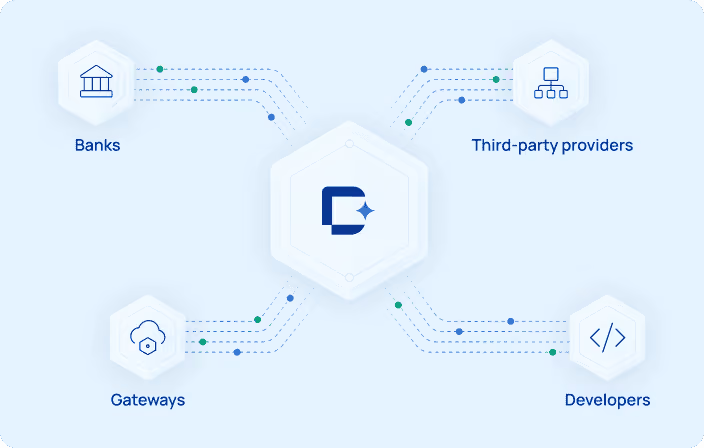
DigitalAPI connects to a wide array of sources where your legacy internal APIs might reside. This includes not just modern gateways like Apigee, MuleSoft, AWS, Kong, and Azure, but also Git repositories, older service registries, custom endpoints, and even through network analysis. We help you uncover the APIs you didn't even know you had, providing a truly comprehensive view of your entire internal API estate, regardless of age or technology.
2. Automated Specification and Metadata Normalization
We understand that legacy internal APIs often lack standardized specifications. DigitalAPI excels at ingesting various API definitions, from partial OpenAPI snippets to older WSDLs or even inferred REST endpoints, and normalizing them into a consistent, machine-readable format. Our platform automatically enriches each API with essential metadata – owner, domain, lifecycle stage, dependencies, and risk level – transforming raw data into actionable intelligence without extensive manual effort.
3. Bridging Tribal Knowledge with Structured Documentation
DigitalAPI facilitates the capture of critical tribal knowledge that surrounds many legacy internal APIs. We provide intuitive ways for subject matter experts to add context, usage examples, caveats, and best practices directly to API entries. This information, combined with auto-generated documentation from any available specs, creates a rich, trustworthy source of truth for every API, making legacy systems more approachable for new teams.
4. Centralized Governance and Risk Management
Bringing legacy internal APIs into a governed environment is crucial. DigitalAPI enables you to define and enforce governance rules for versioning, naming conventions, security standards, and deprecation policies across your entire API portfolio. This proactive approach allows you to identify and address security vulnerabilities or compliance gaps in older APIs, significantly reducing operational risk.
5. Modern Developer Portal for Enhanced Discovery
Despite their legacy status, these APIs need to be discoverable. DigitalAPI's developer portal provides a modern, intuitive interface with powerful search, filtering, and domain-based navigation. Developers can quickly find, understand, and integrate with legacy internal APIs, accelerating development cycles and reducing dependency on tribal knowledge. The portal makes your entire API estate, old and new, feel cohesive and accessible.
6. Future-Proofing for AI-Driven Automation
DigitalAPI prepares your inventoried legacy internal APIs for the agentic future. By structuring specifications and enriching metadata, we make your APIs machine-readable and consumable by AI agents and automated workflows. This allows you to leverage your existing legacy investments in new, intelligent automation scenarios, extending their lifespan and unlocking new operational efficiencies.
FAQs
1. What exactly are legacy internal APIs?
Legacy internal APIs are programmatic interfaces that expose functionalities or data from older, internal systems within an organization. They often predate modern API standards, may use custom protocols, lack comprehensive documentation, and are primarily used by other internal systems or teams. Despite their age, they typically support critical business processes.
2. Why is inventorying legacy internal APIs so important?
Inventorying legacy internal APIs is crucial for several reasons: it reduces operational risk by clarifying dependencies, accelerates digital transformation by providing visibility into existing capabilities, prevents duplication of effort, improves security and compliance, streamlines developer onboarding, and prepares the organization to leverage these core functionalities with new technologies like AI and automation.
3. What are the biggest challenges in inventorying legacy internal APIs?
Key challenges include: lack of formal documentation, tribal knowledge dependencies, disparate technologies and protocols, unclear ownership, inconsistent security, and the sheer volume of such APIs spread across the organization. The absence of modern API specifications (like OpenAPI) often makes automated discovery and documentation difficult without specialized tools.
4. How is inventorying legacy internal APIs different from modern APIs?
While both require a catalog, legacy internal APIs often demand a more investigative discovery phase due to missing documentation and non-standard formats. Metadata becomes even more critical for legacy APIs to compensate for incomplete specifications. The process heavily relies on capturing tribal knowledge and integrating with diverse, often older, source systems rather than just standard API gateways.
5. Can I use a regular API catalog for my legacy internal APIs?
A basic API catalog or a gateway-specific catalog will likely fall short for legacy internal APIs. You need a unified API catalog solution designed to ingest from diverse sources (not just modern gateways), normalize heterogeneous specifications, prioritize rich metadata, facilitate tribal knowledge capture, and offer automated, continuous synchronization to handle the unique characteristics of legacy systems.
Dhayalan Subramanian is Associate Director, Product Growth at DigitalAPI, where he leads go-to-market and product growth for the company’s multi-gateway API management platform. His work focuses on helping large enterprises and mid-market cloud companies consolidate APIs across AWS, Azure, Apigee, Kong, MuleSoft, and other gateways into a single control plane for governance, discovery, monetization, and agent consumption.
Dhayalan brings 14+ years of experience across product strategy, enterprise architecture, and engineering leadership. Earlier in his career, he held senior roles at Encora (as Associate Architect and Technical Manager), Mindtree (Technology Lead), Tech Mahindra (Technical Lead), and Primus Analytics, where he designed integration frameworks and delivered enterprise-grade digital platforms for global customers.
At DigitalAPI, he works directly with platform, integration, and developer experience leaders at Fortune 500 organizations to operationalize unified API catalogs, developer portals, and MCP-ready APIs. He writes regularly on API developer experience, API governance, and AI agent architectures.


One email a fortnight. Worth opening.
A short digest of what we're writing, what we're learning from customers, and the handful of links you'd actually want from us. No tracking pixels.

.avif)