



What Is an MCP Host? The Role, Responsibilities, and Examples
An MCP host is the AI app that runs the model and manages connections to MCP servers. Its four responsibilities, how it differs from clients and servers, and examples.

TL;DR:
What it is: An MCP host is the AI application that runs the model and manages the connections to MCP servers. It is the app you actually interact with, like Claude Desktop or Cursor.
Its real job: The host does four things: it runs the model, manages one client per server, owns the user experience, and enforces consent over which tools get called.
Host vs client vs server: The host orchestrates many clients, each client connects to one server, and the server provides the tools. The host is both the brain and the boundary.
Not the same as hosting a server: "MCP host" is the application role. "Hosting an MCP server" is deployment. They are two different things people often confuse.
At enterprise scale: Every AI app is a host opening connections into your systems, so you govern which clients can reach which servers at the gateway, which is what DigitalAPI provides.
Most explanations of the Model Context Protocol describe the host in a single line, as one-third of a host, client, and server diagram, and move on. That undersells it. The host is the application the user actually uses, the place the model runs, and the point where a human decides whether a tool is allowed to run. This guide is about the host specifically: what it is, the four things it does, how it differs from a client and a server, and why "MCP host" and "hosting an MCP server" are not the same thing.
What is an MCP host?
An MCP host is the AI application that runs the model and coordinates everything around it. It is the thing a user opens and talks to, and underneath the conversation it acts as the container that creates and manages connections to MCP servers. When people say Claude Desktop, Cursor, or ChatGPT "supports MCP," they mean those applications are MCP hosts.
The host is best understood as both a brain and a body. The brain is the model: the host runs or calls the language model and decides, based on what the user asks, when an external tool or data source is needed. The body is the orchestration: the host spins up the connections, routes the model's requests to the right one, brings results back, and shows them to the user. No other part of MCP plays this coordinating role. The server provides tools, the client carries messages, but the host is what ties the model, the user, and the connections together.
What an MCP host does: its four responsibilities
The clearest way to understand a host is by what it is responsible for. A host has four jobs, and the fourth is the one most explanations skip.
- Run and coordinate the model: The host is where the model lives or is called from. It interprets the user's request, decides when a tool is needed, and turns the model's decision into an action.
- Manage the clients: For each MCP server it connects to, the host creates and manages one client. It handles their lifecycle, opening the connection, negotiating capabilities, and closing it, and routes each request to the correct client.
- Own the user experience: The host is the application the user sees. It collects input, displays results, and, with the MCP Apps extension, renders interactive interfaces a server sends back.
- Enforce consent and authorization: The host decides which servers are connected and, crucially, asks the user to approve tool calls before they run. It is the boundary where a human stays in control of what an agent is allowed to do.
That fourth responsibility is what makes the host more than a container. The host is the trust boundary of an MCP setup. When an agent wants to delete a file, send a message, or write to a database, it is the host that pauses and asks the user, or applies a policy about what is allowed. Get the host's consent model wrong and the other layers cannot save you, which is exactly why the host matters more than a one-line definition suggests.
MCP host vs client vs server
The three roles are easy to confuse because they often run on the same machine, so here is the compact version.
In one sentence: the host orchestrates many clients, each client maintains a one-to-one connection to a single server, and each server exposes tools and data. The host is the only one of the three that talks to the user and the only one that holds the model. If you have read our explainer on the MCP client, this is the other side of that relationship: the client is the messenger the host creates and directs.
"MCP host" vs "hosting an MCP server": clearing up the confusion
A surprising amount of confusion comes from the word "host," because it is used two completely different ways in MCP, and search results blur them together.
- The MCP host (the role): The AI application that runs the model and manages clients. This is the architectural term, the one this guide is about. It is about what the application does, not where anything runs.
- Hosting an MCP server (deployment): Running an MCP server on infrastructure so others can reach it, the way you would host any web service. This is an operations question, covered by topics like remote MCP servers and where to deploy them.
So "is Claude Desktop an MCP host?" and "how do I host an MCP server?" are unrelated questions despite sharing a word. The first is about the application's role in the architecture. The second is about deploying a server. If you came here trying to deploy a server, you want server hosting and remote MCP server guidance, not this page. If you want to understand the application that runs the model, you are in the right place.
Examples and types of MCP hosts
In practice, an MCP host is any application that has added MCP support. They fall into a few categories.
Chat hosts
These are conversational applications where the host is a chat interface. Claude Desktop is the reference example, and ChatGPT and self-hosted chat apps like LibreChat also act as hosts. You talk to the assistant, and behind the scenes the host connects to servers to fetch data or take actions.
Coding and IDE hosts
Here the host is a developer tool. Cursor, Windsurf, and VS Code with an MCP-capable extension are hosts that let the model reach tools while you code. The host manages the connections to your servers and surfaces the results inside the editor.
CLI and agent hosts
These are terminal tools and autonomous agents. Claude Code is a command-line host, and any custom agent you build that connects to MCP servers is also a host. This category is where most teams end up when they build their own AI applications, because the agent they write becomes the host.
Can you build your own MCP host?
Yes, and many teams do, because a custom agent is a host. Using an MCP client SDK, your application takes on the four responsibilities above: it runs or calls the model, opens a client for each server and lists the available tools, passes those tools to the model, executes the client call the model chooses, and returns the result, prompting the user for consent where needed.
The SDK handles the protocol, so building a host is mostly about wiring the model to the clients and deciding your consent and approval rules. That consent logic is the part worth designing carefully, because it is your trust boundary.
Governing MCP hosts in the enterprise
For one person, a host is just the app they installed and the tool approvals they click. For an enterprise, hosts are a governance problem, because every AI application your teams adopt is a host opening connections into your systems. Each one decides, on its own, which servers to connect and which tool calls to allow. You cannot realistically depend on every host, across every team, to enforce your organization's policy correctly.
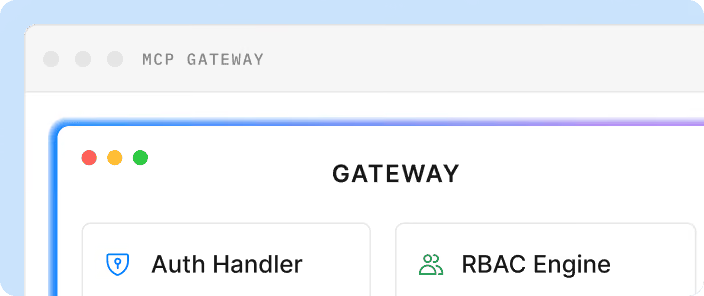
The practical answer is to stop relying on the host as the only control point and govern the server side instead. A gateway in front of your MCP servers enforces who can reach what, no matter which host initiates the connection, so policy is applied centrally rather than trusting each application.
DigitalAPI provides exactly that: a governed MCP gateway and registry that control which identities and clients can reach which servers, with authentication, role-based access, and audit, unified with the way you already govern your APIs. If your teams are adopting MCP hosts and you need that access controlled and auditable, book a demo and we will map it to your stack.
FAQs
What is an MCP host?
An MCP host is the AI application that runs the model and manages connections to MCP servers. It is the application the user interacts with, such as Claude Desktop or Cursor, and it is responsible for running the model, managing clients, owning the user experience, and approving tool calls.
What is the difference between an MCP host and an MCP client?
The host is the application that runs the model and manages the overall experience. The client is a connector the host creates, one per server, that handles the protocol. A host runs many clients. The host decides and approves, the client carries the messages.
What is the difference between an MCP host and an MCP server?
The host is the application that runs the model and initiates requests. The server is the external program that exposes tools and data and responds to them. The host consumes what the server provides, through a client.
Is Claude Desktop an MCP host?
Yes, Claude Desktop is one of the most common MCP hosts. It runs the model, lets you connect MCP servers, and prompts you to approve tool calls, which are the defining jobs of a host.
What are examples of MCP hosts?
Claude Desktop, ChatGPT, Cursor, Windsurf, VS Code with an MCP extension, Claude Code, and any custom agent you build that connects to MCP servers are all MCP hosts.
Does "MCP host" mean hosting an MCP server?
No. "MCP host" is the application role, the app that runs the model. "Hosting an MCP server" means deploying a server on infrastructure. They share a word but are different topics.
Can I build my own MCP host?
Yes. Using an MCP client SDK, your application runs the model, connects to servers, passes their tools to the model, and executes the calls the model chooses. The key design decision is your consent and approval logic, since the host is the trust boundary.
How do I govern MCP hosts across an organization?
Because each host enforces its own approvals, the reliable way to apply organization-wide policy is at the server side. A governed gateway controls which identities and clients can reach which servers regardless of the host, with authentication, access control, and audit.
Dhayalan Subramanian is Associate Director, Product Growth at DigitalAPI, where he leads go-to-market and product growth for the company’s multi-gateway API management platform. His work focuses on helping large enterprises and mid-market cloud companies consolidate APIs across AWS, Azure, Apigee, Kong, MuleSoft, and other gateways into a single control plane for governance, discovery, monetization, and agent consumption.
Dhayalan brings 14+ years of experience across product strategy, enterprise architecture, and engineering leadership. Earlier in his career, he held senior roles at Encora (as Associate Architect and Technical Manager), Mindtree (Technology Lead), Tech Mahindra (Technical Lead), and Primus Analytics, where he designed integration frameworks and delivered enterprise-grade digital platforms for global customers.
At DigitalAPI, he works directly with platform, integration, and developer experience leaders at Fortune 500 organizations to operationalize unified API catalogs, developer portals, and MCP-ready APIs. He writes regularly on API developer experience, API governance, and AI agent architectures.
.png)
One email a fortnight. Worth opening.
A short digest of what we're writing, what we're learning from customers, and the handful of links you'd actually want from us. No tracking pixels.

.avif)