



MCP Compliance: A Guide to HIPAA, PCI DSS, SOC 2, and PSD2
MCP is not a certification. How a governed MCP deployment meets HIPAA, PCI DSS, SOC 2, PSD2, and GDPR, the controls that satisfy each, and how to run it at scale.
TL;DR:
MCP is not a certification: MCP itself is neither compliant nor non-compliant. Whether your deployment meets a regulation depends entirely on how you govern it.
The frameworks that matter: HIPAA (health data), PCI DSS (card data), SOC 2 (trust criteria), PSD2 (open banking), and GDPR (personal data) each impose access, audit, and encryption requirements on any system that touches their data, MCP included.
The same controls satisfy most of them: Least-privilege tool access, scoped authentication, append-only attributable audit logs, encryption, and data residency map to nearly every framework.
Compliance is not security: Security defends against attacks, compliance proves to an auditor that the right controls are in place. You need both, and they are not the same project.
Govern the gateway, not every agent: Enforcing identity, access, and audit at an MCP gateway, as DigitalAPI does, is the practical way to keep MCP deployments auditable across frameworks.
Get a fully compliant MCP gateway with DigitalAPI. Book a Demo!
As enterprises connect AI agents to real systems through the Model Context Protocol, a hard question follows close behind: does this break our compliance obligations? If your agents can read health records, touch card data, or reach account information, then HIPAA, PCI DSS, SOC 2, PSD2, and GDPR all have something to say about it. This guide explains what MCP compliance actually means, gives a straight answer for each framework, maps each requirement to the MCP control that satisfies it, and shows how to run MCP compliantly at scale.
What MCP compliance means, and how it differs from MCP security
MCP compliance is the practice of deploying and governing MCP so that it meets the regulatory frameworks that apply to your data. It is not a property of the protocol. MCP is a way for AI applications to connect to tools and data, and like any integration layer, it can be deployed in a compliant way or a non-compliant way. The protocol does not decide that, your controls do.
This is the first thing to get straight: there is no such thing as a "HIPAA-certified" or "PCI-compliant" MCP server in the abstract. Compliance is assessed at the level of your deployment, the data it touches, and the controls you can prove are in place. A well-governed MCP setup, with least-privilege access and a full audit trail, can sit comfortably inside a regulated environment. An ungoverned one, with agents holding broad access and no record of what they did, will fail an audit regardless of how good the underlying technology is.
It also helps to separate compliance from security, because they are often confused:
- MCP security asks "is this safe?" It defends against threats like prompt injection, tool poisoning, and over-broad access.
- MCP compliance asks "can we prove it meets the regulation?" It is about demonstrating to an auditor that specific controls, such as access restriction, audit logging, and encryption, are in place and working.
The two overlap, because the security controls you implement are usually the same ones an auditor wants to see. But they are different projects with different goals. You can be secure and still fail an audit if you cannot produce evidence, and a checklist of compliance controls is not worth much if they are not actually enforced.
Is MCP compliant? The short answer for each framework
Here is the direct answer for the frameworks enterprises ask about most. The pattern is the same each time: MCP is not certified for anything, but a governed deployment can meet the requirements.
- HIPAA: MCP can be used in a HIPAA environment if every tool that touches protected health information enforces least-privilege access, logs each access with an attributable identity, and is covered by a business associate agreement.
- PCI DSS: MCP can operate in a PCI DSS environment if cardholder data is encrypted and access-controlled, agents see masked or tokenized values rather than raw card numbers, and every access is logged.
- SOC 2: MCP governance infrastructure is in scope for a SOC 2 audit when it can reach systems of record, and it supports the Trust Services Criteria through role-based access, audit logging, encryption, and access reviews.
- PSD2: MCP can support open-banking and payment workflows if it respects strong customer authentication, honors consent, scopes access to account data per identity, and keeps a traceable record of every call.
- GDPR: MCP can handle personal data under GDPR if the deployment applies a lawful basis, limits access to the minimum needed, and keeps records of processing, which MCP audit logs help provide.
The rest of this guide explains how each of those is achieved.
MCP compliance by framework
The single most useful way to think about MCP compliance is to map each framework's core requirement to the MCP control that satisfies it. The table below is the reference.
HIPAA (healthcare)
HIPAA governs protected health information, and its core demand for any system is least-privilege access plus an audit trail attributable to an identifiable user or service for every access to PHI. When an AI agent reads or writes PHI through an MCP server, that requirement does not relax, it extends to the agent. So a compliant MCP deployment in healthcare exposes only the PHI tools an agent genuinely needs, logs every read and write with the identity behind it, and ensures any MCP server handling PHI is covered by a business associate agreement.
PCI DSS (payments)
PCI DSS protects cardholder data through requirements covering encryption, need-to-know access, and logging of all access. The cleanest way to keep MCP compliant here is to keep raw card data away from agents entirely: tokenize or mask the primary account number so the agent works with a safe representation, encrypt data in transit, scope which agents can reach payment tools, and log every call. Done well, this keeps your MCP layer out of, or minimally inside, the cardholder data environment, which dramatically reduces audit scope.
SOC 2 (trust criteria)
SOC 2 is not a law but an attestation, and it is the one most B2B software buyers ask about. If your MCP governance infrastructure can reach systems of record, it is in scope for a SOC 2 Type II audit. MCP supports the Trust Services Criteria, particularly the security and confidentiality criteria, through role-based access control at the tool level, OAuth-based authentication, audit logs you can hand to an auditor or stream to a SIEM, encryption, and documented access reviews. The emphasis in SOC 2 is on evidence over time, so the audit trail matters as much as the access control.
PSD2 (open banking)
PSD2 governs access to payment accounts in the EU and UK, and it is the framework no MCP guide currently covers, despite being directly relevant to any agent touching banking data. Its defining requirements are strong customer authentication, explicit user consent, and tightly scoped access to account information. An MCP deployment aligns with PSD2 when the gateway enforces per-identity OAuth scopes so an agent can only reach the accounts and operations it is authorized for, honors consent, and records every account-data call in an immutable log for traceability.
GDPR (personal data)
GDPR applies whenever MCP touches the personal data of EU residents. Its principles, lawful basis, purpose limitation, and data minimization, translate directly into MCP controls: limit each agent to the minimum data it needs, keep an audit log that doubles as a record of processing activities under Article 30, and retain the ability to restrict or redact data to honor data-subject rights. Minimizing what an agent can reach is both good security and the heart of GDPR compliance.
The controls that make an MCP deployment compliant
Read the framework table again and a pattern jumps out: the same handful of controls satisfy almost every requirement. You do not implement five separate compliance programs, you implement one set of controls and map them to each framework. These are the controls that matter.
A few of these deserve emphasis. Audit logging is the control auditors care about most, because compliance is ultimately about evidence: a log that ties every tool call to an identity, is tamper-evident, and can be exported to your SIEM is what turns "we have controls" into "we can prove it." Least-privilege access at the tool level is the other pillar, since most frameworks reduce to "only the right identity can touch the data, and only for the right purpose." Get those two right and the rest is reinforcement.
MCP compliance in regulated industries
The frameworks are abstract until you see them in a real workflow. Two industries show how the controls come together.
Healthcare
Picture a clinical assistant that summarizes a patient chart. The agent reaches an electronic health record through an MCP server to read the relevant history. Under HIPAA, the compliant version of this looks specific: the server exposes only the read tools the assistant needs and nothing more, every access is written to an audit log carrying the identity of the clinician and the agent, the data returned is the minimum necessary for the summary, and a business associate agreement covers the server. The same agent is not allowed to reach billing or other patients' records, because tool-level access control draws that line.
Financial services
Now picture an agent that reconciles transactions for a bank. It reaches account data through an MCP server, which puts it squarely inside PCI DSS and, in Europe, PSD2. The compliant version never exposes raw card numbers to the agent, it works with tokenized values, and its access to account information is scoped per identity so it can only see the accounts it is authorized for. Strong customer authentication is upheld upstream, consent is respected, and every call against account data lands in an immutable audit log. If an auditor asks who accessed which account and when, the answer is one query away.
How to run MCP compliantly at scale
For one server and one agent, compliance is a careful configuration. For an enterprise with dozens of MCP servers and many agents, it is an operating model. The practical path:
- Inventory and classify: Catalog every MCP server and the data each one touches, then tag it with the regulations that apply.
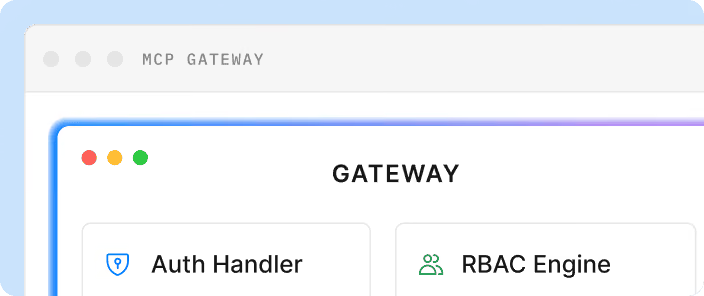
- Put a governed gateway in front: Route all MCP traffic through a gateway that enforces identity, tool-level access control, and scoped authentication, so policy is applied in one place rather than per server.
- Make audit logs immutable and attributable: Ensure every tool call is logged with identity and outcome, and stream those logs to your SIEM.
- Encrypt and set residency: Encrypt in transit and at rest, and pin data to the jurisdictions your regulations require.
- Require approval for high-risk actions: Keep a human in the loop where a framework or your risk appetite demands it.
- Review access and contracts: Run periodic access reviews and keep BAAs and processor agreements current.
How DigitalAPI fits
This operating model is exactly what DigitalAPI provides. It puts a governed MCP gateway and registry in front of your MCP servers, so identity, role-based access, scoped OAuth, rate limits, and immutable audit logging apply consistently to every agent and every tool call, and it unifies that with the way you already govern your APIs rather than standing up a separate compliance silo.
The audit trail it produces is the evidence an auditor asks for, mapped to the frameworks above. If you are taking MCP into a regulated environment and need it to be auditable across HIPAA, PCI DSS, SOC 2, PSD2, or GDPR, book a demo and we will map it to your stack.
Frequently asked questions
1. Is MCP HIPAA compliant?
MCP is not certified for HIPAA, and no software is "HIPAA certified" in the abstract. A HIPAA-covered entity can use MCP for workflows involving PHI when the deployment enforces least-privilege access to PHI, logs every access with an attributable identity, and the MCP servers handling PHI are covered by business associate agreements.
2. Is MCP SOC 2 compliant?
SOC 2 is an attestation of your organization, not the protocol. If your MCP infrastructure can reach systems of record, it is in scope for a SOC 2 audit, and it supports the Trust Services Criteria through role-based access, audit logging, encryption, and access reviews.
3. Can MCP be PCI DSS compliant?
Yes, in a PCI DSS environment MCP can be used if cardholder data is encrypted and access-controlled, agents work with tokenized or masked values instead of raw card numbers, and every access is logged. Keeping raw card data away from agents minimizes audit scope.
4. Does MCP support PSD2 and open banking?
MCP can support PSD2 workflows when it respects strong customer authentication, honors user consent, scopes access to account data per identity, and records every account-data call in a traceable, immutable log.
5. Is MCP GDPR compliant?
MCP can handle personal data under GDPR when the deployment applies a lawful basis, limits each agent to the minimum data needed, keeps records of processing, and can restrict or redact data to honor data-subject rights. Audit logs help satisfy the accountability principle.
6. What audit logs does MCP compliance require?
Across frameworks, you need an append-only, tamper-evident record of which identity called which tool, when, with what inputs at an appropriate level, and what the result was. The log should be attributable to an agent or user and exportable to your SIEM for monitoring and evidence.
7. How do I make an MCP server compliant?
Put it behind a governed gateway, enforce least-privilege tool access and scoped authentication, log every call immutably, encrypt data, set data residency, mask or tokenize sensitive fields, and cover it with the appropriate agreements. Compliance comes from the deployment and its controls, not the server alone.
8. Is MCP secure enough for regulated industries?
MCP can be deployed securely enough for healthcare, finance, and other regulated sectors, but security and compliance are separate. You need the threat defenses and the auditable controls and evidence that frameworks require. Both are achievable with a governed gateway in front of your servers.
9. Does DigitalAPI help with MCP compliance?
Yes, DigitalAPI provides a governed gateway and registry that enforce identity, role-based access, scoped OAuth, and immutable audit logging across your MCP servers, producing the evidence auditors ask for and mapping it to HIPAA, PCI DSS, SOC 2, PSD2, and GDPR.
.png)
One email a fortnight. Worth opening.
A short digest of what we're writing, what we're learning from customers, and the handful of links you'd actually want from us. No tracking pixels.

.avif)