




How to Create Safe, Testable Transaction APIs: Design & Contracts
Transactional APIs are distinct because they manage state changes with far-reaching consequences. Unlike read-only data APIs, a single misstep can lead to catastrophic outcomes.

TL;DR
1. Transaction APIs are critical, handling sensitive state changes and requiring meticulous design for safety and reliability.
2. Core safety mechanisms include idempotency, atomicity, concurrency control, and robust error handling with rollback capabilities.
3. Well-defined API contracts, especially using a contract-first approach, are essential for clear expectations and rigorous testing.
4. Comprehensive testing strategies, from unit to contract and sandbox testing, are non-negotiable for ensuring API integrity.
5. API management platforms play a vital role in enforcing security, controlling access, and providing critical monitoring for transactional systems.
Ready to build robust APIs? Book a Demo with DigitalAPI!
In the digital economy, transaction APIs are the silent workhorses that power commerce, finance, and countless other critical operations. These aren't just data retrieval endpoints; they are the digital handshake that commits a payment, registers a new user, or updates vital inventory. The stakes are profoundly high: data corruption, financial loss, or system instability can ripple through an entire business, eroding trust and incurring significant costs. Building these APIs demands more than just functionality; it requires an unwavering commitment to safety, predictability, and rigorous validation through robust, testable contracts. This blog explores how to create transaction APIs with safe, testable contracts, ensuring they meet the highest standards of reliability.
Why Transaction APIs Demand Extra Scrutiny
Transactional APIs are distinct because they manage state changes with far-reaching consequences. Unlike read-only data APIs, a single misstep can lead to catastrophic outcomes. This heightened risk necessitates a fundamentally different approach to design and testing.
1. Data Integrity and Consistency
The primary concern for any transaction is maintaining the integrity and consistency of data. Whether it's a financial transfer or an inventory update, the system must ensure that operations are fully completed or fully rolled back, leaving no data in an ambiguous or corrupted state.
2. Financial and Reputational Risk
Errors in transactional APIs can directly translate to monetary losses, incorrect billing, or fraudulent activities. Beyond direct financial impact, system outages or data inaccuracies can severely damage a company's reputation and customer trust, which are often harder to recover than lost revenue.
3. Compliance and Regulatory Requirements
Many transactional APIs operate in regulated industries (e.g., finance, healthcare). This means they must adhere to stringent compliance standards like PCI DSS, GDPR, HIPAA, or industry-specific regulations, making meticulous design and auditing imperative.
4. Complex State Management
Transactional processes often involve multiple steps and dependencies, spanning different services or even external systems. Managing the state across these interactions, ensuring atomicity and preventing race conditions, adds significant complexity that demands careful architectural consideration.
.png)
Pillar 1: Designing for Safety in Transaction APIs
Safety is paramount. It's about designing your API to withstand failures, unexpected inputs, and concurrent requests without compromising data integrity.
Idempotency: The Foundation for Reliable Retries
An idempotent operation is one that can be called multiple times without producing different results than the first call. This is crucial for transaction APIs because network issues or server failures often lead to clients retrying requests. Without idempotency, a retry could mistakenly process the same transaction twice (e.g., duplicate a payment).
- Implementation: Typically achieved by clients sending a unique "idempotency key" with each request (often a UUID). The API then stores this key and the result of the first successful processing, returning the stored result for subsequent requests with the same key.
Atomic Operations: All or Nothing
Transactions should be atomic: they either complete entirely and successfully, or they fail completely, leaving the system state unchanged. This prevents partial updates that can lead to inconsistent data.
- Implementation: Utilise database transactions to group related operations. If any part of the transaction fails, the entire transaction is rolled back. For distributed transactions, consider patterns like the Saga pattern or two-phase commit (though often avoided due to complexity).
Concurrency Control: Preventing Race Conditions
Multiple requests attempting to modify the same resource simultaneously can lead to race conditions, where the final state is unpredictable. Concurrency control mechanisms are vital to ensure consistency.
- Optimistic Locking: Each record has a version number. Updates only proceed if the version number matches what was initially read, failing if another process has updated it in the interim.
- Pessimistic Locking: A resource is locked by one transaction, preventing others from accessing it until the lock is released. More straightforward but can lead to performance bottlenecks.
Granular Error Handling and Rollbacks
A safe API clearly communicates what went wrong and provides mechanisms to revert failed operations. Generic error messages are unhelpful for clients trying to recover or troubleshoot.
- Detailed Error Codes: Use HTTP status codes appropriately (e.g., 400 Bad Request, 409 Conflict, 429 Too Many Requests, 500 Internal Server Error). Supplement with custom error codes and human-readable messages in the response body.
- Transaction Reversal/Compensation: For complex, multi-step transactions, design explicit compensation APIs that can undo previously completed (but now invalid) steps if a later step fails.
Robust Security Practices
Protecting transactional APIs from unauthorized access, data breaches, and malicious attacks is non-negotiable. Implementing strong API security measures is fundamental.
- Authentication & Authorization: Use strong API authentication methods like OAuth 2.0 or secure API keys with proper scope control. Implement role-based access control (RBAC).
- Input Validation: Sanitize and validate all incoming data to prevent injection attacks and ensure data conforms to expected formats.
- Data Encryption: Encrypt data in transit (TLS/SSL) and at rest to protect sensitive information.
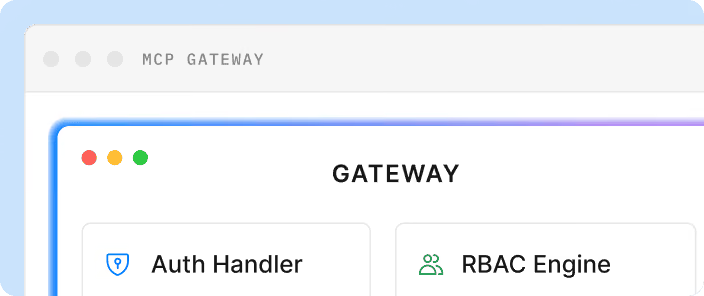
- API Gateway Security: Leverage API gateways to enforce security policies, manage access, and shield backend services.
Pillar 2: Crafting Testable API Contracts
An API contract is a formal agreement between the API provider and consumer, defining how the API behaves. For transactional APIs, this contract must be exceptionally clear, leaving no room for ambiguity, and designed specifically for testability.
What is an API Contract?
An API contract specifies the API's endpoints, request/response formats, data types, authentication requirements, error codes, and expected behaviors. It acts as a blueprint for both development and testing, ensuring everyone is working against the same clear expectations.
Key Elements of a Transaction API Contract
- Clear Input/Output Schemas: Define precise data structures using tools like OpenAPI (Swagger). Specify mandatory fields, data types, value constraints, and maximum lengths for all request and response bodies.
- Defined Pre-conditions and Post-conditions: Explicitly state what must be true before a transaction can execute (e.g., sufficient funds) and what will be true after successful execution (e.g., account balance updated).
- Expected Error Responses: Document every possible error scenario with its specific HTTP status code, custom error code, and detailed error message. This helps clients handle failures gracefully.
- Performance Expectations (SLAs): Include Service Level Agreements (SLAs) specifying expected response times and availability, critical for high-volume transaction systems.
- Idempotency Keys Specification: Clearly document that clients MUST provide a unique idempotency key for each request and how the API will handle repeated keys.
Contract-First Design: The Path to Consistency
Adopting a contract-first API design approach means defining the API contract (e.g., using OpenAPI) before writing any code. This approach offers significant benefits:
- Early Feedback: API consumers can review and provide feedback on the contract before implementation begins.
- Parallel Development: Frontend and backend teams can work in parallel, mocking API responses based on the contract.
- Automated Tooling: Contracts can be used to auto-generate documentation, client SDKs, and server stubs, ensuring consistency.
Pillar 3: Strategies for Robust Testing
Even the safest design needs rigorous testing. For transactional APIs, testing must be comprehensive, covering every possible scenario, including edge cases and failure modes.
Unit Testing
Test individual components (functions, methods) in isolation to ensure they work as expected. This catches bugs early and simplifies debugging.
Integration Testing
Verify that different parts of your system interact correctly, including database interactions, external service calls, and message queues. This is where the atomicity of your transactions is often validated.
API Contract Testing
Ensures that the API implementation adheres strictly to its defined contract. This involves using tools that validate request and response schemas, error codes, and other documented behaviors. It helps prevent breaking changes and ensures client expectations are met.
Performance Testing
Subject your transactional APIs to various loads to assess their scalability, stability, and response times under pressure. This includes:
- Load Testing: Simulate expected user load.
- Stress Testing: Push the system beyond its normal operating capacity to find breaking points.
- Scalability Testing: Determine how the API performs as resources (servers, database capacity) are increased.
Security Testing
Regularly conduct security testing to identify vulnerabilities. This includes penetration testing, vulnerability scanning, and static/dynamic analysis. Leveraging the best API testing tools can streamline this process.
API Sandbox Environments
Provide a dedicated API sandbox testing environment that mimics production behavior but uses synthetic data. This allows developers (both internal and external) to experiment, integrate, and test their applications against your transactional APIs without risking real data or impacting live systems. A clear understanding of what is an API sandbox helps in setting up an effective one.
The Role of API Management in Transactional APIs
An API management platform is an indispensable tool for governing, securing, and operating transactional APIs at scale.
1. API Gateways for Policy Enforcement
API gateways sit in front of your backend services, acting as an enforcement point for security, routing, and traffic management policies. For transactional APIs, they can validate API keys, enforce OAuth scopes, and apply threat protection policies before requests even reach your core logic.
2. Rate Limiting and Throttling
Prevent abuse and ensure fair usage by implementing API rate limiting and API throttling policies. This protects your backend systems from being overwhelmed by too many requests, which is crucial for maintaining the stability and availability of transactional services.
3. Monitoring and Observability
Comprehensive API monitoring is critical for transactional APIs. It allows you to track transaction success rates, response times, error rates, and resource utilization in real-time. Tools that provide deep API observability help identify and diagnose issues quickly, minimizing downtime and data integrity risks.
Book a Demo with DigitalAPI and streamline your API Management Journey!
Final Thoughts
Building transaction APIs is an exercise in meticulous engineering, where every detail matters. The journey from design to deployment requires a relentless focus on safety, ensured through mechanisms like idempotency, atomicity, and robust concurrency control. Simultaneously, the definition of clear, comprehensive, and testable API contracts acts as the bedrock for predictable behavior and seamless integration. Coupled with rigorous testing methodologies, from unit and integration to specialized contract and sandbox testing, and the strategic leverage of API management platforms, organizations can deliver transaction APIs that are not only functional but also resilient, trustworthy, and scalable. Investing in these foundational principles safeguards your data, protects your reputation, and ultimately fuels the reliable growth of your digital ecosystem.
Dhayalan Subramanian is Associate Director, Product Growth at DigitalAPI, where he leads go-to-market and product growth for the company’s multi-gateway API management platform. His work focuses on helping large enterprises and mid-market cloud companies consolidate APIs across AWS, Azure, Apigee, Kong, MuleSoft, and other gateways into a single control plane for governance, discovery, monetization, and agent consumption.
Dhayalan brings 14+ years of experience across product strategy, enterprise architecture, and engineering leadership. Earlier in his career, he held senior roles at Encora (as Associate Architect and Technical Manager), Mindtree (Technology Lead), Tech Mahindra (Technical Lead), and Primus Analytics, where he designed integration frameworks and delivered enterprise-grade digital platforms for global customers.
At DigitalAPI, he works directly with platform, integration, and developer experience leaders at Fortune 500 organizations to operationalize unified API catalogs, developer portals, and MCP-ready APIs. He writes regularly on API developer experience, API governance, and AI agent architectures.
One email a fortnight. Worth opening.
A short digest of what we're writing, what we're learning from customers, and the handful of links you'd actually want from us. No tracking pixels.

.avif)