



Google API Gateway vs Apigee: Differences & Best Use Cases
Before diving into the specifics of Google's offerings, it’s essential to grasp the broader concept of API management.

TL;DR
1. Google API Gateway is a lightweight, fully managed service for securing and managing APIs specifically within the Google Cloud ecosystem, ideal for serverless and microservices.
2. Apigee, by contrast, is a comprehensive, enterprise-grade API management platform offering advanced features like a developer portal, monetization, complex traffic management, and hybrid/multi-cloud support.
3. Choose API Gateway for simpler, GCP-native integrations, internal APIs, and cost-effective basic management of cloud-native services.
4. Opt for Apigee when your API program requires sophisticated lifecycle management, external partner ecosystems, monetization capabilities, robust security policies, and deployment flexibility across diverse environments.
5. In some scenarios, a complementary approach leverages API Gateway for internal GCP traffic and Apigee for broader enterprise and external API programs, combining their strengths.
As organizations increasingly leverage APIs to build connected experiences and enable digital transformation, the choice of an API management solution becomes paramount. Navigating the options offered by cloud providers can be complex, especially when two powerful platforms from the same vendor, Google API Gateway and Apigee, present seemingly similar yet fundamentally different capabilities. Understanding their nuances is critical for architects and developers aiming to build scalable, secure, and efficient API ecosystems. This blog delves into their core distinctions, helping you discern which platform aligns best with your project’s scope, complexity, and strategic objectives, from simple microservices to full-fledged API product programs.
Understanding the API Management Landscape
Before diving into the specifics of Google's offerings, it’s essential to grasp the broader concept of API management. It encompasses the entire lifecycle of an API, from design and development to deployment, security, monitoring, and deprecation. A robust API management strategy addresses critical areas like traffic control, security enforcement, versioning, documentation, and analytics, ensuring APIs are discoverable, reliable, and consumable. It's about turning raw APIs into managed, productized assets that can drive business value.
Google API Gateway: The Cloud-Native Front Door
Google API Gateway is a fully managed service designed to secure, monitor, and scale APIs running on Google Cloud. It acts as a lightweight, high-performance HTTP(S) reverse proxy that provides essential API management functionalities for serverless backends like Cloud Functions, Cloud Run, and App Engine, as well as Compute Engine VMs. It's built for developers who need a straightforward way to expose their backend services securely and efficiently within the Google Cloud ecosystem.
Key Features of Google API Gateway
- Direct GCP Integration: Seamlessly integrates with Google Cloud services like Cloud Functions, Cloud Run, App Engine, and Compute Engine.
- Security: Offers basic API authentication and authorization through API keys and Google Cloud IAM, allowing fine-grained access control.
- Traffic Management: Provides features like request routing, rate limiting, and basic traffic control to protect backend services from overload.
- Monitoring & Logging: Integrates with Google Cloud Monitoring and Cloud Logging for visibility into API performance and usage patterns.
- Simplicity & Speed: Designed for quick deployment and minimal configuration, making it ideal for developers focused on speed and agility.
- Cost-Effectiveness: A pay-as-you-go model that scales with usage, often making it a more economical choice for specific use cases within GCP.
Best Fit for Google API Gateway
Google API Gateway excels in scenarios where simplicity, deep GCP integration, and cost-efficiency are top priorities. It's particularly well-suited for:
- Exposing microservices built on Google Cloud's serverless platforms.
- Internal APIs that primarily serve other applications within your Google Cloud environment.
- Projects requiring a straightforward API proxy for existing GCP backend services.
- Greenfield projects developed entirely within Google Cloud, where a full-fledged API management suite might be overkill.
- Applications with basic API security and traffic management needs.
Apigee: The Enterprise API Management Powerhouse
Apigee, a robust and comprehensive platform, is Google Cloud's enterprise-grade solution for managing, securing, and scaling APIs. Acquired by Google in 2016, Apigee goes beyond a basic gateway, offering a full suite of tools to manage the entire API lifecycle. It caters to large organizations with complex API ecosystems, external partners, and advanced business requirements like API monetization.
Key Features of Apigee
- Advanced Traffic Management: Sophisticated policies for quotas, rate limiting, caching, spike arrest, and routing based on various conditions.
- Robust Security: Comprehensive API security features including OAuth 2.0, SAML, JWT validation, threat protection, and encryption.
- Developer Portal: Fully customizable, self-service developer portal for API discovery, documentation, registration, testing, and community engagement. Crucial for fostering developer adoption.
- API Monetization: Tools for creating API monetization models, packaging APIs, managing billing, and revenue analytics.
- Analytics & Monitoring: Deep, customizable analytics to track API performance, usage patterns, error rates, and business metrics.
- Policy Enforcement & Mediation: Extensive policy framework for request/response transformation, mediation, and orchestration without modifying backend code. Also supports API orchestration.
- Hybrid & Multi-Cloud Deployment: Apigee X and Apigee Hybrid offer flexible deployment options across Google Cloud, on-premises, and other cloud providers, catering to diverse enterprise infrastructures.
- API Governance: Tools and frameworks to enforce consistent API standards, design patterns, and best practices across the organization.
Best Fit for Apigee
Apigee is the preferred choice for enterprises building strategic API programs that extend beyond simple proxies. It shines in situations requiring:
- External-Facing APIs: Managing APIs exposed to partners, third-party developers, and external consumers, requiring a full developer portal and robust security.
- API Monetization: Businesses looking to generate revenue from their APIs through various pricing models and billing mechanisms.
- Complex Integrations: Integrating legacy systems, mediating diverse protocols, and transforming data formats at the API layer.
- Hybrid & Multi-Cloud Environments: Organizations with APIs spanning on-premises data centers, Google Cloud, and other cloud providers.
- Sophisticated Security & Compliance: Strict regulatory requirements or advanced threat protection needs.
- Large-Scale API Programs: Managing hundreds or thousands of APIs with diverse teams and complex governance requirements.
Google API Gateway vs. Apigee: Core Differences
While both services manage APIs, their scope, complexity, and target use cases are vastly different. Here’s a breakdown of their core distinctions:
1. Scope and Complexity
- Google API Gateway: A lightweight, foundational API gateway. It provides essential proxy, security, and traffic management functionalities for APIs primarily within the Google Cloud ecosystem. It's designed for simplicity and direct integration with cloud-native backends.
- Apigee: A comprehensive API management platform. It offers an extensive suite of features covering the entire API lifecycle, from design to deprecation, with advanced capabilities for security, analytics, developer engagement, and monetization. It’s built to handle enterprise-scale API programs with complex business logic.
2. Deployment Model
- Google API Gateway: Fully managed, serverless service native to Google Cloud. You simply configure it, and Google handles the underlying infrastructure, scaling, and maintenance.
- Apigee: Offers flexible deployment options:
- Apigee X: A fully managed SaaS offering on Google Cloud.
- Apigee Hybrid: Allows you to deploy runtime components on your infrastructure (on-premises or other clouds) while the management plane remains on Google Cloud. This provides greater control over data locality and compliance.
3. Feature Set
- Google API Gateway: Focuses on core gateway functionalities: routing, authentication (API keys, IAM), basic rate limiting, logging, and monitoring. It's a front door, not a full-service complex.
- Apigee: Provides a rich set of features including advanced traffic management policies, comprehensive security options (OAuth, SAML), full developer portal capabilities, API productization, monetization engines, detailed analytics, policy transformation, and hybrid/multi-cloud support. The difference is akin to a basic firewall versus a full cybersecurity suite.
4. Target Use Cases
- Google API Gateway: Best for exposing serverless functions, internal microservices, and simpler APIs residing within Google Cloud. It's ideal for developers building new cloud-native applications on GCP.
- Apigee: Geared towards enterprise-wide API programs that involve external partners, require monetization, complex security policies, integration with diverse backend systems (including legacy), and multi-cloud deployments. It’s designed for building and managing an API ecosystem.
5. Cost Model
- Google API Gateway: Follows a pay-as-you-go model based on the number of requests and data transfer, making it cost-effective for lower-volume or simpler use cases. For a broader understanding, see API management cost.
- Apigee: Typically involves enterprise-level licensing, which can be significant, reflecting its comprehensive feature set and support for large-scale deployments. Costs can vary based on scale, features, and deployment model (SaaS vs. Hybrid).
6. Integration Ecosystem
- Google API Gateway: Tightly integrated with Google Cloud services. While it can proxy to external endpoints, its primary strength lies in connecting to GCP compute.
- Apigee: Designed for broad integration, not just within Google Cloud. It can connect to, mediate, and secure APIs from virtually any backend, whether on-premises, in Google Cloud, or other cloud providers.
7. Customization and Extensibility
- Google API Gateway: Limited customization. It's a managed service, so configuration is done via YAML files or the console.
- Apigee: Highly extensible. Developers can write custom policies in JavaScript or Python, build custom logic, and integrate with external systems, offering unparalleled flexibility for complex scenarios.
Choosing the Right Solution: Factors to Consider
Selecting between Google API Gateway and Apigee boils down to a thorough assessment of your specific needs:
- API Program Maturity: Are you just starting with a few APIs or managing a mature, enterprise-wide API product portfolio?
- Scalability and Performance: Both scale, but Apigee handles more complex traffic routing and load balancing at an enterprise level.
- Security Requirements: Do you need basic API key/IAM security or advanced OAuth, threat protection, and compliance features?
- Monetization Goals: Is generating revenue from your APIs a core business objective? If so, Apigee is the clear choice.
- Developer Experience (DX): Do you need a self-service developer portal to onboard external developers and partners efficiently?
- Existing Infrastructure: Are your backends exclusively on Google Cloud, or do you have a mix of on-premises, multi-cloud, and legacy systems?
- Budget: What is your budget for API management, considering both operational and licensing costs?
- Team Expertise: Does your team have the expertise to manage and customize a powerful platform like Apigee, or do you prefer a simpler, managed gateway?
- API Design Philosophy: Are you focusing on simple proxying or complex API design with mediation and transformation?
How DigitalAPI API Management fit in the ecosystem?
Google API Gateway and Apigee work well inside the Google ecosystem. But most enterprises run multiple gateways across clouds and teams. DigitalAPI.ai acts as a unified control plane above them, bringing visibility, governance, and developer experience without replacing your existing stack.
- Unified discovery: Aggregate APIs from Apigee, Google API Gateway, Kong, AWS, and others into one searchable catalog.
- Central governance: Apply consistent policies, access controls, and standards across gateways from a single place.
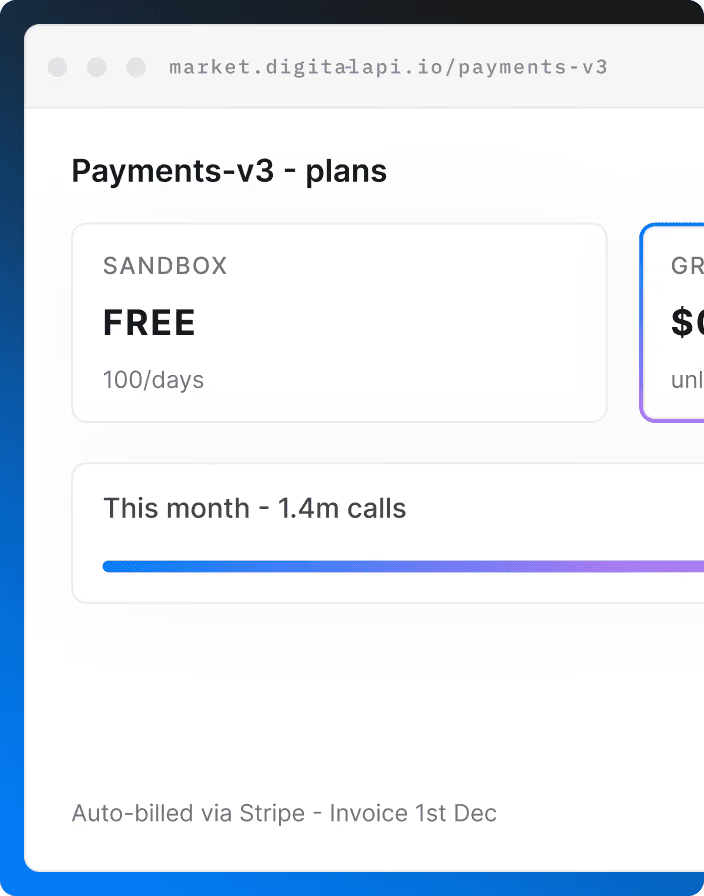
- Self-serve portal & sandbox: Enable faster partner onboarding with documentation, keys, testing, and subscriptions.
- Adoption & monetization insights: Track usage, tiers, and business metrics across your entire API estate.
- AI-ready foundation: Make APIs structured and discoverable for AI agents, not just developers.
.png)
FAQs
1. What is the main difference between Google API Gateway and Apigee?
The main difference lies in their scope and feature set. Google API Gateway is a lightweight, fully managed service for basic API proxying, security, and traffic management within Google Cloud, ideal for cloud-native backends like serverless functions. Apigee is a comprehensive, enterprise-grade API management platform offering advanced features like a full developer portal, API monetization, robust security policies, detailed analytics, and hybrid/multi-cloud deployment options, suited for large, complex API programs.
2. When should I use Google API Gateway?
You should use Google API Gateway when you need a simple, cost-effective solution to expose and manage APIs for backend services running within Google Cloud (e.g., Cloud Functions, Cloud Run, App Engine, Compute Engine). It's best for internal APIs, microservices, or greenfield projects that primarily operate within the GCP ecosystem and have basic security and traffic management requirements.
3. When should I choose Apigee for my API management needs?
Apigee is the better choice for organizations with mature, complex API programs that involve external partners, require API monetization, need robust security and compliance features, or operate across hybrid and multi-cloud environments. It's ideal for building public API programs, integrating legacy systems, and establishing comprehensive API governance and developer engagement strategies.
4. Can Google API Gateway and Apigee be used together?
Yes, they can be used complementarily. Many enterprises use Google API Gateway to manage internal APIs and microservices running on Google Cloud, leveraging its simplicity and native GCP integration. Simultaneously, they deploy Apigee to manage external-facing APIs, partner integrations, and APIs that require advanced features like monetization and a dedicated developer portal, combining the strengths of both platforms.
5. Does Google API Gateway offer a developer portal or monetization features?
No, Google API Gateway does not inherently offer a full-fledged developer portal or API monetization capabilities. Its focus is on providing essential gateway functionalities. For these advanced features, such as self-service developer onboarding, API documentation, and revenue generation from APIs, Apigee is the appropriate Google Cloud offering.
Dhayalan Subramanian is Associate Director, Product Growth at DigitalAPI, where he leads go-to-market and product growth for the company’s multi-gateway API management platform. His work focuses on helping large enterprises and mid-market cloud companies consolidate APIs across AWS, Azure, Apigee, Kong, MuleSoft, and other gateways into a single control plane for governance, discovery, monetization, and agent consumption.
Dhayalan brings 14+ years of experience across product strategy, enterprise architecture, and engineering leadership. Earlier in his career, he held senior roles at Encora (as Associate Architect and Technical Manager), Mindtree (Technology Lead), Tech Mahindra (Technical Lead), and Primus Analytics, where he designed integration frameworks and delivered enterprise-grade digital platforms for global customers.
At DigitalAPI, he works directly with platform, integration, and developer experience leaders at Fortune 500 organizations to operationalize unified API catalogs, developer portals, and MCP-ready APIs. He writes regularly on API developer experience, API governance, and AI agent architectures.
One email a fortnight. Worth opening.
A short digest of what we're writing, what we're learning from customers, and the handful of links you'd actually want from us. No tracking pixels.

.avif)