



Developer portal requirements: The ultimate enterprise guide for 2026
An Enterprise API Developer Portal is critical for centralizing API discovery, documentation, and lifecycle management.

TL;DR
1. Developer portal requirements in 2026 look nothing like they did in 2020: Enterprises expect a self-serve developer experience, persona-based navigation, in-portal testing, multi-gateway cataloging, non-developer content editing, and automated monetisation as baseline, not nice-to-haves.
2. Single-gateway portals are the new legacy: If your portal only serves APIs on one gateway, you are one acquisition or cloud migration away from running two portals. Multi-gateway abstraction is a hard requirement now.
3. The developer experience bar has moved to "successful test call in under thirty minutes": Anything slower is a portal problem, not a developer problem. A self-serve developer experience with built-in try-it consoles, pre-filled payloads, and per-error response examples are what close that gap.
4. Governance, analytics, and RBAC are table stakes for enterprise buyers: Role-based visibility, per-API and per-partner usage analytics, and automated spec governance are critical now.
5. AI-readiness is the 2026 addition to the requirements list: APIs now have to be consumable by AI agents as well as human developers. MCP-ready portals turn the same API catalog into an agent-accessible surface without a second build.
6. The make-or-buy math has shifted: Custom-built portals on Drupal, Backstage, or in-house React now cost more over three years than purpose-built platforms that ship these requirements natively. The enterprises getting this right are buying the portal and investing their engineering time in APIs instead.
Accelerate your API strategy. Explore DigitalAPI's developer portal!
In 2026, the role of APIs has become foundational for enterprise growth and innovation. Yet, for many large organizations, the sheer volume and distributed nature of their APIs create a labyrinth for developers. Discovering the right API, understanding its capabilities, and integrating it efficiently often turns into a time-consuming ordeal. This friction not only slows down development cycles but also stifles innovation and leads to duplicated efforts. A meticulously crafted Enterprise API Developer Portal emerges as the indispensable solution, transforming chaos into clarity and unlocking the full potential of an organization's API ecosystem.
What is an Enterprise API Developer Portal?
An Enterprise API Developer Portal serves as the central hub and single source of truth for all APIs within an organization. More than just a static documentation website, it's a dynamic platform designed to facilitate every stage of the API lifecycle for internal, partner, and external developers. It empowers developers to discover, learn about, test, consume, and manage APIs efficiently and autonomously. By providing a unified interface for an often-scattered API estate, the portal streamlines onboarding, enhances developer experience (DX), and ensures that APIs are not just published, but actively adopted and utilized to their full potential.
Fundamentally, a robust developer portal acts as an API marketplace, complete with rich metadata, interactive documentation, code examples, security credentials, and usage analytics. It bridges the gap between API providers and API consumers, fostering a collaborative environment that accelerates development, improves governance, and drives the strategic value of an enterprise's API investments. For large organizations with diverse API ecosystems, a well-implemented portal is not merely a convenience; it's a strategic imperative for digital transformation and competitive advantage.
Why do enterprises need a robust API developer portal?
As enterprises scale their digital operations, the complexity of managing an ever-growing portfolio of APIs becomes a significant challenge. Without a centralized, intuitive platform, API sprawl, inconsistent documentation, and inefficient discovery can severely hinder productivity and innovation. An Enterprise API Developer Portal addresses these critical pain points, delivering substantial benefits across the organization:
- Accelerated API Adoption: By making APIs easily discoverable, understandable, and testable, a portal significantly lowers the barrier to entry for developers. This ease of use encourages faster adoption of existing APIs, reducing the need to build new services from scratch and maximizing the ROI of API development.
- Enhanced Developer Experience (DX): A superior DX is no longer a luxury but a necessity. A well-designed portal provides a seamless experience, offering comprehensive documentation, interactive tools, and community support, which in turn boosts developer satisfaction, productivity, and loyalty.
- Improved API Governance and Compliance: Centralizing API information, access controls, and lifecycle status allows enterprises to enforce consistent governance standards. This includes managing versioning, ensuring security policies are met, tracking ownership, and maintaining compliance with regulatory requirements across the entire API estate.
- Fostered Innovation and Ecosystem Growth: By exposing a clear catalog of available capabilities, the portal inspires developers to innovate and combine APIs in novel ways. It can also serve as a gateway for external partners and third-party developers, facilitating the growth of a broader API ecosystem around the enterprise's services.
- Reduced Support Burden: A comprehensive portal with self-service capabilities, including detailed documentation, FAQs, and troubleshooting guides, significantly reduces the volume of support requests to API teams. Developers can find answers independently, freeing up valuable engineering resources.
- Drove Business Value: Ultimately, a developer portal translates technical efficiency into business value. Faster integration cycles, quicker time-to-market for new products, enhanced partner collaborations, and improved internal productivity all contribute directly to strategic business objectives.
- Centralized API Lifecycle Management: From design and development to deployment, deprecation, and retirement, a portal provides visibility into the entire API lifecycle. This enables better planning, reduces breaking changes, and ensures that the API portfolio remains healthy and relevant.
.png)
What are the core developer portal requirements for 2026?
Building an effective Enterprise API Developer Portal requires a clear understanding of the essential features and capabilities that empower developers and support enterprise-level operations. Here is a comprehensive list of must-have requirements:
1. Comprehensive API Catalog and Discovery
The heart of any developer portal is its ability to make APIs easily found and understood.
- Centralized API Inventory: A single, unified repository for all APIs (REST, SOAP, GraphQL, Event Streams), regardless of their origin (API Gateway, Git repository, internal service).
- Rich Metadata and Tagging: Ability to associate APIs with extensive metadata such as business domain, owner, team, department, use case, technology stack, security level, and customizable tags for enhanced filtering.
- Powerful Search and Filtering: Intuitive search capabilities with advanced filters (by tag, owner, status, security type, etc.) to quickly pinpoint specific APIs or groups of APIs.
- Clear API Descriptions and Use Cases: Concise, human-readable summaries for each API, explaining its purpose, functionality, and typical use cases, making it easy for developers to assess relevance.
- Versioning Support: Clear indication of API versions, deprecation status, and migration guides to help developers manage dependencies and plan upgrades.
- API Ownership and Contact Info: Transparent display of API owners or responsible teams, with contact information, to facilitate direct communication and support.
2. Superior Documentation and Self-Serve Onboarding
Effective documentation is crucial for developer adoption and self-sufficiency.
- Interactive API Documentation (Swagger UI/OpenAPI): Dynamic, auto-generated documentation from OpenAPI (Swagger) or similar specifications, allowing developers to explore endpoints, parameters, and responses in real-time.
- Code Samples and SDKs (Multiple Languages): Ready-to-use code snippets and client SDKs in popular programming languages (Python, Java, Node.js, C#, Ruby, Go) to accelerate integration.
- Tutorials and Getting Started Guides: Step-by-step instructions for common integration patterns, including authentication, making first calls, and handling responses.
- Use Case Examples and Recipes: Practical examples demonstrating how to combine multiple APIs to solve specific business problems, fostering innovative usage.
- FAQs and Troubleshooting: A dedicated section for frequently asked questions and common troubleshooting tips to resolve issues quickly.
- Sandbox Environments for Testing: Access to non-production environments where developers can test APIs without impacting live systems, complete with mock data.
3. Robust Security and Access Control
Protecting APIs and data is paramount in an enterprise environment.
- User Authentication and Authorization: Support for enterprise-grade authentication mechanisms (e.g., SSO, OAuth 2.0, OpenID Connect) and fine-grained authorization to control who can access which APIs and documentation.
- Role-Based Access Control (RBAC): Granular permissions based on developer roles (e.g., internal developer, partner developer, administrator) to manage access to portal features and APIs.
- API Key and Token Management: Self-service portal for developers to generate, revoke, and manage their API keys, client IDs, and secrets securely.
- Application Registration and Management: Developers can register their applications, link them to specific APIs, and manage application details within the portal.
- Throttling and Rate Limiting Visibility: Clear communication of API usage limits, quotas, and throttling policies to prevent misuse and ensure fair access.
- Security Best Practices and Compliance Info: Guidelines on secure API consumption, data handling, and relevant compliance information (e.g., GDPR, CCPA, HIPAA).
4. API Management and Lifecycle Support
The portal should support the entire API lifecycle from conception to deprecation.
- API Subscription and Unsubscription: Self-service process for developers to subscribe to APIs and manage their active subscriptions.
- Usage Analytics and Dashboards: Provide developers with real-time insights into their API consumption, including call volumes, error rates, and latency.
- Lifecycle Status Management: Clear indication of an API's status (e.g., Alpha, Beta, Production, Deprecated) to guide developer usage and future planning.
- Change Notifications and Alerts: Mechanisms to notify subscribed developers about API updates, breaking changes, deprecations, or service outages.
- Feedback Mechanisms and Community Features: Channels for developers to provide feedback, report bugs, ask questions, and engage with other developers and API providers (e.g., forums, comments).
5. Customization and Branding
The portal should reflect the enterprise's brand and be adaptable to its specific needs.
- Branding Options: Ability to customize the portal with corporate logos, color schemes, and styling to maintain brand consistency.
- Customizable Content and Pages: Flexibility to create custom landing pages, guides, and informational content beyond standard API documentation.
- Developer-Focused UI/UX: An intuitive, clean, and responsive user interface designed specifically for developers, ensuring ease of navigation and a positive experience.
- Multi-language Support: Capability to present portal content and documentation in multiple languages to cater to a global developer audience.
6. Extensibility and Integration
A robust portal doesn't operate in a vacuum; it integrates with the existing ecosystem.
- Integration with API Gateways: Seamless connectivity with various API management platforms and gateways (e.g., Apigee, MuleSoft, AWS API Gateway, Kong, Azure API Management) to synchronize API definitions and runtime policies.
- Integration with CI/CD Pipelines: Automation hooks to update API documentation and catalog entries directly from CI/CD pipelines as new versions are deployed.
- Webhook and Callback Support: Provide developers with the ability to configure webhooks for real-time notifications from APIs.
- External Developer Tools Integration: Support for importing/exporting API definitions (e.g., Postman collections) and integration with IDEs.
- Analytics Platforms Integration: Connect with internal or third-party analytics tools for deeper insights into portal usage and API performance.
7. Performance and Scalability
The portal must handle enterprise-level traffic and data volumes.
- High Availability: Ensure the portal is always accessible, even during peak loads or system failures, through robust architecture and redundancy.
- Low Latency: Fast loading times and responsive interactions for all users, regardless of their geographical location or network conditions.
- Scalable Infrastructure: The underlying platform should be able to scale horizontally and vertically to accommodate a growing number of APIs, developers, and traffic.
- Caching Mechanisms: Efficient caching to serve static content and frequently accessed API data quickly, reducing database load.
8. Analytics and Monitoring
Understanding usage patterns and performance is key to continuous improvement.
- API Usage Metrics: Comprehensive data on API calls, successful requests, error rates, and average response times at a global and per-API level.
- Developer Engagement Data: Insights into portal login frequency, page views, documentation access, and search queries to gauge developer interest and identify areas for improvement.
- Performance Monitoring: Real-time monitoring of portal health, uptime, and performance metrics to proactively identify and resolve issues.
- Error Rates and Alerts: Tracking of API-specific error rates and configuration of alerts for abnormal activity or thresholds.
- Reporting Capabilities: Customizable reports on API consumption, adoption trends, and compliance status for business stakeholders.
How can you avoid common pitfalls when implementing your developer portal?
Implementing a developer portal is a significant undertaking, and several common mistakes can undermine its success. Being aware of these pitfalls can help enterprises navigate the process more effectively:
- Treating the Portal as a "Set-and-Forget" Project: Many organizations launch a portal and assume their work is done. However, APIs evolve, and so must the portal.
Avoid by: Establishing a dedicated team for ongoing content updates, feature enhancements, and maintenance. Integrate with CI/CD for automated documentation updates. - Underestimating Documentation Effort: High-quality, up-to-date, and comprehensive documentation is the lifeblood of a portal. Poor documentation leads to frustration and low adoption.
Avoid by: Prioritizing documentation as a core part of API development. Leverage tools for auto-generating docs from specs and invest in technical writers. - Lack of Executive Buy-in and Sponsorship: Without strong support from leadership, the portal may not receive the necessary resources or organizational priority.
Avoid by: Clearly articulating the business value and ROI of the portal to stakeholders, demonstrating how it aligns with strategic goals. - Ignoring Developer Feedback: The portal is for developers, so their input is invaluable. Failing to incorporate feedback can lead to a tool that doesn't meet their needs.
Avoid by: Implementing clear channels for feedback (e.g., surveys, forums) and actively using this input for continuous improvement and feature prioritization. - Over-customization Without a Clear Strategy: While customization is good, excessive or ill-conceived custom development can lead to maintenance headaches and complex upgrades.
Avoid by: Focusing on core requirements first. Use off-the-shelf features where possible and only customize for critical, differentiating functionalities. - Inadequate Security Planning: Exposing APIs publicly or internally without robust security measures can lead to vulnerabilities and compliance issues.
Avoid by: Baking security into the design from day one, including strong authentication, authorization, API key management, and regular security audits. - Poor Search Capabilities: Even with great content, if developers can't find what they need quickly, the portal's value is diminished.
Avoid by: Investing in powerful search engines with advanced filtering, full-text indexing, and natural language processing capabilities.
What are the best practices for fulfilling your developer portal requirements?
To maximize the impact and adoption of your Enterprise API Developer Portal, consider these best practices:
- Prioritize Developer Experience (DX): Always design with the developer in mind. An intuitive UI, clear navigation, and useful tools will drive adoption.
- Ensure Continuous Content Updates: Implement automated processes to keep API specifications, documentation, and lifecycle status in sync with source systems (e.g., Git, API Gateways).
- Foster a Community: Encourage interaction through forums, Q&A sections, and feedback mechanisms. A vibrant community enhances knowledge sharing and peer support.
- Measure and Optimize: Utilize analytics to track portal usage, API adoption rates, common search queries, and documentation effectiveness. Use these insights to iterate and improve.
- Secure by Design: Integrate security measures from the outset, including strong authentication, granular access controls, and transparent security policies.
- Start Small, Iterate Often: Don't aim for a perfect portal on day one. Launch with core functionality, gather feedback, and progressively add features based on user needs and strategic priorities.
- Get Executive Sponsorship: Secure high-level support to ensure the portal receives adequate funding, resources, and organizational buy-in for long-term success.
How DigitalAPI meets the 2026 enterprise requirements list?
Most enterprise buyers walk into a developer portal evaluation with a requirements spreadsheet. Authentication, documentation, sandbox, RBAC, governance, analytics, monetisation, multi-gateway, AI-readiness. By row 40 it becomes clear that most portals on the market were built to tick three or four of those boxes, not all of them. DigitalAPI was built to meet the full list, which is why the platform shows up in most enterprise shortlists in 2026.
It is a purpose-built solution for any organization that exposes APIs to developers, partners, or AI agents and has outgrown documentation-only tools, spreadsheets, or homegrown portals.
Instead of forcing teams to stitch together a docs tool, a key-management spreadsheet, a sandbox, a ticket queue, and a finance handoff, the portal connects discovery, testing, access, subscriptions, and analytics in one place. Developers and AI agents query the catalog in plain English and find any API by use case, name, or data type.
Unlike documentation-only or gateway native developer portals that offer a subpar experience, or open-source internal portal frameworks that take 3 to 6 months to set up and require huge engineering effort, DigitalAPI's Developer Portal handles the entire developer journey out of the box and can be up and running in 3 days. It's built agent-ready from day one, so AI agents consume your APIs through the same governance and audit trail as human developers.
Key features of DigitalAPI's Developer Portal
- Unified API catalog and search: Get a searchable registry of all available APIs in your organization in one searchable catalog, spread across multiple gateways, teams, repositories, and environments, with role-based visibility per audience.
- AI-powered search and API-GPT: Developers and AI agents find the right API by use case, name, data type, or plain English query. The same natural-language layer serves human developers and AI agents, which matters as agent traffic grows.
- Interactive API explorer and sandboxing: An interactive sandbox inside the portal with pre-filled auth tokens, saved history, and shareable examples. Collapses the gap from "discovered the API" to "made the first call" from days to minutes.
- Self-serve onboarding and subscription management: External developers sign up, accept terms, pick a tier, and get a key. Internal engineers request access and get routed to the API owner. Plan tiers, quotas, key rotation (90 or 120-day, per-user), and audit trails handle the full lifecycle.
- Usage analytics and visibility: Consumer dashboards show what's being called, by whom, and how often. Account managers see partner usage and expiry; internal teams see reuse and dependency maps.
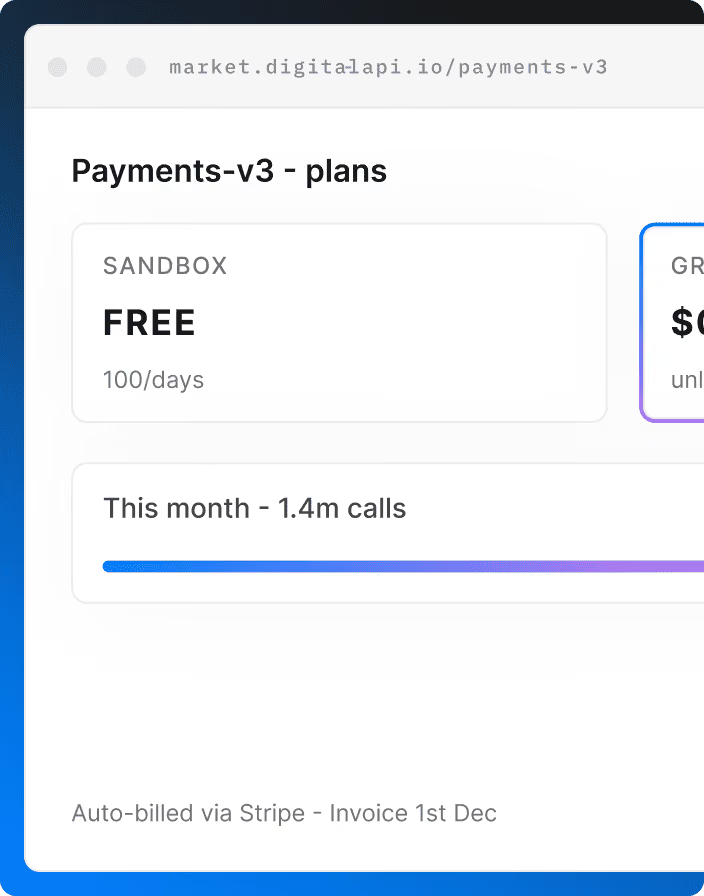
- Monetization ready: Native billing for tiered subscriptions, pay-per-use, and overages, with usage data flowing directly into Stripe, NetSuite, or QuickBooks. Revenue recognition is audit-ready out of the box. Turns external APIs from a support cost into a revenue line without standing up a separate billing stack.
- Comprehensive SDKs: Auto-generated, downloadable code kits in Python, Java, JavaScript, Go, and .NET, distributed via NPM, Maven, and the package managers developers already use. One-click global language switching changes the programming language of every code snippet across the portal, so developers can integrate in their stack of choice.
- Governance and RBAC: Role-based access control with custom roles for internal engineers, external partners, and AI agents under one access model. IP allowlisting, scoped credentials, and immutable audit logs export to your SIEM, so every audience operates under the same compliant policies.
- Community and support: Integrated changelogs, FAQ sections, an embedded chatbot, and Salesforce-routed support ticketing keep developers informed and engaged. A built-in CMS lets a non-developer team publish guides, tutorials, and announcements without engineering.
- Automated, high-quality documentation and key management: Docs generate from your OpenAPI specs and stay current as APIs change. Keys provision on approval, rotate on policy, notify before expiry. Ends the cycle of stale docs and surprise key expirations.
- White-label branding without engineering: Custom domain, your colors, typography, and logos. A drag-and-drop theme editor and built-in CMS let a product or partner team publish updates without an engineering ticket. New tenant portals are provisioned in minutes.
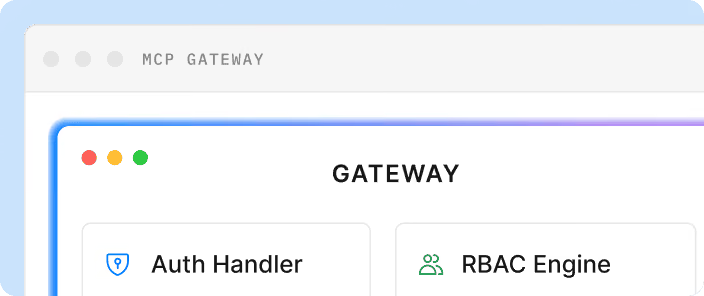
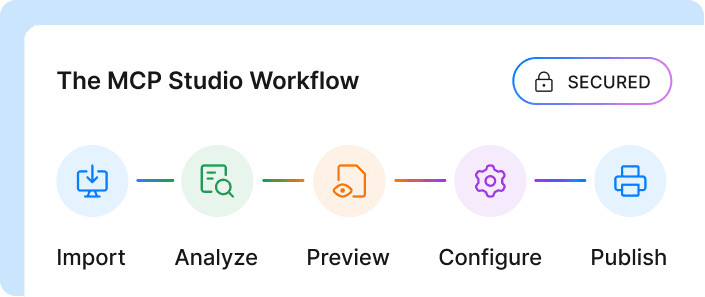
- Agent and MCP ready: Every API auto-generates an MCP tool definition from its OpenAPI spec. Agents authenticate via OAuth M2M with scoped access and per-agent rate limits. One catalog, one governance model, one audit trail across human developers, partners, and AI agents.
If you are scoring vendors against an enterprise requirements list right now, book a 30-minute walkthrough and we will map DigitalAPI against your checklist line by line.
FAQs
1. What is an Enterprise API Developer Portal?
An Enterprise API Developer Portal is a centralized platform that serves as a single source of truth for all an organization's APIs. It provides developers with tools for API discovery, access to documentation, testing environments, and management of their API keys and applications, streamlining the entire API consumption lifecycle.
2. Why is a Developer Portal important for enterprises?
For enterprises, a developer portal is crucial for scaling API adoption, improving developer experience (DX), enforcing consistent API governance, fostering innovation, reducing support overhead for API teams, and ultimately driving business value by making APIs more usable and accessible across the organization and to partners.
3. What are the key requirements for an Enterprise API Developer Portal?
Essential requirements include a comprehensive API catalog with powerful search, interactive and up-to-date documentation, robust security with self-service API key management, support for the API lifecycle (versioning, deprecation), strong analytics, customization options, and deep integration with API gateways and CI/CD pipelines.
4. How does an API Developer Portal improve developer experience?
An API Developer Portal enhances developer experience by providing a self-service environment where developers can easily discover APIs, find clear and interactive documentation, access code samples, test APIs in sandbox environments, and manage their applications and subscriptions, all from a single, intuitive interface.
5. Can an API Gateway's built-in portal suffice for enterprise needs?
While API gateways often offer basic developer portal functionalities, they typically only cover APIs managed by that specific gateway. Enterprises often have APIs distributed across multiple gateways, clouds, and internal services. A true enterprise-grade developer portal needs to aggregate and unify APIs from all these disparate sources to provide a comprehensive and consistent view.
Dhayalan Subramanian is Associate Director, Product Growth at DigitalAPI, where he leads go-to-market and product growth for the company’s multi-gateway API management platform. His work focuses on helping large enterprises and mid-market cloud companies consolidate APIs across AWS, Azure, Apigee, Kong, MuleSoft, and other gateways into a single control plane for governance, discovery, monetization, and agent consumption.
Dhayalan brings 14+ years of experience across product strategy, enterprise architecture, and engineering leadership. Earlier in his career, he held senior roles at Encora (as Associate Architect and Technical Manager), Mindtree (Technology Lead), Tech Mahindra (Technical Lead), and Primus Analytics, where he designed integration frameworks and delivered enterprise-grade digital platforms for global customers.
At DigitalAPI, he works directly with platform, integration, and developer experience leaders at Fortune 500 organizations to operationalize unified API catalogs, developer portals, and MCP-ready APIs. He writes regularly on API developer experience, API governance, and AI agent architectures.

One email a fortnight. Worth opening.
A short digest of what we're writing, what we're learning from customers, and the handful of links you'd actually want from us. No tracking pixels.

.avif)