


REST API Alternatives: 8 Options and When to Use Each
REST is still the default, but it is not the only option. This guide compares eight REST API alternatives side by side, shows a short code sample for each, and gives you a decision tree for picking the right protocol for each job.

TL;DR:
What are the best alternatives to REST APIs?
The main REST API alternatives are GraphQL, gRPC, WebSockets, Server-Sent Events (SSE), webhooks and event-driven APIs (described with AsyncAPI), SOAP, tRPC and the Model Context Protocol (MCP). Nothing fully replaces REST.
Each alternative wins a specific job: flexible queries, fast service-to-service calls, real-time updates, event notifications, legacy contracts, end-to-end TypeScript or AI agent tool access.
Your mobile team wants one call per screen instead of six. The payments team wants faster internal calls between 40 microservices. Product wants live order tracking, and the AI team wants an agent that can call your order API safely. Four requests, and plain REST is the awkward fit for all of them.
That is why architects search for REST API alternatives. Not because REST is broken, but because one style rarely fits every job. Most mature API estates now run REST next to GraphQL, gRPC, event streams and, increasingly, MCP servers for AI agents.
This guide compares eight options side by side, shows a short code sample for each, and ends with a decision tree you can apply to your next service.
What are the main REST API alternatives?
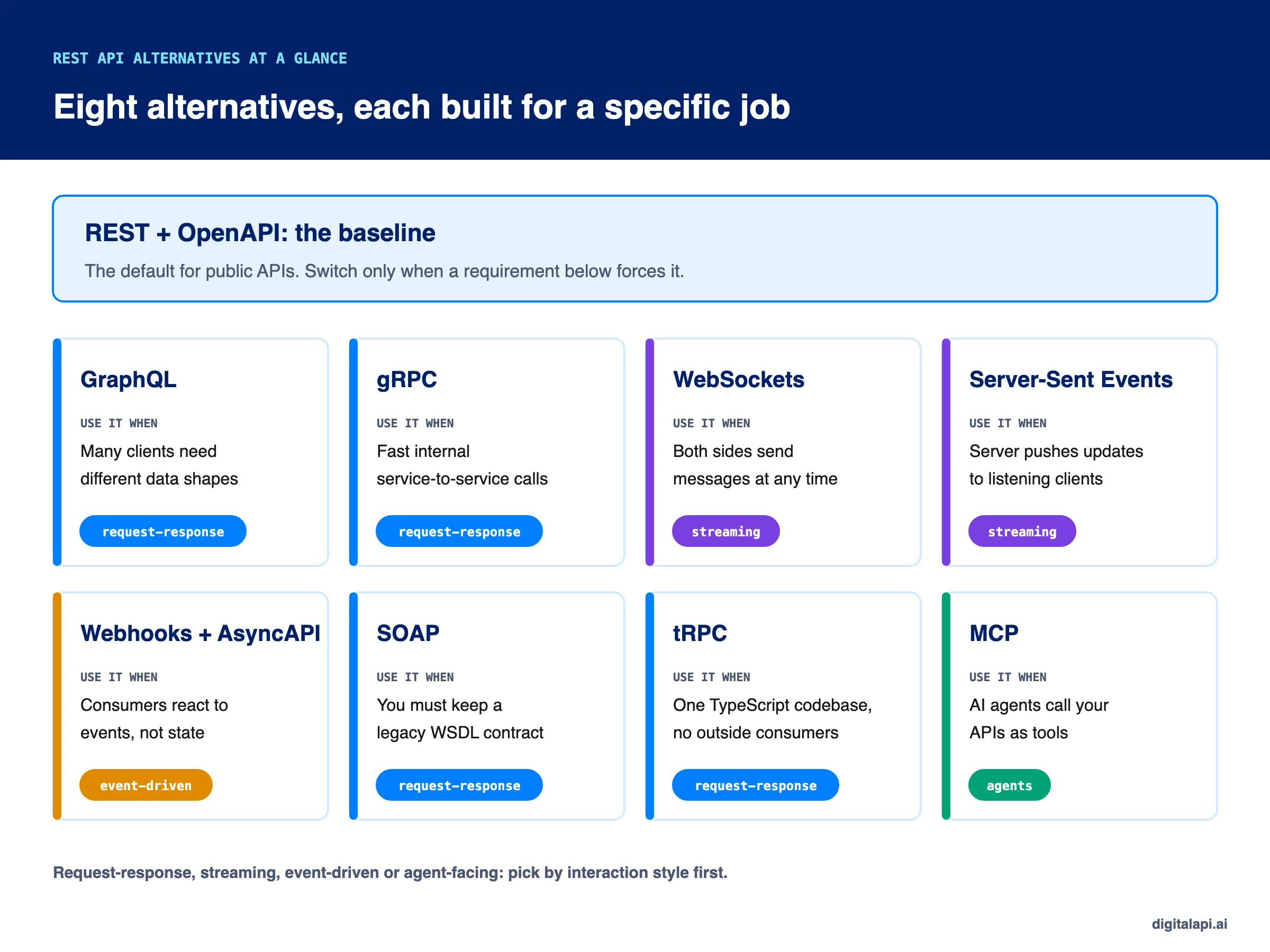
There are eight widely used REST API alternatives, and each one solves a different problem REST handles poorly. Pick by the job, not by trend:
- GraphQL: clients ask for exactly the fields they need.
- gRPC: fast, typed calls between internal services.
- WebSockets: two-way, real-time messaging over one connection.
- Server-Sent Events (SSE): one-way server push over plain HTTP.
- Webhooks and event-driven APIs (AsyncAPI): notify consumers when something happens.
- SOAP: strict XML contracts for legacy and regulated integrations.
- tRPC: type-safe calls inside a single TypeScript codebase.
- MCP: a standard way for AI agents to discover and call tools.
If you need a refresher on the baseline first, see what is a REST API.
Why do teams look for an alternative to RESTful APIs?
Teams look for an alternative to RESTful API design when the request-response, resource-per-URL model creates extra round trips, extra payload or no way to push data. REST is still the right default for public, cacheable, resource-oriented APIs.
The common pain points:
- Over-fetching and under-fetching. A
GET /orders/42returns 60 fields when the screen needs 5, and the screen still needs a second call for the customer. - Chatty service-to-service calls. JSON over HTTP/1.1 adds parsing cost and latency when services call each other thousands of times per second.
- No server push. REST clients must poll to learn that something changed.
- Loose contracts. Without discipline, an OpenAPI file drifts from the code.
- AI agents. Agents need machine-readable tool descriptions and a uniform calling convention, not 300 different endpoint styles.
How do REST alternatives compare side by side?
The fastest way to compare REST alternatives is by interaction style, format and transport. The table below covers what matters when choosing.
For deeper three-way analysis, see our GraphQL vs REST vs gRPC guide: REST vs GraphQL vs gRPC.
1. GraphQL: when should you use it instead of REST?
Use GraphQL when many clients need different shapes of the same data and you want one endpoint where each client asks for exactly the fields it needs.
The client decides the response shape, so one query can replace several REST calls:
The spec defines three operation types: query (read), mutation (write) and subscription (events over time). It does not mandate a transport, but almost everyone serves GraphQL over HTTP POST.
Trade-offs: HTTP caching is harder because everything goes to one URL. You need query depth and cost limits, since one deep query can hit dozens of resolvers. Authorization moves into resolvers, field by field. GraphQL fits best as a layer in front of existing REST services, not a replacement for them. For the full comparison, read GraphQL vs REST.
2. gRPC: when is it the better choice?
Use gRPC when internal services call each other at high volume and you want strict, generated contracts and binary payloads.
You define the service once and generate clients and servers in many languages:
gRPC supports four method types: unary, server streaming, client streaming and bidirectional streaming. Binary protobuf payloads are smaller than equivalent JSON and faster to parse.
Trade-offs: browsers cannot speak native gRPC. gRPC-Web needs a proxy such as Envoy and supports only unary and server-streaming calls. Payloads are not human-readable, so debugging needs tooling. That is why most teams use gRPC inside the platform and REST or GraphQL at the edge. More in gRPC vs REST.
3. WebSockets: how does WebSocket vs REST compare?
Use WebSockets when both client and server must send messages at any time over a long-lived connection, such as chat, multiplayer editing or live trading.
The WebSocket vs REST difference is the connection model. REST opens a request, gets a response and is done. A WebSocket stays open, so the server can push without being asked:
Trade-offs: every open socket is server state, so scaling needs sticky sessions or a pub/sub backplane. RFC 6455 defines framing, not message semantics, so you must design your own message types, acknowledgments and reconnect logic. Standard HTTP caching, status codes and many gateway policies do not apply to individual frames. Keep REST for commands and queries, and add WebSockets only for the live channel.
4. Server-Sent Events: when is SSE enough?
Use Server-Sent Events when the server pushes updates and the client only listens, such as dashboards, notifications or streaming AI responses.
The wire format is plain text, one field per line:
SSE is simpler than WebSockets: it is ordinary HTTP, works with existing auth headers and proxies, and the browser reconnects automatically (the retry field sets the delay). It is also how many large language model APIs stream tokens, and MCP's Streamable HTTP transport can return replies as an SSE stream.
Trade-offs: it is one-way only, and text only. The spec warns that browsers' per-server connection limits can bite when many tabs open streams to the same domain. If the client must also send frequent messages, use WebSockets.
5. Webhooks and event-driven APIs: when should you push events instead?
Use webhooks or event-driven APIs when consumers need to know that something happened, without polling you for it.
Webhooks are the simplest form: you POST a JSON event to a URL the consumer registered. Sign every delivery. The Standard Webhooks spec defines webhook-id, webhook-timestamp and webhook-signature headers, with an HMAC-SHA256 signature over the ID, timestamp and payload. The OpenAPI Specification also has a top-level webhooks field for documenting them.
Broker-based events suit internal streams with many subscribers. AsyncAPI describes channels, messages and operations, where each operation's action is send or receive:
Trade-offs: delivery is asynchronous, so plan for retries, duplicates (make handlers idempotent) and ordering. Webhook consumers need a public endpoint. Events are also the APIs most often missing from the catalog, because nobody writes them down.
6. SOAP: when does legacy still win?
Use SOAP when you integrate with systems that already expose it, or when a partner contract requires WSDL, XML schemas and WS-Security.
SOAP is still common in banking, insurance, telecom and government because its contracts are strict and its security and reliability extensions are mature.
Trade-offs: verbose XML, heavier tooling and a poor fit for browsers and mobile apps. For new public APIs, REST almost always wins. The usual pattern is to wrap SOAP services behind a REST facade at the gateway. Full comparison: REST vs SOAP.
7. tRPC: how does tRPC vs REST compare?
Use tRPC when the same team owns a TypeScript front end and back end and wants end-to-end type safety without writing a schema.
The tRPC vs REST choice comes down to who consumes the API. tRPC is excellent inside one TypeScript monorepo. It is a poor fit for public or partner APIs, because consumers in Java, Python or Go get none of the type benefits, and there is no language-neutral contract like OpenAPI by default. Keep tRPC internal and expose REST at the boundary.
8. MCP: is it the REST alternative for AI agents?
Use the Model Context Protocol when AI agents need to discover and call your capabilities as tools, with a uniform request format and machine-readable schemas.
An agent first calls tools/list to read each tool's name, description and JSON Schema input, then calls a tool:
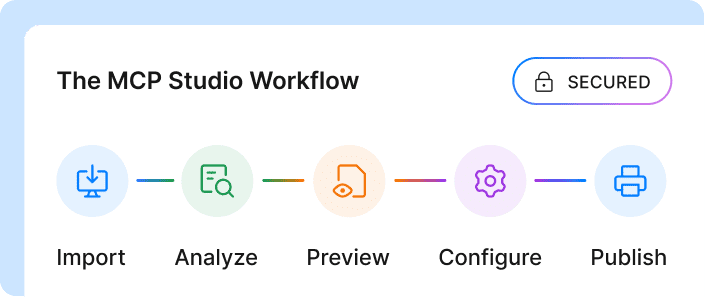
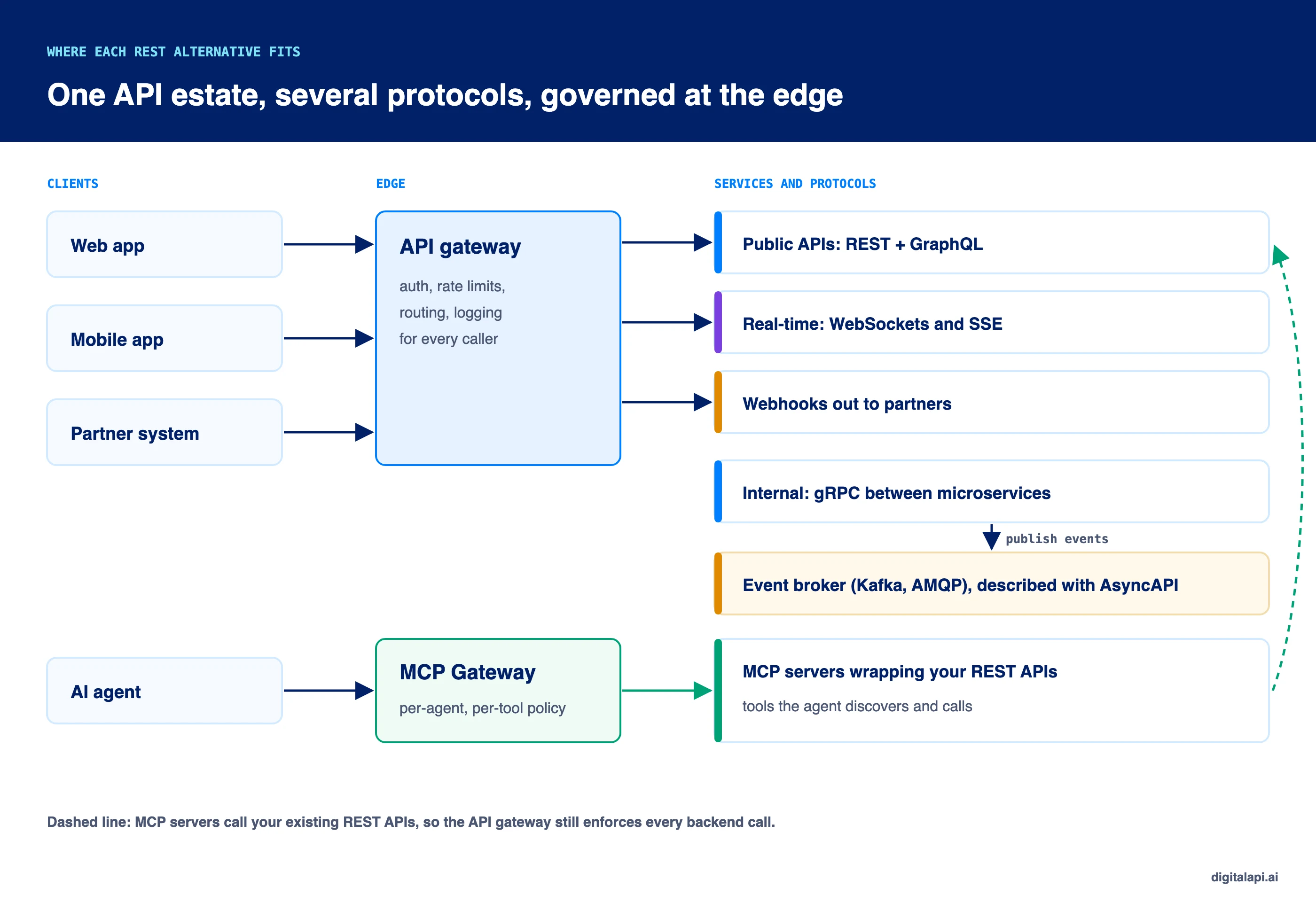
MCP does not replace your REST APIs. In most estates an MCP server wraps existing REST endpoints and describes them in a way a model can use. The spec puts the burden on servers to validate inputs, enforce access controls and rate-limit tool calls, so treat every MCP server as a production API surface. MCP Studio turns existing API specs into MCP servers without code, and the MCP Gateway applies authentication, policy and logging to agent traffic. For the bigger picture, see MCP vs APIs.
How do you choose the right REST API alternative?
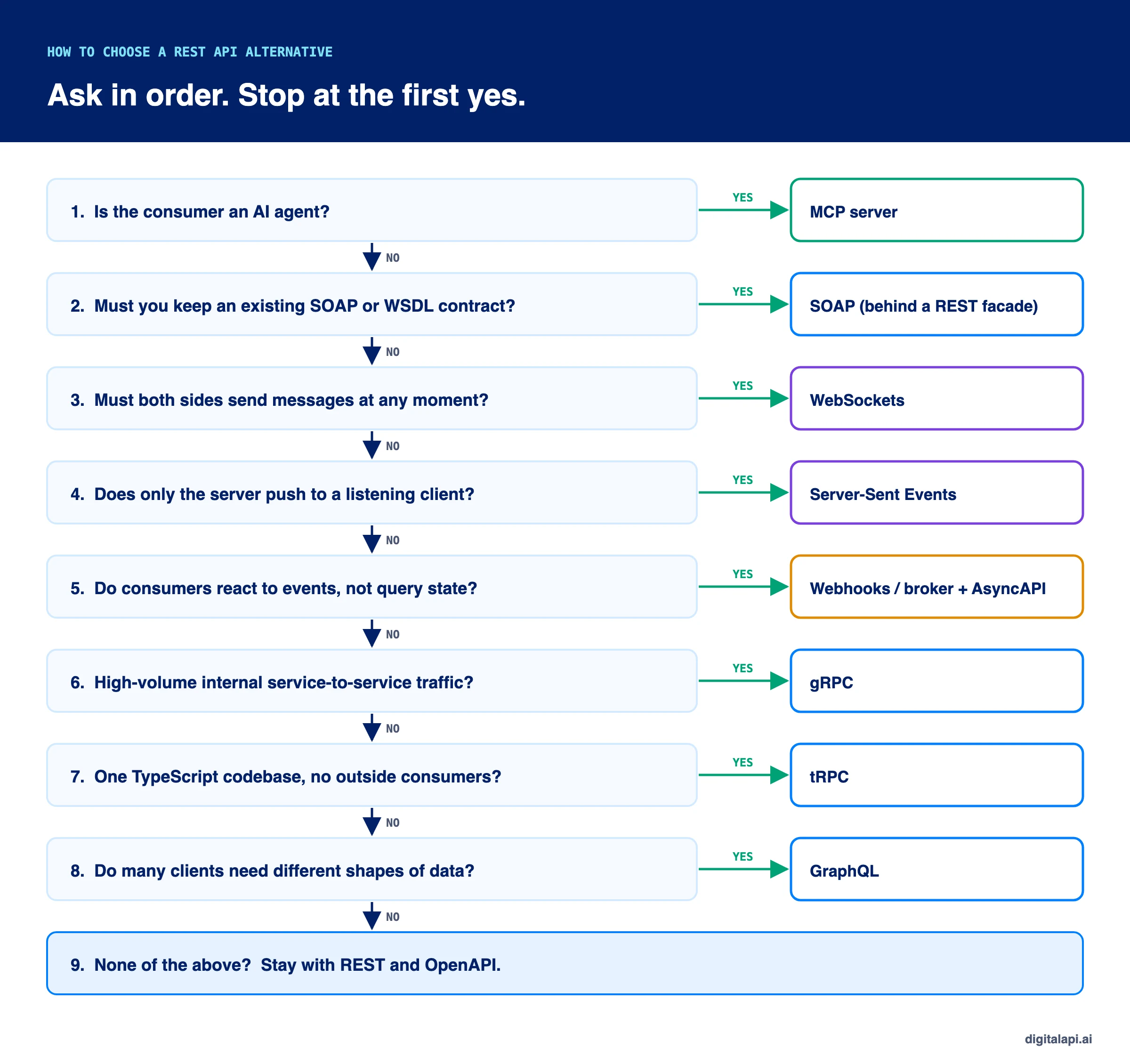
Start with REST, then switch only when a specific requirement forces it. Work through these questions in order and stop at the first "yes":
- Is the consumer an AI agent? Expose an MCP server, usually wrapping your existing REST API.
- Must you integrate with an existing SOAP or WSDL contract? Use SOAP, ideally behind a REST facade.
- Must both sides send messages at any moment? Use WebSockets.
- Does only the server push, to a browser or client that listens? Use Server-Sent Events.
- Do consumers need to react to events, not query state? Use webhooks for external consumers and a broker with AsyncAPI for internal ones.
- Is it high-volume, internal, service-to-service traffic? Use gRPC.
- Is it a single TypeScript codebase with no outside consumers? Use tRPC.
- Do many clients need different shapes of the same data? Use GraphQL.
- None of the above? Stay with REST and OpenAPI.
What is replacing REST APIs?
Nothing is replacing REST outright. What is changing is that REST is no longer the only style in the estate. GraphQL took over many front-end aggregation layers, gRPC took internal service traffic, event-driven APIs took notifications, and MCP is becoming the standard way AI agents reach APIs. Most of those still sit on top of REST services. The question has moved from "what is replacing REST API design" to "how do we run several API styles without losing control".
How do you manage a mixed-protocol API estate?
Put every API, whatever its protocol, into one catalog with one set of ownership, security and lifecycle rules. Mixed estates fail through sprawl, not through protocol choice.
The usual failure: REST APIs live in an OpenAPI catalog, GraphQL schemas in a repo, protobuf files in another, AsyncAPI documents nowhere, and MCP servers spin up per team. Nobody can answer "which APIs touch customer data?" across all of them. That is API sprawl.
What works:
- One catalog for every spec type: OpenAPI, GraphQL SDL, protobuf, AsyncAPI and MCP tool definitions, each with an owner and lifecycle stage.
- One policy layer: authentication, rate limits and logging applied the same way, whichever gateway or protocol carries the call.
- One portal for consumers: developers find REST, GraphQL and event APIs in the same place. The API Developer Portal handles discovery, subscriptions and keys.
- Agent access through the same governance: MCP servers registered, scoped and monitored like any other API.
DigitalAPI Marketplace acts as a management plane across the gateways you already run, and the API Gateway enforces policy at runtime, so adding a new protocol does not mean adding a new silo.
Key takeaways
- The eight main REST API alternatives are GraphQL, gRPC, WebSockets, SSE, webhooks and event-driven APIs (AsyncAPI), SOAP, tRPC and MCP.
- None replaces REST. Each wins a specific job: flexible queries, internal speed, real-time, events, legacy contracts, TypeScript type safety or AI agents.
- Choose by interaction pattern first: request-response, two-way streaming, server push or events.
- Keep internal-only styles internal. gRPC and tRPC behind the gateway, REST or GraphQL at the edge.
- Govern every protocol in one catalog, including AsyncAPI events and MCP servers, or sprawl follows.
Frequently asked questions
1. What are the alternatives to REST APIs?
The main alternatives to REST APIs are GraphQL, gRPC, WebSockets, Server-Sent Events, webhooks and event-driven APIs described with AsyncAPI, SOAP, tRPC and the Model Context Protocol (MCP). Each suits a different job, from flexible data fetching and fast internal calls to real-time updates, event notifications and AI agent access. Most organizations use several of them alongside REST.
2. What is replacing REST API?
Nothing is replacing REST outright. REST remains the default for public, resource-oriented APIs. Other styles have taken over specific jobs: GraphQL for front-end aggregation, gRPC for internal microservices, event-driven APIs for notifications and MCP for AI agent tool access. Most of these still call REST services underneath, so the real shift is toward running several API styles at once.
3. What is the difference between WebSocket and REST?
REST uses short request-response exchanges: the client asks, the server answers and the exchange ends. A WebSocket, defined in RFC 6455, upgrades one HTTP connection into a persistent, full-duplex channel where both sides can send messages at any time. Use REST for commands and queries, and WebSockets for live, two-way features such as chat or collaborative editing.
4. Is GraphQL better than REST?
GraphQL is not better in every case. It is better when many clients need different shapes of the same data, because each client requests exactly the fields it needs from one endpoint. REST is simpler to cache, secure and monitor, and suits public, resource-based APIs. Many teams put a GraphQL layer in front of existing REST services rather than replacing them.
5. When should I use gRPC instead of REST?
Use gRPC for high-volume, internal service-to-service calls where latency and strict contracts matter. It uses Protocol Buffers over HTTP/2 and supports streaming in both directions. Avoid it for public browser-facing APIs: browsers need gRPC-Web and a proxy, which supports only unary and server-streaming calls. Most teams pair gRPC internally with REST or GraphQL at the edge.
6. What is the difference between tRPC and REST?
tRPC shares TypeScript types directly between server and client, so there is no schema or code generation and type errors show up at build time. REST is language-neutral and usually described with OpenAPI, so any client can consume it. Use tRPC inside a single TypeScript codebase, and REST for public, partner or multi-language consumers.
7. Is FastAPI REST or SOAP?
FastAPI is a Python web framework, not a protocol, and it is used to build REST-style HTTP APIs, not SOAP. It is based on the OpenAPI and JSON Schema standards and generates interactive OpenAPI documentation automatically. If you need SOAP in Python, you would use a dedicated SOAP library instead.
8. Is MCP a replacement for REST APIs?
No. MCP is a protocol for AI agents to discover and call tools, using JSON-RPC 2.0 over stdio or Streamable HTTP. In practice an MCP server usually wraps existing REST APIs and describes them as tools with JSON Schema inputs. Your REST APIs keep serving apps and partners, while MCP gives agents a uniform way to use them.
9. What are the four types of APIs?
The four types of APIs are usually grouped by audience: public (open) APIs, partner APIs, internal (private) APIs and composite APIs that combine several calls. This is a separate question from API style. Any of the four types can be built with REST, GraphQL, gRPC, SOAP, events or MCP.
10. Can you use REST and GraphQL or gRPC together?
Yes, and most mature API estates do. A common pattern is gRPC between internal services, REST for public and partner APIs, GraphQL as an aggregation layer for front ends and webhooks for event notifications. The challenge is governance, so keep every API, whatever its protocol, in one catalog with shared security and lifecycle rules.
Conclusion
The best REST API alternatives are not replacements. They are specialists. GraphQL for flexible queries, gRPC for internal speed, WebSockets and SSE for real-time, webhooks and AsyncAPI for events, SOAP for legacy contracts, tRPC for TypeScript monorepos and MCP for AI agents. REST stays the backbone for most public APIs.
Start from REST, move to an alternative only when the decision tree gives you a clear reason, and keep every protocol in one governed catalog. The protocol you pick matters less than whether anyone can find, secure and retire the API later.
Govern REST, GraphQL, gRPC and async APIs in one catalog. Explore DigitalAPI Marketplace
Prefer a walkthrough? Book a Demo
Dhayalan Subramanian is Associate Director, Product Growth at DigitalAPI, where he leads go-to-market and product growth for the company’s multi-gateway API management platform. His work focuses on helping large enterprises and mid-market cloud companies consolidate APIs across AWS, Azure, Apigee, Kong, MuleSoft, and other gateways into a single control plane for governance, discovery, monetization, and agent consumption.
Dhayalan brings 14+ years of experience across product strategy, enterprise architecture, and engineering leadership. Earlier in his career, he held senior roles at Encora (as Associate Architect and Technical Manager), Mindtree (Technology Lead), Tech Mahindra (Technical Lead), and Primus Analytics, where he designed integration frameworks and delivered enterprise-grade digital platforms for global customers.
At DigitalAPI, he works directly with platform, integration, and developer experience leaders at Fortune 500 organizations to operationalize unified API catalogs, developer portals, and MCP-ready APIs. He writes regularly on API developer experience, API governance, and AI agent architectures.
One email a fortnight. Worth opening.
A short digest of what we're writing, what we're learning from customers, and the handful of links you'd actually want from us. No tracking pixels.