





Master API Security: Essential Best Practices for 2026
In an era defined by interconnectedness, API security stands as the bedrock of digital trust and business continuity.

TL;DR
1. API security is going to be paramount in 2026 due to escalating cyber threats and the pervasive integration of APIs across digital ecosystems.
2. Adhere to the OWASP API Security Top 10, which identifies the most critical risks from broken authentication to server-side request forgery.
3. Implement robust authentication (OAuth 2.0, OpenID Connect) and granular authorization (RBAC/ABAC) to control access effectively.
4. Validate all inputs and encode all outputs meticulously to prevent injection attacks and data breaches.
5. Employ rate limiting, API gateways, WAFs, and comprehensive security testing (SAST, DAST, penetration tests) as multi-layered defenses.
6. Prioritize continuous monitoring, detailed logging, and a well-defined incident response plan to detect and mitigate threats in real-time.
7. Secure the entire API lifecycle, from design to deprecation, by embedding security-by-design principles and regular audits.
As digital interactions increasingly hinge on a web of interconnected services, the very fabric of modern software relies on Application Programming Interfaces. These powerful connectors, while enabling unprecedented innovation and agility, also present an expansive attack surface. In 2026, navigating this complex landscape demands a proactive, comprehensive approach to API security. The sheer volume of data exchanged, the complexity of distributed architectures, and the sophistication of cyber threats mean that robust API security isn't merely a technical consideration; it's a fundamental business imperative. This guide explores the essential practices to fortify your API ecosystem against evolving risks.
What is API Security?
API security refers to the strategies, practices, and tools used to protect APIs from attacks, unauthorized access, and misuse. It encompasses a wide range of measures designed to ensure the confidentiality, integrity, and availability of the data and services exposed through APIs. This includes securing the API endpoints, protecting the data transmitted between clients and servers, authenticating and authorizing users and applications, and monitoring API usage for suspicious activity. Effective API security addresses vulnerabilities at every stage of the API lifecycle, from design and development to deployment, runtime, and deprecation, integrating security controls into the very architecture of the API infrastructure.

Why API Security is More Critical Than Ever in 2026
The digital transformation accelerated by recent global shifts has solidified APIs as the backbone of virtually every modern application, microservice architecture, and data exchange. From mobile apps and IoT devices to intricate enterprise integrations and AI-powered services, APIs facilitate the flow of information that drives business operations and customer experiences. This pervasive reliance, however, significantly expands the potential attack surface, making API security a non-negotiable priority.
In 2026, several factors converge to elevate API security's importance:
- Increasingly Sophisticated Threats: Cybercriminals are constantly evolving their tactics, exploiting API vulnerabilities with greater precision, leading to data breaches, service disruptions, and financial losses.
- Explosive API Growth: The sheer volume of APIs, internal, external, and partner-facing, has created complex, interconnected ecosystems that are challenging to monitor and secure holistically. Shadow APIs and zombie APIs often emerge, creating unknown points of entry.
- Regulatory Compliance: Stricter data protection regulations (like GDPR, CCPA) mandate robust security controls. API breaches can lead to massive fines and reputational damage.
- Microservices and Distributed Architectures: While offering flexibility, microservices introduce a proliferation of inter-service APIs, each a potential point of compromise if not properly secured, complicating traditional perimeter defenses.
- Rise of AI and Automation: AI agents will increasingly interact with APIs, making the machine-readability, discoverability, and intrinsic security of APIs paramount to prevent malicious or unintended autonomous actions.
- Supply Chain Attacks: Compromised third-party APIs or components in the API supply chain can introduce vulnerabilities that ripple across an organization's entire digital infrastructure.
Neglecting API security in this environment isn't just a risk; it's an invitation for disaster. A single compromised API can grant attackers access to sensitive data, disrupt critical services, or serve as a pivot point into an entire network.
The OWASP API Security Top 10 (A Foundational Guide)
The OWASP API Security Top 10 provides a critical awareness document for developers, architects, and security professionals, highlighting the most prevalent and impactful security risks for APIs. It's an indispensable framework for understanding and prioritizing API security efforts. Adhering to these principles forms the bedrock of a robust API security posture.
1. Broken Object Level Authorization
This vulnerability occurs when an API does not properly validate that the user is authorized to access a specific resource. Attackers can manipulate object IDs in requests to access or modify data belonging to other users without authorization. Implementing granular authorization checks on every resource access is crucial.
2. Broken Authentication
Flaws in authentication mechanisms allow attackers to compromise authentication tokens or exploit weak implementation to assume legitimate user identities. This includes weak password policies, insecure session management, or vulnerable credential recovery processes. Strong authentication standards (like OAuth 2.0, OpenID Connect) and secure token handling are essential.
3. Broken Object Property Level Authorization
Similar to BFLA but at the property level. This occurs when clients can access or modify properties in a resource object that they are not authorized for, often due to mass assignment or insufficient filtering of request parameters. Explicitly defining authorized properties for different roles is key.
4. Unrestricted Resource Consumption
APIs often deal with requests that consume server resources like CPU, memory, database connections, or disk I/O. Without proper limits, an attacker can flood an API with resource-intensive requests, leading to denial-of-service (DoS) or performance degradation. Implementing rate limiting, throttling, and payload size limits mitigates this risk.
5. Broken Function Level Authorization
This vulnerability occurs when an API allows a user to access functionality or endpoints that they are not authorized to use. It often stems from poorly defined access control policies for different user roles, where a low-privilege user can access admin functions, for example. Robust, centralized authorization logic is necessary.
6. Unrestricted Access to Sensitive Business Flows
APIs often expose critical business logic, like purchasing, account creation, or payment processing. If these flows lack sufficient protection against automated abuse, attackers can exploit them for fraud, spam, or denial of-service. This requires implementing specific anti-automation and bot detection mechanisms.
7. Server Side Request Forgery
SSRF vulnerabilities allow an attacker to trick the server-side application into making requests to an unintended location, even if the application appears to be accessing a trusted remote resource. This can lead to internal network scanning, access to internal services, or disclosure of sensitive information. Strict input validation and whitelisting of allowed URLs are crucial.
8. Security Misconfiguration
This category covers a broad range of security issues resulting from improper setup, default configurations, or unpatched systems. Examples include unnecessary features enabled, default credentials, misconfigured CORS policies, or insecure cloud storage. Regular security audits, secure configuration baselines, and patch management are vital.
9. Improper Inventory Management
Lack of proper API inventory can lead to exposure of outdated API versions, debug endpoints, or forgotten shadow APIs that lack adequate security. This creates unknown attack vectors. A comprehensive API catalog and lifecycle management strategy are necessary to track and secure all APIs.
10. Unsecure Consumption of Third-Party APIs
When an API consumes other third-party APIs (e.g., payment gateways, external services), vulnerabilities in those external APIs, or insecure integration practices, can introduce risks. This requires careful vetting of third-party services, secure integration patterns, and robust error handling for external calls.
Essential API Security Best Practices for 2026
Beyond the OWASP Top 10, a holistic API security strategy requires embedding security at every layer and stage. These best practices provide a comprehensive roadmap for safeguarding your API ecosystem.
1. Strong Authentication and Authorization
- Implement Industry-Standard Protocols: Leverage OAuth 2.0 for delegation and OpenID Connect (OIDC) for identity verification. Avoid custom, homegrown authentication schemes.
- Use API Keys Judiciously: API keys are simple but offer limited security. Use them only for basic client identification and rate limiting, not for user authentication. Pair them with other mechanisms, and ensure they are protected like credentials.
- Enforce Strong Credential Policies: Mandate complex passwords, multi-factor authentication (MFA) for user accounts, and rotation of API keys/secrets.
- Implement Granular Authorization: Apply Role-Based Access Control (RBAC) or Attribute-Based Access Control (ABAC) to ensure users can only access resources and perform actions explicitly permitted by their roles or attributes. Always validate authorization at the API endpoint level, not just the UI.
- Secure Token Management: Use JSON Web Tokens (JWTs) securely. Ensure they are signed, have short expiry times, and are validated on every request. Implement revocation mechanisms for compromised tokens.
2. Rigorous Input Validation and Output Encoding
- Validate All Inputs: Treat all client-supplied data as untrusted. Enforce strict schema validation for every incoming request payload, URL parameters, and headers. Validate data types, formats, lengths, and acceptable values.
- Sanitize and Filter: Remove or neutralize any potentially malicious characters or scripts (e.g., HTML, JavaScript) from user inputs before processing them.
- Encode All Outputs: Before displaying data to users, ensure it is properly encoded for the context (e.g., HTML entity encoding, URL encoding, JavaScript encoding) to prevent cross-site scripting (XSS) attacks.
3. Rate Limiting and Throttling
- Prevent Abuse and DoS: Implement rate limiting to control the number of requests a user or client can make within a specified timeframe. This prevents brute-force attacks, credential stuffing, and denial-of-service (DoS) attacks.
- Protect Backend Resources: Throttling mechanisms help manage peak loads, ensuring that backend services aren't overwhelmed by excessive API calls, thus maintaining service availability.
4. Secure API Design and Development
- Principle of Least Privilege: Design APIs to expose only the necessary data and functionality. Avoid over-fetching or returning excessive data that clients don't need.
- Version APIs: Use clear versioning (e.g., /v1/, /v2/), to manage API evolution, allowing for secure deprecation of older, potentially vulnerable versions without breaking existing integrations.
- Use Idempotent Operations: Design API endpoints for actions like creating or updating resources to be idempotent where applicable. This means that making the same request multiple times has the same effect as making it once, preventing unintended side effects from retries.
- Avoid Sensitive Data in URLs: Never expose sensitive information (e.g., user IDs, session tokens, personal data) directly in API URLs.
5. Robust Error Handling and Logging
- Generic Error Messages: Provide generic, non-descriptive error messages to clients. Avoid revealing internal system details, stack traces, or database errors that could aid an attacker.
- Comprehensive Logging: Implement detailed logging of all API requests, responses (excluding sensitive data), authentication attempts, and authorization failures. Logs should include client IP, user ID, timestamp, and requested endpoint.
- Centralized Log Management: Use a centralized logging system to aggregate, monitor, and analyze logs for suspicious patterns or security incidents.
6. Encryption and Data Protection
- Enforce HTTPS/TLS: Always use HTTPS/TLS for all API communication to encrypt data in transit, preventing eavesdropping and man-in-the-middle attacks. Ensure up-to-date TLS versions and strong cipher suites.
- Encrypt Sensitive Data at Rest: Encrypt sensitive data stored in databases, file systems, or other storage mechanisms.
7. API Gateway and WAF Implementation
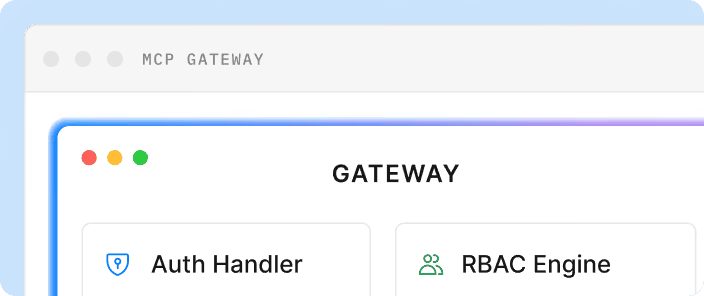
- Centralized Policy Enforcement: Deploy an API Gateway to act as the single entry point for all API traffic. Gateways can enforce authentication, authorization, rate limiting, and traffic management policies centrally.
- Web Application Firewall (WAF): Integrate a WAF to provide an additional layer of protection against common web vulnerabilities like SQL injection, XSS, and bot attacks before traffic reaches your APIs.
8. Comprehensive Security Testing
- Static Application Security Testing (SAST): Integrate SAST tools into your CI/CD pipeline to analyze source code for vulnerabilities during development.
- Dynamic Application Security Testing (DAST): Use DAST tools to test running APIs for vulnerabilities by actively probing them with malicious inputs.
- Penetration Testing: Regularly conduct manual penetration tests by security experts to identify complex vulnerabilities that automated tools might miss.
- Fuzz Testing: Subject APIs to large amounts of malformed or unexpected data inputs to discover crashes or vulnerabilities.
9. Continuous Monitoring and Incident Response
- Real-time Threat Detection: Implement real-time monitoring and alerting for suspicious API activity, such as unusual traffic patterns, failed authentication attempts, or access to sensitive endpoints.
- Security Information and Event Management (SIEM): Use SIEM systems to correlate security events across your infrastructure and detect complex attack patterns.
- Incident Response Plan: Develop and regularly test a clear incident response plan specifically for API security incidents, outlining steps for detection, containment, eradication, recovery, and post-incident analysis.
10. API Lifecycle Security
- Security by Design: Embed security considerations from the very beginning of the API design phase. Conduct threat modeling and security reviews early and often.
- Regular Audits and Reviews: Periodically audit API configurations, code, and access controls to ensure adherence to security policies and best practices.
- Secure Deprecation Strategy: When deprecating an API version, provide clear communication, adequate transition time, and ensure it is properly shut down and removed, not just left unmonitored.
Common Pitfalls in API Security
Even with good intentions, organizations frequently fall into common traps when securing their APIs. Avoiding these pitfalls is as crucial as implementing best practices.
- Over-Reliance on Network Perimeter Security: Believing that firewalls and network segmentation alone are sufficient. APIs are often exposed directly to the internet, bypassing traditional perimeter defenses.
- Neglecting Shadow APIs and Zombie APIs: Uncataloged APIs ("shadow APIs") or outdated, unmaintained versions ("zombie APIs") often become forgotten backdoors that are not monitored or secured.
- Inadequate Authorization Logic: Implementing authorization only at the service level and failing to enforce granular object-level authorization (BFLA) for every resource access.
- Verbose Error Messages: Providing too much detail in error responses, which can give attackers valuable information about the backend system's architecture or vulnerabilities.
- Ignoring Internal APIs: Assuming internal APIs don't need the same level of security as external ones. Insider threats or compromised internal systems can exploit these just as easily.
- Lack of Continuous Security Testing: Treating security testing as a one-time event rather than an ongoing process integrated into the CI/CD pipeline.
- Hardcoding Secrets: Embedding API keys, database credentials, or other sensitive information directly into codebases, making them vulnerable if the code is exposed.
Future of API Security: AI and Automation
As the scale and complexity of API ecosystems continue to grow, manual security efforts will become increasingly unsustainable. The future of API security will be heavily reliant on artificial intelligence and automation. AI and machine learning will play a pivotal role in:
- Advanced Threat Detection: AI-powered analytics can detect subtle anomalies and sophisticated attack patterns that humans might miss, identifying emerging threats in real-time.
- Automated Policy Enforcement: Automation will enable the dynamic application and enforcement of security policies across hundreds or thousands of APIs, scaling governance without manual intervention.
- Proactive Vulnerability Management: AI can assist in identifying potential vulnerabilities in code and configurations before deployment, offering intelligent recommendations for remediation.
- Behavioral Analytics: AI can profile normal API behavior and flag deviations, helping to identify malicious actors or compromised accounts.
Integrating AI and automation will transform API security from a reactive struggle into a proactive, adaptive defense mechanism, essential for protecting the increasingly interconnected digital landscape.
Conclusion
In an era defined by interconnectedness, API security stands as the bedrock of digital trust and business continuity. The landscape of threats is ever-evolving, demanding more than just adherence to, basic practices; it requires a deep commitment to security by design, continuous vigilance, and adaptive strategies. By embracing the essential best practices, from robust authentication and rigorous validation to comprehensive testing and automated monitoring, organizations can build resilient API ecosystems. Proactive security measures aren't merely a shield against threats; they are an enabler of innovation, allowing businesses to leverage the full potential of APIs with confidence and peace of mind.
Stay on top of API Security threats in 2026 With DigitalAPI, Book a Demo today!
FAQs
1. What is API security?
API security refers to the protective measures implemented to safeguard Application Programming Interfaces from unauthorized access, misuse, and attacks. It involves securing API endpoints, encrypting data in transit and at rest, authenticating and authorizing users and applications, and continuously monitoring for suspicious activity to ensure the confidentiality, integrity, and availability of API-exposed data and services.
2. Why is API security critical in 2026?
API security is critical in 2026 due to the exponential growth of APIs, the increasing sophistication of cyber threats, the prevalence of microservices architectures, and stringent regulatory compliance requirements. APIs are central to modern digital operations, making them prime targets for data breaches, DoS attacks, and unauthorized data exposure, which can lead to severe financial, reputational, and operational consequences.
3. What are the main API security vulnerabilities?
The main API security vulnerabilities are often highlighted by the OWASP API Security Top 10. These include Broken Object Level Authorization (BFLA), Broken Authentication, Broken Function Level Authorization (BFLA), Unrestricted Resource Consumption, Security Misconfiguration, and Server-Side Request Forgery (SSRF). These flaws can lead to unauthorized data access, account takeovers, service disruptions, and system compromises.
4. How can I implement strong authentication for APIs?
To implement strong authentication, use industry-standard protocols like OAuth 2.0 for authorization and OpenID Connect (OIDC) for identity verification. Avoid custom authentication schemes. Enforce strong password policies, multi-factor authentication (MFA), and secure token management (e.g., short-lived JWTs with proper signing and validation). API keys should be used cautiously and primarily for client identification or rate limiting, not as the sole authentication mechanism.
5. What role do API gateways play in API security?
API gateways are crucial for API security as they act as a central enforcement point for all API traffic. They can enforce authentication and authorization policies, perform rate limiting and throttling, route requests, transform protocols, and integrate with Web Application Firewalls (WAFs) for advanced threat protection. By centralizing security controls, gateways help protect backend services and ensure consistent policy application across the API estate.
Dhayalan Subramanian is Associate Director, Product Growth at DigitalAPI, where he leads go-to-market and product growth for the company’s multi-gateway API management platform. His work focuses on helping large enterprises and mid-market cloud companies consolidate APIs across AWS, Azure, Apigee, Kong, MuleSoft, and other gateways into a single control plane for governance, discovery, monetization, and agent consumption.
Dhayalan brings 14+ years of experience across product strategy, enterprise architecture, and engineering leadership. Earlier in his career, he held senior roles at Encora (as Associate Architect and Technical Manager), Mindtree (Technology Lead), Tech Mahindra (Technical Lead), and Primus Analytics, where he designed integration frameworks and delivered enterprise-grade digital platforms for global customers.
At DigitalAPI, he works directly with platform, integration, and developer experience leaders at Fortune 500 organizations to operationalize unified API catalogs, developer portals, and MCP-ready APIs. He writes regularly on API developer experience, API governance, and AI agent architectures.
One email a fortnight. Worth opening.
A short digest of what we're writing, what we're learning from customers, and the handful of links you'd actually want from us. No tracking pixels.

.avif)