


iPaaS vs API Gateway: What's the Difference?
An iPaaS moves data between apps. An API gateway controls who calls your APIs and how often. This guide compares the two by role, shows where they overlap and explains how most enterprises run both.

TL;DR:
What is the difference between iPaaS and an API gateway?
In the iPaaS vs API gateway comparison, an iPaaS connects apps and moves data between them.
An API gateway sits in front of your APIs and controls traffic: it checks callers, limits rates and routes requests.
A new order lands in your ecommerce app. Your ERP needs it, your CRM needs it, and your warehouse system needs it in a different format. Meanwhile, a partner wants to call your order API 500 times a minute.
Those are two different problems. The first is integration. The second is traffic control. The iPaaS vs API gateway question is about which tool owns which problem.
The gap is wide. The MuleSoft 2025 Connectivity Benchmark Report found the average enterprise runs 897 applications. Only 29% of them are integrated. That gap drives iPaaS demand. Every API you expose to close it still needs a gateway in front of it.
This guide compares the two by role, shows where they overlap and explains how to run both.
iPaaS vs API gateway: what is the difference?
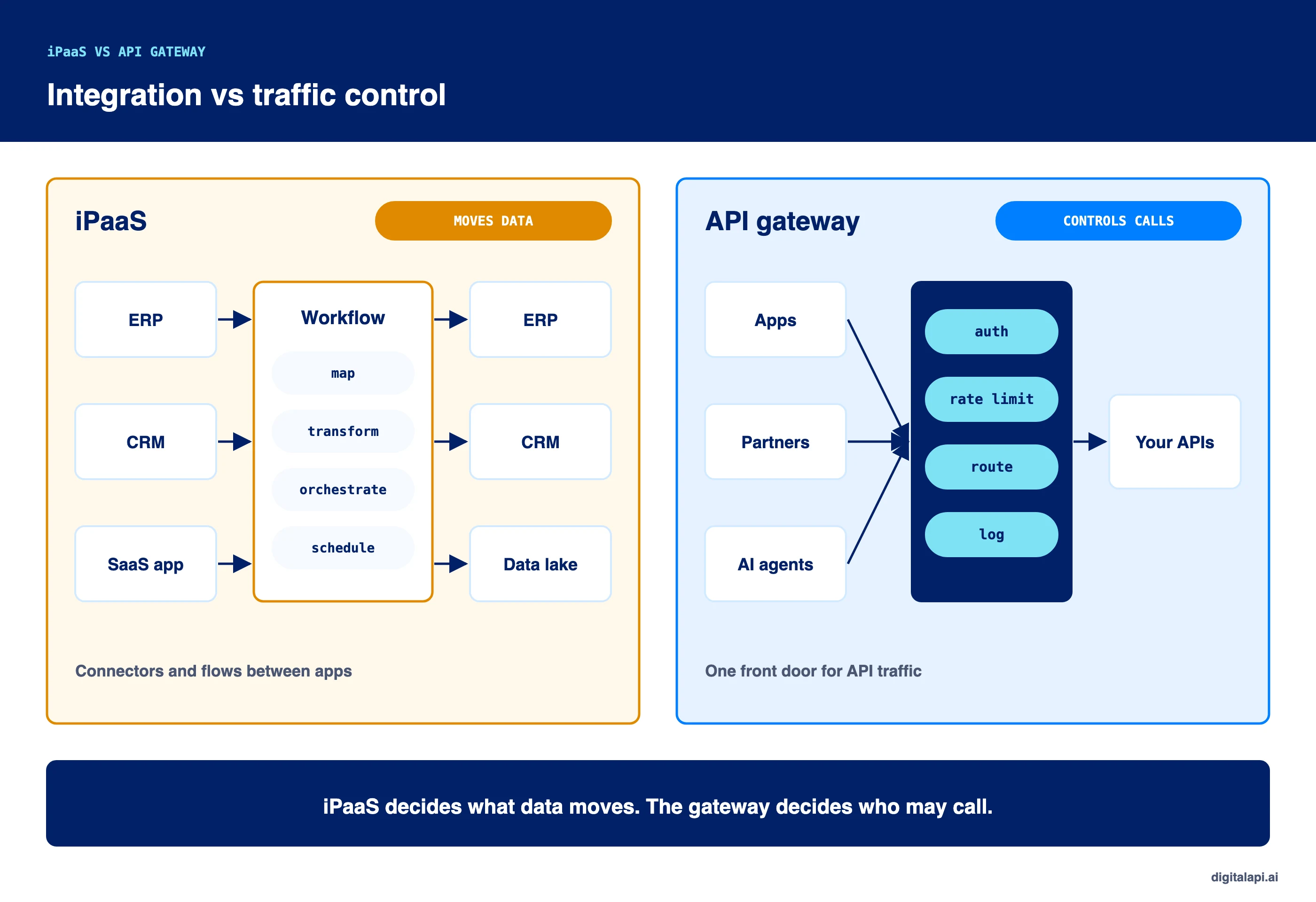
An iPaaS builds integrations between systems. An API gateway enforces policy on calls to your APIs. The iPaaS decides what data moves and how it changes on the way. The gateway decides who can call an API, how often and where the request goes.
Think of an iPaaS as a builder of flows and a gateway as a checkpoint. Most enterprises use both.
What does an iPaaS do?
An iPaaS connects applications, transforms data between them and automates multi-step processes. It syncs customers from your CRM to your ERP without custom code for each pair of systems.
Core iPaaS capabilities include:
- Prebuilt connectors for SaaS apps, databases, file systems and legacy systems.
- Data mapping and transformation, for example converting XML to JSON or renaming fields.
- Orchestration, which chains steps into a workflow with branches, retries and error handling.
- Triggers on schedules, events or webhooks.
- Low-code design, so integration specialists and business technologists can build flows.
The market reflects the demand. Gartner's 2025 Magic Quadrant for iPaaS estimates iPaaS revenue exceeded $9 billion in 2024. It forecasts more than $17 billion by 2028.
What does an API gateway do?
An API gateway protects and routes API traffic at runtime. Every call passes through it. That makes it the one place to apply security and traffic policy.
NIST SP 800-204 lists the core features an API layer for microservices needs. They include authentication and access management, secure communication, monitoring, load balancing and throttling. A gateway covers these in one place:
- Authentication and authorization with API keys, OAuth 2.0 and mTLS.
- Rate limits and quotas per consumer or plan.
- Routing and load balancing to backend services.
- Request and response transformation, such as header changes or protocol translation.
- Logging and metrics for every call.
Gateways also defend against risks in the OWASP API Security Top 10 2023. Examples are broken authentication and unrestricted resource consumption. For a deeper look, read our API gateway guide.
iPaaS vs API gateway: how do they compare by role?
An iPaaS is a design-time and process tool owned by integration teams. An API gateway is a runtime control point owned by platform and security teams. The table compares them role by role. That is how the API gateway vs integration platform choice plays out in real teams.
The pricing row matters. High-volume API traffic through a per-message iPaaS gets expensive. Complex mapping inside a gateway turns it into a fragile integration layer.
Where do iPaaS and an API gateway overlap?
Both can expose an API, transform a payload and call a backend. That overlap is why teams confuse them, and why some vendors sell them in one suite.
Common overlap areas:
- API exposure. Many iPaaS tools can publish a flow as an HTTP endpoint. That endpoint still lacks full gateway policy, such as per-consumer quotas.
- Transformation. Gateways can rewrite headers or translate SOAP to REST. An iPaaS does far deeper mapping.
- Monitoring. Both log activity. The iPaaS logs flow runs. The gateway logs individual API calls.
What is the difference between API and ESB?
An API is a contract that lets one system request data or actions from another. An enterprise service bus (ESB) is middleware that routes, transforms and orchestrates messages between many systems. An API defines how to talk to a service. An enterprise service bus is a central hub that carries the conversation.
The ESB is the on-premises ancestor of iPaaS. Many teams replace ESBs with an iPaaS for integration and an API gateway for exposure. The gateway takes the access-control role. The iPaaS takes the routing and transformation role.
How do you use iPaaS and an API gateway together?
Put the API gateway in front of anything outside consumers call. Let the iPaaS run the flows behind it. The gateway handles identity, limits and audit. The iPaaS handles mapping and orchestration.
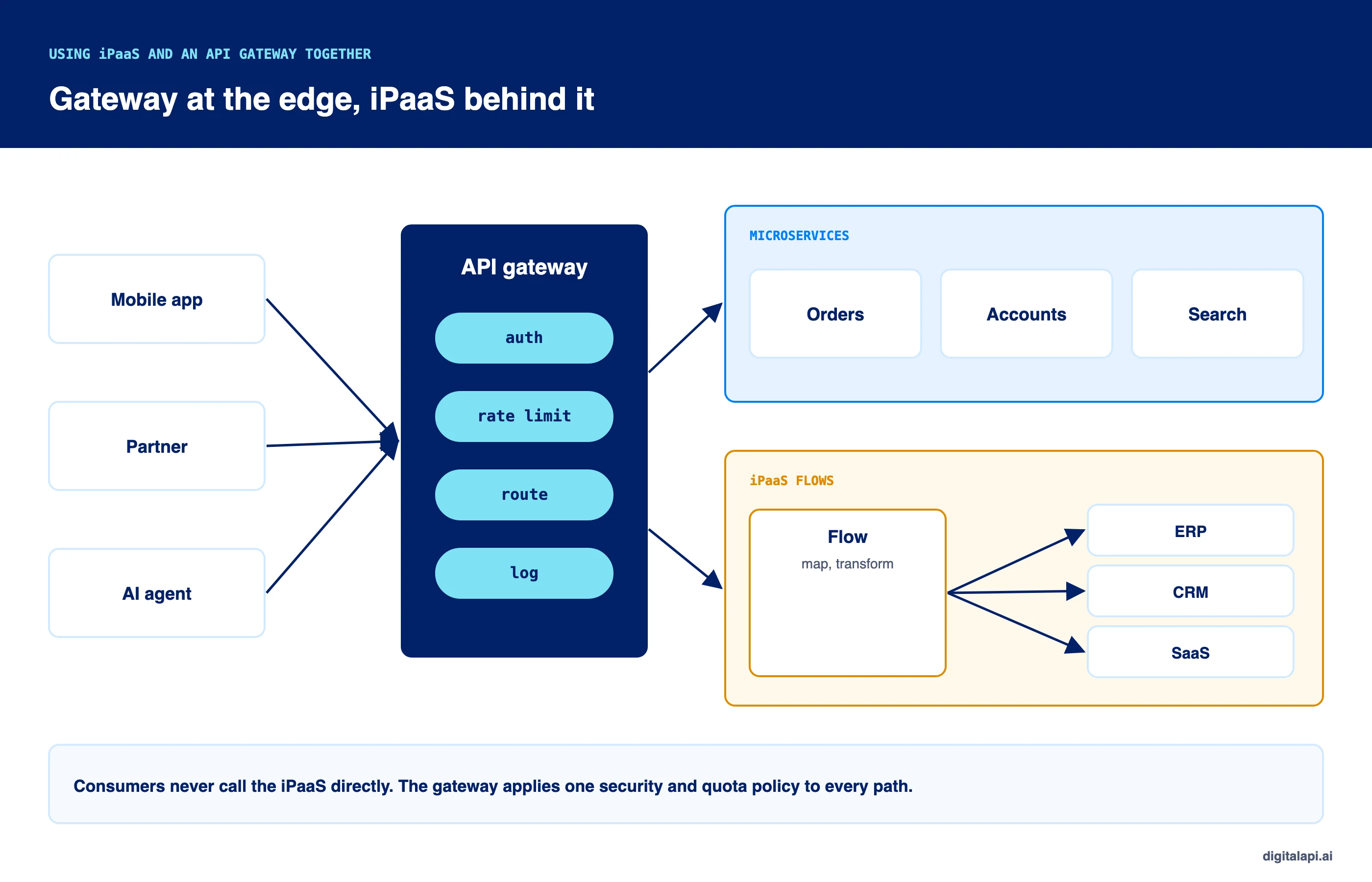
A common pattern looks like this:
- A partner calls
POST /orderson your API gateway with an OAuth token. - The gateway validates the token, checks the partner's quota and logs the call.
- The gateway routes the request to an iPaaS flow endpoint.
- The iPaaS flow maps the order and writes it to the ERP, CRM and warehouse system.
- The gateway returns the response and records latency and status.
This split keeps each tool in its lane. Security teams govern one entry point. Integration teams change flows without reopening access rules.
It gets harder with several gateways. Each one brings its own portal, keys and usage reports. DigitalAPI Gateway Connectors import the APIs, products and plans from each gateway into one governed catalogue. Traffic and keys stay on the gateway, so nothing is migrated.
This approach is right for you if:
- External partners, apps or AI agents call APIs that trigger integration flows.
- You need per-consumer quotas and audit that your iPaaS endpoints don't provide.
- Security and integration teams want to change their layers on separate schedules.
It is not right for you if:
- All your integrations are internal, scheduled syncs with no outside callers.
- You expose one or two low-traffic endpoints, where the iPaaS's built-in API features are enough.
How does iPaaS relate to API management?
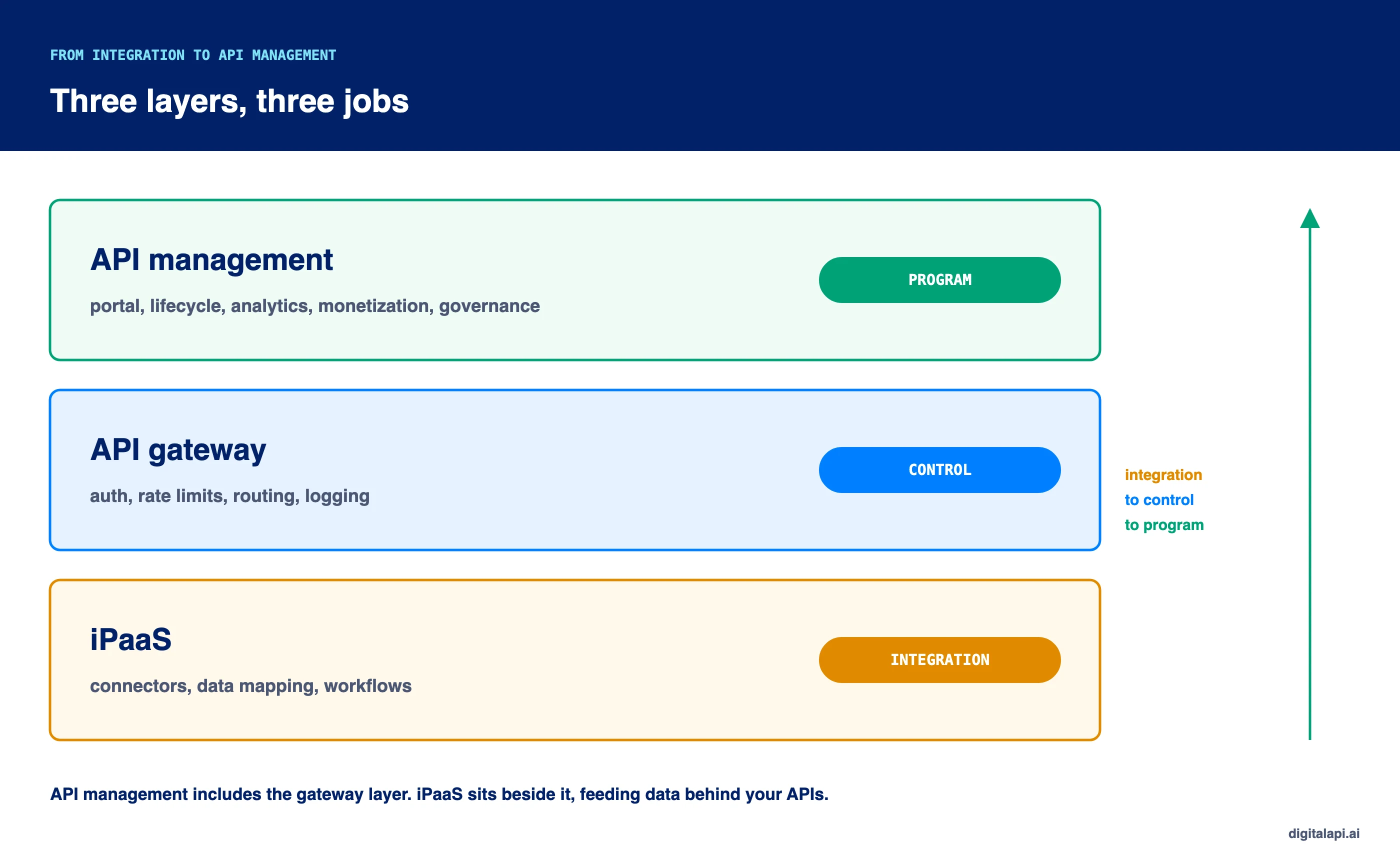
API management is broader than a gateway. It adds a developer portal, API lifecycle, analytics and monetization on top of runtime control. So the iPaaS vs API management question compares integration with the full API program, not only traffic policy.
The gateway is the runtime part of API management. Our post on API gateway vs API management explains that split. For the wider comparison, see how iPaaS compares with full API management.
Legacy systems show how the layers meet. The DigitalAPI API Gateway can front a SOAP service as REST with no backend changes. That removes one common reason to build an iPaaS flow only to modernize an interface. For the full program view, read the API management guide.
See how DigitalAPI brings every gateway's APIs, plans and usage into one governed catalogue → Book a Demo
Key takeaways
- iPaaS vs API gateway is integration vs traffic control. iPaaS moves and transforms data. A gateway decides who calls your APIs and how often.
- They work at different speeds. iPaaS flows tolerate seconds. Gateway policies run in milliseconds on every call.
- Overlap is real but shallow. An iPaaS can expose an endpoint, but it lacks full gateway policy.
- The ESB split into two. iPaaS took routing and transformation. The API gateway took exposure and access control.
- Most enterprises run both. Put the gateway at the edge and the iPaaS behind it.
- API management sits above both, adding portal, lifecycle, analytics and monetization.
Frequently asked questions
1. Is an API gateway the same as iPaaS?
No. An API gateway is a runtime proxy that authenticates callers, applies rate limits and routes requests to APIs. An iPaaS is a cloud platform that connects applications with connectors, data mapping and workflows. The gateway controls access to APIs. The iPaaS moves data between systems. Many enterprises use both, with the gateway in front of iPaaS flows.
2. Can iPaaS replace an API gateway?
Only for simple cases. Many iPaaS tools can publish a flow as an HTTP endpoint with basic authentication. They usually lack per-consumer quotas, threat protection, developer onboarding and call-level analytics. For APIs used by partners, customers or AI agents, a dedicated API gateway is the safer choice. Keep the iPaaS for integration logic behind it.
3. What is the difference between API and ESB?
An API is a contract that lets one system request data or actions from another. An enterprise service bus (ESB) is middleware that routes, transforms and orchestrates messages between many systems. The API defines the interface. The ESB carries and reshapes the messages. Today, iPaaS has largely replaced the ESB, and API gateways handle exposure.
4. Which API gateway is best for microservices?
The best gateway for microservices depends on where your services run and who calls them. Look for Kubernetes-native deployment, low latency, service discovery, mTLS and OpenTelemetry support. Check that it fits your identity provider and CI/CD pipeline. If partners consume your APIs, also weigh developer portal and plan management features.
5. Is iPaaS part of API management?
No, they are separate categories that work together. API management covers the API lifecycle: gateway, developer portal, analytics, security and monetization. iPaaS covers integration: connectors, data mapping and workflows. Some vendors bundle both in one suite. Even then, the integration and API management capabilities are usually licensed and operated as distinct products.
6. Do AI agents need an iPaaS or an API gateway?
AI agents usually need an API gateway first. Agents call APIs at machine speed, so they need their own credentials, rate limits and audit trails. An iPaaS can still run the workflows those calls trigger behind the gateway. Teams that expose tools to agents over the Model Context Protocol often add an MCP gateway as well.
Conclusion
The iPaaS vs API gateway choice is rarely either-or. An iPaaS connects your applications and moves data between them. An API gateway controls who reaches your APIs, how often and with what identity.
Start by sorting your work. Internal syncs and multi-step processes belong in the iPaaS. Anything partners, customers or agents call belongs behind the gateway. When both apply, put the gateway at the edge and route to the iPaaS flow.
Then look one layer up. API management ties gateways, portals and analytics into one program. That keeps your integrations and APIs governed as they grow.
Bring every gateway's APIs, plans and usage into one governed catalogue with DigitalAPI, with no migration project. Manage gateways and integrations in one place
Prefer a walkthrough? Book a Demo
Read next: iPaaS vs API management · API gateway vs API management · The API gateway guide
Dhayalan Subramanian is Associate Director, Product Growth at DigitalAPI, where he leads go-to-market and product growth for the company’s multi-gateway API management platform. His work focuses on helping large enterprises and mid-market cloud companies consolidate APIs across AWS, Azure, Apigee, Kong, MuleSoft, and other gateways into a single control plane for governance, discovery, monetization, and agent consumption.
Dhayalan brings 14+ years of experience across product strategy, enterprise architecture, and engineering leadership. Earlier in his career, he held senior roles at Encora (as Associate Architect and Technical Manager), Mindtree (Technology Lead), Tech Mahindra (Technical Lead), and Primus Analytics, where he designed integration frameworks and delivered enterprise-grade digital platforms for global customers.
At DigitalAPI, he works directly with platform, integration, and developer experience leaders at Fortune 500 organizations to operationalize unified API catalogs, developer portals, and MCP-ready APIs. He writes regularly on API developer experience, API governance, and AI agent architectures.
One email a fortnight. Worth opening.
A short digest of what we're writing, what we're learning from customers, and the handful of links you'd actually want from us. No tracking pixels.