

Developer Onboarding Tools for API Programs: What to Look For in 2026
A developer onboarding platform takes external developers from sign-up to a first API call without emails or tickets. Here are the eight things to look for.

TL;DR
A developer onboarding platform is software that takes an external developer from sign-up to a first successful API call without a person in the loop. It handles self-service sign-up, access approval, API key management, sandbox testing and docs in one place.
When you compare developer onboarding tools, check eight things: self-service accounts, approval rules, team access control, the full key lifecycle, sandboxes, interactive docs, onboarding analytics and support for every gateway you run.
Open your inbox and count the emails it took to issue the last API key to a partner. Then count the days between that partner signing the contract and their first successful API call.
Most teams have never counted the second number. This is why you need proper developer onboarding. In this guide, we will take a look at what a developer onboarding platform is and why it is so important for API-first businesses.
What is a developer onboarding platform for APIs?
A developer onboarding platform is defined as the system that moves an external developer from "I found your API" to "my first call worked" on their own. It combines account sign-up, access requests and approvals, API key issuing, a sandbox and the docs, so no one on your team has to step in for a routine request.
Search for "developer onboarding tools" and most results are about something else: getting new engineering hires productive in their first weeks. That's internal onboarding, and tools like internal developer portals handle it.
This guide covers the other kind. It's for teams that publish APIs to partners, customers or other business units and want those developers live faster, with fewer tickets.
The people who own this problem are usually:
- Platform leads: They run the gateways and get pulled in to issue keys by hand.
- API product managers: They own adoption and see partners stall before the first call.
- Partner and support teams: They answer the "how do I get access?" emails.
Where does API developer onboarding stall without one?
Without a developer onboarding platform, API developer onboarding stalls wherever a person has to reply. That's usually at approval, key issuing and sandbox access. The API is ready, but the path to it runs through an inbox.
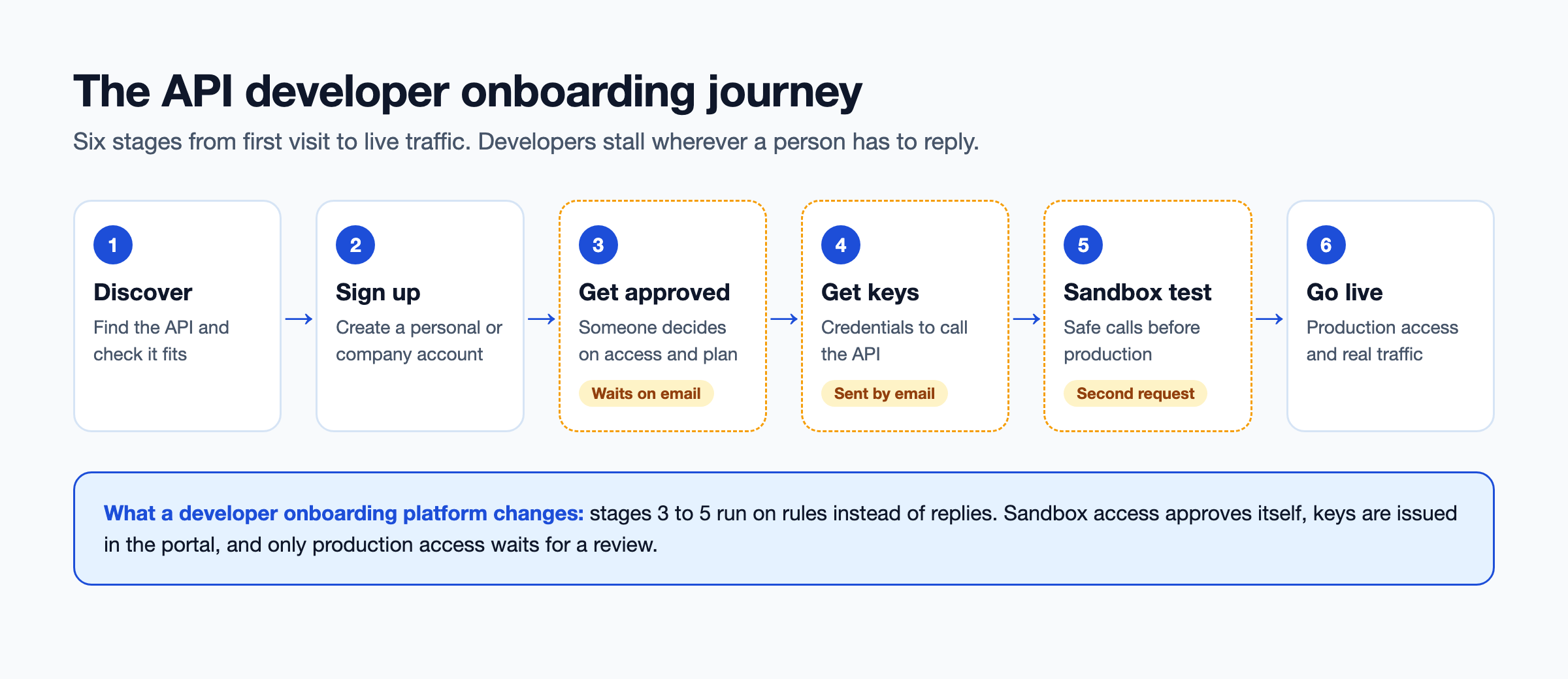
Every external developer goes through the same six stages:
- Discover: They find the API and decide whether it does what they need.
- Sign up: They create an account for themselves or their company.
- Get approved: Someone decides whether they can use this API and on which plan.
- Get keys: They receive credentials to call the API.
- Test in a sandbox: They try calls against safe data before touching production.
- Go live: They move to production access and start real traffic.
Here's what each stage looks like when it runs on manual work:
The pattern behind these stalls shows up in industry research. Postman's 2025 State of the API report found that 93% of teams struggle with API collaboration. The most common blockers were inconsistent documentation (54%), discovering existing APIs (31%) and managing access (26%). The same report found 29% of respondents still use email to share API changes.
These stalls map to three problems most API programs carry:
- Support overhead: Every access request becomes a ticket or an email thread. Your engineers spend time issuing keys instead of building.
- No self-service: Developers can read the docs but can't act on them. They need a person to move from one stage to the next.
- Access and key sprawl: Keys get created by hand, shared by email and rarely rotated. Nobody has a full list of who holds which key.
Partners shouldn't need an email thread to get an API key.
See how DigitalAPI gives them self-service access across your gateways.
How do you measure developer onboarding experience?
Measure developer onboarding experience by how long it takes and how much help it needs. Time to first call is the main number. Support tickets per partner and the share of keys issued without a person tell you why it's slow.
You can pull most of these numbers from tools you already have:
Pick two of these and track them monthly. Time to first call and tickets per partner are the easiest to start with, and they're the two numbers leadership understands fastest.
What should you look for in developer onboarding tools?
Look for developer onboarding tools that remove a person from every routine step without removing control. That means self-service where risk is low, approvals where it isn't, and a full record of who has access to what. These eight criteria cover it.
1. Self-service sign-up with company accounts
Developers should be able to sign up, verify their email and land in the portal without waiting. For B2B APIs, they should sign up as part of a company account, not as a lone user, so access belongs to the partner and not to one person.
Ask the vendor: "Can a developer create an account and see the API catalog without anyone on our team doing anything?"
2. Approval rules you can set per plan
Not every request needs a human. A sandbox plan can approve itself. A production plan or a regulated API might need a product owner to sign off. Good tools let you set this per API or per plan, and route approvals to the right owner with one click.
Ask the vendor: "Can sandbox access approve itself while production access needs a manual review?"
3. Team and account access control
Partners rarely onboard with one developer. They add colleagues, those colleagues leave, and contracts end. One pattern we see often is a partner team that needs account-level access control and API key management to come as part of onboarding, not as a separate project later. The partner's admin should be able to invite and remove their own people, with roles, while you keep the final say.
Ask the vendor: "Can a partner admin manage their own team's access, and can we see and override it?"
4. The full API key lifecycle
Issuing a key is the easy part. You also need to scope it to the right APIs and plans, rotate it on a schedule, revoke it right away when a contract ends and expire keys nobody uses. This matters because leaked credentials are common. GitGuardian's State of Secrets Sprawl 2025 found 23.77 million new hardcoded secrets added to public GitHub repositories in 2024, up 25% on the year before. Our guide to API key management covers the lifecycle in more depth.
Ask the vendor: "Can partners rotate their own keys, and can we revoke a whole subscription in one step?"
5. Sandboxes and mock environments
Developers need somewhere safe to test before production. Look for per-environment sandboxes, built-in token generation for OAuth and a mock server for APIs that aren't live yet. See how API sandboxing works in practice.
Ask the vendor: "Can a developer make a test call within minutes of sign-up, without asking anyone?"
6. Interactive docs that stay current
Docs should let developers try a call from the page with their own key, not copy examples into another tool. They should also update when the API does. If your team keeps specs in Git, look for tools that sync from the repository. Our guide to docs as code for APIs explains that workflow.
Ask the vendor: "When we merge a spec change, how does the published reference update?"
7. Onboarding analytics
You can't fix drop-off you can't see. The tool should show where developers stop: signed up but never requested access, approved but never called, called the sandbox but never went live. Usage per developer, API and endpoint tells you who's active.
Ask the vendor: "Can we see how many sign-ups made a first call, and how long it took?"
8. Support for every gateway, with SSO and an audit trail
Large API programs rarely run on one gateway. If your APIs sit on Apigee, Kong, AWS and Azure, onboarding should work the same way across all of them, from one catalog. Enterprise buyers also need single sign-on, role-based access control and an audit log of every approval and key change.
Ask the vendor: "Which gateways do you create keys in directly, and what does the audit log record?"
Which types of developer onboarding tools are there?
Developer onboarding tools fall into four types: docs tools, gateway portals, internal developer portals and API management platforms with a developer portal. Only the last type covers all eight criteria above for external developers. The others cover parts of the journey.
A few notes on each type:
- Docs tools: These publish great reference pages but stop at reading. Developers still email for access. Our guide to Docusaurus alternatives compares the options.
- Gateway portals: These handle keys well for one gateway. Programs with more than one gateway end up running more than one portal.
- Internal developer portals: These are what most "developer onboarding tools" searches return. They're built for your own engineers, not for partners outside the company.
- API management platforms with a portal: These sit across your gateways and cover the full journey for external developers. They cost more than a docs tool, so they make sense once partner onboarding is a real workload.
Should you build or buy a developer onboarding platform?
Buy unless developer onboarding is part of the product you sell. Building the portal pages is the easy part. The cost sits in what comes after: approval routing, key rotation, partner team management, audit logs and keeping it working with every gateway upgrade.
Teams that build usually start with a docs site and a sign-up form. Then they add a key-issuing script, then an approval step, then team management. Each piece is small. Together they become a product your platform team now maintains, without a roadmap or a product manager.
Building makes sense in a few cases:
- You run one gateway and few partners: Its built-in portal plus good docs may be enough.
- Onboarding is your differentiator: If the developer experience is what you sell, owning it end to end can be worth the cost.
- You have hard data residency rules no vendor meets: Check deployment options first, as many vendors offer private or customer-cloud hosting.
For a fuller comparison, see our guide on whether to build or buy an API developer portal.
How do you roll out a developer onboarding platform in 30 days?
Roll out a developer onboarding platform one API at a time, starting with the one that creates the most access requests. Measure before you switch so you can show the change. Thirty days is enough for the first API.
- Week 1, measure today's baseline: Count time to first call and access tickets for your last five partners. These are your before numbers.
- Week 1, pick the first API: Choose the API with the most access requests, not the most important one. It shows results fastest.
- Week 2, set approval rules: Decide which plans approve themselves and who signs off on the rest. Write it down before you configure it.
- Week 3, move existing keys: Bring current partners' keys into the platform so you have one list. Set rotation dates for keys older than your policy allows.
- Week 4, open it up and measure again: Point new partners to the portal and compare time to first call and tickets against your baseline.
Once the first API works, add the next one. Most teams find the second and third go much faster because the approval rules and account setup already exist.
Is a developer onboarding platform right for you?
This is right for you if:
- Partners or customers email your team to get API access or keys
- You run more than one API gateway, or plan to
- You can't list every active key and who holds it
- Partner onboarding takes weeks, and the API isn't the reason
This is not right for you if:
- Your APIs are internal only, and your engineers are the only consumers. An internal developer portal fits better.
- You have one public API with open sign-up and no approvals. A docs tool plus your gateway's portal may be enough.
How does DigitalAPI speed up developer onboarding?
An API management platform with a developer portal turns the six onboarding stages into one self-service flow, across every gateway you run. Developers sign up, request access, get keys and test in a sandbox without waiting on your team, while you keep approvals and a full audit trail.
DigitalAPI is an API management platform built for this. Teams using it replace email-based access with self-service onboarding:
- One-click approvals: Requests go to the API owner, who approves or rejects in one click. Sandbox plans can approve themselves, and production plans can require review.
- Keys delivered to the portal: Once approved, credentials go straight to the partner's portal account, created in your gateway automatically.
- Partner-run key rotation: Partners rotate their own keys on a schedule, and admins revoke an app or a whole subscription right away when a contract ends.
- Sandboxes from day one: Per-environment sandboxes, built-in OAuth token generation and a mock server let developers test before production.
- One catalog across gateways: APIs from Apigee, Kong, AWS, Azure, MuleSoft and others appear in one portal, with SSO, role-based access and audit logs as standard.
See how DigitalAPI cuts time to first call on the API developer portal page, or read what a full API developer portal should include.
FAQ
What's the difference between a developer portal and a developer onboarding platform?
A developer portal is the website where developers find APIs and docs. A developer onboarding platform is the system behind it that handles sign-up, approvals, API keys and sandbox access. Many modern developer portals include onboarding, but a docs-only portal does not.
How long should API developer onboarding take?
For a sandbox, a developer should make a first call within minutes of signing up, with no human approval. Production access depends on your review rules but should take days, not weeks. If onboarding takes weeks and the API is ready, the delay is usually manual approval and key issuing.
What is time to first call?
Time to first call is the time between a developer signing up for an API and making their first successful request. It's the most common measure of developer onboarding experience. A shorter time to first call usually means higher adoption and fewer support tickets.
Do public APIs need approval workflows?
Not always. Public APIs with free tiers often let developers get a sandbox key with no approval. Approval workflows matter when access has a cost, a contract or a compliance requirement, such as paid plans, partner APIs or financial data.
How often should API keys be rotated?
Rotate API keys on a fixed schedule set by your security policy, often every 90 days, and right away if a key may have leaked. The simplest way to keep to a schedule is to let partners rotate their own keys from the portal, with alerts before a key expires.
Can a developer onboarding platform work with multiple API gateways?
Yes, if it's built for that. Some platforms create keys and subscriptions directly in each gateway, such as Apigee, Kong, AWS and Azure, from one portal. Gateway-specific portals only work with their own gateway.
Is a developer onboarding platform the same as an internal developer portal?
No. An internal developer portal, such as Backstage, helps your own engineers find services and get set up. A developer onboarding platform for APIs helps external developers, such as partners and customers, get access to your APIs. Some platforms cover both from one catalog.
Final word
Developer onboarding tools aren't judged by how good the docs look. They're judged by how many steps a developer can finish without emailing you.
Go back to the two numbers from the start: emails per key and days to first call. If either one surprised you, that's the gap a developer onboarding platform closes.
Partners shouldn't need an email thread to get an API key.
See how DigitalAPI gives them self-service access across your gateways.
Dhayalan Subramanian is Associate Director, Product Growth at DigitalAPI, where he leads go-to-market and product growth for the company’s multi-gateway API management platform. His work focuses on helping large enterprises and mid-market cloud companies consolidate APIs across AWS, Azure, Apigee, Kong, MuleSoft, and other gateways into a single control plane for governance, discovery, monetization, and agent consumption.
Dhayalan brings 14+ years of experience across product strategy, enterprise architecture, and engineering leadership. Earlier in his career, he held senior roles at Encora (as Associate Architect and Technical Manager), Mindtree (Technology Lead), Tech Mahindra (Technical Lead), and Primus Analytics, where he designed integration frameworks and delivered enterprise-grade digital platforms for global customers.
At DigitalAPI, he works directly with platform, integration, and developer experience leaders at Fortune 500 organizations to operationalize unified API catalogs, developer portals, and MCP-ready APIs. He writes regularly on API developer experience, API governance, and AI agent architectures.
One email a fortnight. Worth opening.
A short digest of what we're writing, what we're learning from customers, and the handful of links you'd actually want from us. No tracking pixels.