





What are external APIs? Types, examples, and best practices
Learn what external APIs are, their types, real examples, and best practices to use them effectively in your apps and integrations.


TL;DR
External APIs allow organizations to expose services, data, and functionality to third-party developers, partners, and customers under defined access, security, and governance policies. Without a structured management framework, external APIs create security gaps, inconsistent developer experiences, and missed monetization opportunities.
With DigitalAPI’s unified control plane, organizations can publish, govern, and monetize external APIs across multiple gateways through a branded developer portal with built-in documentation, sandbox testing, and usage analytics.
Expose your APIs securely to external developers. Book a demo
Every enterprise that exposes services to third-party developers, partners, or customers relies on external APIs. These interfaces define how external systems interact with your platform, what data they can access, and under what conditions. Managing external APIs without a governance framework leads to security gaps, inconsistent experiences, and missed monetization opportunities. This guide covers the types, real-world applications, and operational best practices for running an external API program at scale.
What are external APIs?
External APIs are application programming interfaces published for consumption by developers, partners, or customers outside your organization. They provide controlled access to your services, data, or functionality through documented endpoints with defined authentication, rate limits, and usage policies.
External APIs vs internal APIs: key differences
Internal APIs connect services within your organization. External APIs cross organizational boundaries and introduce additional requirements around security, documentation, versioning, and commercial terms. The distinction affects every operational decision, from access control to support models.
Organizations that manage internal and external APIs through separate systems create governance fragmentation. A unified control plane provides consistent policies across both audiences while respecting the distinct requirements of each.
Types of external APIs: open, partner, and composite
External APIs fall into several categories based on access model, audience, and technical architecture. Each type serves a specific business purpose and requires tailored governance controls.
1. Open APIs (public APIs)
Open APIs are available to any developer who registers for access. They have the lowest barrier to entry and are designed to maximize adoption and ecosystem reach. Payment processors, mapping services, and social media platforms publish open APIs to enable third-party integrations at scale.
Key characteristics of open APIs include self-serve registration through a developer portal, standardized authentication using API keys, published rate limits and usage tiers, and public documentation with interactive testing capabilities.
2. Partner APIs
Partner APIs are shared with specific business partners under contractual agreements. Access is restricted to approved organizations, and usage terms are negotiated rather than self-serve. Financial institutions, healthcare providers, and supply chain platforms use partner APIs to enable secure data exchange with trusted counterparts.
Partner APIs require approval workflows for access requests, dedicated API key management per partner organization, custom rate limits and SLA commitments, and enhanced monitoring for compliance and audit purposes.
3. Composite APIs
Composite APIs bundle multiple backend services into a single endpoint, reducing the number of calls a developer must make to complete a workflow. An e-commerce composite API might combine inventory lookup, pricing, and availability into one request. This pattern simplifies the developer experience while abstracting internal microservice complexity.
Composite APIs benefit from API orchestration layers that manage request routing, data aggregation, and error handling across backend services.
Real-world external API examples by industry
External APIs power integrations across every industry. The following examples illustrate how different organizations expose services to external consumers.
1. External APIs in financial services
Banks and fintech companies expose open banking APIs for account aggregation, payment initiation, and balance inquiries. Regulatory frameworks like PSD2 mandate external API access for licensed third parties. Partner APIs enable secure data sharing between banks and fintech partners under contractual and compliance controls.
2. External APIs in healthcare
Healthcare organizations publish FHIR-compliant APIs for patient data exchange, appointment scheduling, and claims processing. External APIs in healthcare must comply with strict data privacy regulations and require granular access controls based on provider credentials and patient consent.
3. External APIs in e-commerce and logistics
Retail platforms expose product catalog, order management, and shipping APIs to enable marketplace integrations, affiliate programs, and supply chain coordination. These APIs drive partner ecosystem growth and enable third-party developers to build extensions on top of the core platform.
Best practices for external API management and governance
External APIs require governance rigor beyond what internal APIs demand. Third-party consumers have no visibility into your internal systems, so every aspect of the API experience must be explicit, documented, and enforced at the gateway level.
1. Secure every external API endpoint
Security is the top priority for any API exposed outside your network. External endpoints face constant scanning, credential stuffing, and abuse attempts. Layer your defenses to protect both the API and the data it exposes.
- Enforce OAuth 2.0 for user-level authorization and API keys for application-level authentication
- Apply rate limiting at the gateway to prevent abuse and protect backend services
- Use HTTPS for all external traffic without exception
- Implement API security best practices, including input validation, schema enforcement, and OWASP compliance
- Monitor for anomalies using behavioral analysis and automated alerting
2. Publish structured external API documentation
External developers rely entirely on your documentation to understand and integrate with your APIs. Poorly documented APIs generate support tickets, slow adoption, and drive developers to alternative platforms.
- Provide getting started guides that walk developers from registration to the first API call
- Auto-generate endpoint reference pages from OpenAPI specifications
- Include request and response examples for every endpoint
- Document error codes with resolution steps
- Maintain a changelog that tracks version updates and deprecations
3. Implement external API versioning policies
Breaking changes to external APIs disrupt partner integrations and erode trust. Version management must be a first-class concern for any external API program.
- Use URL-based or header-based API versioning strategies
- Maintain backward compatibility within major versions
- Communicate deprecation timelines well in advance of retirement
- Support parallel versions during migration periods
- Test new versions in sandbox environments before production release
4. Track external API usage with analytics
Visibility into how external developers use your APIs drives product decisions, monetization strategy, and support prioritization. API analytics should capture granular usage data at the consumer, endpoint, and subscription tier levels.
- Monitor call volumes, latency, and error rates per consumer
- Track adoption trends to identify high-value partners
- Detect integration issues before they escalate to support tickets
- Use usage data to inform pricing and packaging decisions
How does DigitalAPI help manage external APIs?
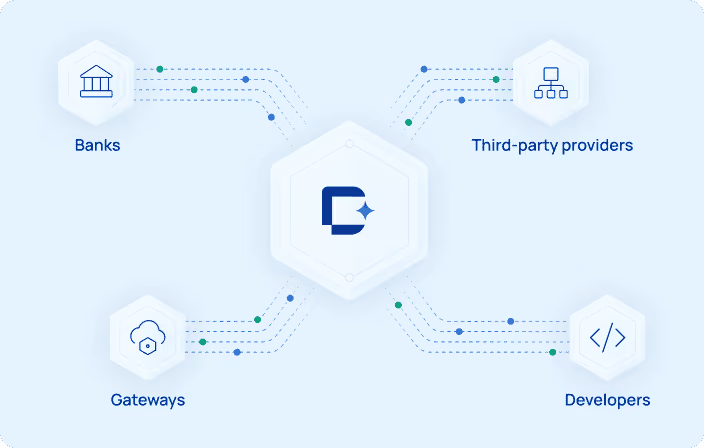
External API programs require coordinated capabilities across discovery, governance, documentation, security, and monetization. DigitalAPI provides a unified API management platform that consolidates these functions without requiring gateway migration.
- Publish external APIs through a branded API marketplace with self-serve registration
- Enforce consistent API governance policies across all gateways and environments
- Auto-generate and maintain API documentation synced to live specs
- Manage API keys, subscriptions, and billing through a unified control plane
- Monitor external API usage with real-time analytics and anomaly detection
DigitalAPI operates as a gateway-agnostic layer that works across all your existing gateways, providing a single pane of glass for your entire external API estate.
.png)
Frequently Asked Questions
1. What is the difference between external and internal APIs?
Internal APIs connect services within an organization and rely on network-level trust. External APIs are published for third-party consumption and require formal authentication, published documentation, versioning commitments, and contractual SLAs. External APIs introduce stricter governance, security, and support requirements due to the cross-organizational nature of consumption.
2. Are external APIs the same as public APIs?
Not all external APIs are public. Public APIs allow self-serve registration by any developer. Partner APIs restrict access to approved organizations under contractual terms. Both are external because they serve consumers outside the organization, but they differ in access model, governance requirements, and commercial terms.
3. How do you secure external APIs?
External API security requires layered controls, including token-based authentication, API key validation, rate limiting, HTTPS enforcement, input validation, and behavioral monitoring. Gateway-level enforcement ensures that security policies apply uniformly before requests reach backend services, preventing unauthorized access and abuse.
4. Can external APIs be monetized?
External APIs are frequently monetized through usage-based billing, tiered subscription plans, freemium models, and revenue-share agreements. Effective monetization requires automated billing, subscription management, and quota enforcement. Platforms that support self-serve subscriptions and real-time usage tracking accelerate revenue realization.
5. How does DigitalAPI support external API management?
DigitalAPI provides a gateway-agnostic control plane for publishing, governing, and monetizing external APIs. It includes a branded developer portal, automated documentation, API key management, sandbox environments, and unified analytics. Organizations manage their external API program from a single platform without replacing existing gateway infrastructure.
Rajanish GJ is Chief Technology Officer at DigitalAPI, the multi-gateway API management platform that helps large enterprises consolidate API discovery, governance, monetization, and AI agent enablement across heterogeneous gateway environments, including Apigee, AWS API Gateway, Azure API Management, Kong, and MuleSoft.
Rajanish brings 20+ years of engineering leadership to the role. He spent formative years at Apigee, the API management platform now part of Google Cloud and widely regarded as the category’s foundational product, and at Google itself, where he worked on developer-facing infrastructure at scale. That operator background informs DigitalAPI’s architectural bets around gateway abstraction, MCP-ready APIs, and agent-native developer experience.
He writes regularly on API architecture, developer infrastructure, and AI-native API management, with particular focus on how engineering teams can future-proof their API platforms for the agent era.

One email a fortnight. Worth opening.
A short digest of what we're writing, what we're learning from customers, and the handful of links you'd actually want from us. No tracking pixels.

.avif)