




How To Share APIs Securely With Fintech Partners
Secure API sharing refers to the controlled exposure of application interfaces to external partners through structured authentication, authorization, encryption, monitoring, and governance controls.


TLDR
1. Treat API sharing as a controlled product distribution exercise, not a one-time technical task.
2. Enforce strong authentication, scoped authorization, and encrypted communication.
3. Use sandbox environments before production access.
4. Monitor usage patterns continuously and respond in real time.
5. Formalize governance with clear contracts, SLAs, and audit trails.
Secure Fintech APIs With DigitalAPI
Fintech ecosystems rely on interconnected platforms that exchange financial and identity data through APIs. Weak controls expose organizations to regulatory scrutiny, reputational damage, and partner friction. API security is a governance decision that shapes risk posture, trust, and scalability. The sections below outline the essential controls and oversight mechanisms required to share APIs with fintech partners responsibly.
What Is Secure API Sharing In Fintech
Secure API sharing refers to the controlled exposure of application interfaces to external partners through structured authentication, authorization, encryption, monitoring, and governance controls. Organizations leveraging a unified platform, such as an API management platform, can centralize policy enforcement and visibility across integrations. It ensures that sensitive financial and identity data is accessed only within approved scopes, logged for audit purposes, and protected by enforceable policies that align with enterprise risk and compliance expectations.
Common Security Risks When Sharing APIs With Fintech Partners
Financial APIs expose account data, transaction records, KYC documents, and identity attributes that are subject to regulatory scrutiny and contractual obligations. Weak controls can trigger compliance breaches, partner disputes, and erosion of customer trust. Executive teams must understand this expanded risk surface and ensure adequate safeguards exist before approving any external API access.
Unauthorized Access
Weak authentication mechanisms or poorly scoped tokens can permit unintended access to sensitive endpoints. Implementing a dedicated API authentication reduces impersonation risk and strengthens credential governance. Shared credentials, static API keys, and excessive privileges significantly expand the attack surface. Organizations should enforce short- lived tokens, granular scopes, and clear credential ownership policies to reduce unauthorized access and limit potential damage from compromised credentials.
Data Leakage
Improper response filtering can expose more data than a partner requires to complete its approved use case. Structured controls through API design best practices help limit exposed attributes to only approved fields. Excessive fields in API payloads increase the likelihood of privacy violations and regulatory findings. Field- level filtering and strict schema governance ensure that only necessary attributes are transmitted across integration boundaries.
Abuse And Fraud
Unmonitored APIs may be misused for credential stuffing, account enumeration, or synthetic identity testing that probes system weaknesses. Integrating API security best practices enables early identification of abnormal behavioral patterns. Without traffic baselines and anomaly detection, such activity can persist undetected. Continuous monitoring and rate controls are necessary to identify suspicious behavior early and contain abuse before it impacts customers or partners.
Compliance Violations
Fintech organizations must align API exposure with data protection laws and sector- specific financial regulations. Enterprise teams frequently rely on banking API governance to validate counterparties before enabling data exchange. Inadequate audit trails or missing access logs complicate compliance reporting and weaken defensibility during regulatory reviews. Comprehensive logging and retention policies strengthen accountability and demonstrate control over partner access.
Core Principles Of Fintech API Security
Security must be systematic rather than reactive. The following principles provide a disciplined foundation for secure fintech API collaboration while keeping controls measurable and enforceable.
Step-by-StepStep By Step Framework To Share APIs Securely
A structured rollout reduces ambiguity and speeds onboarding while preserving governance. Clear scope definitions, approval checkpoints, and credential controls prevent misalignment between business and security teams.
Step 1: Define the business scope
Document the business objective, required data elements, regulatory constraints, and measurable success criteria before exposing any endpoints. Translate these requirements into clearly scoped APIs, field- level restrictions, and approval workflows that reflect both operational needs and compliance obligations.
Step 2: Conduct security due diligence
Assess the partner’s security posture through structured questionnaires, relevant certifications, and recent penetration testing reports. Validate incident response readiness, data handling practices, and access governance models before granting any form of test or production access.
Step 3: Design the access architecture
Design an access model that defines authentication flows, granular scopes, token lifetimes, rotation policies, and revocation procedures. Incorporate network-levelnetwork level protections such as IP restrictions or private connectivity where risk assessments justify additional controls.
Step 4: Provision sandbox access and test data
Provide sandbox credentials and realistic test datasets that mirror production schemas without exposing live personally identifiable information. Document expected responses, validation steps, and error handling behavior to ensure integration accuracy prior to production launch.
Step 5: Execute penetration testing and security validation
Conduct targeted internal and third-partythird party security assessments focused on the exposed integration surface before production launch. Remediate identified findings promptly and verify control effectiveness prior to go-livego live approval.
Step 6: Enable production access with guardrails
Issue time-boundtime bound production credentials supported by granular rate limits, mandatory logging, and documented approval workflows. Maintain clear justification for granted scopes and record all changes to preserve audit integrity.
Step 7: Monitor usage and review periodically
Schedule recurring access reviews to revalidate granted scopes, confirm continued business necessity, and revoke dormant credentials. Maintain comprehensive audit trails for all access modifications to support compliance and governance reviews.
Fintech API Security Controls Checklist
Enterprise API security must be operationalized through clearly documented controls that can be audited, measured, and improved over time. A unified API governance strategies strengthens policy enforcement and oversight. A structured checklist ensures that technical safeguards align with governance expectations and executive risk oversight.
This structured checklist ensures that security measures align with enterprise risk management frameworks.
Role Of API Gateways In Secure API Sharing
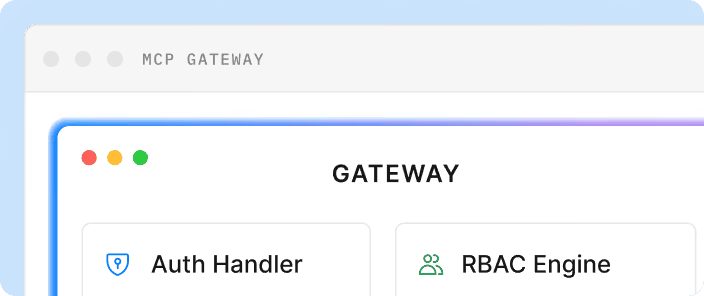
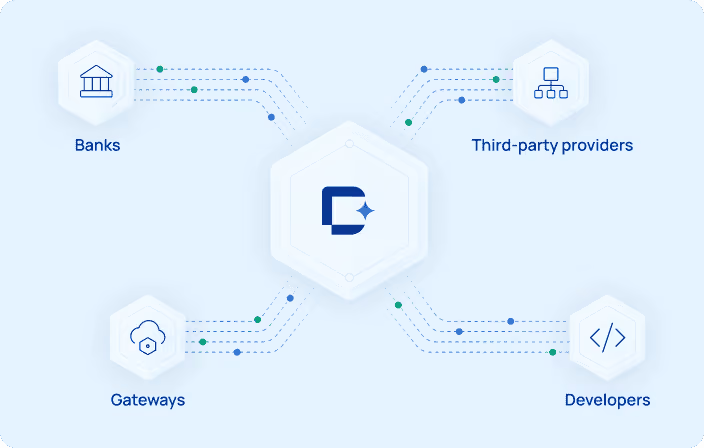
API gateways serve as centralized enforcement layers between internal systems and external partners, consolidating authentication, authorization, validation, rate controls, and logging into a single policy execution point. Integrating them with a comprehensive API observability tool enhances visibility across traffic flows. Centralization reduces configuration drift, improves observability, and enables consistent security enforcement across all exposed fintech APIs without duplicating controls within individual services.
Key capabilities include:
- Token validation and transformation
- Rate limiting and throttling
- Request and response validation
- Centralized logging
- Threat detection and blocking
A well- configured gateway strengthens governance consistency and simplifies oversight across expanding partner ecosystems.
Sandbox Environments And Synthetic Data In Fintech API Testing
Controlled sandbox environments allow partners to validate integrations without exposing live financial or identity data. Synthetic datasets should mirror production structures while excluding sensitive attributes, enabling accurate functional testing without regulatory or privacy exposure. Structured sandbox governance accelerates onboarding and reduces the likelihood of misconfigurations reaching production systems.
Incident Response And Monitoring Strategy In Fintech APIs
Continuous visibility into API traffic, authentication behavior, and endpoint usage is critical in regulated fintech environments where delayed detection can amplify financial and reputational impact. Organizations should implement automated alerts for unusual traffic spikes, repeated authentication failures, abnormal endpoint consumption, and unexpected geographic access patterns.
Monitoring frameworks must integrate with clearly documented escalation workflows that define responsibilities across security, legal, compliance, and executive leadership. Predefined response playbooks, centralized logging, and structured communication protocols reduce confusion during incidents and enable rapid containment, investigation, and coordinated recovery efforts without disrupting ongoing partner integrations.
Regulatory And Compliance Considerations In Fintech APIs
Regulatory alignment underpins sustainable fintech partnerships and directly shapes API governance expectations. Leveraging compliant open banking security supports regulatory defensibility and audit readiness. Strategies must reflect data protection mandates, anti-moneyanti money laundering obligations, sector-specificsector specific financial regulations, data residency constraints, and consent management requirements. Continuous review of access controls, logging retention policies, and partner oversight procedures ensures defensibility during regulatory examinations and strengthens trust with customers and ecosystem participants.
How DigitalAPI Enables Secure Fintech API Sharing
Enterprise fintech leaders require infrastructure that enforces authentication, authorization, policy standardization, lifecycle control, and continuous visibility within a unified operating environment. DigitalAPI.ai positions its platform around secure API governance for regulated banking and open finance ecosystems where compliance, auditability, and partner oversight are mandatory.
Key capabilities
- Centralized API management hub that standardizes authentication, routing policies, lifecycle governance, and version control across internal and external fintech integrations.
- API gateway management that enforces rate limiting, traffic validation, strong authentication controls, and consistent security policies across distributed environments.
- Governance workflows that support structured approvals, change oversight, and controlled API exposure in regulated open banking environments.
- Secure sandbox environments that enable compliant fintech onboarding and controlled pre-production validation before live access is granted.
- API analytics and observability capabilities that provide traffic visibility, anomaly detection, and compliance-ready audit trails across partner integrations.
These capabilities enable fintech organizations to expose APIs to partners while maintaining executive-level oversight, regulatory alignment, and operational consistency across their API estate.
.png)
Frequently Asked Questions
How can fintech companies verify partner security posture?
Fintech companies should request detailed security documentation, relevant certifications, penetration testing summaries, and incident response policies from prospective partners. Structured due diligence questionnaires combined with periodic audits help validate that partners maintain appropriate safeguards for handling financial and identity data in line with regulatory expectations.
What authentication method is recommended for fintech APIs?
Token-based authentication, such as OAuth with short-lived access tokens, is recommended for fintech APIs because it limits credential exposure and enables granular scope management. Mutual TLS adds an additional verification layer by authenticating both client and server identities, strengthening trust between fintech partners.
How frequently should API access reviews occur?
Access reviews should align with internal risk management cycles and regulatory expectations to ensure privileges remain appropriate. Periodic reviews confirm that access rights still reflect active business needs and that dormant or excessive credentials are revoked in a timely manner.
Is sandbox testing mandatory before production access?
Sandbox testing is strongly advised before granting production credentials because it allows partners to validate integrations in a controlled environment. Such testing reduces integration errors, limits exposure of sensitive data, and enables security validation before live deployment.
What should be included in an API incident response plan?
An API incident response plan should define detection mechanisms, escalation workflows, communication protocols, legal notification requirements, and post-incident review processes. Clear ownership assignments and documented procedures reduce confusion during high-pressure events and support coordinated containment and recovery.
Rajanish GJ is Chief Technology Officer at DigitalAPI, the multi-gateway API management platform that helps large enterprises consolidate API discovery, governance, monetization, and AI agent enablement across heterogeneous gateway environments, including Apigee, AWS API Gateway, Azure API Management, Kong, and MuleSoft.
Rajanish brings 20+ years of engineering leadership to the role. He spent formative years at Apigee, the API management platform now part of Google Cloud and widely regarded as the category’s foundational product, and at Google itself, where he worked on developer-facing infrastructure at scale. That operator background informs DigitalAPI’s architectural bets around gateway abstraction, MCP-ready APIs, and agent-native developer experience.
He writes regularly on API architecture, developer infrastructure, and AI-native API management, with particular focus on how engineering teams can future-proof their API platforms for the agent era.
One email a fortnight. Worth opening.
A short digest of what we're writing, what we're learning from customers, and the handful of links you'd actually want from us. No tracking pixels.

.avif)