




13 Best API Governance Tools for 2026, by Use Case
Selecting the right API governance tool is critical for establishing effective control over your API estate. These tools offer varying strengths, from design-time enforcement to runtime policy management, catering to diverse organizational needs.

The best API governance tools in 2026 depend on which layer you need to govern. Use Spectral or Redocly to lint API specifications, Postman or SmartBear API Hub to enforce design standards, 42Crunch for API security checks, and Kong or Apigee to enforce policies at runtime. To govern APIs spread across several gateways, Apigee API hub catalogs them in Google Cloud, and DigitalAPI gives you one catalog, one rule set and one self-serve developer portal across Apigee, Kong, MuleSoft, AWS and Azure.
TL;DR
1. Modern API landscapes demand robust governance to counter sprawl, maintain consistency, and ensure security.
2. API governance tools automate policy enforcement, standardize design, and centralize management across diverse API ecosystems.
3. Key selection factors include integration capabilities, scalability, automation features, and support for various API specifications.
4. Implementing the right tool transforms chaotic API environments into well-ordered, discoverable, and secure assets.
5. A strategic approach to API governance is crucial for innovation and future-proofing your digital infrastructure.
Govern your APIs with ease with DigitalAPI. Book a demo today!
In an era where digital interactions are increasingly API-driven, organizations face the formidable challenge of managing a burgeoning and often fragmented API landscape. APIs, once mere technical interfaces, have evolved into strategic business assets powering everything from internal microservices to global partner integrations. This proliferation, while enabling rapid innovation, also introduces significant complexities: inconsistent designs, security vulnerabilities, compliance risks, and debilitating API sprawl. Without a clear framework for control, this growth can quickly lead to chaos, hindering rather than accelerating progress. Effective API governance is no longer optional; it's the bedrock for stability, security, and sustained digital transformation. The right tools can turn this challenge into a competitive advantage.
What is API governance and why does it matter?
The sheer volume and diversity of APIs in contemporary enterprises necessitate a structured approach to their lifecycle management. API governance provides the policies, processes, and tools required to design, develop, deploy, and manage APIs consistently, securely, and efficiently. It's not just about setting rules; it's about enabling controlled innovation while minimizing risk.
Without strong governance, organizations typically encounter:
- API Sprawl: Uncontrolled proliferation of similar or redundant APIs across different teams and environments.
- Inconsistency: Varying design standards, documentation quality, and security practices that lead to developer frustration and integration headaches.
- Security Vulnerabilities: Lack of uniform security policies and enforcement leaves APIs exposed to attacks.
- Compliance Risks: Difficulty in demonstrating adherence to industry regulations (e.g., GDPR, HIPAA) due to inconsistent data handling and access controls.
- Reduced Discoverability: Developers struggle to find existing APIs, leading to duplication of effort and slower project delivery.
- Operational Inefficiencies: Manual processes for API review, deployment, and monitoring consume valuable resources and introduce errors.
API governance tools address these challenges by automating policy enforcement, providing centralized visibility, standardizing documentation, and integrating security measures throughout the API lifecycle. They empower teams to build and consume APIs with confidence, accelerating time-to-market for new services and ensuring a reliable, secure digital ecosystem.
What types of API governance tools are there?
API governance tools fall into five layers, and most organizations need more than one. A specification linter catches design mistakes before code is written, a security tool checks contracts for vulnerabilities, a catalog shows what APIs exist and who owns them, and a gateway enforces policies on live traffic. A linter alone is not a governance program, and a gateway alone does not govern API design.
What are the best API governance tools in 2026?
The 13 tools below are grouped by the governance layer they cover. Design-time tools such as Spectral, Postman and Redocly enforce standards before code ships. 42Crunch adds security checks, Apigee API hub and DigitalAPI govern the wider API estate, and gateways such as Kong and MuleSoft enforce policy on live traffic.
Which tools govern API design and standards?
Design-time tools stop inconsistent APIs before they are built. They check specifications against shared style guides in the editor and in CI/CD, which is the cheapest place to catch a naming, versioning or error-format problem.
1. Postman
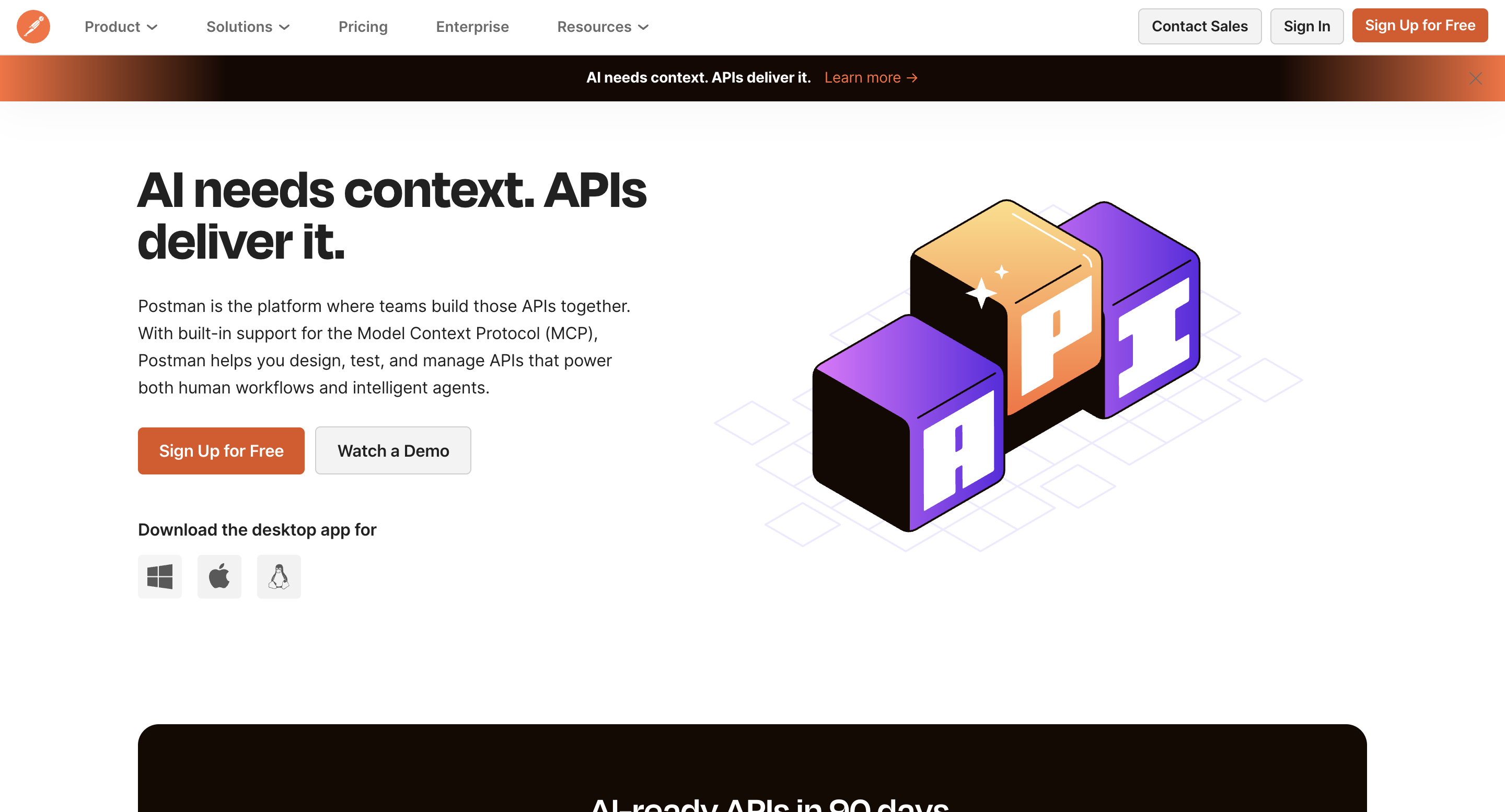
Widely recognized for API development and testing, Postman has significantly expanded its capabilities to include robust API governance, particularly through its API Builder and governance rulesets. It enables teams to define, enforce, and validate API standards and best practices across the entire API lifecycle, from design to deployment. Postman's collaborative workspaces facilitate shared understanding and adherence to organizational policies, making it a powerful tool for maintaining consistency.
Best Features
- API Style Guides & Enforcement
- Centralized Workspaces & Collaboration
- API Schema Validation
- Integration with CI/CD Pipelines
- Comprehensive API Development & Testing Features
Pros
- Extremely popular with a large user base and strong community support.
- Intuitive user interface that simplifies API workflows.
- Comprehensive platform for the entire API lifecycle.
- Strong collaboration features for distributed teams.
Cons
- Advanced governance features may require higher-tier paid plans.
- Can be resource-intensive for very large organizations or extensive API collections.
- Primary focus remains on development and testing, with governance as an added layer.
2. Spectral
Spectral is an open-source linter for JSON and YAML files, including OpenAPI and AsyncAPI specifications. Teams write rulesets for naming, versioning, error formats and required descriptions, then run Spectral in the IDE or CI/CD pipeline to block non-compliant APIs before they ship. It is maintained by Stoplight, now part of SmartBear, and several platforms, including Postman, use Spectral rules for custom governance.
Best Features
- Custom rulesets in YAML or JavaScript
- Built-in OpenAPI and AsyncAPI rules
- CLI, IDE and CI/CD integration
- Shareable, extendable style guides
Pros
- Free and open source (Apache 2.0).
- Lightweight, with no platform to run.
- Widely supported rule format.
- Fits developer workflows and pull requests.
Cons
- Covers specification linting only, with no catalog or runtime enforcement.
- Rules must be written and maintained by your team.
- No built-in dashboards or reporting.
3. SmartBear API Hub (formerly SwaggerHub)
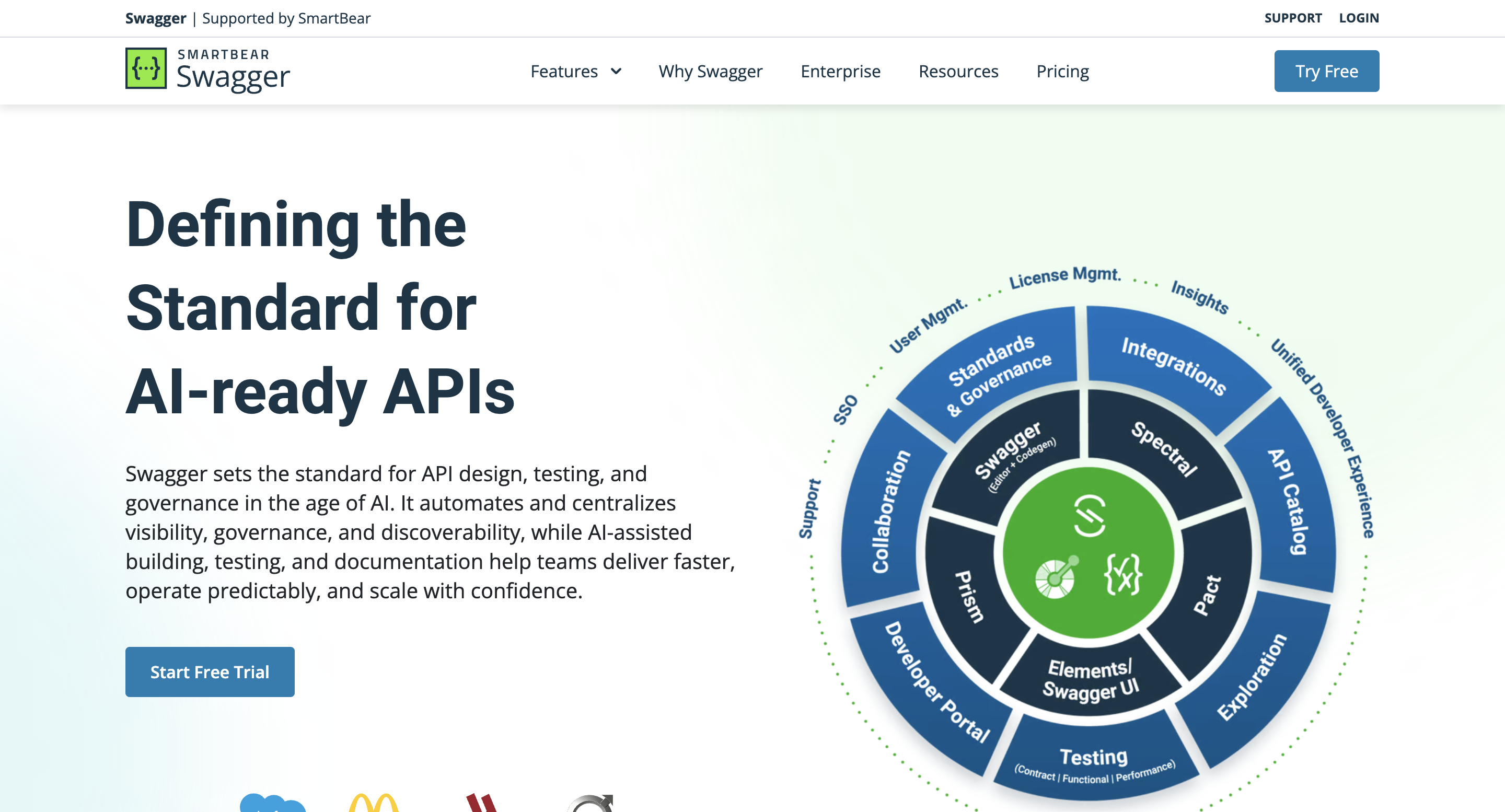
SwaggerHub, powered by the OpenAPI Specification, offers a collaborative platform for API design, documentation, and management. Its core strength lies in ensuring that API designs adhere to organizational standards and best practices from the initial design phase. By centralizing OpenAPI definitions and providing robust style validation, SwaggerHub proactively prevents inconsistencies and enforces a design-first approach, crucial for scalable API ecosystems. SmartBear now sells SwaggerHub within its API Hub product family and has integrated Stoplight’s open-source tools, including the Spectral linter, into it.
Best Features
- OpenAPI-driven API Design & Editor
- API Style Validation & Enforcement
- Centralized API Definitions & Version Control
- Automated Documentation Generation
- Integration with API Gateways & CI/CD
Pros
- Excellent for design-first API development and consistency.
- Strong support for the OpenAPI Specification, a widely adopted standard.
- Good collaboration features for API designers and developers.
- Automated validation reduces manual review effort.
Cons
- Primarily focused on OpenAPI, which may limit flexibility for other specification formats.
- Less comprehensive for runtime governance compared to full API management platforms.
- Can become costly for large teams and extensive API catalogs.
4. Stoplight

Stoplight provides a comprehensive platform for API design, documentation, and governance, with a strong emphasis on design-first principles. It empowers teams to create and maintain consistent API specifications using customizable style guides, automate validation checks, and centralize API assets within a discoverable catalog. This ensures consistency and quality from the earliest stages of API development, making it an invaluable tool for enforcing design standards across complex API ecosystems. SmartBear acquired Stoplight in 2023 and is bringing its tools into SwaggerHub, so check the product roadmap before you standardize on it.
Best Features
- Visual API Design Studio
- API Style Guide Enforcement & Linting
- Automated Documentation Generation
- API Catalog & Discovery
- Mock Servers & Testing Integration
Pros
- Excellent design-first capabilities with intuitive visual tools.
- Strong focus on API consistency and quality through automated validation.
- Streamlines documentation and mock server creation.
- Promotes collaboration among API designers and developers.
Cons
- Primarily focused on design and documentation-time governance, less on runtime policy enforcement.
- Requires integration with API gateways for full lifecycle management.
- Can be more expensive than some open-source alternatives.
5. Redocly
Redocly focuses on OpenAPI quality and documentation. The open-source Redocly CLI lints and bundles OpenAPI definitions against configurable rules, and Redocly’s commercial platform adds hosted API reference docs, developer portals and review workflows. It suits teams that treat the OpenAPI file as the source of truth and want validation built into their docs pipeline.
Best Features
- Open-source CLI for linting and bundling
- Configurable and custom lint rules
- API reference documentation
- Docs-as-code workflows with Git
Pros
- Strong OpenAPI tooling with an open-source entry point.
- High-quality API documentation.
- Easy to add to CI/CD.
- Good fit for docs-as-code teams.
Cons
- Centered on OpenAPI; limited runtime governance.
- Portal and collaboration features need a paid plan.
- No cross-gateway API inventory.
Which tools govern API security?
Security governance checks API contracts for vulnerabilities, not just style. Use a dedicated tool when governance must cover authentication, data exposure and contract conformance.
6. 42Crunch
42Crunch brings security into API governance. Its API Audit statically checks OpenAPI contracts for security issues and scores them, API Scan tests running APIs for conformance with their contracts, and API Protect enforces the contract at runtime. Free IDE extensions let developers audit specifications as they write them, which makes it a common choice for regulated and security-led teams.
Best Features
- Static security audit of OpenAPI contracts
- Dynamic conformance scanning
- Contract-based runtime protection
- IDE and CI/CD integrations
Pros
- Security checks that linters do not cover.
- Shift-left feedback in the IDE.
- Clear security scoring for governance reports.
- Works alongside existing gateways.
Cons
- Focused on security, not general design standards.
- Full platform requires a commercial licence.
- Depends on accurate OpenAPI contracts.
Which tools govern APIs across gateways and teams?
Estate governance tools show which APIs exist, who owns them and whether they meet your standards, wherever they run. They matter most when APIs are spread across several gateways, clouds and teams.
7. Apigee and Apigee API hub (Google Cloud)
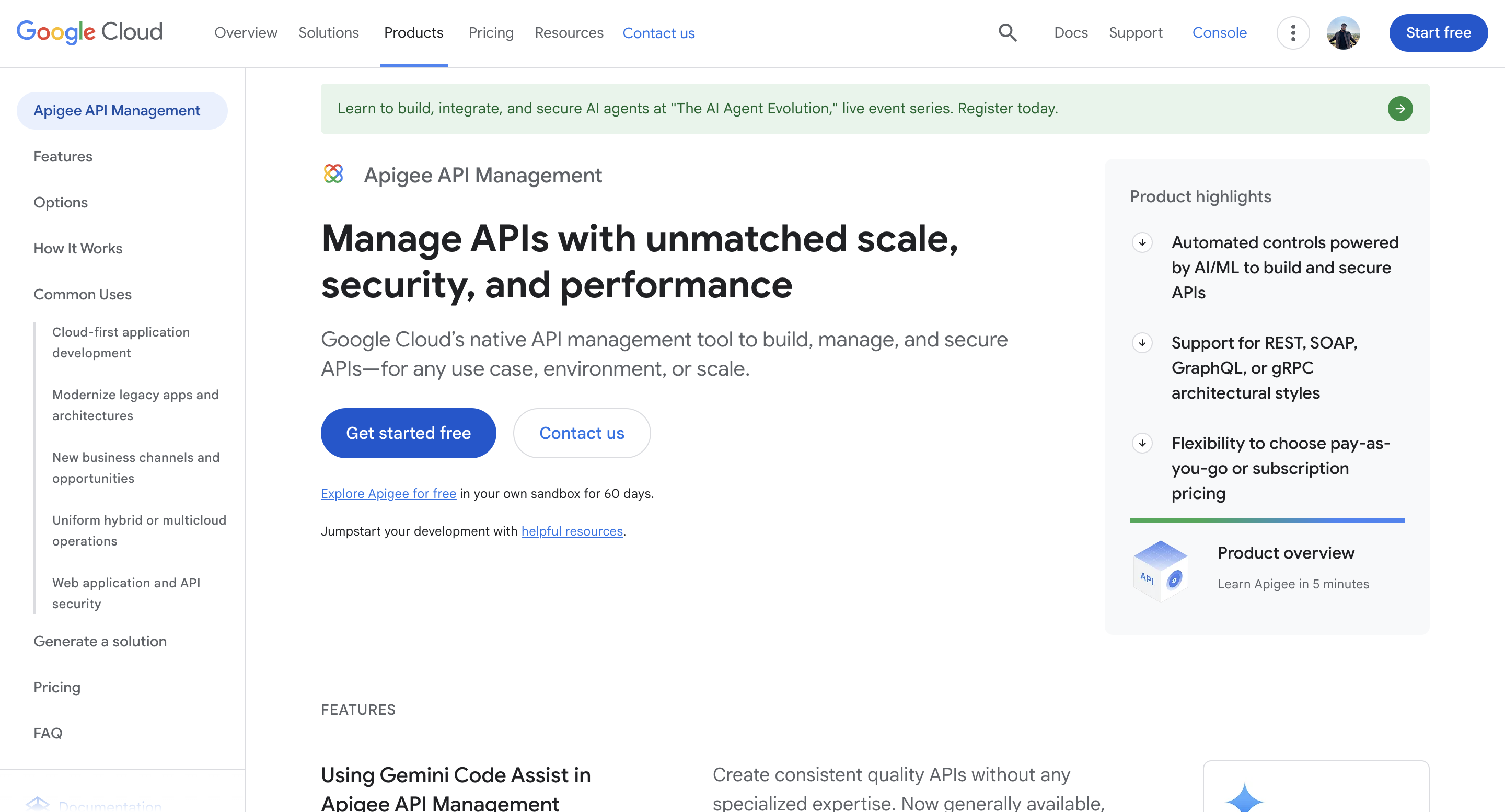
Apigee, a leading API management platform from Google Cloud, provides an extensive suite of tools for designing, securing, analyzing, and scaling APIs. While a full-fledged API gateway, its governance features are deeply embedded, enabling organizations to enforce security policies, manage traffic, control access, and monitor API health to ensure compliance and robust performance across their entire API landscape. It's an enterprise-grade solution for complex API ecosystems. For governance across the wider estate, Apigee API hub catalogs APIs from across the organization, including APIs that do not run on Apigee, with ownership, lifecycle metadata and specification linting.
Best Features
- API Proxy & Gateway Management
- Advanced Security Policies (Authentication, Authorization, Threat Protection)
- Traffic Management & Rate Limiting
- Comprehensive API Analytics & Monitoring
- Developer Portal & API Monetization
Pros
- Robust, enterprise-grade solution suitable for very large-scale deployments.
- Extensive feature set for security, analytics, and lifecycle management.
- Strong integration with Google Cloud ecosystem.
- High reliability and scalability for critical APIs.
Cons
- Can be expensive, especially for smaller organizations.
- Complex to set up and manage, requiring specialized expertise.
- Steep learning curve for new users.
- Primarily an API gateway with governance capabilities, rather than a standalone governance tool.
8. DigitalAPI
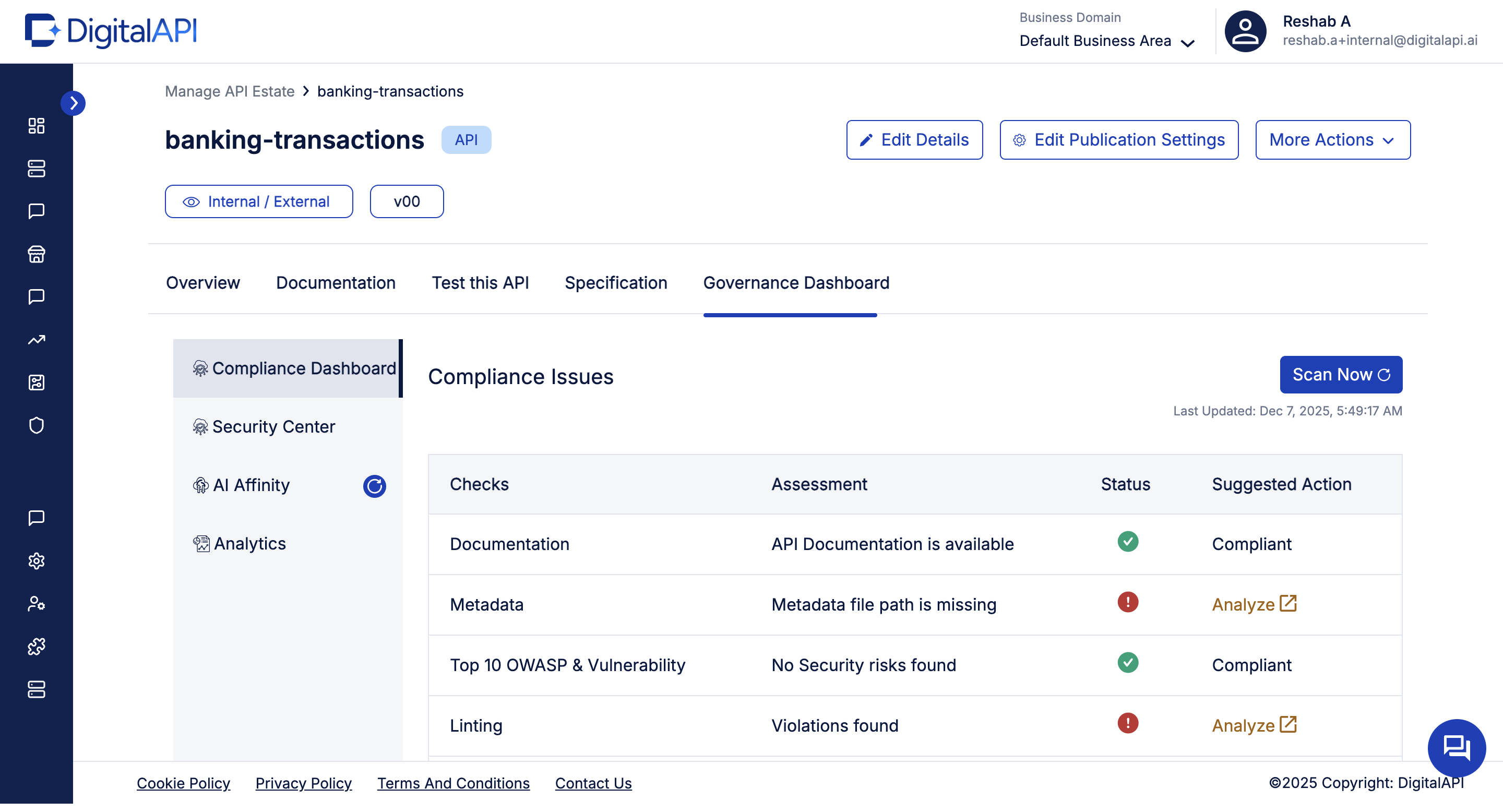
DigitalAPI.ai is an enterprise-grade API governance and intelligence platform purpose-built for organizations operating with fragmented API estates across Apigee, Kong, MuleSoft, AWS, Azure, and custom gateways. It unifies the APIs from those gateways into one governed catalog, without moving them off the gateways they run on.
By connecting directly to multiple gateways, Postman collections, Git repos, and CI/CD systems, DigitalAPI automates discovery, cataloguing, policy enforcement, documentation, and analytics. Its governance engine ensures consistent standards, risk-based security enforcement, versioning discipline, metadata quality, and complete lifecycle tracking across thousands of APIs, without requiring migration or vendor lock-in.
Best for: organizations whose APIs are spread across several gateways and teams, and who need one catalog, one rule set and a self-serve developer portal for partners.
DigitalAPI is built for enterprises seeking visibility, compliance, standardization, and AI-readiness across distributed teams, clouds, and gateway providers.
Best Features
- Multi-gateway governance & unified API estate view: Automatically discovers APIs from Apigee, Kong, Mulesoft, AWS gateway, Azure APIM, GitHub, Postman, and internal registries, unifying them into a single searchable catalog with lineage, ownership, metadata, and lifecycle states.
- AI-powered policy enforcement & standardization: Applies organization-wide governance rules (Naming conventions, security, versioning, schema quality, metadata completeness) and uses AI to identify violations, missing details, and risks.
- API schema & security validation (Oas, asyncapi, events): Validates schemas for accuracy, versioning discipline, breaking changes, and compliance with internal standards, including governance for event APIs.
- Integrated CI/CD & DevOps governance: Enforces governance rules at design and deployment stages, ensuring APIs meet organizational policies before they reach production or the developer portal.
- Developer portal & consumer governance: Provides a unified developer portal with access policies, subscription workflows, analytics, usage visibility, and role-based access control for internal, partner, and public APIs.
- Unified analytics (cross-gateway insights): Offers enterprise-wide observability across all gateways, including latency, adoption, errors, usage patterns, monetization metrics, security insights, and anomaly detection.
- AI-ready architecture (MCP-ready APIs): Automatically prepares API metadata, schemas, and documentation to be agent-consumable and compatible with the model context protocol (MCP).
Pros
- True multi-gateway governance eliminates sprawl across Apigee, Kong, MuleSoft, AWS, Azure, and internal services.
- Extremely strong visibility layer with a unified estate view of all APIs, versions, owners, domains, and lifecycle stages.
- AI-powered policy checks improve governance accuracy and reduce manual review workload.
- Seamless integration with CI/CD, Git, and Postman, enabling automated governance before deployment.
Cons
- Requires initial onboarding to integrate multiple gateways and align teams on governance workflows.
- Advanced capabilities (multi-gateway analytics, AI governance rules, developer portal customizations) may require enterprise-tier plans.
- More comprehensive than simple catalog or testing tools, best suited for organizations serious about API governance at scale.
.png)
Which API gateways enforce governance at runtime?
Gateways enforce policies on live traffic, such as authentication, rate limits and quotas. They complement design-time tools rather than replace them, because a gateway cannot fix an inconsistent API design.
9. MuleSoft Anypoint Platform (Salesforce)
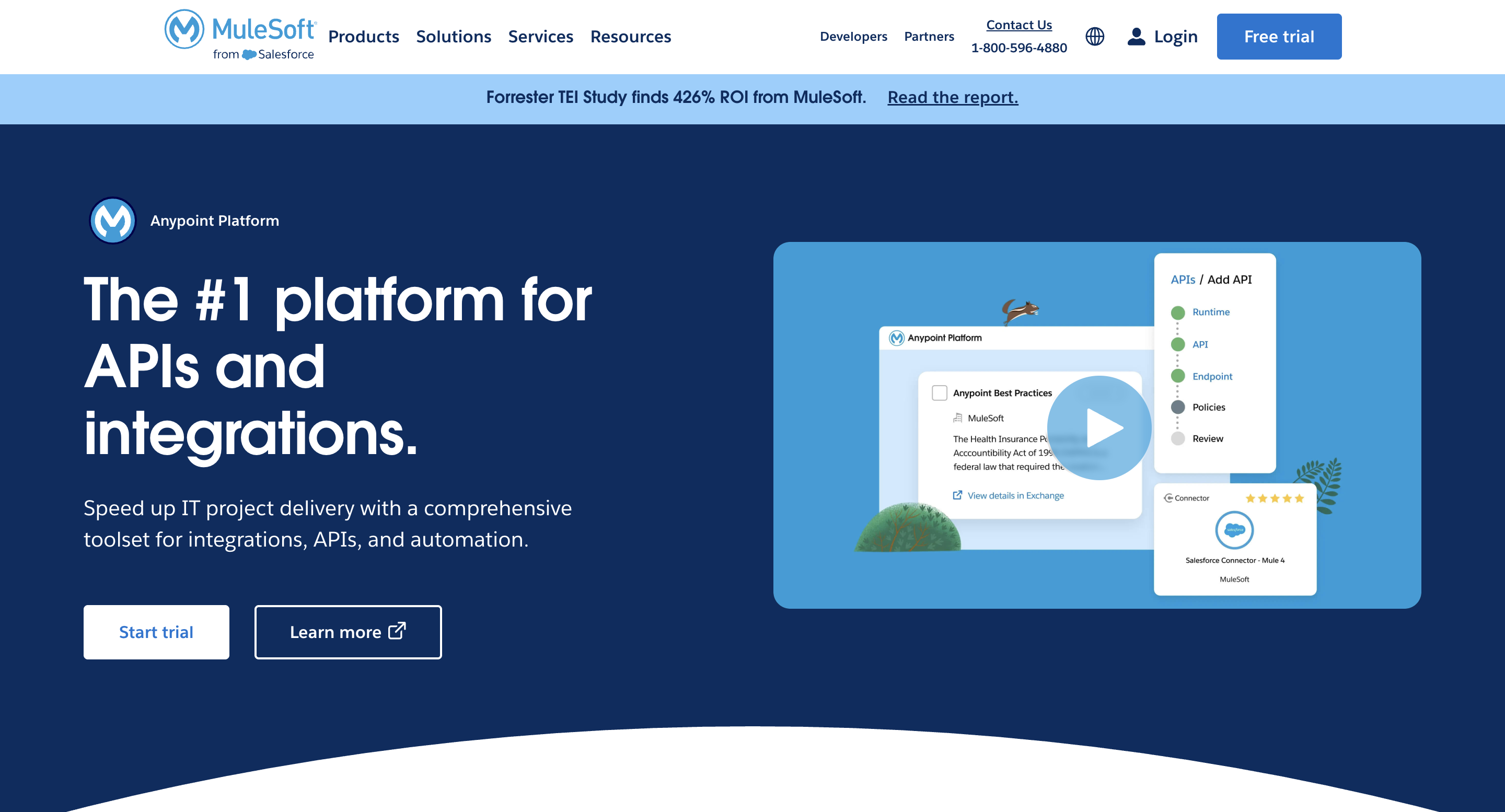
MuleSoft's Anypoint Platform is a unified, API-led connectivity platform that provides robust tools for API design, development, deployment, and governance. It emphasizes reusability and discoverability, with governance features focused on ensuring adherence to technical standards, security policies, and operational best practices across the entire API ecosystem. Anypoint Exchange acts as a central hub for discovering and reusing governed APIs, promoting consistency and accelerating development. Anypoint API Governance checks API specifications in Exchange against rulesets, such as OWASP API security rules or your own standards.
Best Features
- API Designer & Policy Manager
- Anypoint Exchange for API Discovery & Reusability
- Security Policies & Access Management
- Runtime Manager for Deployment & Monitoring
- DataWeave for Data Transformation
Pros
- Excellent for complex enterprise integration and connecting disparate systems.
- Strong emphasis on API reusability and discoverability.
- Comprehensive, unified platform for the full API lifecycle.
- Good for hybrid cloud and on-premises deployments.
Cons
- Can be expensive, especially with enterprise-level licensing.
- Significant learning curve due to the breadth of the platform.
- Best utilized within a broader MuleSoft ecosystem, which might not fit all organizations.
- Configuration and management can be complex.
10. Kong Enterprise and Kong Konnect

Kong is a popular open-source API Gateway that also offers an enterprise version with advanced governance, security, and management features. Kong Enterprise enables organizations to manage their APIs across various environments, enforcing policies, controlling traffic, and providing real-time analytics. Its plugin-based architecture allows for highly customizable governance rules, ensuring APIs meet compliance standards and operate at optimal performance. It's particularly strong for microservices architectures. Kong Konnect, its SaaS control plane, centralizes gateway policies and adds a service catalog across teams.
Best Features
- High-Performance API Gateway
- Extensive Plugin Ecosystem for Custom Policies
- Service Mesh Integration (Kuma)
- Developer Portal & Catalog
- Advanced Access Control & Authentication
Pros
- Highly performant and scalable for demanding workloads.
- Flexible and extensible via a rich plugin ecosystem.
- Strong open-source community support for the core gateway.
- Supports multi-cloud, hybrid, and Kubernetes environments.
Cons
- Enterprise features and support can be costly.
- Requires expertise for complex configurations and plugin development.
- Governance features are primarily focused on runtime aspects, less on design-time validation.
- Management UI can be less intuitive for beginners.
11. Gravitee.io
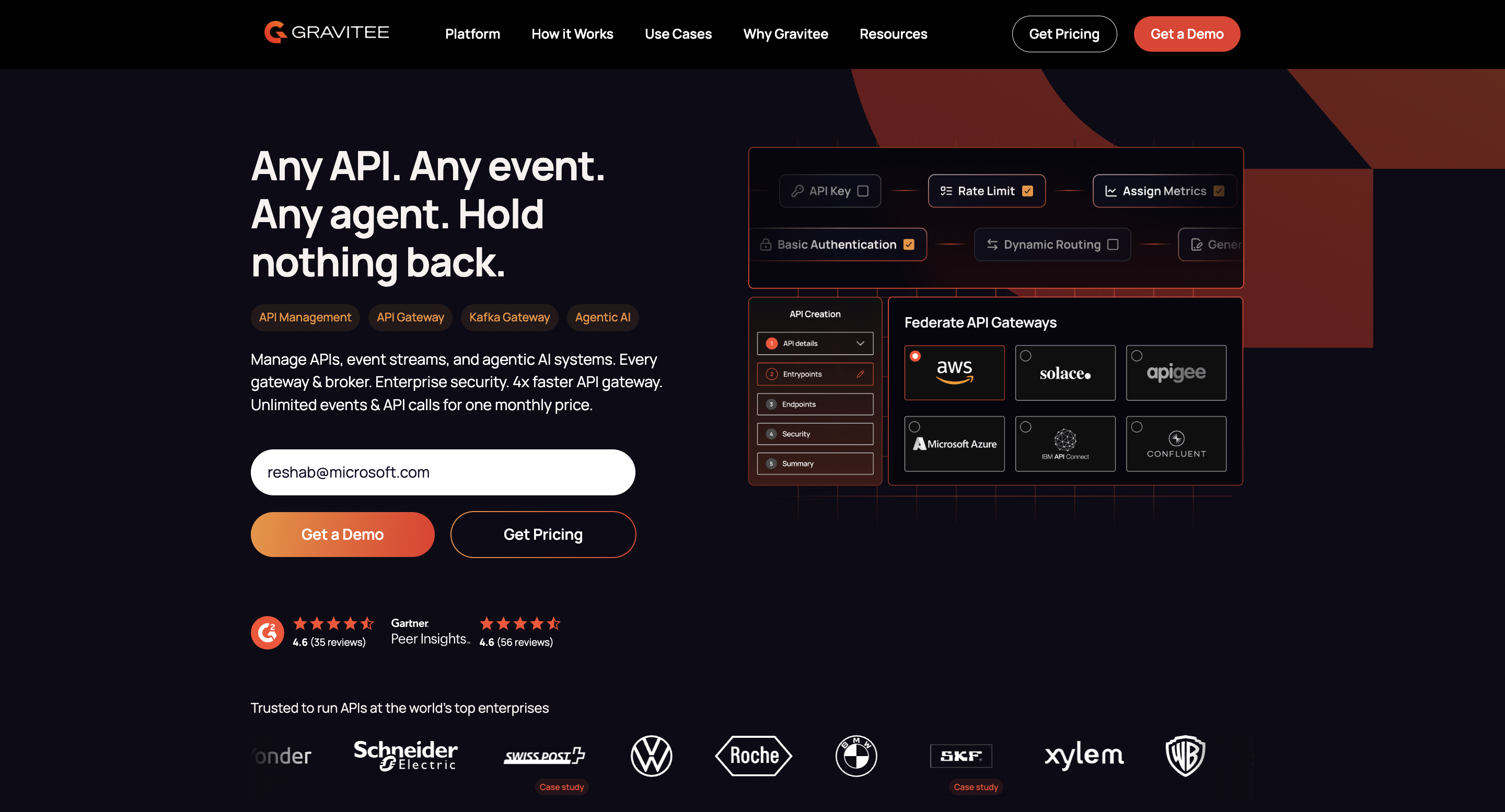
Gravitee.io is an open-source, API management platform offering a comprehensive set of features for managing, securing, and governing APIs. It provides tools for API design, proxying, monitoring, and policy enforcement, allowing organizations to maintain granular control over their API landscape. Gravitee's flexibility and event-native architecture make it suitable for modern, distributed systems, ensuring scalability and adaptability for diverse API needs.
Best Features
- API Gateway & Proxying
- Access Management (Authentication, Authorization)
- Developer Portal & API Catalog
- Policy Studio for Custom Rules
- API Analytics & Real-time Monitoring
Pros
- Open-source flexibility with a strong community.
- Feature-rich API management platform.
- Supports event-driven architectures and AsyncAPI.
- Good for hybrid and multi-cloud environments.
Cons
- Enterprise features and commercial support require paid subscriptions.
- May require technical expertise for self-hosting and advanced configurations.
- Documentation can be dense, impacting initial adoption for some users.
12. Tyk API Management
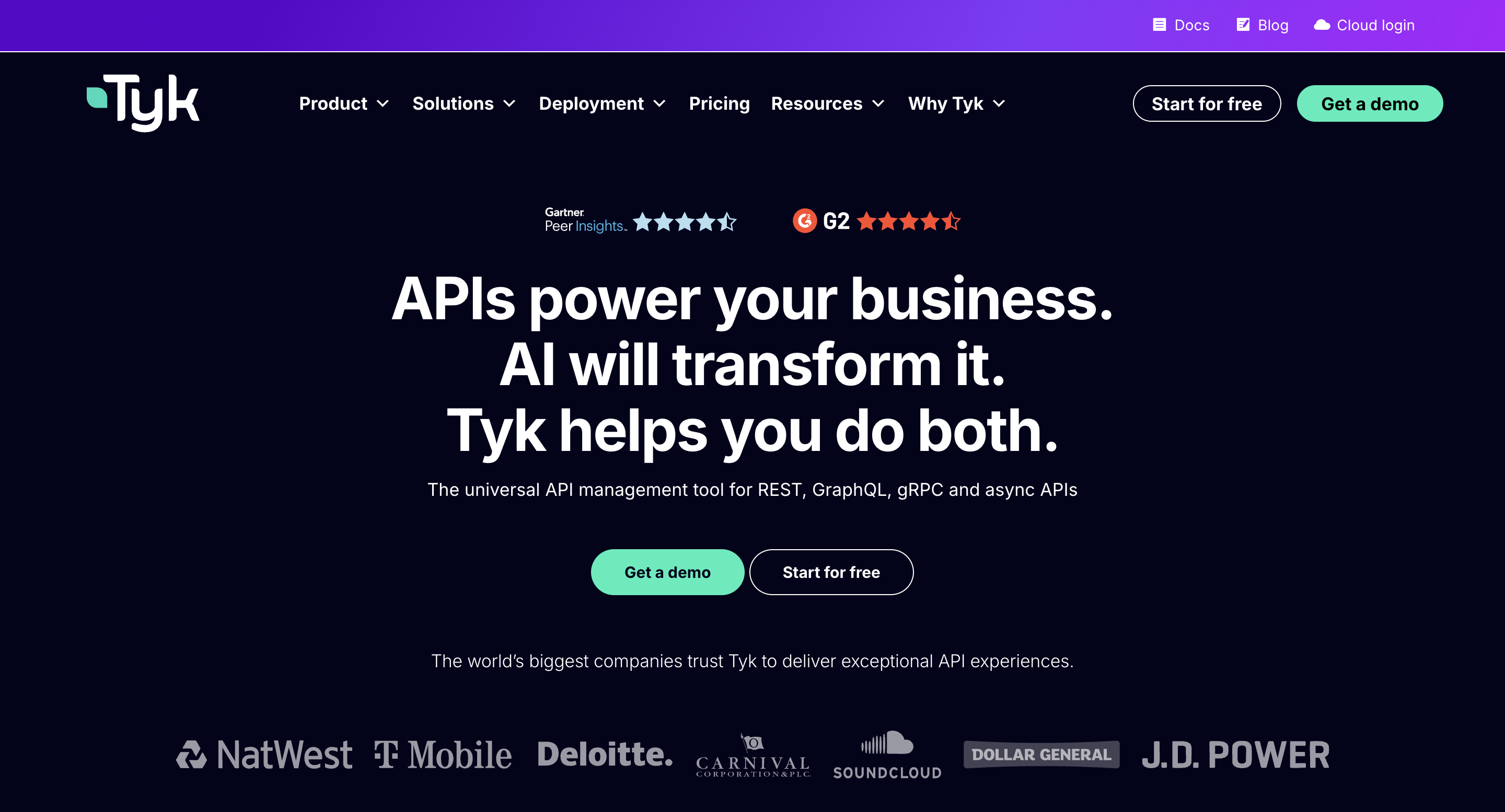
Tyk is a high-performance, open-source API Gateway and API Management platform that offers a powerful and lightweight solution for managing, securing, and governing APIs. Its extensive features include intelligent traffic management, robust authentication mechanisms, comprehensive analytics, and flexible policy enforcement. Tyk is designed to cater to modern microservices and distributed architectures, providing the control and insights needed for a well-governed API landscape.
Best Features
- High-Performance API Gateway
- Intuitive Dashboard for API Management
- Developer Portal & API Catalog
- Advanced Rate Limiting & Quotas
- Comprehensive Authentication & Authorization Options
Pros
- Open-source flexibility with commercial enterprise options.
- High performance and low latency, suitable for demanding environments.
- Lightweight and scalable, supporting modern cloud-native deployments.
- Supports hybrid and multi-cloud environments effectively.
Cons
- Enterprise features and dedicated support are part of paid plans.
- Can be complex to set up and configure for users new to API gateways.
- Community support, while active, might be less extensive than older, more established platforms.
13. Red Hat 3scale API Management
3scale API Management, integrated within Red Hat's OpenShift ecosystem, provides a robust platform for controlling API access, managing developer workflows, and enforcing policies. Its governance tools are geared towards standardizing API usage, securing endpoints, and monitoring performance to ensure APIs consistently meet both technical requirements and business objectives. It's particularly appealing to organizations invested in the Red Hat stack or seeking strong integration with Kubernetes. Note that Red Hat is retiring 3scale: maintenance support ends on 30 June 2027, with paid extended support to June 2029 for self-managed installs, and the hosted service ends on 30 June 2027. Red Hat points customers to Red Hat Connectivity Link or IBM API Connect.
Best Features
- Access Control & API Key Management
- Rate Limiting & Quotas
- Developer Portal & API Discovery
- Analytics, Logging & Reporting
- Policy Enforcement & Authentication Gateways
Pros
- Integrates seamlessly with OpenShift and other Red Hat products.
- Strong focus on API lifecycle management from a business perspective.
- Good for monetizing APIs and managing partner ecosystems.
- Flexible deployment options (on-premise, cloud, hybrid).
Cons
- May be less feature-rich in specific areas compared to standalone enterprise solutions.
- Learning curve for those unfamiliar with the Red Hat ecosystem.
- Primarily a management platform with governance controls, rather than a dedicated governance suite.
- Being retired: maintenance support ends in June 2027, so it is a poor choice for new projects.
Which API governance tool should you choose?
Start from where your governance gaps are: design, security, inventory or runtime. Most teams combine a linter with a catalog and their existing gateway policies.
- One platform for design standards and collaboration: Postman or SmartBear API Hub.
- Free, code-driven rules in CI/CD: Spectral, or Redocly CLI if documentation matters.
- Security is the main concern: 42Crunch, alongside your linter.
- Google Cloud estate: Apigee with Apigee API hub.
- APIs spread across several gateways: DigitalAPI gives you one catalog, one rule set and a self-serve developer portal without migrating APIs.
- Runtime enforcement on your existing gateway: Kong, MuleSoft, Gravitee or Tyk policies. Plan a move off 3scale before June 2027.
What should you look for in an API governance tool?
Selecting the ideal API governance tool goes beyond simply looking at feature lists. It requires a thoughtful evaluation of your organization's specific needs, existing infrastructure, and long-term strategic goals. Here are critical factors to consider:
- Scalability and Flexibility: Can the tool grow with your API estate, accommodating increasing complexity and volume? Does it offer the flexibility to adapt to evolving governance requirements?
- Integration Capabilities: How well does it integrate with your existing API gateways, CI/CD pipelines, source control systems (e.g., Git), developer portals, and identity providers? Seamless integration is crucial for automation and minimizing manual effort.
- Specification Support: Does it fully support the API specification formats your teams use (e.g., OpenAPI, AsyncAPI, GraphQL)? Consistent validation across formats is vital.
- Automation and Enforcement: What level of automation does it offer for policy enforcement, validation, and lifecycle management? The more automated, the more efficient and consistent your governance will be.
- User Experience and Adoption: Is the tool intuitive and easy for API designers, developers, and governance teams to use? High adoption rates are directly tied to a positive user experience.
- Security Features: Does it offer robust features for defining, enforcing, and auditing security policies, including authentication, authorization, and threat protection?
- Reporting and Analytics: Does it provide actionable insights into API usage, compliance status, and performance, enabling continuous improvement?
- Deployment Options: Does it support your preferred deployment model (e.g., cloud-native, on-premises, hybrid)?
- Cost and Licensing: Understand the total cost of ownership, including licensing, support, and potential infrastructure requirements.
Before you buy, test these six things in a proof of concept:
- Standards enforcement: Can you write reusable rules for naming, versioning, error formats and pagination?
- CI/CD blocking: Can a violation block a merge or release, with severities and approved exceptions?
- Security checks: Does it validate contracts for security issues, or do you need a second tool?
- Inventory: Can it discover APIs across teams and gateways, and show owners and lifecycle status?
- Formats: Does it support OpenAPI, AsyncAPI, GraphQL or gRPC where you need them?
- Audit and reporting: Are audit trails, role-based access and compliance reports in your plan?
By carefully evaluating these considerations, organizations can choose a tool that not only addresses their current governance challenges but also supports their future API strategy.
How do you future-proof API governance?
API governance is not a one-time project but an ongoing journey of continuous improvement and adaptation. As technologies evolve and business demands shift, so too must your governance strategy. Future-proofing your API landscape involves anticipating emerging trends and integrating them into your governance framework.
Key aspects of future-ready API governance include:
- AI-Driven Governance: Leveraging artificial intelligence and machine learning for predictive insights, anomaly detection, automated policy suggestions, and even self-healing API ecosystems.
- Event-Driven API Governance: Extending governance to AsyncAPI specifications and event streams, ensuring consistency and control over asynchronous communication patterns.
- Microservices and Mesh Governance: Adapting governance models to the unique challenges of distributed microservices architectures and service mesh deployments.
- Platform Engineering Integration: Embedding governance directly into platform engineering practices, making compliance and best practices part of the developer workflow by default.
- Emphasis on Developer Experience: Ensuring that governance measures enhance, rather than hinder, developer productivity and satisfaction through clear guidelines and accessible tooling.
By embracing these forward-looking approaches, organizations can ensure their API governance strategy remains agile, resilient, and supportive of innovation. The ultimate goal is to foster an environment where APIs are not just discoverable and secure, but also inherently trustworthy and easy to consume, empowering digital transformation for years to come.
Frequently asked questions
1. What is an API governance tool?
An API governance tool helps an organization apply consistent standards to its APIs. Depending on the tool, that means linting API specifications against style rules, checking contracts for security issues, cataloging which APIs exist and who owns them, or enforcing policies such as authentication and rate limits on live traffic.
2. What is the difference between API governance and API management?
API governance defines and checks the standards APIs must meet, such as naming, versioning, security and documentation. API management runs the APIs, covering gateways, traffic policies, developer portals and analytics. Governance tools often work before deployment, while API management platforms mostly act at runtime, and many organizations use both.
3. Can an API gateway handle API governance?
Only partly. An API gateway such as Kong, Apigee or MuleSoft enforces runtime policies like authentication, quotas and rate limits. It does not check whether an API design follows your standards before it is built, so most teams add a specification linter or design platform and a catalog alongside the gateway.
4. What is the best open-source API governance tool?
Spectral is the most widely used open-source API governance tool. It lints OpenAPI and AsyncAPI files against custom rulesets and runs in the IDE or CI/CD. Redocly CLI is another open-source option that combines linting with documentation. For runtime policy, Kong, Gravitee and Tyk have open-source gateway cores.
5. Is Spectral free?
Yes. Spectral is open source under the Apache 2.0 licence and free to use. It is maintained by Stoplight, which is now part of SmartBear. Commercial platforms such as SmartBear API Hub and Postman build governance features on top of Spectral-style rules.
6. How do you govern APIs across multiple gateways?
Start with one catalog that pulls in APIs from every gateway, with owners and lifecycle status. Apply the same rule set to every API specification in CI/CD, and keep runtime policies on each gateway. Tools such as Apigee API hub and DigitalAPI provide that cross-gateway catalog, and DigitalAPI adds a single self-serve developer portal across Apigee, Kong, MuleSoft, AWS and Azure.
Dhayalan Subramanian is Associate Director, Product Growth at DigitalAPI, where he leads go-to-market and product growth for the company’s multi-gateway API management platform. His work focuses on helping large enterprises and mid-market cloud companies consolidate APIs across AWS, Azure, Apigee, Kong, MuleSoft, and other gateways into a single control plane for governance, discovery, monetization, and agent consumption.
Dhayalan brings 14+ years of experience across product strategy, enterprise architecture, and engineering leadership. Earlier in his career, he held senior roles at Encora (as Associate Architect and Technical Manager), Mindtree (Technology Lead), Tech Mahindra (Technical Lead), and Primus Analytics, where he designed integration frameworks and delivered enterprise-grade digital platforms for global customers.
At DigitalAPI, he works directly with platform, integration, and developer experience leaders at Fortune 500 organizations to operationalize unified API catalogs, developer portals, and MCP-ready APIs. He writes regularly on API developer experience, API governance, and AI agent architectures.
One email a fortnight. Worth opening.
A short digest of what we're writing, what we're learning from customers, and the handful of links you'd actually want from us. No tracking pixels.

.avif)