



Programmers portal: what it is and how to build one
A programmers portal is the self-service hub that turns scattered APIs into a discoverable, governable asset. Learn what it is, how it works across internal and external audiences, and how to build one that reduces onboarding time and drives partner adoption.
TL;DR
1. A programmers portal is a self-service hub where developers discover, test, and integrate APIs without human handoffs.
2. Most teams need one once APIs cross 20+ services or span more than one cloud, gateway, or business unit.
3. The portal is the difference between an API that gets used and an API that sits in a repo collecting dust.
4. Core functions: catalogue, interactive docs, sandbox testing, credential provisioning, analytics, and governance.
5. DigitalAPI runs a gateway-agnostic developer portal that unifies APIs from AWS, Azure, Kong, Apigee, and MuleSoft into one branded interface.
Get started with DigitalAPI's developer portal. Book a Demo!
Your engineers spend more time hunting for the right API than building with it. Endpoints live in three gateways, documentation sits in four wikis, and every partner integration kicks off a Slack thread that ends with a calendar invite. That friction has a name, and the fix has a name too.
What is a programmers portal
A programmers portal is a centralised web interface where developers find APIs, read documentation, test endpoints, generate credentials, and manage their integrations without filing a ticket. It is the front door to your API estate. Whether you call it a developer portal, API portal, or programmers portal, the job is the same: reduce the time between "I need this data" and "my code is in production."
The term programmers portal usually shows up in two contexts. Enterprise architects use it to describe the internal catalogue that prevents duplicate service builds across teams. Product leaders use it to describe the external, branded hub that partners log into to consume paid APIs. The good news: one modern platform handles both.
The portal looks different depending on who you ask, and that is the point. A well-designed portal serves multiple personas at once without forcing any of them into someone else's workflow.
Simple definition: A programmers portal is a website where developers find and use APIs.
Technical definition: A programmers portal aggregates an OpenAPI-driven catalogue, interactive try-it consoles, sandbox environments, OAuth and API key provisioning, SDK downloads, usage analytics, and governance controls into a single developer-facing layer that sits above your gateways and CI/CD pipelines.
Business definition: A programmers portal is the commercialisation surface for your API programme. It turns internal engineering work into discoverable, subscribable, monetisable products that drive partner revenue and reduce support costs.
Why programmers portals matter now
APIs have stopped being plumbing. They are the product. When Fiserv, Zurich Insurance, and Canara Bank run their partner ecosystems, the portal is the contract between them and every third party building on top. Break the portal experience, and you break the business.
Three shifts pushed this from nice-to-have to non-negotiable. First, API sprawl: large enterprises now run thousands of services across multiple clouds, and nobody remembers which team owns what. Second, AI agents: LLMs consuming APIs need structured metadata and MCP-ready endpoints, which only a proper catalogue can deliver. Third, monetisation: CFOs want the API programme on the P&L, not buried in engineering overhead.
The payoff is concrete. Partner onboarding drops from weeks to days. Duplicate services get flagged before they ship. Developers stop asking "does this already exist" and start shipping features. You can read a deeper breakdown of the business case in our guide to API developer portals.
Core features every programmers portal must ship with
A portal earns its keep on six capabilities. Miss any one, and developers quietly route around it.
1. Unified API catalogue
The catalogue is the heart. It ingests APIs from every gateway you run, normalises the specs, and makes the whole estate searchable. DigitalAPI pulls from AWS, Azure, Kong, Apigee, MuleSoft, Postman, GitHub, and SwaggerHub into a single "API State." Without that multi-gateway reach, you are just building another silo.
2. Interactive documentation
Static Swagger pages do not cut it anymore. Developers expect try-it consoles that fire real requests against a sandbox, live response viewers, and code samples in the language they actually use. DigitalAPI's documentation layer auto-generates and syncs docs from OpenAPI specs, so the portal never drifts from what is actually deployed.
3. Sandbox and self-service testing
A sandbox lets developers verify behaviour before they touch production. Proxy-enabled mock responses, stable test data, and one-click reset are the minimum bar. This is where trust gets built: if a developer can hit an endpoint in 30 seconds and see a clean response, they will integrate. If they cannot, they will email procurement and ask for alternatives.
4. Automated credential provisioning
API keys, OAuth flows, and client IDs should not require a human approval chain for every request. Self-service issuance with role-based scopes and automated rotation removes the biggest bottleneck in partner onboarding.
5. Analytics and usage insight
Real-time dashboards for call volume, error rates, latency, and consumer behaviour feed two decisions: which APIs to double down on, and which to deprecate. Without API analytics, product teams fly blind on pricing, tiering, and roadmap.
6. Governance and AI affinity
Governance runs in the background: OWASP linting, policy enforcement, versioning rules, deprecation workflows. DigitalAPI's AI Affinity feature goes further, using specification matching to flag duplicate APIs across the estate before teams rebuild something that already exists. You can see the full governance approach in our API governance guide.
Internal vs external vs public: choosing the right access model
One portal, three access tiers. The distinction matters because security, branding, and commercial logic change with each.
A bank might expose balance-check APIs internally to 40 product teams, externally to 12 fintech partners under a paid contract, and publicly as a showcase of its open banking readiness. One catalogue, three audiences, three access policies.
Programmers portal vs API marketplace: the real difference
People use the terms interchangeably. They are not the same thing.
What each row means in practice
Primary focus: A portal answers "what APIs exist and how do I use them?" A marketplace answers "what can I subscribe to and what does it cost?" Same catalogue, completely different commercial logic on top.
Access model: A portal issues credentials. A marketplace enforces subscription tiers against those credentials. Without the marketplace layer, there is no mechanism to restrict a free-tier consumer from hitting production volumes.
Monetisation: A portal has none by design. Monetisation requires a billing engine, a payment gateway, and usage metering wired directly to the gateway. None of that exists in a standard portal out of the box.
Billing: The most underestimated gap. Manual billing breaks the moment you have more than a handful of subscribers on different plans. Automated invoicing needs to run without human intervention at scale.
Analytics: Portal analytics tell you which APIs are slow or broken. Marketplace analytics tell you which APIs generate revenue, which pricing tiers convert, and where subscribers churn. Different dashboards. Different business questions.
Think museum versus retail store. A portal shows you what exists. A marketplace sells you access to it. Most mature API programmes run both, with the portal acting as the discovery layer feeding into marketplace subscription flows. DigitalAPI's API marketplace sits directly on top of the portal catalogue, so there is no separate publishing step.
Industry use cases
The programmers portal model has moved furthest in industries where proprietary data, regulated access, and high-volume partner ecosystems converge. Here is how it plays out across four sectors.
Banking and financial services
Canara Bank runs dozens of APIs across account services, KYC, payments, and loans. A portal bundles these into "Open Banking Products" with a single subscription key per partner, turning a 90-day integration into a 10-day one. Fiserv uses tiered pricing plus usage metering on its DigitalAPI-powered programme to serve both community banks and large fintechs from the same catalogue.
Insurance
Zurich Insurance exposes quote, claims, and policy APIs to brokers through a white-labelled portal. The branded experience keeps Zurich's identity front and centre while partners get self-service onboarding. Underwriting APIs that used to take weeks to expose now ship in days because governance is automated, not committee-driven.
Telecom and platform businesses
Chenosis, a pan-African API marketplace, aggregates telco APIs across multiple operators and countries. A single portal abstracts the operator-level complexity so a developer in Lagos can consume an SMS API without caring which network routes the message. This only works if the catalogue is gateway-agnostic and multi-tenant by design.
Internal platform teams
A global bank with 2,400+ APIs across AWS, Azure, and legacy gateways used DigitalAPI's AI Affinity to identify 340 duplicate or near-duplicate services in the first audit. Deprecating half of those freed engineering capacity that went straight into new product work.
How to build a programmers portal in 9 steps
Heads up: this is the end-to-end sequence. Skipping steps saves time early and costs time later.
1. nventory your API estate:
Pull every API spec from every gateway, repo, and Postman workspace into one list. You cannot build a portal for APIs you cannot name.
2. Define your audiences:
Decide upfront whether you are serving internal devs, external partners, public developers, or all three. This drives access control design.
3. Pick your catalogue source of truth:
OpenAPI is the standard. If specs do not exist, generate them from runtime traffic or code annotations before you go further.
4. Set up a gateway-agnostic ingestion layer:
Connect Kong, AWS, Azure, Apigee, MuleSoft, or whatever else you run. Build this once so you never have to rewire it.
5. Auto-generate documentation:
Interactive docs from OpenAPI specs, with live try-it consoles. No hand-written Markdown that goes stale in two sprints.
6. Stand up a sandbox:
Proxy-enabled or mock-backed. Developers should be able to test without credentials for discovery flows, and with scoped credentials for integration flows.
7. Automate credential provisioning:
Self-service API keys, OAuth client registration, and role-based scopes. Every manual approval is a drop-off point.
8. Wire in governance and analytics:
OWASP checks, linting, policy enforcement on publish. Usage dashboards for product owners. Deprecation workflows for old versions.
9. Brand it and launch:
White-label the portal with your logo, colours, and domain. Launch internally first, gather feedback, then expose the external tier.
For a deeper implementation walkthrough, our step-by-step portal build guide covers architecture and tooling choices in detail.
Build vs buy: the honest comparison
Every platform team hits this fork. Here is how it breaks down.
Building looks cheap until you cost the platform team needed to keep it alive. Most enterprises that started with Backstage end up buying anyway once the TypeScript maintenance burden exceeds the value. Our Backstage alternatives comparison covers the tradeoffs in full.
If you are weighing vendors, our portal selection guide walks through the evaluation criteria that actually predict long-term fit.
How DigitalAPI turns your programmers portal into a revenue-generating marketplace
A programmers portal gets developers to their first API call. DigitalAPI's API Marketplace Portal takes the next step, turning that discovery layer into a commercial product your organisation can monetise.
Most portals stop at documentation and credentials. DigitalAPI does not. The marketplace layer sits directly on top of the portal catalogue, so APIs move from internal discovery to external subscription without a separate publishing workflow or a rebuild of your existing stack.
The full commercial stack, built in
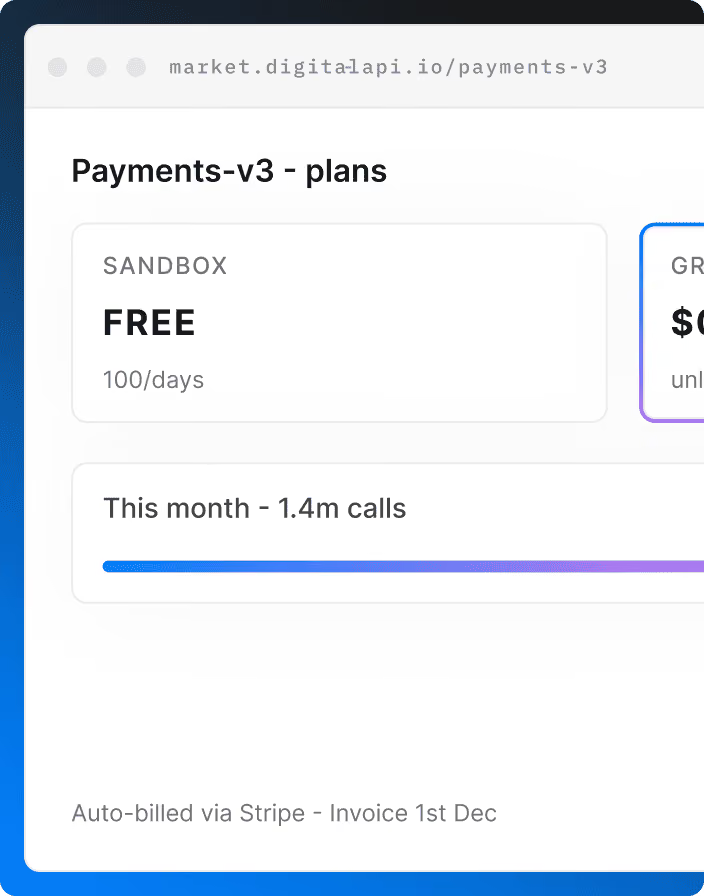
Subscription and billing automated end-to-end: Tiered plans, usage-based pricing, freemium thresholds, and enterprise licensing are all configurable through DigitalAPI's API monetisation platform. Stripe and Braintree connect natively. Usage flows from the gateway to the invoice automatically — no manual reconciliation, no spreadsheet billing at month end.
White-label branding that holds up at scale: Your marketplace runs under your brand, your domain, and your design. Zurich Insurance built a fully branded marketplace on DigitalAPI's white-labelled developer portal that now processes millions of API transactions with no third-party vendor badge in sight.
Sandbox before subscription: Developers test before they pay. DigitalAPI's API sandbox gives trial users a fully isolated environment with realistic mock data. They validate behaviour, inspect responses, and build confidence all before a subscription plan is selected.
Revenue analytics alongside API performance: DigitalAPI's API analytics gives marketplace operators two separate views: API performance data and business revenue data. Subscription growth, churn, and conversion rates sit alongside latency and error metrics because the team managing the product roadmap and the team managing infrastructure are asking different questions.
Proven in production across regulated industries
Fiserv used this model to take fintech partner onboarding from weeks to days. Chenosis built a monetisable API ecosystem for African telecoms on DigitalAPI from the ground up. Canara Bank doubled transaction volume while cutting infrastructure costs by 50%.
The portal handles discovery. The marketplace handles revenue. DigitalAPI runs both from one platform, live in 4 to 8 weeks, without replacing a single gateway you already run.
The bottom line
A programmers portal is not documentation with a nicer theme. It is the operational layer that turns scattered APIs into a usable, governable, revenue-generating asset. The enterprises that treat it as strategic infrastructure — not a side project — are the ones whose partners actually build on their APIs.
If you are running APIs across multiple gateways and partner onboarding keeps getting stuck on manual handoffs, DigitalAPI unifies your estate into one branded, AI-ready portal with governance, sandbox, and monetisation built in. Partners go from first look to first call in hours, not weeks. Book a demo to see how the pieces fit together.
FAQs
1. What is the difference between a programmers portal and a developer portal?
There is no meaningful difference. Both terms describe the same thing: a self-service hub where developers discover, test, and integrate APIs without human handoffs. "Developer portal" is the more common industry term. "Programmers portal" often appears in enterprise architecture contexts where the audience is internal engineering teams rather than external partners or third-party developers.
2. Do small teams need a programmers portal?
If you run fewer than 10 APIs for a single internal team, a well-organised wiki is enough. Once you cross 20 or more services, have more than one consuming team, or expose anything externally, a portal pays for itself quickly. Self-service discovery and automated credential provisioning alone remove enough manual overhead to justify the investment.
3. Can a programmers portal monetise APIs directly?
Yes, when paired with marketplace capabilities. DigitalAPI integrates Stripe and Braintree natively, so subscription plans, tiered pricing, and usage-based billing run from the same interface developers use to discover APIs. Freemium thresholds, enterprise licensing, and revenue sharing are all configurable without custom engineering. More detail is available in our API monetisation guide.
4. How does a portal handle APIs across multiple clouds and gateways?
A gateway-agnostic portal ingests specs from each gateway through dedicated connectors, normalises them into a unified catalogue, and presents one searchable interface to developers. DigitalAPI supports AWS, Azure, Kong, Apigee, MuleSoft, Postman, GitHub, and SwaggerHub out of the box. The ingestion layer runs continuously, so the catalogue stays current as new APIs are deployed or updated.
5. Is a programmers portal useful for AI agents?
Increasingly, yes. AI agents consume APIs through structured metadata and MCP (Model Context Protocol) endpoints. A portal with clean OpenAPI specs and MCP conversion makes your API estate consumable by both human developers and autonomous agents. DigitalAPI's one-click MCP server feature converts any catalogued API into an MCP-ready endpoint without modifying the underlying service.

One email a fortnight. Worth opening.
A short digest of what we're writing, what we're learning from customers, and the handful of links you'd actually want from us. No tracking pixels.

.avif)