



How to Build a Developer Portal: Architecture, Tools, and Best Practices
Learn how to build a developer portal for your APIs. A step-by-step guide covering architecture, tools, governance, and best practices.

TL;DR
1. An API developer portal functions as the front door to your APIs - managing discovery, documentation, testing, authentication, subscription, and usage visibility in one place.
2. Building one from scratch means assembling at least 6 components (gateway integration, docs engine, identity, sandbox, analytics, CMS), which typically takes 3 to 6 months with a dedicated team.
3. The core architecture decisions that matter: how you aggregate APIs across gateways, how you handle self-serve access and governance, how docs stay in sync with specs, and whether your portal is ready for AI agents, not just humans.
4. Best practices for 2026: one catalog across every gateway, role-based visibility, auto-generated docs from OpenAPI, built-in sandbox, audit logs from day one, and MCP-ready endpoints for agent consumers.
5. Most enterprise teams now skip the build and buy a purpose-built platform. DigitalAPI's API developer portal ships every core component as one product - self-serve onboarding, key management, sandboxing, enterprise security, white-label options, and agent-ready capabilities - and launches in 3 days.
Get a personalized walkthrough of DigitalAPI's developer portal. Book a Demo!
What Is a Developer Portal and Why Do Companies Build One?
A developer portal is a self-service platform where developers discover APIs, learn how to use them, and integrate them into applications. It centralizes documentation, authentication, testing tools, and onboarding workflows into one interface.
Organizations build developer portals to improve developer experience and accelerate API adoption. Instead of relying on internal support teams, developers can independently explore APIs, generate keys, and start building integrations.
Some of the key benefits include:
- Faster developer onboarding: Developers can access documentation and test APIs without manual support.
- Increased API adoption: A well-designed portal encourages external developers and partners to use your APIs.
- Reduced support overhead: Clear documentation and onboarding workflows reduce developer support requests.
- Improved API governance: Centralized visibility helps teams manage API lifecycle and standards.
According to the World Journal of Advanced Engineering Technology and Sciences, organizations with mature API practices report 35% higher developer productivity and 26% increased operational efficiency across IT functions.
What Core Components Are Required in a Developer Portal?
A functional developer portal combines documentation, authentication systems, onboarding tools, and developer resources that help users understand and integrate APIs quickly.
The core components typically include:
Seeing how many components you actually need?
This is why most enterprise API programs no longer build portals from scratch. They start with a platform that already has the gateway integrations, docs engine, sandbox, governance, and AI-ready layer in one place.
See what that looks like with DigitalAPI!
How Does Developer Portal Architecture Work?
Developer portals typically sit between API infrastructure and developers, acting as the primary interface for API discovery and integration. A typical architecture includes several layers that work together to deliver documentation, authentication, and analytics.
Typical Developer Portal Architecture
Infrastructure Layer
- API gateways
- API management platforms
- backend services
Access and Identity Layer
- OAuth providers
- identity management systems
- credential provisioning
Documentation Layer
- OpenAPI documentation generators
- developer documentation frameworks
Developer Interface
- portal UI
- interactive API consoles
- onboarding workflows
Analytics Layer
- API usage monitoring
- developer activity tracking
This layered architecture ensures developers can explore APIs safely while platform teams maintain governance and security.
How to Build a Developer Portal Step by Step
Building a developer portal requires defining APIs, creating documentation, implementing authentication workflows, and designing a developer-friendly interface.
Step 1: Define API Products and Access Models
Start by organizing APIs into logical products or services. Developers should understand what each API product does and how it fits into their application architecture.
Key elements to define:
API Product Structure
- Group APIs by capability (payments, messaging, identity, etc.)
- Define endpoints included in each product
- Provide clear use cases
Access Models
- Public APIs (open access with registration)
- Partner APIs (restricted to approved partners)
- Internal APIs (used within an organization)
Usage Policies
- Rate limits
- Quotas
- Pricing tiers
- SLA expectations
Clear API product design reduces confusion and helps developers quickly determine which API they need to use.
Step 2: Create Structured API Documentation
Documentation is the foundation of a developer portal. Poor documentation is one of the most common reasons developers abandon integrations.
Use standardized specifications such as:
- OpenAPI Specification
- AsyncAPI for event-driven APIs
- GraphQL schemas
Effective API documentation should include:
Endpoint Details
- Request parameters
- Authentication requirements
- Response formats
- Error codes
Example Requests
- cURL commands
- Code samples (JavaScript, Python, Java)
Use Case Guides
- Step-by-step integration examples
- Real-world workflows
Interactive documentation allows developers to test API calls directly from the portal, reducing implementation time.
Step 3: Implement Authentication and Credential Provisioning
Developers must be able to securely access APIs through the portal. This requires automated credential generation.
Common authentication methods include:
- API keys
- OAuth 2.0
- JWT tokens
- Client certificates
A good developer portal should allow developers to:
- Generate API credentials
- Manage multiple applications
- Rotate or revoke keys
- Monitor usage per credential
Self-service credential provisioning reduces support tickets and speeds up developer onboarding.
Step 4: Design Developer Onboarding Workflows
The onboarding flow determines how quickly developers can start using your APIs. The ideal experience guides users from account creation to the first successful API call.
A typical onboarding flow includes:
- Create Developer Account: Developers register and verify their email.
- Create an Application: Developers define the application that will use the API.
- Generate Credentials: The portal issues API keys or OAuth credentials.
- Make the First API Call: Interactive documentation or sandbox environments allow testing.
The faster developers reach the first working API call, the higher the adoption rate.
Step 5: Provide SDKs, Examples, and Testing Tools
SDKs and sample code reduce the complexity of API integration.
Developers prefer tools that help them avoid writing boilerplate code.
Important resources include:
SDKs
- JavaScript
- Python
- Java
- Go
- PHP
Code Samples
- Authentication examples
- API request workflows
- Error handling examples
Testing Tools
- API explorer
- Postman collections
- Sandbox environments
These resources shorten the learning curve and help developers move from documentation to production integration faster.
Step 6: Launch and Monitor Developer Adoption
Launching the portal is only the beginning. Continuous monitoring helps improve the developer experience and API adoption.
Key metrics to track:
Developer Metrics
- Number of registered developers
- Active developers
- Time to first API call
API Usage Metrics
- API call volume
- Endpoint usage distribution
- Error rates
Integration Success Metrics
- Completed integrations
- SDK downloads
- Documentation engagement
These insights reveal where developers struggle and where the portal experience needs improvement.
What Are the Most Common Developer Portal Implementation Mistakes?
Many developer portals fail to gain adoption because they focus on documentation rather than developer experience.
- Poor documentation: Incomplete or outdated documentation is the most common reason developers abandon an API.
- Complex onboarding: Developers should be able to make their first API call within minutes. Long setup processes discourage adoption.
- Lack of governance: Without governance policies, portals can become fragmented as new APIs are added without consistent standards.
- No developer analytics: Teams often launch portals without tracking developer engagement or API usage.
- Treating the portal as a static website: Modern developer portals must provide interactive testing, credential management, and onboarding automation.
According to the State of the API Report (2024), 58% of developers rely on internal documentation to understand APIs, but 39% cite inconsistent documentation as their primary obstacle.
Should You Build or Buy a Developer Portal Platform?
Organizations often face a key decision: build a custom developer portal or adopt a platform that provides built-in portal capabilities. Both approaches have advantages depending on team resources and infrastructure complexity.
Teams with strong platform engineering capabilities may choose to build their own portal. However, many organizations adopt platforms that simplify developer onboarding, API governance, and analytics.
How DigitalAPI Helps Teams Launch Developer Portals Faster and Boost Adoption?
Many organizations struggle to build developer portals because they must integrate documentation tools, authentication systems, analytics platforms, and API governance workflows.
DigitalAPI solves this offering an API Developer Portal that is self-serve, fully customizable, and built to offer a great developer experience for both internal teams, external developers, customers, partners, and AI agents.
It is a purpose-built solution for any organization that exposes APIs to developers, partners, or AI agents and has outgrown documentation-only tools, spreadsheets, or homegrown portals.
Instead of forcing teams to stitch together a docs tool, a key-management spreadsheet, a sandbox, a ticket queue, and a finance handoff, the portal connects discovery, testing, access, subscriptions, and analytics in one place. Developers and AI agents query the catalog in plain English and find any API by use case, name, or data type.
With DigitalAPI, teams get:
- Unified API catalog across every gateway: One source of truth for APIs from Apigee, Kong, AWS API Gateway, Azure APIM, APISIX, and custom gateways. No glue code, no ETL job to keep in sync.
- AI-powered search and API-GPT: Developers find APIs in plain English. Ask "how do I initiate a payment?" and the portal returns the right endpoint with a working sample request.
- Built-in testing console: A Postman-like sandbox inside the portal. Pre-filled auth tokens, live responses, shareable examples. Developers try APIs without leaving your ecosystem.
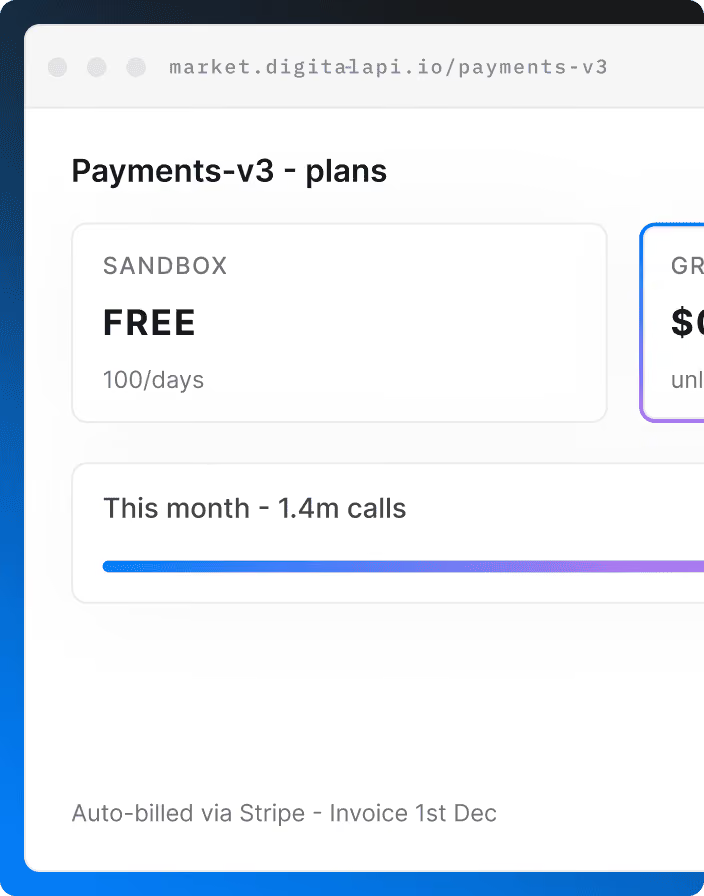
- Self-serve subscription and key management: Access requests, free trial sessions, automated key provisioning on approval, quota monitoring, and overage alerts per developer.
- Auto-generated docs that stay current: Documentation is generated from your OpenAPI specs and updates as they change. No parallel wiki to maintain.
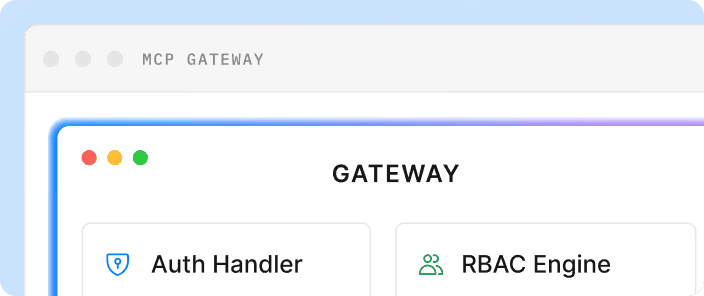
- Enterprise security from day one: SSO (SAML, OIDC), SCIM provisioning, RBAC, immutable audit logs, SIEM export, data residency (EU, US, APAC), 99.9% uptime SLA. No enterprise-tier upgrade.
- White-label and CMS: Custom domain, full brand control, and a CMS your product or partner team can run without filing tickets to engineering.
- Agent-ready out of the box: Your catalog doubles as an MCP tool registry so AI agents can discover and call your APIs alongside human developers. This is something you would have to design from scratch in a DIY build.
Instead of building and maintaining a custom developer portal from scratch, organizations can use DigitalAPI to launch a production-ready developer portal faster while maintaining consistent API standards.
Book a demo to see how DigitalAPI’s developer portal helps teams deliver better developer experiences and scale their API ecosystems.
Final Thoughts
Developer portals play a critical role in modern API ecosystems. They enable developers to discover APIs, understand documentation, and integrate services quickly without relying on manual support.
Building a successful developer portal requires careful planning around architecture, documentation, authentication, onboarding, and developer analytics. While some organizations build custom portals, many choose platforms that simplify these processes and improve governance.
If your organization is planning to launch or scale a developer portal, DigitalAPI provides the tools needed to streamline API onboarding, maintain governance, and improve developer adoption.
FAQs
What is an API developer portal?
An API developer portal is a self-service platform where developers discover APIs, read documentation, obtain credentials, and test integrations. It centralizes onboarding resources so developers can quickly understand APIs and start building applications.
What features should a developer portal include?
A developer portal should include API documentation, authentication and credential management, interactive API testing, SDKs or code samples, onboarding workflows, and developer analytics. These features help developers understand APIs and integrate them faster.
How long does it take to build a developer portal?
Building a developer portal can take weeks to months depending on infrastructure complexity. Teams must integrate documentation systems, authentication workflows, onboarding flows, and analytics tools. Using a developer portal platform can significantly reduce implementation time.
What is the difference between internal and external developer portals?
Internal developer portals help engineering teams discover and use internal APIs within an organization. External developer portals support partners or third-party developers by providing public API documentation, credentials, and integration resources.
Should companies build or buy a developer portal?
Organizations can build developer portals internally for full customization, but it requires significant development and maintenance. Many teams choose developer portal platforms to accelerate deployment, simplify governance, and improve developer onboarding.
Rajanish GJ is Chief Technology Officer at DigitalAPI, the multi-gateway API management platform that helps large enterprises consolidate API discovery, governance, monetization, and AI agent enablement across heterogeneous gateway environments, including Apigee, AWS API Gateway, Azure API Management, Kong, and MuleSoft.
Rajanish brings 20+ years of engineering leadership to the role. He spent formative years at Apigee, the API management platform now part of Google Cloud and widely regarded as the category’s foundational product, and at Google itself, where he worked on developer-facing infrastructure at scale. That operator background informs DigitalAPI’s architectural bets around gateway abstraction, MCP-ready APIs, and agent-native developer experience.
He writes regularly on API architecture, developer infrastructure, and AI-native API management, with particular focus on how engineering teams can future-proof their API platforms for the agent era.

One email a fortnight. Worth opening.
A short digest of what we're writing, what we're learning from customers, and the handful of links you'd actually want from us. No tracking pixels.

.avif)