



8 best Backstage alternatives in 2026 - reviewed and compared
Backstage is powerful but can be complex to operate and customize. If you’re looking for faster setup, better UX, or a managed developer portal

TL; DR
Backstage is powerful but can be complex to operate and customize. If you’re looking for faster setup, better UX, or a managed developer portal, these eight Backstage alternatives offer different tradeoffs. They cater to various team sizes, complexity levels, and hosting preferences:
DigitalAPI: Best for API-first teams looking for a self-hosted developer portal and catalog solution with strong API governance.
Port: Best managed (SaaS) alternative for small to mid-sized teams seeking quick setup and minimal infrastructure overhead.
OpsLevel: Best for enterprise teams that need robust service ownership and governance without building from scratch.
Cortex: Best for growing teams that want a low-code, self-hosted portal to unify services and internal docs.
Atlassian Compass: Best for teams already in the Atlassian ecosystem needing an integrated developer experience and cataloging.
A developer portal is meant to streamline your workflows, but what if it’s actually creating more complexity?
Backstage, the popular open-source developer portal framework created by Spotify, was designed to solve tool sprawl, poor service visibility, and fragmented documentation by centralizing everything into a single internal platform. With its software catalog, templates, and plugin ecosystem, Backstage helps teams standardize best practices and improve developer productivity at scale.
But here is the tricky part: As adoption grows, organizations discover challenges that prompt them to look for Backstage alternatives. This is because of the platform’s high setup effort, ongoing maintenance, limited flexibility, and the need for significant platform engineering investment.
But what are the best Backstage competitors?
This guide will explore the top 8 alternatives to Spotify Backstage to help you build a developer portal that truly fits your team’s needs.
What is Backstage?
Backstage is an open-source framework for building internal developer portals that unifies tools, services, and documentation into one centralized interface to help engineering teams create, discover, manage, and ship software more efficiently.
It’s built for developers, platform teams, and engineering organizations. Developers can quickly spin up new software components, platform teams can promote consistent best practices, and the whole organization benefits from having a central hub for everything tech-related.
Here is a detailed explanation YouTube video of Backstage by Spotify:
Practically, Backstage tackles complexity and fragmentation in modern engineering environments by giving teams one place to find what they need (services, code, docs, tooling, and metadata), standardizing how they build software, and encouraging best practices.
For developers, it speeds up the creation of software components. For platform teams, it helps enforce standards. And for entire engineering organizations, it acts as a central nervous system that ties together software, tooling, and knowledge, improving productivity and collaboration.
Backstage Competitors Compared
When evaluating alternatives to Backstage for building internal developer portals, teams need to consider hosting options, API gateway support, integration capabilities, governance, and ideal use cases. Each platform offers a unique strength. Some focus on API management, others on service catalogs, orchestration, or managed Backstage experiences. Here is a side-by-side comparison table of the leading Backstage competitors to help you quickly identify the best fit for your developer ecosystem.
Best Backstage Alternatives Reviewed
Let’s explore these developer portal tools and Backstage competitors in depth.
1. DigitalAPI
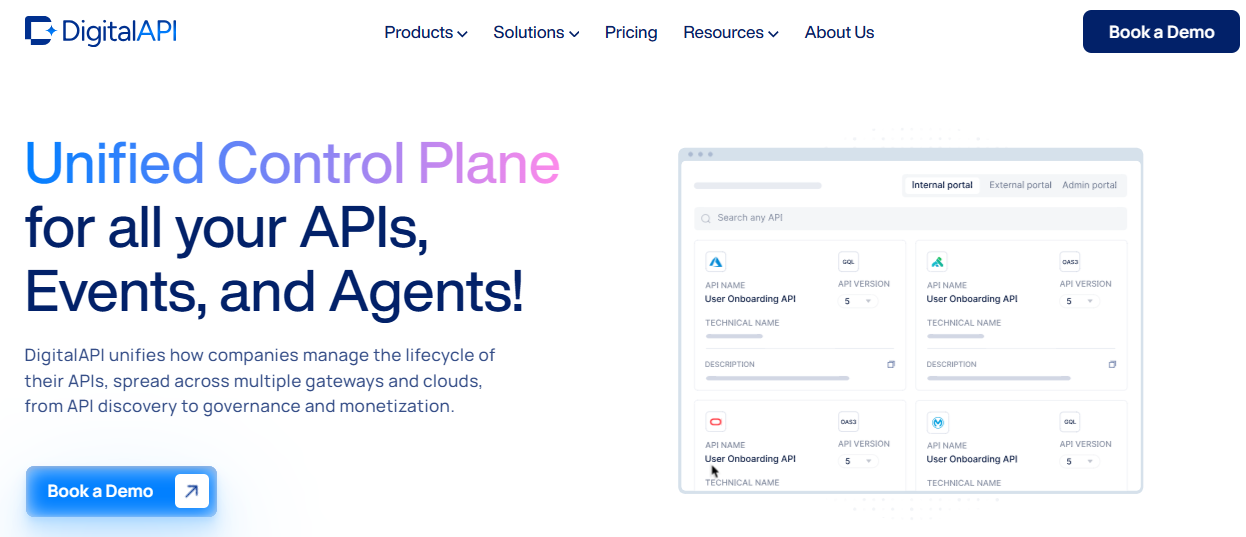
DigitalAPI stands out among the best Backstage alternatives, with a fully managed developer portal and unified service catalog that consolidates APIs from multiple gateways and clouds into one searchable platform with governance, discovery, analytics, and monetization capabilities.
While Backstage is an open-source framework, it’s not free. Furthermore, it requires plugins and costs enterprises 6-12 months of engineering effort to build and maintain a developer portal. On the other hand, DigitalAPI offers a built-in developer portal as a core component of its API management platform.
This portal is a ready-to-use, white-labeled solution designed to help enterprises publish, document, and manage their APIs for both internal and external developers.
At its core, DigitalAPI addresses common challenges that ackstage cannot address, such as API sprawl, lack of unified discovery, ongoing portal maintenance, governance gaps, and slow time-to-value. It eliminates the need to build and maintain your own portal infrastructure, provides built-in RBAC and compliance workflows, and offers analytics without external plugins.
The platform is best suited for mid-market to enterprise teams needing unified API discovery, governance, and monetization across multi-gateway ecosystems.
Key features
Some of the notable features of DigitalAPI include:
- Service and API catalog: The platform provides a centralized, searchable repository that brings APIs, events, SDKs, and related tools from all gateways and clouds into one unified view for discovery and reuse.
- Developer self-service: DigitalAPI offers a branded developer portal where users can browse documentation, test endpoints in sandboxes, request access, and subscribe to APIs without manual support.
- Templates and workflows: It includes preconfigured templates and governance workflows to streamline API publication, onboarding, approval, and lifecycle transitions with minimal engineering effort.
- Ownership and metadata: The software enriches each API with contextual metadata like owners, tags, SLA info, versions, and business domains to support governance and meaningful discovery.
- Governance and standards: DigitalAPI enforces consistent policies, compliance checks, role-based access control, and lifecycle states across all APIs to maintain security and quality at scale.
- Analytics and insights: The platform delivers real-time metrics on API usage, performance, traffic, and adoption to help teams optimize APIs and make data-driven decisions.
- Integrations (GitHub, Jira, CI/CD, cloud): It connects with existing gateways, repos, CI/CD pipelines, and tools so API metadata, docs, and lifecycle state are kept in sync with development workflows.
Pros
- DigitalAPI provides an excellent developer experience with immediate self-service and discovery.
- The platform has low operational overhead compared to DIY frameworks like Backstage.
- It has strong governance, compliance, and analytics built in.
Cons
- By design, DigitalAPI is less customizable than an open-source build-your-own portal.
- Has a small learning curve during the initial setup, especially while configuring policies and roles.
Backstage vs DigitalAPI
Backstage is an open-source platform that requires significant engineering effort to build, maintain, and customize a developer portal. On the other hand, DigitalAPI offers a fully managed, API management solution with built-in developer portal. The platform consolidates APIs, events, and services from multiple gateways and clouds into a single searchable catalog, with built-in workflows, analytics, and compliance features. This means teams can achieve enterprise-grade API visibility and self-service without the operational overhead of maintaining a custom portal.
DigitalAPI pricing model
Unlike Backstage, DigitalAPI recognizes that not all API organizations have the same needs, so you only pay for the features you’ll actually use. Contact support to get a quote based on your company's size and requirements!
2. Port
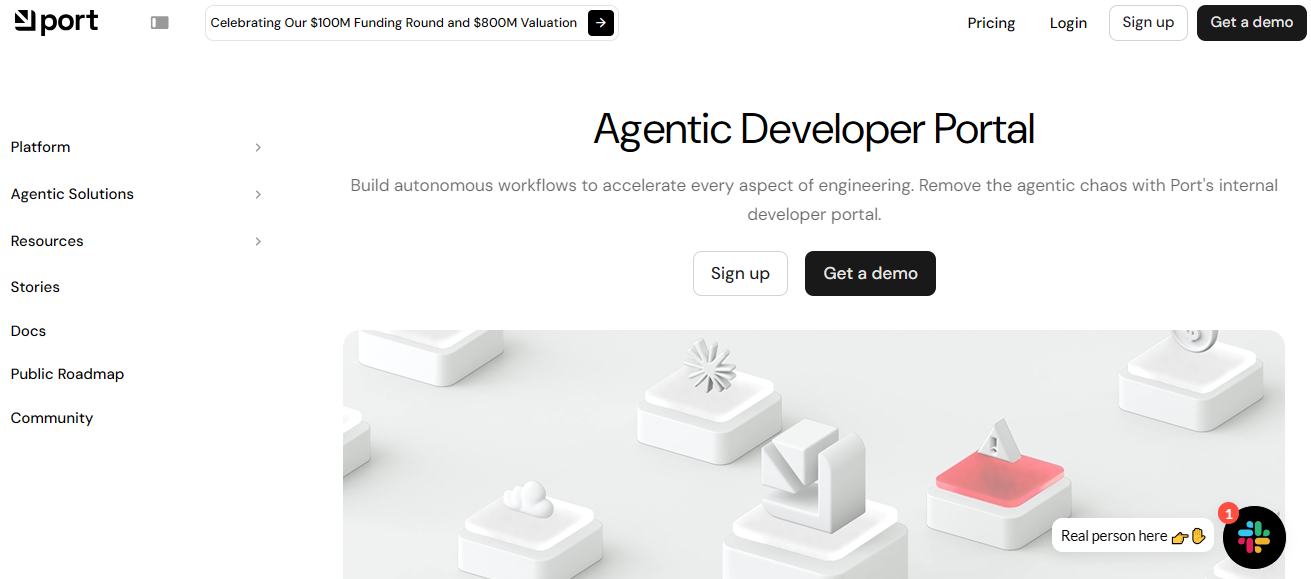
Port is an agentic internal developer portal and platform that centralizes engineering context into a unified software catalog with dynamic scorecards, self-service actions, and workflow automation, enabling developers and platform teams to discover, act, and govern software and infrastructure without custom code.
The platform solves the complexity of building and maintaining custom internal developer portals by providing out-of-the-box cataloguing, scorecards, self-service actions, and automation to reduce engineering friction, improve visibility, and enforce standards across the software lifecycle.
It’s suitable for platform teams building extensible internal developer portals with workflow automation.
Features
- Centralized internal developer portal: Port provides a customizable internal developer portal that acts as a single source of truth for software catalogs, workflows, scorecards, and developer self-service actions.
- Agentic and automated workflows: The platform enables building autonomous workflows (e.g., self-healing incidents and automated ticket resolution) to accelerate engineering operations and reduce manual tasks.
Pros
- Port improves engineer productivity
- The platform centralizes data
- It also supports advanced automation and AI integration
Cons
- Port requires configuration and adoption effort to model data and set up workflows effectively (implied technical complexity).
- The platform primarily focuses on internal developer and platform engineering use cases, so it may not directly address non-engineering business workflows.
Backstage vs Port
While the Backstage open-source framework requires significant engineering effort to build and customize a developer portal, Port delivers a managed, no-code/low-code platform with self-service and automation features out of the box. Additionally, Port includes built-in governance and scorecards that reduce the need for custom plugin development and ongoing maintenance.
Port pricing model
Port offers a free limited plan, with premium plans starting from $30 per month/dev, limited to organizations with up to 50 developers.
3. OpsLevel
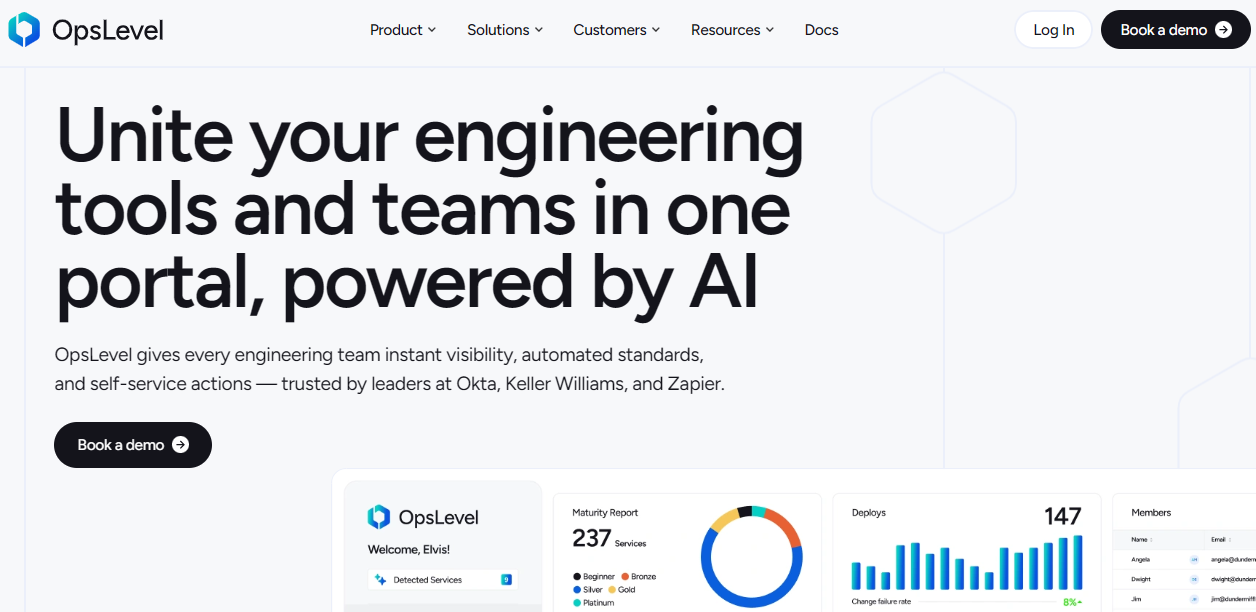
OpsLevel is among the Backstage alternatives for building a service catalog, enforcing standards with scorecards and checks, and empowering developers with one-click self-service actions; all from a unified dashboard to boost engineering visibility and quality.
It’s a governance-first, managed SaaS platform designed to standardize service ownership and health instead of offering raw infrastructure components. It prioritizes developer experience through automation and out-of-the-box tooling rather than relying on open-source extensibility.
By design, OpsLevel is ideal for teams looking for a managed, opinionated internal developer portal with a turnkey service catalog/IDP with strong standards enforcement rather than a fully custom framework.
Features
- AI-powered service catalog: OpsLevel discovers and enriches services with owners, metadata, and descriptions.
- Scorecards and checks: It’s designed with built-in and customizable checks that continuously measure service health against organizational standards.
- Developer actions: The platform uses one-click self-service actions to scaffold services, manage cloud artifacts, or override deploy freezes safely.
Pros
- OpsLevel features an intuitive dashboard and UI.
- It integrates with your existing tech stack.
- The platform uses automated service maturity tracking to provide actionable insights.
Cons
- Many users complain that OpsLevel has a steep learning curve for new teams.
- The platform doesn’t provide comprehensive out-of-the-box monitoring or anomaly detection.
Backstage vs OpsLevel
By design, Backstage is an open-source DIY internal developer portal, but it requires some expertise to customize and maintain. OpsLevel, on the other hand, has with built-in catalog, standards enforcement, and self-service actions that work out-of-the-box with less upkeep.
Pricing model
OpsLevel is available in two different pricing plans. Contact support for a quote.
4. Cortex
Cortex centralizes service and software metadata, scorecards, and workflows, unifying tools and data to improve visibility, enforce standards, and accelerate developer productivity across teams.
It is a managed, proprietary developer portal designed for turnkey use rather than open-source DIY frameworks and is built with scorecards and standards enforcement to codify best practices and compliance.
Based on its features, Cortex is ideal for teams wanting a more structured, less DIY portal than Backstage, with scaffolding and templates.
Features
- Unified service and resource catalog: Cortex has a centralized repository combining ownership, dependencies, and metadata across your software ecosystem.
- Custom scorecards and standards: The platform can define, measure, and enforce organizational best practices and operational metrics.
- Workflow automation and self-service: You can also automate common engineering actions and empower developers to self-serve with guided workflows.
Pros
- Cortex offers out-of-the-box aggregation of data and tooling into a unified system of record.
- The platform emphasizes strong governance.
- It also enables self-serve workflows to improve velocity.
Cons
- Cortex has a more rigid architecture that can restrict how much you can tailor it.
- The platform’s scorecard capabilities can be less flexible for certain advanced use cases.
Backstage vs Cortex
Backstage requires internal effort to build and maintain a custom developer portal. Cortex, in contrast, is a managed commercial IDP that offers a ready-built portal with scorecards and workflows, prioritizing governance and rapid delivery.
Pricing model
Cortex is priced based on the number of engineers you have in your organization. Contact support for a quote.
5. Atlassian Compass
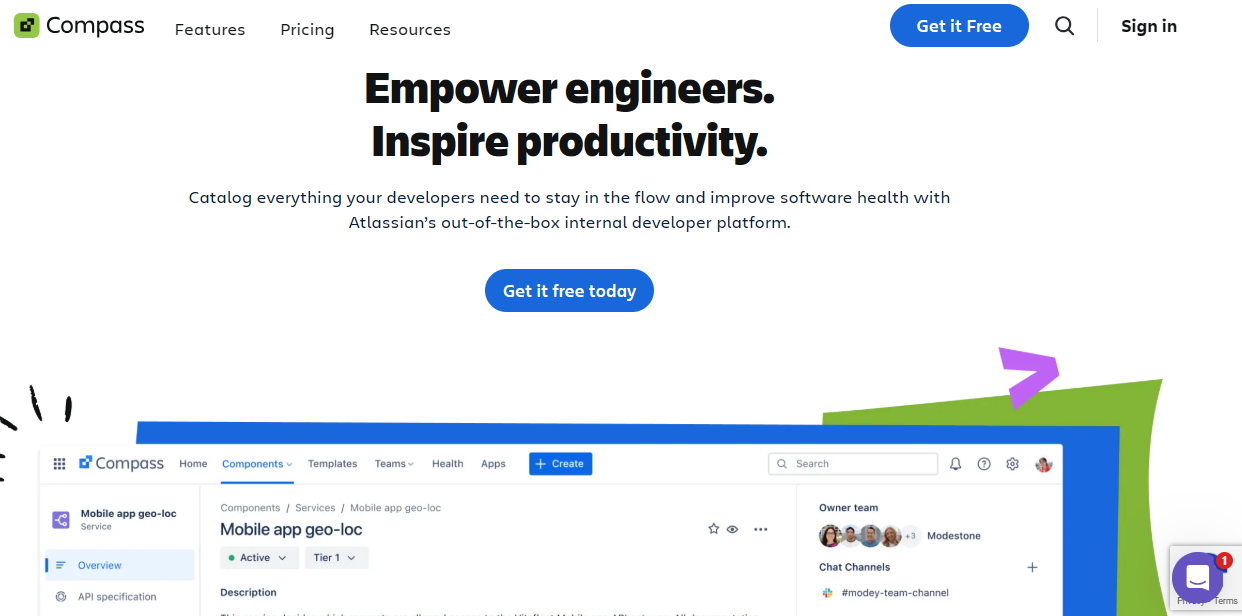
Atlassian Compass centralizes software components, team metrics, and health scorecards, enabling teams to streamline development and improve software quality.
The platform follows a governance-first, developer-experience (DevEx)-first approach, focusing on managed platforms rather than fully open-source solutions. It operates by cataloging software components, tracking software and team health, managing APIs, and providing actionable insights into bottlenecks to reduce cognitive load and improve both productivity and code quality.
Features
- Service catalog: Atlassian Compass centralizes all services, APIs, and libraries for easy discovery.
- Health and security scorecards: They measure code quality, test coverage, and vulnerabilities.
- Team metrics: The platform can track DORA metrics and identify blockers to optimize development cycles.
Pros
- Atlassian Compass streamlines developer workflows and reduces context switching.
- The platform provides actionable metrics for software and team health.
- It’s also extensible with integrations across tools and infrastructure.
Cons
- Atlassian Compass can be complex for small teams
- Some users complain that the platform has a learning curve for configuring catalogs and scorecards.
Backstage vs Atlassian Compass
While Backstage is open-source and highly customizable, Compass is a managed, governance-first platform with built-in analytics and scorecards. The platform emphasizes reducing operational overhead for enterprise teams.
Pricing model
Atlassian Compass offers 3 different pricing plans: a free limited plan, and premium plans starting from $7.67 per user/month.
6. Harness
Harness Internal Developer Portal is a managed, governance-first platform for streamlining developer workflows, so teams can discover, use, and manage internal tools, APIs, and services efficiently while improving developer experience and operational visibility.
As one of the prominent Backstage competitors, the platform is ideal for growing and mature engineering teams looking to catalog internal services, track API usage, implement scorecards, and manage workflows.
Features
- Service catalog: Harness is built with a centralized registry of internal APIs, services, and tools to boost discoverability.
- Scorecards: The platform can track team and service health metrics to optimize operations and efficiency.
- Workflow automation: It can also streamline internal processes with built-in, governance-aligned workflows.
Pros
- Harness is a fully managed platform that reduces operational overhead.
- The platform’s governance-first approach ensures compliance and security.
- It enhances developer experience with streamlined access to internal tools.
Cons
- Some users complain that Harness is less customizable compared to other Backstage alternatives.
- It also requires subscription costs, which makes it not ideal for small startups.
Backstage vs Harness Internal Developer Portal
Backstage is an open-source platform emphasizing flexibility and customizability, while Harness Internal Developer Portal is a managed, governance-focused solution prioritizing security and developer experience. Backstage requires self-management, whereas Harness offers a turnkey enterprise-ready approach.
Pricing model
Harness offers three distinct pricing plans. Contact sales for a quote.
7. Humanitec
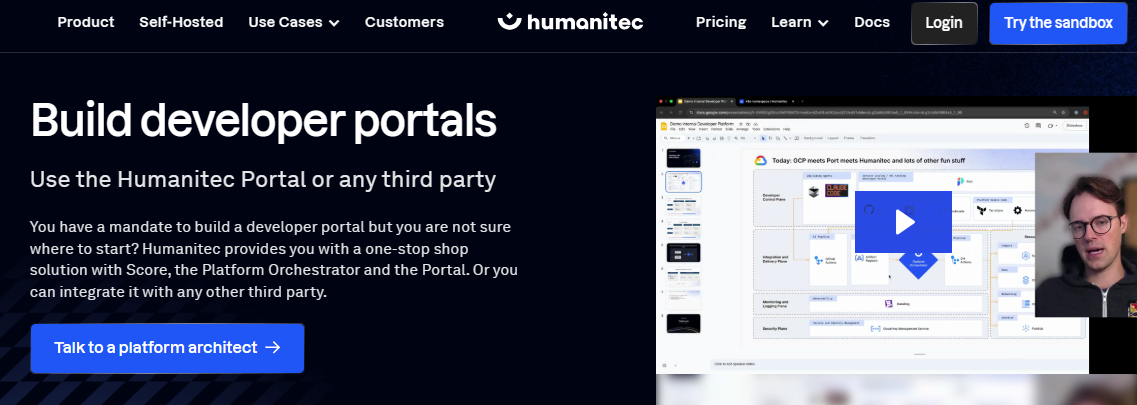
Humanitec enables teams to build internal developer portals with complete automation, governance, and self-service capabilities. Its philosophy is governance-first and DevEx-first, offering a managed solution rather than purely open-source, ensuring consistency and efficiency. The platform solves challenges like manual deployment bottlenecks, fragmented DevOps workflows, and complex infrastructure orchestration.
Operationally, Humanitec is ideal for organizations at mid-to-large platform maturity, with teams ranging from 20 to 200 engineers, who need a unified solution for service catalogs, APIs, workflows, and scorecards.
Features
- Platform orchestrator: Humanitec automates and standardizes infrastructure operations at scale.
- Developer portal: The platform provides self-service access to infrastructure, apps, and services.
- Score and reference architectures: It enables developers to interact with a consistent, code-based interface and adopt enterprise-grade blueprints.
Pros
- Humanitec offers full transparency on deployments across environments.
- The platform has high adoption and developer satisfaction.
- It simplifies Kubernetes and multi-cloud orchestration.
Cons
- Humanitec can be costly for small teams and startups.
- Some users complain that the platform is complex to set up compared to other developer portal tools.
Backstage vs Humanitec
Unlike Backstage, which is open-source and developer-centric, Humanitec offers a managed, governance-first platform with built-in orchestration and self-service features. It is more focused on enterprise-scale infrastructure management rather than just cataloging services.
Pricing model
Humanitec offers three different pricing tiers starting from $ 1,979/month, 5 users included.
8. Roadie
Roadie is a fully managed SaaS platform built on Backstage to help organizations adopt an internal developer portal faster with governance, templates, scorecards, and curated plugins, without the operational burden of running Backstage yourself.
It is ideal for teams supporting tens of thousands of developers moving from early or fragmented platforms to standardized internal developer platforms.
Features
- Managed backstage platform: A production-ready Backstage environment with hosting, upgrades, security patches, and support handled by Roadie.
- Scorecards and governance: Built-in scorecards to track engineering standards, ownership, documentation, and operational maturity.
- Self-service templates and workflows: Golden paths that let developers create services, APIs, and infrastructure consistently and safely.
Pros
- No infrastructure or maintenance overhead
- Faster time-to-value than self-hosted Backstage
- Strong governance and enterprise-ready features
Cons
- Less low-level customization than pure OSS Backstage
- SaaS dependency may not fit highly regulated environments
- Pricing is not transparent without sales engagement
Backstage vs Roadie
Backstage is an open-source framework that requires teams to host, operate, and customize it themselves, while Roadie delivers Backstage as a fully managed SaaS. Besides, Roadie prioritizes speed, governance, and reliability, whereas Backstage prioritizes flexibility and full control.
Pricing model
Roadie is available in two different pricing tiers, starting from $24 per dev/month for 50 to 150 developers.
Why Should You Consider Alternatives to Spotify Backstage?
Teams explore Backstage alternatives due to high engineering overhead, customization complexity, governance gaps, and slow time-to-value. Backstage competitors and modern internal developer portal alternatives often deliver faster setup, better visibility, and lower total cost.
Here are a few reasons to explore Internal developer portal alternatives to Backstage:
1. Engineering overhead
When teams first adopt Backstage, the promise of an open-source developer portal is appealing. Over time, though, the engineering overhead becomes hard to ignore.
Backstage typically requires a dedicated platform team to keep things running, manage frequent upgrades, and handle ongoing maintenance. Because most organizations need custom frontend and backend work, the effort doesn’t stop after launch.
For many teams, this pushes them to evaluate Backstage alternatives or other developer portal tools that are easier to operate with leaner resources.
2. Customization challenges
Customization is another challenge that makes teams consider Backstage competitors. While Backstage’s plugin ecosystem is powerful, plugins require continuous support and updates, and quality can vary widely.
Enforcing consistent standards across dozens or hundreds of plugins is challenging at scale. As organizations grow, these issues can slow innovation instead of enabling it, prompting teams to look at Backstage competitors or more opinionated internal developer portal alternatives that offer built-in capabilities with less ongoing customization work.
3. Governance and visibility gaps
Governance and visibility also tend to be sticking points. Backstage lacks a native API marketplace, and policy enforcement often requires additional tooling or custom development.
Another thing, the platform offers limited analytics and reporting out of the box, making it harder for teams to measure adoption, track usage, or demonstrate value. In contrast, many open-source developer portal alternatives and commercial platforms prioritize governance, visibility, and insights from day one.
4. Time-to-value issues
Finally, time-to-value is a major consideration. Despite Backstage pricing being attractive on paper because it’s open source, implementation cycles can be long and internal costs high.
When speed, clarity, and measurable impact matter, many organizations find that exploring Backstage alternatives delivers faster results and a lower total cost of ownership.
How to Choose the Right BackStage Alternative
Choosing the right alternative to Backstage is more than just finding a one-size-fits-all replacement. It involves matching the platform to how your engineering team actually works today and where it’s headed tomorrow. With many strong Backstage alternatives and competitors now available, teams have more flexibility than ever when evaluating internal developer portal alternatives and modern developer portal tools.
Here are the key decision criteria to focus on when selecting the right option.
1. Team size and platform maturity
Smaller or fast-growing teams often need a solution that works out of the box with minimal configuration. If your platform practices are still evolving, Backstage alternatives like DigitalAPI, Port, or Roadie can help you move quickly without heavy upfront design.
Larger, more mature platform teams may prefer tools like OpsLevel, Cortex, or Humanitec that support deeper customization and complex workflows. Your team’s operational maturity should guide how much flexibility versus simplicity you need.
2. Managed vs. self-hosted preference
Backstage is open source, which gives teams full control but also full responsibility. If managing infrastructure, upgrades, and plugins feels like a burden, a managed alternative may deliver faster results.
Many Backstage competitors remove operational overhead entirely while still offering extensibility. On the other hand, if control and customization are critical, you may still lean toward open-source developer portal alternatives or hybrid models like Roadie.
3. Governance and standards enforcement
If you care deeply about service ownership, compliance, and golden paths, governance becomes a deciding factor. Platforms such as OpsLevel, Cortex, and Atlassian Compass excel at defining standards and measuring adherence. These tools help platform teams guide developers without slowing them down—something that often requires extra effort when building directly on Backstage.
4. Time-to-value
Backstage can take months to fully implement, especially when factoring in plugins and maintenance. If speed matters, evaluate how quickly a portal delivers value after onboarding. Managed developer portal tools typically win here, letting teams focus on adoption rather than setup.
5. Integration ecosystem
Your portal should fit into your existing toolchain—CI/CD, cloud providers, observability, and ticketing systems. Strong integrations reduce friction and improve adoption. Many internal developer portal alternatives now offer broader native integrations than vanilla Backstage.
6. Budget and long-term cost
While Backstage pricing appears attractive since it’s open source, the hidden costs—engineering time, hosting, and maintenance—add up. Commercial Backstage alternatives offer transparent pricing that may be more cost-effective over time, especially for smaller teams.
Elevate Your API Strategy with DigitalAPI Today
In the search for the perfect developer portal, DigitalAPI emerges as the best overall solution, outshining other Backstage alternatives by delivering a ready-to-use, enterprise-grade platform where others offer frameworks or partial tools.
While platforms like Backstage require months of engineering just to build and maintain a basic portal, and others like Port or Cortex focus on specific aspects like service cataloging or developer experience, DigitalAPI provides an end-to-end solution that works on day one.
Here’s why DigitalAPI is the definitive Backstage competitor choice:
- Solves the multi-gateway chaos: Unlike other Backstage alternatives, which struggle with API visibility across different systems, DigitalAPI natively unifies APIs from gateways like Apigee, Kong, AWS, and MuleSoft into a single, searchable catalog. This eliminates the context-switching and fragmented governance that plague complex enterprises.
- Delivers instant value: Backstage is a framework that demands a dedicated platform team to build and maintain, often for years. Similarly, open-source or self-managed alternatives can become costly, ongoing engineering burdens. DigitalAPI is a fully managed, turnkey platform that deploys in days, not months, with predictable pricing and no hidden maintenance costs.
- Offers built-in, not bolted-on governance and analytics: Where Backstage lacks out-of-the-box controls, and other developer portal tools may require extensive integration, DigitalAPI comes with enterprise-ready RBAC, SLA enforcement, compliance workflows, and unified analytics across all your APIs. It provides the governance and full-stack insights enterprises need without custom coding.
DigitalAPI directly addresses the core limitations of Backstage lengthy setup, lack of multi-gateway support, and absent governance transforming the vision of a unified developer portal into an operational reality.
Ready to transform your developer portal? Get a customized demo of DigitalAPI's unified platform and see how the platform works!
FAQs on Backstage Alternatives
1. Why do companies replace Backstage?
Companies replace Backstage due to high customization effort, ongoing maintenance, and hidden costs. Teams often outgrow DIY setups, struggle with scalability, or need faster time-to-value. Backstage alternatives and managed Backstage competitors offer predictable Backstage pricing, enterprise support, governance, and simpler adoption than open-source developer portal alternatives.
2. Is Backstage still worth using in 2026?
Backstage can still be worth using in 2025 for organizations with strong platform teams and open-source expertise. However, many companies prefer internal developer portal alternatives that reduce maintenance and speed delivery. Modern developer portal tools and Backstage competitors now provide managed experiences, security, and clearer Backstage pricing.
3. What is the best managed alternative to Backstage?
The best managed alternative to Backstage is typically a fully hosted internal developer portal that removes operational burden. Leading Backstage alternatives offer built-in templates, integrations, upgrades, and support. Compared to open-source developer portal alternatives, managed Backstage competitors deliver faster onboarding, enterprise governance, and predictable Backstage pricing.
4. Which tool is best for platform engineering teams?
Platform engineering teams benefit most from developer portal tools that centralize services, standards, and automation. While Backstage remains popular, many teams choose Backstage alternatives with opinionated workflows and governance. The best internal developer portal alternatives improve developer experience, scale easily, and reduce platform maintenance compared to open-source developer portal alternatives.
5. Can Backstage handle large enterprises?
Backstage can handle large enterprises, but success depends on significant investment in customization, infrastructure, and governance. Many enterprises evaluate Backstage competitors when scaling globally or managing compliance. In these cases, managed Backstage alternatives and internal developer portal alternatives often outperform pure open-source developer portal alternatives in reliability and support.
6. Is there a Backstage alternative with built-in governance?
Yes, several Backstage alternatives include built-in governance, security controls, and compliance workflows. These developer portal tools are designed for regulated environments and enterprise scale. Compared to open-source developer portal alternatives, governed Backstage competitors provide policy enforcement, approvals, and auditability without heavy customization or unpredictable Backstage pricing.
Dhayalan Subramanian is Associate Director, Product Growth at DigitalAPI, where he leads go-to-market and product growth for the company’s multi-gateway API management platform. His work focuses on helping large enterprises and mid-market cloud companies consolidate APIs across AWS, Azure, Apigee, Kong, MuleSoft, and other gateways into a single control plane for governance, discovery, monetization, and agent consumption.
Dhayalan brings 14+ years of experience across product strategy, enterprise architecture, and engineering leadership. Earlier in his career, he held senior roles at Encora (as Associate Architect and Technical Manager), Mindtree (Technology Lead), Tech Mahindra (Technical Lead), and Primus Analytics, where he designed integration frameworks and delivered enterprise-grade digital platforms for global customers.
At DigitalAPI, he works directly with platform, integration, and developer experience leaders at Fortune 500 organizations to operationalize unified API catalogs, developer portals, and MCP-ready APIs. He writes regularly on API developer experience, API governance, and AI agent architectures.
One email a fortnight. Worth opening.
A short digest of what we're writing, what we're learning from customers, and the handful of links you'd actually want from us. No tracking pixels.

.avif)