



MuleSoft API Developer Portal: Why Teams Should Look Beyond the Default Portal
Explore the MuleSoft API developer portal, its limitations, and key features. Learn how to improve API discovery and developer onboarding for MuleSoft APIs.


TL;DR
MuleSoft provides a developer portal through Anypoint Exchange, but many teams face limitations as their API programs grow. Challenges such as limited customization, complex onboarding for external developers, and difficulty organizing large API catalogs can affect developer experience.
With DigitalAPI’s developer portal for MuleSoft APIs, organizations can improve API discovery, streamline developer onboarding, and provide a more flexible developer experience beyond the default Anypoint portal.
Book a demo to see how DigitalAPI helps organizations build a scalable MuleSoft API developer portal.
MuleSoft provides a developer portal through its Anypoint Platform to help organizations publish and manage APIs. It allows teams to share API documentation, manage API products, and provide access to developers through a centralized interface.
However, as API programs expand, many teams find that the default MuleSoft API developer portal may not fully support their evolving developer experience needs. Organizations often require more flexibility for API discovery, onboarding workflows, and portal customization to support growing developer ecosystems.
What Are the Limitations of the MuleSoft API Developer Portal?
MuleSoft provides a developer portal through Anypoint Exchange, where APIs, connectors, and documentation can be published for developers. While this works well within the MuleSoft ecosystem, many organizations encounter challenges as their API programs grow or when they need more flexibility in how APIs are presented and consumed. Some common limitations include:
- Tight coupling with the Anypoint Platform: The MuleSoft developer portal is closely integrated with the Anypoint ecosystem. This can make it difficult for teams that manage APIs across multiple gateways or platforms.
- Limited flexibility in portal customization: Customizing the portal experience, layout, and developer workflows can be restrictive. Organizations often want more control over how APIs and documentation are presented.
- API discovery becomes difficult at scale: As more APIs are published in Anypoint Exchange, developers may find it harder to discover and navigate available APIs quickly.
- Complex onboarding for external developers: External developers often need to create Anypoint accounts and follow multiple steps before they can access APIs, which can slow down onboarding.
- Limited control over developer workflows: Teams may want customized approval flows, onboarding processes, or access management policies that are not easily configurable within the default portal.
- Strong dependency on MuleSoft infrastructure: The developer portal works best within the MuleSoft ecosystem. Organizations looking to manage APIs beyond MuleSoft may need a more flexible developer portal approach.
What Features Should a MuleSoft API Developer Portal Have?
A MuleSoft API developer portal should make it easier for developers to discover APIs, understand how they work, and start integrating quickly. As API programs grow, the portal should also support better organization of APIs and more flexible developer onboarding.
1. Clear API Catalog for MuleSoft APIs
Developers should be able to browse and search APIs published through MuleSoft easily. A well-structured API catalog helps organize APIs with descriptions, versions, and categories.
This makes it easier for developers to understand what APIs are available and how they can use them.
2. Interactive API Documentation
API documentation should clearly explain endpoints, parameters, and response formats. Interactive documentation allows developers to explore APIs and understand how they work before writing code.
This improves developer experience and reduces integration errors.
3. Self serve Developer Onboarding
Developers should be able to sign up, request API access, and start integrating without unnecessary steps. A streamlined onboarding process helps reduce delays and encourages API adoption.
The portal should also support onboarding workflows for both internal and external developers.
4. API Product Visibility
MuleSoft allows APIs to be packaged as API products or assets. A developer portal should clearly present these API products so developers understand available capabilities and access requirements.
This helps organizations structure their APIs in a way that is easier for developers to consume.
5. Usage Insights for API Teams
API platform teams need visibility into how APIs are used. Analytics and usage insights help teams understand which APIs are popular and how developers interact with them. These insights support better API governance and platform growth.
Why Choose DigitalAPI’s Developer Portal for MuleSoft APIs?
Many organizations using MuleSoft want a developer portal that provides more flexibility than the default Anypoint experience. DigitalAPI complements MuleSoft by adding a developer-focused layer that improves API discoverability, onboarding, and developer engagement.
It is a purpose-built solution for any organization that exposes APIs to developers, partners, or AI agents and has outgrown documentation-only tools, spreadsheets, or homegrown portals.
Instead of forcing teams to stitch together a docs tool, a key-management spreadsheet, a sandbox, a ticket queue, and a finance handoff, the portal connects discovery, testing, access, subscriptions, and analytics in one place. Developers and AI agents query the catalog in plain English and find any API by use case, name, or data type.
Unlike documentation-only or gateway native developer portals that offer a subpar experience, or open-source internal portal frameworks that take 3 to 6 months to set up and require huge engineering effort, DigitalAPI's Developer Portal handles the entire developer journey out of the box and can be up and running in 3 days. It's built agent-ready from day one, so AI agents consume your APIs through the same governance and audit trail as human developers.
Key features of DigitalAPI's Developer Portal
- Unified API catalog and search: Get a searchable registry of all available APIs in your organization in one searchable catalog, spread across multiple gateways, teams, repositories, and environments, with role-based visibility per audience.
- AI-powered search and API-GPT: Developers and AI agents find the right API by use case, name, data type, or plain English query. The same natural-language layer serves human developers and AI agents, which matters as agent traffic grows.
- Interactive API explorer and sandboxing: An interactive sandbox inside the portal with pre-filled auth tokens, saved history, and shareable examples. Collapses the gap from "discovered the API" to "made the first call" from days to minutes.
- Self-serve onboarding and subscription management: External developers sign up, accept terms, pick a tier, and get a key. Internal engineers request access and get routed to the API owner. Plan tiers, quotas, key rotation (90 or 120-day, per-user), and audit trails handle the full lifecycle.
- Usage analytics and visibility: Consumer dashboards show what's being called, by whom, and how often. Account managers see partner usage and expiry; internal teams see reuse and dependency maps.
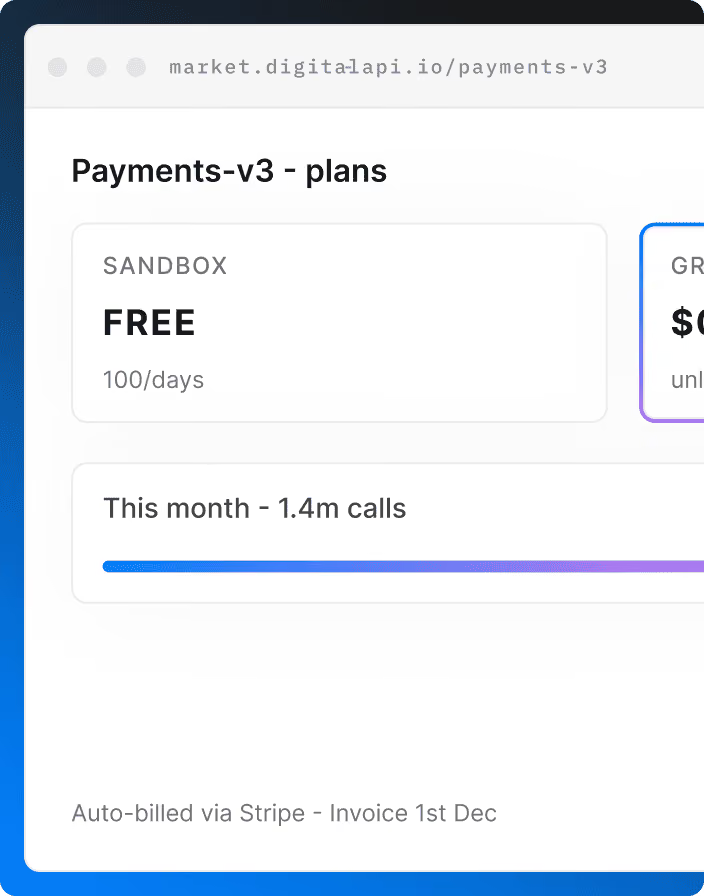
- Monetization ready: Native billing for tiered subscriptions, pay-per-use, and overages, with usage data flowing directly into Stripe, NetSuite, or QuickBooks. Revenue recognition is audit-ready out of the box. Turns external APIs from a support cost into a revenue line without standing up a separate billing stack.
- Comprehensive SDKs: Auto-generated, downloadable code kits in Python, Java, JavaScript, Go, and .NET, distributed via NPM, Maven, and the package managers developers already use. One-click global language switching changes the programming language of every code snippet across the portal, so developers can integrate in their stack of choice.
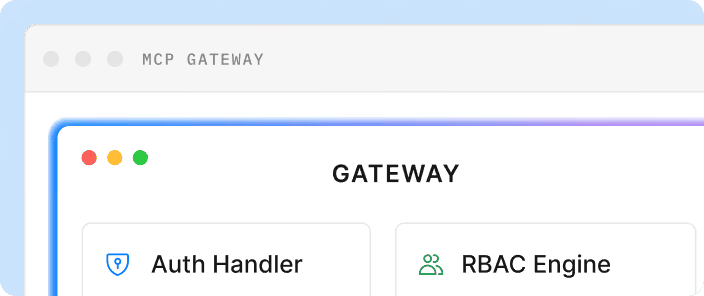
- Governance and RBAC: Role-based access control with custom roles for internal engineers, external partners, and AI agents under one access model. IP allowlisting, scoped credentials, and immutable audit logs export to your SIEM, so every audience operates under the same compliant policies.
- Community and support: Integrated changelogs, FAQ sections, an embedded chatbot, and Salesforce-routed support ticketing keep developers informed and engaged. A built-in CMS lets a non-developer team publish guides, tutorials, and announcements without engineering.
- Automated, high-quality documentation and key management: Docs generate from your OpenAPI specs and stay current as APIs change. Keys provision on approval, rotate on policy, notify before expiry. Ends the cycle of stale docs and surprise key expirations.
- White-label branding without engineering: Custom domain, your colors, typography, and logos. A drag-and-drop theme editor and built-in CMS let a product or partner team publish updates without an engineering ticket. New tenant portals are provisioned in minutes.
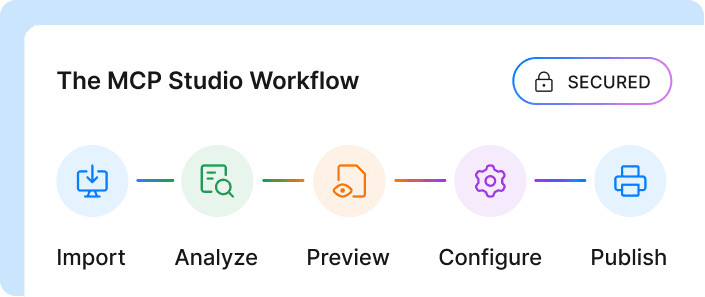
- Agent and MCP ready: Every API auto-generates an MCP tool definition from its OpenAPI spec. Agents authenticate via OAuth M2M with scoped access and per-agent rate limits. One catalog, one governance model, one audit trail across human developers, partners, and AI agents.
Book a demo to see how DigitalAPI helps organizations build a scalable MuleSoft API developer portal.
FAQs
1. What is a MuleSoft API developer portal?
A MuleSoft API developer portal is a platform where developers can discover APIs, read documentation, request access, and integrate with APIs managed through the MuleSoft Anypoint Platform.
2. Does MuleSoft provide a developer portal?
Yes. MuleSoft provides a developer portal through Anypoint Exchange, where organizations can publish APIs, connectors, and other reusable assets for developers.
3. Why do teams look for alternatives to the MuleSoft developer portal?
Some teams look for mulesoft alternatives because they want more flexibility in portal customization, developer onboarding workflows, and API discovery, especially when managing large API ecosystems.
4. How do developers access APIs in MuleSoft?
Developers typically access APIs through applications created in the MuleSoft platform. Once approved, they receive credentials such as client IDs and secrets to authenticate API requests.
5. What should teams look for in a MuleSoft API developer portal?
Teams should look for features such as a centralized API catalog, interactive documentation, self-service onboarding, credential management, and usage insights to improve developer experience.
Dhayalan Subramanian is Associate Director, Product Growth at DigitalAPI, where he leads go-to-market and product growth for the company’s multi-gateway API management platform. His work focuses on helping large enterprises and mid-market cloud companies consolidate APIs across AWS, Azure, Apigee, Kong, MuleSoft, and other gateways into a single control plane for governance, discovery, monetization, and agent consumption.
Dhayalan brings 14+ years of experience across product strategy, enterprise architecture, and engineering leadership. Earlier in his career, he held senior roles at Encora (as Associate Architect and Technical Manager), Mindtree (Technology Lead), Tech Mahindra (Technical Lead), and Primus Analytics, where he designed integration frameworks and delivered enterprise-grade digital platforms for global customers.
At DigitalAPI, he works directly with platform, integration, and developer experience leaders at Fortune 500 organizations to operationalize unified API catalogs, developer portals, and MCP-ready APIs. He writes regularly on API developer experience, API governance, and AI agent architectures.
One email a fortnight. Worth opening.
A short digest of what we're writing, what we're learning from customers, and the handful of links you'd actually want from us. No tracking pixels.

.avif)