



Top MuleSoft Alternatives for API Management in 2026: Compared by Features, Cost, and Fit
The enterprise integration landscape has shifted dramatically. For years, MuleSoft was the default choice for connecting monolithic systems.

The top MuleSoft alternatives in 2026 are DigitalAPI, Apigee, Solo, Kong, Gravitee, Zuplo, Tyk, and API7. Each addresses a different dimension of what MuleSoft gets expensive, complex, or inflexible on at scale.
TL;DR
MuleSoft Anypoint Platform is a 12-time Gartner Magic Quadrant leader for iPaaS, but median contract values above $55,000 per year, vCore-based pricing that compounds as workloads grow, Salesforce ecosystem dependency, and a steep implementation curve push enterprise teams to evaluate alternatives at renewal.
DigitalAPI sits above MuleSoft or any replacement gateway as a unified control plane, adding a self-serve developer portal, API monetization, multi-gateway cataloguing, and native MCP tooling without requiring a MuleSoft rip-and-replace.
Apigee is the strongest alternative for Google Cloud-committed enterprises needing deep analytics and policy-driven governance at scale.
Kong is the most direct gateway-level alternative for teams that want plugin-rich API management without enterprise iPaaS pricing.
Gravitee and Tyk are the strongest open-source full-lifecycle alternatives with built-in developer portals and no feature-gating.
Zuplo suits cloud-native teams that want managed edge simplicity and native AI gateway capabilities without infrastructure overhead.
Solo targets service mesh and Envoy infrastructure complexity at the Kubernetes layer.
API7 is for APISIX-native teams wanting commercial support without proprietary lock-in.
Why Teams Move Away from MuleSoft in 2026
MuleSoft's architecture is not wrong. For the largest enterprises running Salesforce, SAP, and Workday integrations with dedicated teams of 10 to 20 integration engineers, Anypoint Platform is genuinely difficult to displace. The pressure to evaluate alternatives builds from specific structural pain points rather than a wholesale failure.
1. vCore pricing becomes unpredictable at scale:
MuleSoft bills on vCore capacity units rather than API calls or services. As workloads grow, vCore allocation grows with them. Teams that launch with a manageable annual contract find renewal conversations driven by capacity usage they did not forecast accurately at signing. Contract values above $55,000 per year are common for mid-sized enterprise deployments, and growth compounds that figure further.
2. Salesforce lock-in is structural:
MuleSoft was acquired by Salesforce in 2018. Since then, the Anypoint Platform has deepened its integration with the Salesforce ecosystem. For enterprises not committed to Salesforce CRM, that dependency is increasingly difficult to justify architecturally. Deployment, support, and roadmap decisions are influenced by Salesforce's priorities rather than the standalone API management market.
3. Implementation timelines are long:
MuleSoft regularly requires an implementation partner engagement to stand up properly. Teams that need a working developer portal, catalogued APIs, and external partner access within weeks consistently find MuleSoft's configuration overhead front-loads time and cost in ways that delay any measurable return.
4. AI-readiness is add-on rather than native:
MuleSoft's Anypoint AI Agent capabilities arrived as part of a recent Anypoint platform evolution. For teams building agent-facing API surfaces now, MCP gateway support and agent-grade credential scoping are not yet first-class features in the way purpose-built AI-ready platforms deliver them.
Quick Comparison: MuleSoft vs. Top Alternatives
(scroll to view full table)
The 8 Best MuleSoft Alternatives
1. DigitalAPI
DigitalAPI is a gateway-agnostic API management platform that connects to MuleSoft, Apigee, Kong, AWS API Gateway, and Azure APIM via read-only credentials and indexes everything across your existing gateways into a single searchable catalogue within 24 hours. For teams that want to reduce MuleSoft's footprint without a rip-and-replace, DigitalAPI provides the control plane, developer portal, and monetization layer above MuleSoft while a phased migration runs in parallel.
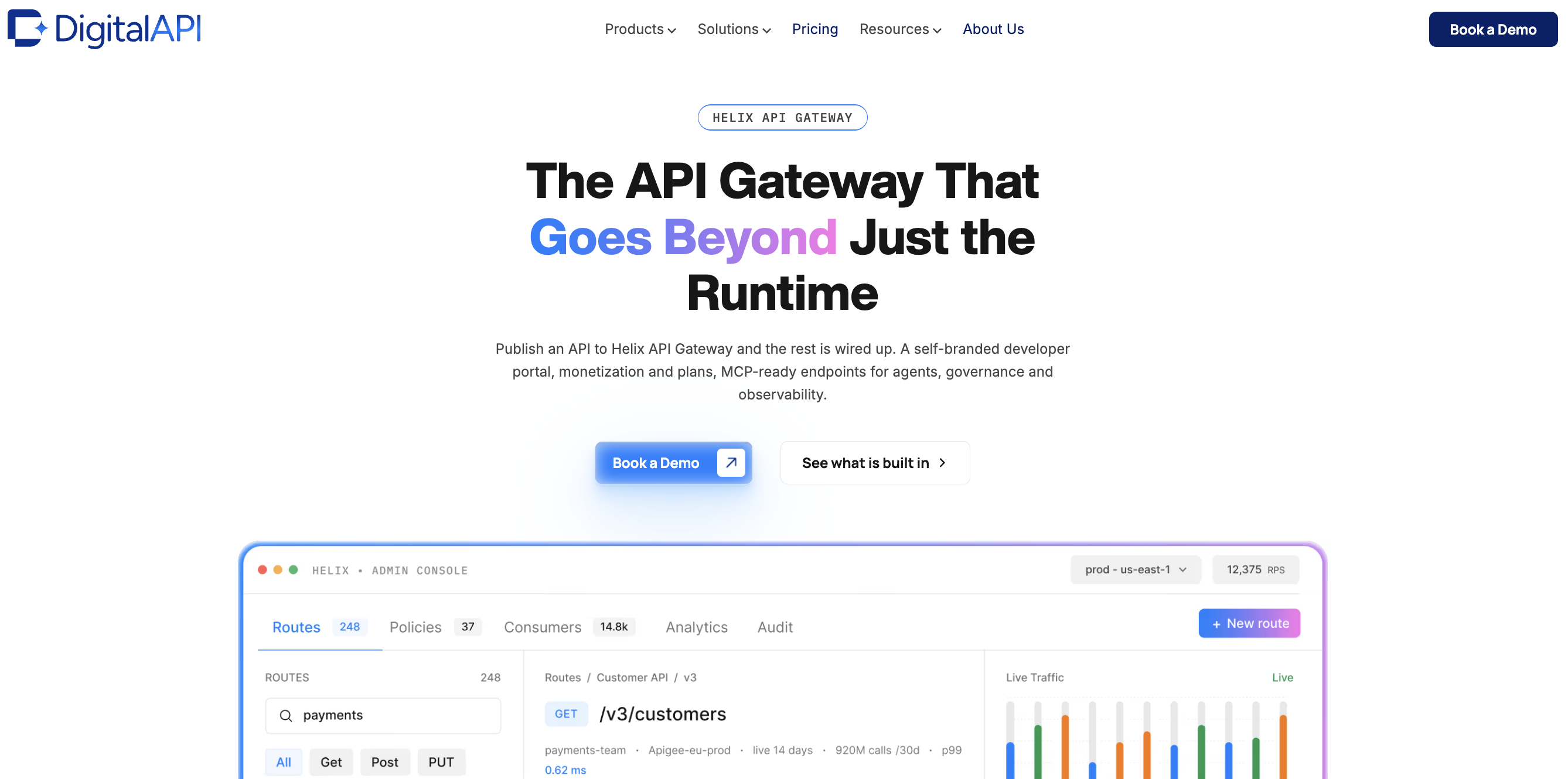
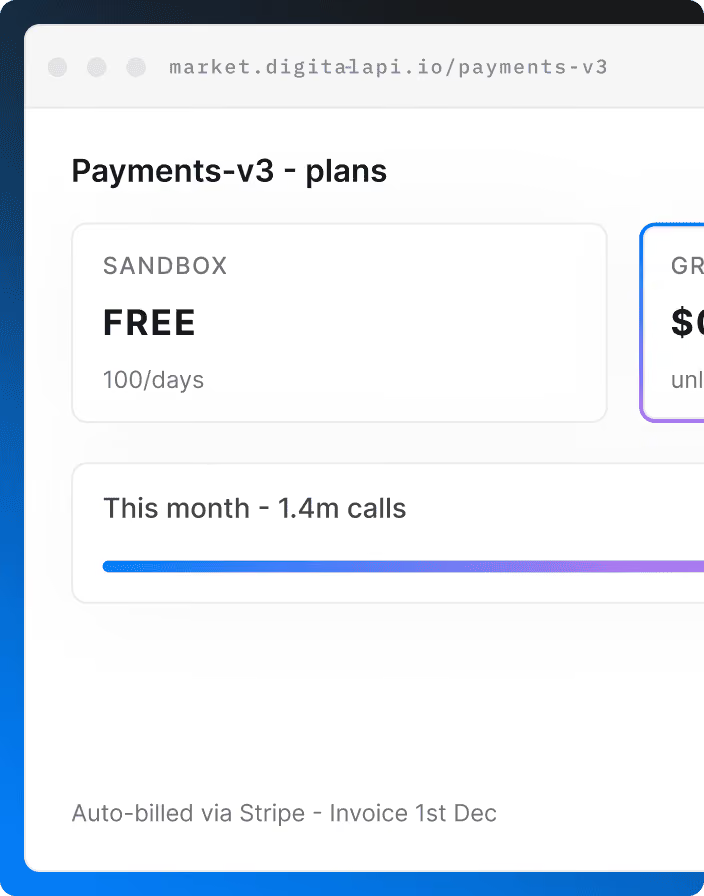
The practical impact for enterprise teams is immediate. MuleSoft handles the integration runtime and transformation logic it does well. DigitalAPI handles the developer-facing layer MuleSoft's Anypoint Exchange and Developer Portal require extensive configuration to deliver: a branded portal where internal teams, external partners, and AI agents discover APIs, generate their own credentials, test against a live sandbox, and subscribe to products with billing handled automatically.
For teams committing to a full migration off MuleSoft, DigitalAPI's Arelio API Gateway provides native gateway capabilities with the full platform already in place, so services migrate individually without a parallel platform build. The phased approach, adding DigitalAPI above existing MuleSoft infrastructure and migrating services one by one, is the same pattern Canara Bank and Fiserv follow in production.
What makes it distinct from every other option on this list:
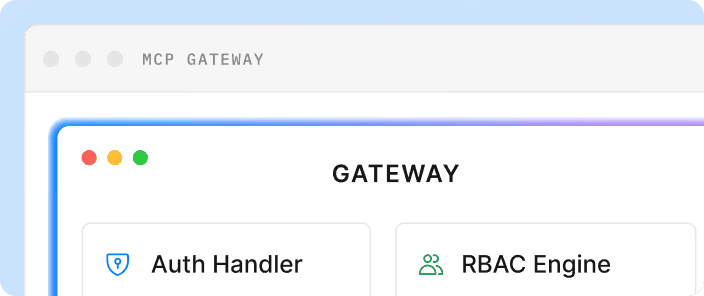
The MCP Gateway converts every catalogued API into an AI-callable tool with agent-grade credentials, per-call policies, and audit logging flowing through the same trust boundary as your existing API programme. That includes APIs still running on MuleSoft's Flex Gateway. An enterprise running SAP integrations through MuleSoft can have those APIs callable by AI agents within the same governance framework, without touching the MuleSoft configuration.
The white-label developer portal supports RBAC across internal, partner, and public audiences from day one. Developers get self-serve API key generation, live sandbox access, and subscription management without contacting your engineering team. That combination, multi-gateway catalogue above MuleSoft plus self-serve portal plus native MCP tooling, is what MuleSoft's Anypoint Exchange delivers only after significant configuration investment.
Fits best when: You run MuleSoft or multiple gateways and need a developer portal, multi-gateway catalogue, API monetization, and AI-agent readiness above the integration layer without a full platform migration at contract renewal.
Does not fit when: Your only requirement is a low-code integration runtime connecting SaaS applications with no external developer-facing API programme to support.
2. Apigee
Apigee is Google Cloud's enterprise API management platform, built for organisations that need deep traffic analytics, policy-driven threat protection, and full API lifecycle management on Google infrastructure.

For teams evaluating MuleSoft alternatives specifically for API management rather than data integration, Apigee is the most direct comparison in terms of enterprise positioning. Both carry custom enterprise pricing, both have developer portals that require configuration effort, and both serve large regulated organisations with complex compliance requirements. The core difference is architecture: MuleSoft is an iPaaS with API management built in, while Apigee is an API management platform with integration handled by the broader Google Cloud ecosystem.
Apigee's analytics layer integrates with BigQuery, making it the strongest option on this list for teams that treat API traffic data as a strategic business input. Security policies, OAuth2, and threat protection cover the compliance baseline at enterprise depth. The trade-off is Google Cloud commitment: Apigee X runs on Google infrastructure, and Apigee Edge reached end-of-life in March 2024, adding migration pressure for existing Edge deployments alongside any MuleSoft review.
Fits best when: Your stack is committed to Google Cloud, your compliance requirements are strict, and deep traffic analytics and threat protection are primary requirements rather than add-ons.
Does not fit when: You run multi-cloud infrastructure, need multi-gateway federation across existing platforms, or want a self-serve developer portal without significant configuration investment.
3. Solo.io (Gloo Gateway)
Solo.io builds Gloo Gateway, an Envoy-based API gateway and service mesh platform for platform engineering teams managing Kubernetes-native microservices architectures where east-west service communication control is the primary challenge.
For teams leaving MuleSoft because its ESB architecture creates bottlenecks in Kubernetes-native deployments, Solo addresses the infrastructure layer directly. Gloo Gateway integrates with Istio, supports mTLS between services, handles traffic shifting for canary deployments, and extends through WebAssembly rather than Lua plugins. The operational model demands Kubernetes expertise, but it gives infrastructure teams precise control over service mesh governance that a general-purpose iPaaS cannot provide.
The scope distinction is critical for anyone evaluating Solo as a MuleSoft replacement. There is no native developer portal, no API monetization, and no multi-gateway federation across cloud-provider gateways. Teams moving off MuleSoft because of cost or Salesforce lock-in will find Solo solves a fundamentally different problem unless the specific bottleneck is Kubernetes service mesh governance at the infrastructure layer.
Fits best when: Your primary bottleneck is Kubernetes service mesh governance, zero-trust security between microservices, and Envoy-based traffic control at the infrastructure layer.
Does not fit when: You need a developer portal, API monetization, multi-gateway catalogue, or AI-agent tooling above the gateway layer.
4. Kong
Kong is the most widely deployed open-source API gateway and the most direct gateway-level alternative for teams that want MuleSoft's API management capabilities without enterprise iPaaS pricing or Salesforce ecosystem dependency.
Where MuleSoft bundles API management inside a broader integration platform, Kong focuses on the gateway layer: routing, rate limiting, authentication, and traffic management through a plugin ecosystem of over 100 plugins. For teams whose primary use of MuleSoft is API management rather than data transformation, Kong covers the core requirement at significantly lower licensing cost using the open-source edition.
The Konnect managed platform adds a developer portal, service catalog, and analytics with a tiered pricing model. Kong Gateway 3.12 added MCP gateway support in late 2025, making AI-agent readiness available as a plugin layer. The operational trade-off compared to MuleSoft is different rather than simpler: Kong requires a Postgres or Cassandra database, a data plane cluster, and Lua or Go expertise for custom plugins, which trades MuleSoft's vCore pricing complexity for infrastructure management complexity.
Fits best when: You want a mature, plugin-rich API gateway without enterprise iPaaS licensing, and your team has platform engineers capable of managing Kubernetes-native infrastructure.
Does not fit when: You need multi-gateway federation across existing enterprise platforms, a white-label developer portal with enterprise subscription management, or MuleSoft's low-code integration runtime for connecting SaaS applications.
5. Gravitee
Gravitee is an open-source API management platform covering gateway, developer portal, API design, event-driven APIs, and monetization under one product, with a community edition that is production-ready and a clear upgrade path to enterprise.
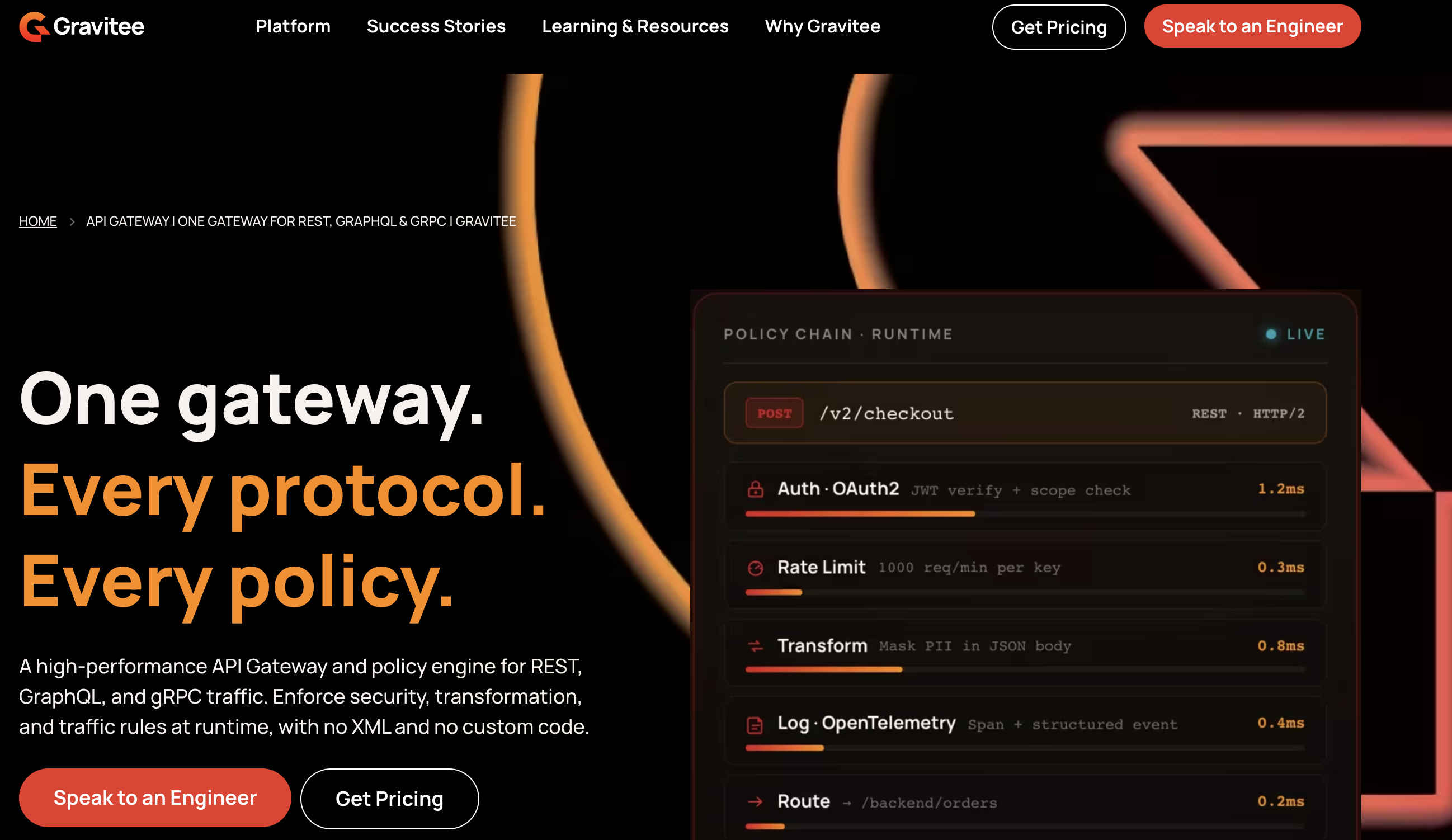
For teams moving off MuleSoft's API management layer specifically, Gravitee offers the broadest open-source feature coverage relative to cost. It handles REST, GraphQL, MQTT, Kafka, and WebSocket natively without plugins, directly relevant for teams managing event-driven workloads that MuleSoft handles through its Async API and event-driven architecture module. The developer portal is included without a paid tier, with subscription management, access control, and API key issuance as part of the core product.
Gravitee's governance module covers API design rules, lifecycle management, and access policies in a dashboard usable under production pressure rather than only during post-mortems. The enterprise edition adds multi-data-centre federation and dedicated support. For teams that find MuleSoft's licensing model unsustainable but need its full lifecycle API management surface area, Gravitee is the most complete open-source alternative.
MCP and AI-agent readiness is still partial. The platform handles API traffic reliably but native MCP server generation and agent-specific credential scoping are not first-class features.
Fits best when: You want a full API lifecycle platform with an open-source core, event-driven protocol support, and a developer portal included without paying for each feature tier separately.
Does not fit when: Your primary requirement is native MCP tooling for AI agents, a white-label partner portal with enterprise billing, or multi-gateway federation across MuleSoft, Apigee, and AWS simultaneously.
6. Zuplo
Zuplo is a managed, edge-native API gateway for cloud-native teams that want GitOps-first workflows, predictable consumption pricing, and native AI gateway capabilities without Kubernetes operator overhead or vCore-style pricing surprises.
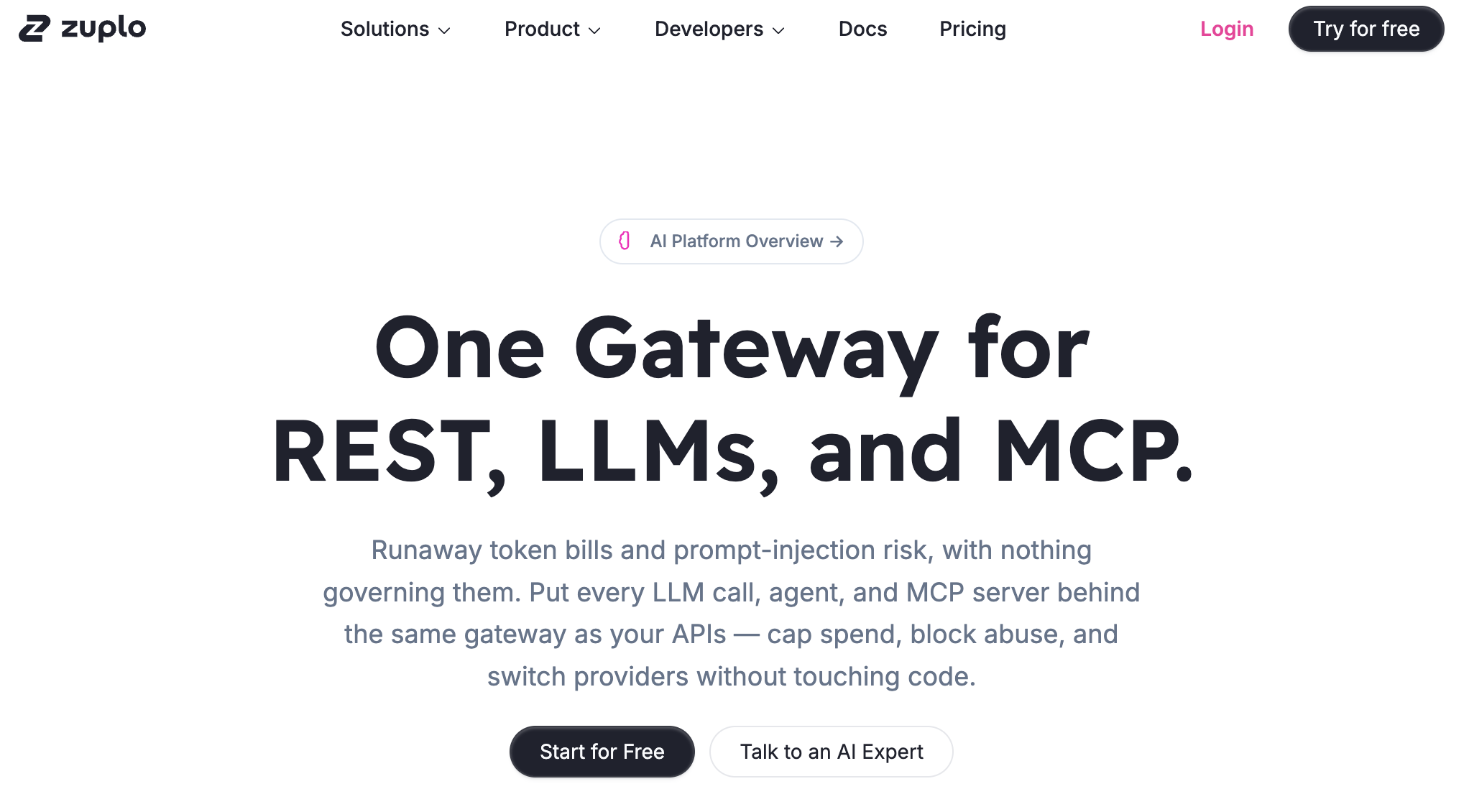
For teams whose MuleSoft frustration is specifically operational weight and unpredictable cost scaling, Zuplo is the sharpest contrast on this list. No Postgres to manage, no data plane cluster, no enterprise iPaaS pricing model. The platform runs on 300-plus edge locations with sub-20-second global deploys, uses TypeScript for custom logic, and bills per-request at predictable rates.
The AI Gateway is native: multi-provider model routing, semantic caching, prompt injection protection, per-customer model budgets, and MCP server exposure are all built in. For teams that have evaluated MuleSoft's Anypoint AI Agent capabilities and found them insufficiently mature for current AI-agent workloads, Zuplo provides the most advanced managed gateway AI capability on this list.
The honest limitation is platform depth. Zuplo does not cover MuleSoft's enterprise integration runtime for Salesforce, SAP, and Workday connectivity. It is a gateway and AI layer, not a full iPaaS replacement.
Fits best when: You want a managed edge gateway with predictable billing, native AI capabilities, and low operational overhead. Particularly relevant for cloud-native SaaS companies and API-first teams building AI-agent-facing surfaces now.
Does not fit when: You need MuleSoft's low-code integration runtime, multi-gateway federation across existing enterprise platforms, or a white-label developer portal with enterprise subscription management at scale.
7. Tyk
Tyk is a full API lifecycle management platform with a Go-based open-source gateway, built-in developer portal, real-time analytics, and a monetization model that does not gate core features behind enterprise contracts.
For teams replacing MuleSoft's API management layer, Tyk closes the developer portal self-service gap that MuleSoft's Anypoint Exchange requires configuration effort to deliver. Developers register, generate credentials, subscribe to API plans, and view real-time usage data without contacting anyone on the team. The Go-based gateway benchmarks well under high concurrency, and the deployment model supports on-premises, cloud, and hybrid configurations without changing the licensing model.
Tyk's real-time analytics dashboard surfaces usage spikes, quota breaches, and security anomalies in a single view rather than requiring a separate observability stack. The governance layer covers rate limiting, quota management, and access control policies at the depth required for most enterprise compliance frameworks.
MCP and AI-agent tooling is maturing but not yet first-class. Tyk handles API traffic reliably for both human and AI consumers, but native MCP server generation and agent-specific credential scoping are not current platform priorities.
Fits best when: You want an open-source, Go-based full lifecycle platform with a self-serve developer portal, real-time analytics, and no Google Cloud or Salesforce dependency.
Does not fit when: You need multi-gateway federation across MuleSoft, Apigee, Kong, and AWS simultaneously, or native MCP tooling for AI agents as a first-class platform capability.
8. API7
API7 is the enterprise-supported distribution of Apache APISIX, built for teams standardised on APISIX's high-performance cloud-native architecture who need commercial support, governance tooling, and a managed control plane without proprietary lock-in.
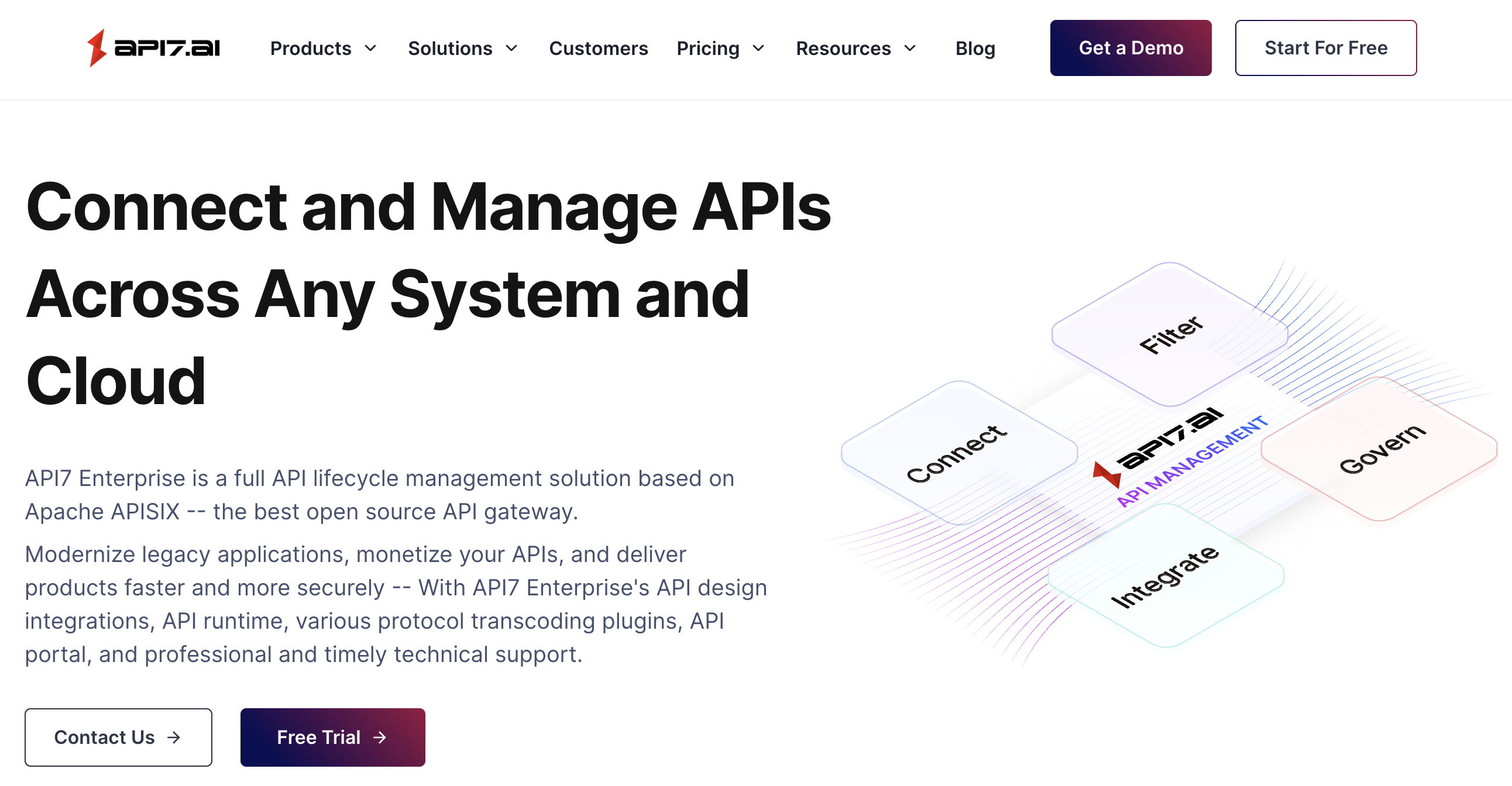
For teams leaving MuleSoft specifically because of proprietary vendor dependency, API7 provides an open-core gateway with commercial backing and a clear architectural separation between the open-source runtime and the commercial management layer. APISIX uses etcd for configuration storage rather than Postgres, supports dynamic routing and gRPC, and benchmarks well under high-concurrency loads compared to both MuleSoft's Flex Gateway and Kong's Nginx-based core.
API7 is a gateway and governance tool, not a full iPaaS or API product management platform. The developer portal is limited, API monetization is not a core use case, and external developer self-service at the level of Tyk, Gravitee, or DigitalAPI is not what the platform is built to deliver.
Fits best when: Your team is APISIX-native, values etcd-based architecture, runs high-concurrency cloud-native workloads, and wants commercial support without Salesforce or Google Cloud dependency.
Does not fit when: You need a self-serve external developer portal, API monetization workflows, or multi-gateway federation across existing enterprise infrastructure.
How to Choose: Four Questions That Narrow the Field
1. Are you replacing MuleSoft's integration runtime or its API management layer?
These are different problems with different solutions. If your team uses MuleSoft primarily to connect Salesforce, SAP, and Workday through a low-code interface, none of the gateway tools on this list replace that runtime. If your team uses MuleSoft for API gateway, developer portal, and API lifecycle management, Kong, Gravitee, Tyk, and DigitalAPI are the right starting points. Most enterprise MuleSoft deployments cover both, so the evaluation must separate them before tool selection begins.
2. Is Salesforce ecosystem dependency the primary concern, or is cost the driver?
If Salesforce lock-in is structural, any platform outside the Salesforce ecosystem resolves it. If cost is the driver, the comparison becomes total cost of ownership: MuleSoft's vCore model versus Kong's infrastructure management overhead versus Gravitee or Tyk's open-source base plus enterprise support contract. DigitalAPI's per-product predictable model addresses cost forecasting directly. See how multi-gateway cataloguing reduces the duplication that drives vCore usage on the API discovery solution page.
3. Do you need to expose APIs commercially to external developers or partners?
MuleSoft's Anypoint Exchange provides an internal API catalogue that requires configuration to become a genuine external developer portal. Gravitee and Tyk cover the open-source path with included portal and monetization. DigitalAPI covers the managed, white-label, enterprise path with billing schedules, subscription workflows, and invoice management at regulated-industry scale. Solo and API7 are not developer portal or monetization tools.
4. Are AI agents a current or near-term API consumer?
MuleSoft's Anypoint AI Agent capabilities are still maturing. Zuplo and DigitalAPI are the most advanced for AI agent use cases in 2026. Zuplo handles MCP at the edge gateway layer. DigitalAPI handles it at the catalogue and credential layer across every gateway you already run, including existing MuleSoft Flex Gateway deployments, meaning APIs managed by MuleSoft become MCP-callable without any gateway configuration change. Review the full capability on the MCP Gateway product page.
Industry Use Cases
Financial services: A bank running MuleSoft for Salesforce CRM integration and Apigee for API traffic management needs a unified developer portal above both platforms for external fintech partners. Rather than building a custom portal on top of either gateway, the team adds DigitalAPI above the existing infrastructure. MuleSoft continues handling Salesforce connectivity. Apigee continues handling traffic. DigitalAPI provides the portal, catalogue, monetization, and MCP layer. This is the pattern Canara Bank and Fiserv use in production.
Insurance: An insurer evaluates replacing MuleSoft due to vCore cost pressure across multiple business units running separate Anypoint environments. Gravitee's open-source community edition handles the API gateway layer with the included developer portal covering external broker access. The enterprise tier adds dedicated support for audit requirements without per-environment licensing increments.
Enterprise SaaS: A SaaS company on Kubernetes finds MuleSoft's ESB architecture misaligned with its microservices deployment model. Zuplo replaces the API gateway layer with managed edge deployment and native AI gateway capabilities. DigitalAPI adds the developer portal and MCP tooling layer above Zuplo, giving external developers and AI agents a single surface to discover and consume the company's APIs. The API sandboxing solution covers the live sandbox access developers need before subscribing.
Retail and e-commerce: A retailer running MuleSoft for SAP and NetSuite connectivity evaluates moving the API management and partner portal layer to DigitalAPI, separating the integration runtime decision from the developer experience decision and allowing each to be assessed and optimised independently at renewal.
How We Chose These Alternatives
The competitor set here comes from the gateway category of DigitalAPI's API landscape research: Apigee, Solo, Kong, Gravitee, Zuplo, Tyk, and API7. These are the platforms enterprise API and integration teams actually evaluate when reassessing MuleSoft at renewal. Each was assessed across gateway architecture, developer portal capability, monetization, AI-readiness, cloud flexibility, and total cost of ownership. No tool was included or excluded based on paid placement.
FAQs
1. What is the best MuleSoft alternative for enterprises in 2026?
DigitalAPI is the strongest choice if you need a multi-gateway control plane, self-serve developer portal, API monetization, and MCP tooling above your existing infrastructure without a full migration. Gravitee and Tyk are the strongest open-source full-lifecycle alternatives with built-in developer portals and no feature-gating.
2. Can DigitalAPI replace MuleSoft without a full migration?
Yes. DigitalAPI connects above your existing MuleSoft Flex Gateway, indexes your APIs into a unified catalogue, and adds a self-serve portal, monetization, and MCP tooling without changing your configuration. Arelio API Gateway then provides a parallel path for migrating gateway services individually at your own pace.
3. What is the cheapest MuleSoft alternative?
Gravitee, Tyk, and API7 all have open-source community editions free to self-host. Infrastructure costs for production deployments typically run between $500 and $2,000 per month, compared to MuleSoft's median contract value above $55,000 per year.
4. Which MuleSoft alternative is best for AI agent traffic?
Zuplo and DigitalAPI lead here in 2026. Zuplo provides a native AI gateway with MCP server support at the edge. DigitalAPI's MCP Gateway makes every catalogued API callable by AI agents with scoped credentials and per-call audit logging, across any gateway including existing MuleSoft Flex Gateway deployments.
5. Does replacing MuleSoft require changing the integration runtime and the gateway at the same time?
Not with DigitalAPI. The platform adds the portal, catalogue, and MCP layer above your existing MuleSoft infrastructure without touching the runtime. DigitalAPI's API gateway manager and Arelio API Gateway provide a parallel migration path that lets teams move gateway services individually without forcing a runtime change at the same time.
The Bottom Line
MuleSoft is a mature, genuinely capable enterprise platform for the largest organisations running Salesforce, SAP, and Workday integrations at scale. The pressure to evaluate alternatives is real and structural: vCore pricing that compounds at scale, Salesforce ecosystem dependency that constrains multi-cloud architecture, and AI-readiness that arrived as an add-on rather than a native platform capability.
Apigee covers the Google Cloud-committed enterprise path for API management at scale. Kong is the most direct gateway-level replacement without enterprise iPaaS pricing. Gravitee and Tyk are the strongest open-source full-lifecycle alternatives with included developer portals. Zuplo is the right evaluation for cloud-native teams that want managed edge simplicity and native AI capabilities. Solo applies to infrastructure teams managing Envoy-based service mesh complexity. API7 fits APISIX-native teams wanting commercial support without proprietary lock-in.
For teams that need a unified control plane above their existing MuleSoft infrastructure, a self-serve developer portal, API marketplace with monetization, and native MCP tooling for AI agents, DigitalAPI provides all of that without forcing a runtime migration at renewal time. Fiserv, Canara Bank, and Zurich Insurance run it in production across regulated, multi-gateway environments where MuleSoft handles parts of the integration layer and DigitalAPI provides the management and developer experience layer above it.
The DigitalAPI vs. MuleSoft comparison covers exactly where each platform operates and how they work together in enterprise multi-gateway environments.
Dhayalan Subramanian is Associate Director, Product Growth at DigitalAPI, where he leads go-to-market and product growth for the company’s multi-gateway API management platform. His work focuses on helping large enterprises and mid-market cloud companies consolidate APIs across AWS, Azure, Apigee, Kong, MuleSoft, and other gateways into a single control plane for governance, discovery, monetization, and agent consumption.
Dhayalan brings 14+ years of experience across product strategy, enterprise architecture, and engineering leadership. Earlier in his career, he held senior roles at Encora (as Associate Architect and Technical Manager), Mindtree (Technology Lead), Tech Mahindra (Technical Lead), and Primus Analytics, where he designed integration frameworks and delivered enterprise-grade digital platforms for global customers.
At DigitalAPI, he works directly with platform, integration, and developer experience leaders at Fortune 500 organizations to operationalize unified API catalogs, developer portals, and MCP-ready APIs. He writes regularly on API developer experience, API governance, and AI agent architectures.
One email a fortnight. Worth opening.
A short digest of what we're writing, what we're learning from customers, and the handful of links you'd actually want from us. No tracking pixels.

.avif)