



What Is an MCP Client? How It Works, and the Best MCP Clients in 2026
An MCP client connects an AI app to MCP servers. How it works, client vs server vs host, and the best MCP clients (Claude Desktop, Cursor, Cline, and more).

TL;DR:
What it is: An MCP client is the component inside an AI application that connects it to an MCP server, handling the protocol so the app can use the server's tools and data.
Client vs server vs host: the host is the app (Claude Desktop, Cursor), the client is the connector inside it, and the server is the external tool. One client connects to one server, and a host runs many clients.
How it works: the client connects, exchanges capabilities in a handshake, then calls tools, reads resources, and runs prompts over JSON-RPC 2.0.
The best clients: Claude Desktop, ChatGPT, Cursor, Windsurf, Cline, VS Code, Claude Code, Goose, and LibreChat lead in 2026.
At enterprise scale: as clients and agents multiply, you control which can reach which servers at the gateway, which is what DigitalAPI provides.
People talk about MCP servers constantly, but the other half of the Model Context Protocol gets less attention: the client. The client is what actually connects an AI app to a server and makes its tools usable. This guide explains what an MCP client is, how it differs from a server and a host, how it works under the hood, the best MCP clients in 2026, how to build your own, and how to govern them at enterprise scale.
What is an MCP client?
An MCP client is the app-side component that connects an AI application to an MCP server. It maintains the connection, speaks the protocol, and translates between the AI application and the server. When a model wants to use a tool, like looking up a record or sending a message, the client is what carries that request to the right server and brings the result back.
The protocol exists to solve an integration problem. Before MCP, every AI app needed a custom integration for every tool it wanted to use, which is an M-by-N explosion of one-off connectors. MCP replaces that with one standard interface, the way USB-C replaced a drawer full of proprietary cables. The client is the plug on the application side of that standard interface.
One detail defines the client: It connects to exactly one server. If an AI app needs five servers, it runs five clients, one per server. The client is not the AI and not the tool. It is the connector in the middle that lets the two talk.
The two meanings of "MCP client"
In practice the term is used in two ways, and it helps to separate them:
- The protocol client: It is the connector object inside an application that holds a one-to-one session with a single server. This is what the MCP specification means by "client."
- The client application: When someone says "Claude Desktop is an MCP client" or asks for "the best MCP clients," they mean the whole app that supports MCP. That app may run many protocol clients inside it, one for each server it connects to.
Both are correct. The rest of this guide uses "client" for the connector and "client app" when the distinction matters.
MCP client vs server vs host
This is the distinction that trips people up, because the three roles often run on the same machine. Here is the clean separation:
Put simply: the host is the brain that decides an action is needed and initiates it. The client is the messenger that carries the request and handles the protocol. The server is the hands that actually do the work and return a result. A host can run many clients at once, but each client talks to a single server.
A request, end to end
It is easiest to see the roles in motion. Say you tell Claude Desktop, "create a GitHub issue titled 'login bug'." Here is what happens:
- The host decides: Claude, running in the host, determines it needs the GitHub server's "create issue" tool.
- The client carries it: The GitHub client inside the host wraps that into a JSON-RPC call and sends it to the GitHub MCP server.
- The server acts: The server calls the real GitHub API, creates the issue, and returns the result.
- The client returns it: The client passes the result back to the host, and Claude tells you the issue was created.
The names overlap because all three can sit on your laptop, but the roles are distinct: the host thinks, the client connects, the server does.
How an MCP client works
An MCP client sits between the host and a server and manages the whole exchange. Communication runs over JSON-RPC 2.0, a lightweight standard for structured request-and-response messages.
Transports: local and remote
The client talks to a server over one of two transports:
- Standard input/output (stdio): For local servers. The client launches the server as a subprocess on the same machine and exchanges messages over its input and output streams. This is how desktop apps run local servers.
- Streamable HTTP: For remote servers. The client connects over HTTP to a server running as a web service, which is how hosted and shared servers work. This is the transport that matters once MCP goes past one laptop.
The connection lifecycle
However it connects, a client and server move through three stages:
- Connect: The client opens a connection and sends an initialize message with its protocol version and the capabilities it supports.
- Handshake: The server responds with its own version and capabilities, and the two agree on what they can do together. The client confirms, and the session is live.
- Exchange: The client and server send messages back and forth, either request-and-response calls (such as "list your tools" or "call this tool") or one-way notifications such as updates and alerts.
This capability handshake is why a client and server built by different people still work together: they negotiate what they support up front rather than assuming it.
Tools, resources, prompts, and MCP Apps
Through the client, the host can use the three things an MCP server exposes:
- Tools: Functions the model can call to take an action or fetch live data. The client discovers them with a list call and runs them with a call request.
- Resources: Tead-only data the model or user can load for context, addressed by a URI.
- Prompts: Reusable templates a user can invoke from the client.
A recent addition matters here. In January 2026, MCP Apps became an official extension, which lets a server return an interactive UI to render inside the host, not just text or JSON. A server can now send back a dashboard, a form, an approval flow, or a chart that appears directly in the conversation, and the client is what renders it. It is a sign of where clients are heading: from passing text to hosting real interfaces.
The best MCP clients in 2026
"MCP client" in everyday use means an app that supports MCP. The ecosystem has grown to hundreds of them, but a handful lead. Here is a shortlist by category.
Chat clients
If you want a conversational assistant, Claude Desktop is the reference client and the place most people first use MCP, with support for both local and remote servers. ChatGPT now supports MCP through its Apps SDK, bringing servers to the largest consumer AI audience. For self-hosted setups, LibreChat and Cherry Studio are strong multi-model desktop and web chat apps that connect to MCP servers, and lightweight options like 5ire and Cherry Studio suit users who want a simple local client they control.
Coding agents and IDEs
For developers, the richest MCP support is in coding tools, and this is where most of the early adoption happened. Cursor and Windsurf are the leading AI-native IDEs, both with mature MCP support and agent modes. VS Code with GitHub Copilot brings MCP to the most widely used editor in the world. In the terminal, Claude Code and Codex CLI are agentic coding clients that connect to servers as you work. Cline is the standout open-source pick for MCP inside VS Code, with a bring-your-own-key model and active forks in Roo Code and Kilo Code. Continue and Zed round out the editor options, and Replit brings MCP into a browser-based environment.
Open-source and workflow clients
Beyond chat and IDEs, Goose is an open-source agent from Block with broad MCP support, built for automating real engineering tasks. n8n exposes an MCP client node so you can call servers from automation workflows, which makes it the bridge between MCP and the no-code automation world. Open WebUI is a popular self-hosted front end that can act as a client, and on the local-model side, setups built around Ollama let you point an open-weight model at MCP servers.
Building MCP into your own app
The clients above are finished apps, but MCP is also something you wire into software you write. Frameworks like LangChain and LangGraph provide adapters that load a server's tools into an agent, and the official SDKs let you embed a client directly. If you are searching for a "Python MCP client" or a "LangChain MCP client," that is this category: not an app you download, but a client you build into your own agent. The next section covers it.
How to build an MCP client
If none of the existing clients fit, you can build your own. The official SDKs, in Python, TypeScript, C#, and more, handle the protocol for you, so a basic client does a short loop:
- Connect to a server over stdio or HTTP and run the initialize handshake.
- List tools the server offers and pass their definitions to your model.
- Call the tool the model chooses, then feed the result back to the model so it can continue.
That loop, connect, list, call, return, is the whole job of a client. Higher-level frameworks like LangChain wrap it further, turning a server's tools into agent tools with a few lines. You can test any client the same way you test a server, with the MCP Inspector, before wiring it into an application. If you are building the other side too, our guide on how to build an MCP server walks through exposing tools that any of these clients can call.
Governing MCP clients in the enterprise
For a single developer, the client is just an app you install. For an enterprise, MCP clients are a governance question, because every client and agent is a new way to reach your systems. The teams adopting Claude Desktop, Cursor, and custom agents are, in effect, opening connections into your data and tools, and you need to control which clients and agents can reach which servers.
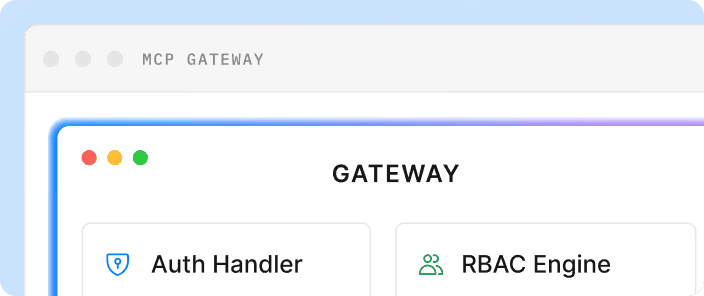
The practical answer is to govern the server side rather than trying to lock down every client. A gateway in front of your MCP servers enforces authentication, role-based access, rate limits, and audit on every connection, no matter which client initiates it. DigitalAPI provides exactly that: a governed gateway and registry that control which identities can reach which servers, with OAuth and machine-to-machine authentication, RBAC, and immutable audit logs, unified with the way you already govern your APIs. If your teams are adopting MCP clients and you need that access controlled and auditable, book a demo and we will map it to your stack.
Frequently asked questions
What is an MCP client?
An MCP client is the component inside an AI application that connects it to an MCP server. It maintains the connection, speaks the protocol, and carries the model's requests to the server and the results back.
What is the difference between an MCP client and an MCP server?
The client is the consumer that runs on the application side and makes requests. The server is the provider that exposes tools and data and responds. A client connects to a single server.
What is the difference between an MCP client and an MCP host?
The host is the application where the AI runs and decides what to do, such as Claude Desktop or Cursor. The client is the connector inside the host that talks to one server. A host can run many clients.
What are examples of MCP clients?
Claude Desktop, ChatGPT, Cursor, Windsurf, VS Code with Copilot, Cline, Claude Code, Goose, LibreChat, and n8n are widely used MCP clients in 2026.
What is the best MCP client?
It depends on the job. Claude Desktop is the best general chat client, Cursor and Windsurf lead for coding, Cline is the best open-source pick, and n8n is best for automation workflows.
Is Claude Desktop an MCP client?
Yes. Claude Desktop is one of the most common MCP clients, with support for both local and remote MCP servers.
Is ChatGPT an MCP client?
Yes. ChatGPT supports MCP through its Apps SDK, so it can connect to MCP servers and use their tools and apps.
Is Cursor an MCP client?
Yes. Cursor is an AI-native IDE with MCP support, so it can connect to MCP servers and use their tools while you code.
How does an MCP client connect to a server?
It opens a connection, exchanges protocol versions and capabilities in a handshake, then sends and receives JSON-RPC 2.0 messages over stdio for local servers or streamable HTTP for remote ones.
Can I build my own MCP client?
Yes. The official MCP SDKs handle the protocol, so a client mainly needs to connect to a server, list its tools, and call them. Frameworks like LangChain make this even shorter, and you can test it with the MCP Inspector before integrating it into an app.
Dhayalan Subramanian is Associate Director, Product Growth at DigitalAPI, where he leads go-to-market and product growth for the company’s multi-gateway API management platform. His work focuses on helping large enterprises and mid-market cloud companies consolidate APIs across AWS, Azure, Apigee, Kong, MuleSoft, and other gateways into a single control plane for governance, discovery, monetization, and agent consumption.
Dhayalan brings 14+ years of experience across product strategy, enterprise architecture, and engineering leadership. Earlier in his career, he held senior roles at Encora (as Associate Architect and Technical Manager), Mindtree (Technology Lead), Tech Mahindra (Technical Lead), and Primus Analytics, where he designed integration frameworks and delivered enterprise-grade digital platforms for global customers.
At DigitalAPI, he works directly with platform, integration, and developer experience leaders at Fortune 500 organizations to operationalize unified API catalogs, developer portals, and MCP-ready APIs. He writes regularly on API developer experience, API governance, and AI agent architectures.
.png)
One email a fortnight. Worth opening.
A short digest of what we're writing, what we're learning from customers, and the handful of links you'd actually want from us. No tracking pixels.

.avif)