



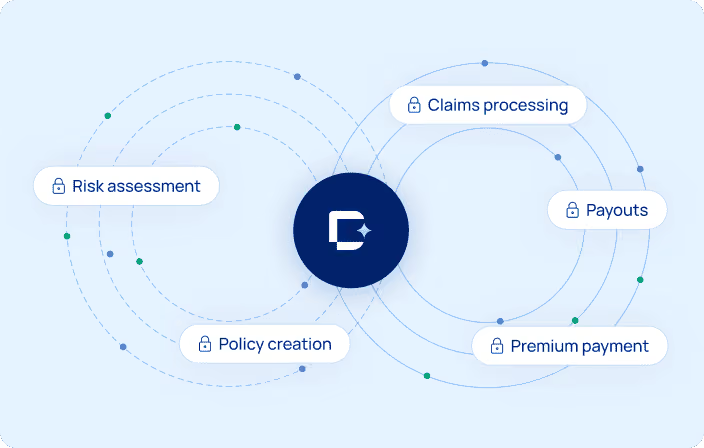



Microservices Security Best Practices: How to Secure Distributed Systems at Scale
Microservices security breaks when systems scale faster than assumptions. These microservices security best practices focus on identity, communication, APIs, and visibility to help you secure distributed systems without slowing teams down.

TL;DR
1. Microservices security breaks when services trust each other by default instead of enforcing identity and access on every request.
2. APIs, internal traffic, and runtime behavior create the real attack surface as systems scale.
3. Standardizing API governance, observability, and enforcement early reduces long-term security risk.
Moving to microservices breaks the traditional security model we relied on for years. In a monolith, you essentially defend one perimeter. Once inside, function calls are safe in memory. Microservices replace those safe calls with network requests, creating an explosion of services that massively expand your attack surface.
You can't just filter "North-South" user traffic anymore; you must now secure the "East-West" communication between services. To make it harder, decentralized ownership often leads to teams using inconsistent controls across the stack.
This blog covers the microservices security best practices and architectural patterns you need to solve these challenges without blocking development.
Common microservices security challenges
When you decouple your microservices security architecture, you aren't just changing how you deploy code. You are trading a single, manageable security perimeter for a chaotic web of network calls. The real microservices security challenges usually aren't about hackers breaking your encryption; they are about the operational mess we create for ourselves.
Here is where the friction really happens in production:
1. Service-to-service trust issues
In a traditional app, different parts of the code talk to each other safely in the computer memory. In microservices, they talk over a network. The problem is that many teams set up their services to trust any traffic that comes from inside the network.
This weak service-to-service security is a major risk. If an attacker gets into one small service, they can use it to send requests to your critical database service. The database service trusts the request simply because it came from an internal IP address.
2. API sprawl and undocumented endpoints
Teams ship code fast. Often, they create new APIs to fix a quick problem and forget to document them. We call these "Shadow APIs." They are dangerous for two reasons:
- They often bypass the main security gateway.
- They do not get security updates because nobody knows they exist.
3. Inconsistent authentication mechanisms
In a monolith, you have one login system. In microservices, different teams might build their own ways to check identities. Team A might use API keys. Team B might use complex tokens. This creates a mess. When there is no standard, it is hard to enforce security rules across the whole platform.
4. Over-privileged services
Engineers often give services too much power to make development easier. If a service needs to read a user profile, the developer might give it "Admin" access just to avoid permission errors. It violates the rule of least privilege which means that if that one service is hacked, the attacker gets full control instead of just limited access.
5. Poor visibility and observability
It is hard to see what is happening in a distributed system. A single request from a user might jump through ten different services before it finishes. If you do not have central logging, you are blind. You might see an error on the front end, but you will not see the data leak happening deep in the back end.
6. Secrets management at scale
You need to manage passwords and certificates for hundreds of services. Hardcoding these secrets in the code is bad practice. But managing them safely across many different containers is difficult. If you do not have an automated system to rotate these secrets, they will eventually leak.
Key best practices for microservices security
Microservices security breaks when systems scale faster than assumptions. These microservices security best practices focus on identity, communication, APIs, and visibility to help you secure distributed systems without slowing teams down.
Here are the best practices you can follow:
1. Adopt zero trust as the security foundation
The traditional "castle and moat" strategy is simply no longer sufficient. If you are building a microservices security architecture today, assuming a service is safe just because it runs inside your cluster is a risky mindset. You need zero trust microservices principles where you eliminate implicit trust entirely.
- Authenticate and authorize every single request, even internal ones.
- Treat internal traffic with the same caution as traffic from the internet.
- Focus on service identity rather than network location.
IP addresses change constantly in dynamic environments, but identity remains the trusted constant. It is the only way to be sure your access rules actually hold up under pressure when services scale up and down.
2. Secure service-to-service communication
If your front door is locked but the hallway is open, you are still exposed. Service-to-service security ensures internal chatter is private. You really should be using Mutual TLS (mTLS) here. It encrypts traffic so it remains confidential, and more importantly, it verifies that Service A is actually allowed to talk to Service B.
Don't rely on IP allowlists; they are difficult to maintain. Use strong cryptographic identities instead. And please, automate certificate rotation because managing keys by hand often leads to mistakes. If you forget one key, things stop working. Encrypt all east-west traffic to stay safe and keep your data private.
3. Implement strong authentication and authorization
This is where many teams find challenges. You have to handle microservices authentication and authorization as distinct but connected steps.
- Authentication: Rely on a centralized identity provider to confirm who is knocking. Use short-lived tokens so if a key gets compromised, it is useless in minutes.
- Authorization: This is about access. Enforce fine-grained, policy-based access to lock things down.
Never hardcode permissions in your code; it creates a maintenance headache later. Use role and scope-based controls to ensure services only access what they absolutely need. Security depends on these layers working together perfectly, otherwise, you leave gaps.
4. API security best practices for microservices
Your APIs are essentially open doors to your data, so securing microservices APIs has to be a priority. Don't let services talk directly without a filter.
- Use API gateways as enforcement points for heavy lifting like rate limiting.
- Input validation is necessary to stop incorrect data from affecting systems.
- Establish clear versioning and deprecation policies to close older endpoints.
- Remember, microservices API security applies to internal routes too.
Tools like DigitalAPI.ai can often help automate this schema enforcement, ensuring you don't miss a validation step. Don't just guard the front door; if a threat gets past the perimeter, your internal APIs are the next target.
5. Secure secrets and configuration
It sounds obvious, but it is worth repeating: never hardcode secrets in your source code. It is a significant security risk. You need to separate your credentials from your logic completely.
- Use centralized secrets management to inject passwords at runtime.
- Automate rotation so compromised credentials become useless fast.
- Adhere to microservices security best practices by granting least privilege access.
Only give services the exact secrets they need to run their specific job, and nothing more. If a service is compromised, this limits the impact significantly and prevents unauthorized access to your database or other critical cloud resources.
6. Runtime and container security
Since this infrastructure runs on containers, Kubernetes microservices security is critical. You can't just deploy and forget. Start with your artifacts:
- Use minimal container images to reduce the attack surface.
- Start scanning and signing images before they reach production.
- Use runtime threat detection to catch unusual behavior live.
- Apply pod-level security controls and strict network policies.
Don't trust the environment blindly. You need to isolate workloads so that if one container has an issue, it is contained there and cannot affect other services. Isolation is your best defense against a potential breach spreading across your entire cluster.
7. Observability, logging, and threat detection
You cannot protect what you cannot see. One of the biggest microservices security challenges is losing track of the mesh. You need centralized logging that pulls data from every single service into one dashboard. Without this, you are operating without full context.
- Maintain audit trails for every API access to trace steps.
- Alert on anomaly detection in traffic patterns immediately.
- Monitor authentication failures closely as they indicate probing.
If a service suddenly starts sending 10x data, you need to know. Visibility is the difference between stopping an issue early and reacting to it later. You have to be watching to react.
8. Governance and standardization across teams
When fifty teams build services, inconsistency is the default state. To scale microservices security best practices, you need governance. You can't rely on every developer to be a security expert.
- Create standard security patterns everyone must follow.
- Provide shared libraries and templates for auth and encryption.
- Enforce consistent API standards across the board.
Platforms that centralize this, like DigitalAPI.ai, can prevent drift by enforcing these standards automatically. Don't wait until deployment to check for issues. Shift security left into your CI/CD pipeline to catch vulnerabilities before they are ever merged.
9. Microservices security anti-patterns to avoid
Sometimes knowing what not to do is just as important. There are common microservices security challenges that act as traps for new teams.
- Stop trusting the internal network; it isn't automatically safe.
- Avoid using one shared service account for everything.
- Be careful with overly permissive APIs exposing data.
- Stop managing certificates and secrets manually.
Automation tools can handle the lifecycle management that is tedious for teams. Finally, never treat security as something you add after deployment. It has to be baked in from day one. If you try to add it later, it is rarely effective.
How DigitalAPI.ai strengthens microservices security
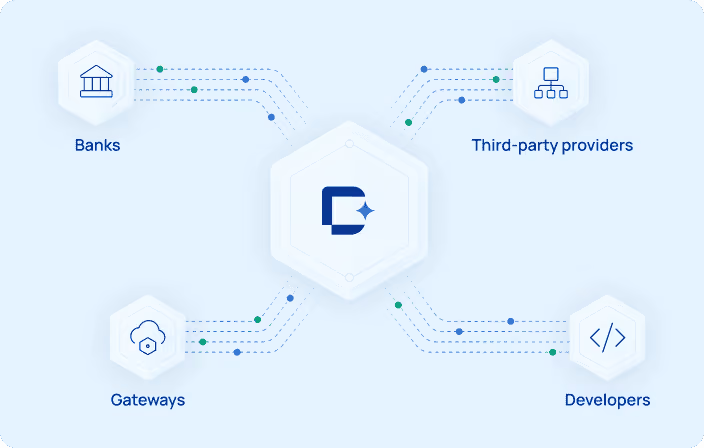
Implementing these best practices manually across dozens of teams is a massive headache. You can't just hope developers read the wiki and follow the rules. You need a system that enforces them automatically. DigitalAPI.ai acts as that central nervous system by translating complex security concepts into automated controls.
It supports your microservices security with:
- Unified API catalog: You cannot secure what you don't know exists. DigitalAPI provides a single pane of glass to discover every internal and external API which effectively eliminates shadow IT.
- Automated governance: Stop slowing down for manual reviews. The platform automatically checks API definitions against security standards and compliance rules like OAS compliance before they ever hit deployment.
- Policy enforcement: Apply consistent security policies like rate limiting and authentication standards across all services without forcing developers to write boring boilerplate code.
- Deep observability: You can’t fix what you can’t see. DigitalAPI gives you granular analytics on traffic and usage so you can spot microservices security challenges like anomaly spikes instantly.
- Lifecycle management: DigitalAPI makes it easy to deprecate old endpoints properly so you don't leave dangerous "zombie" APIs running in your cluster.
Conclusion: Bring microservices security back under control
Microservices security rarely fails all at once. It erodes slowly as systems grow, teams change, and small shortcuts add up. The microservices security best practices above are meant to slow that erosion by making trust explicit, access reviewable, and behavior visible. You don’t need to implement everything at once. Start by tightening service identity, API boundaries, and internal communication, then build from there.
Platforms like DigitalAPI.ai help by bringing visibility and governance to APIs, which makes it easier to apply these controls consistently as systems expand. The goal isn’t perfection; it’s making security decisions easier to understand, easier to change, and harder to ignore over time.
Dhayalan Subramanian is Associate Director, Product Growth at DigitalAPI, where he leads go-to-market and product growth for the company’s multi-gateway API management platform. His work focuses on helping large enterprises and mid-market cloud companies consolidate APIs across AWS, Azure, Apigee, Kong, MuleSoft, and other gateways into a single control plane for governance, discovery, monetization, and agent consumption.
Dhayalan brings 14+ years of experience across product strategy, enterprise architecture, and engineering leadership. Earlier in his career, he held senior roles at Encora (as Associate Architect and Technical Manager), Mindtree (Technology Lead), Tech Mahindra (Technical Lead), and Primus Analytics, where he designed integration frameworks and delivered enterprise-grade digital platforms for global customers.
At DigitalAPI, he works directly with platform, integration, and developer experience leaders at Fortune 500 organizations to operationalize unified API catalogs, developer portals, and MCP-ready APIs. He writes regularly on API developer experience, API governance, and AI agent architectures.

One email a fortnight. Worth opening.
A short digest of what we're writing, what we're learning from customers, and the handful of links you'd actually want from us. No tracking pixels.

.avif)