






API governance: A beginner’s guide to control & security
Learn how to implement effective API governance to enhance security, consistency, and innovation. Discover best practices to manage your API ecosystem effectively

TL;DR
Many organizations don’t actually know how many APIs they run. Without visibility into your API estate, you’re open to risks like security gaps, inconsistent data, broken integrations, and wasted effort.
That’s where solid API governance comes in. By putting in place standards, processes, and policies, you create consistency, improve security, and enable reuse of APIs, making your landscape easier to manage and better aligned with business value
But governance isn’t a one-time project. It needs to be treated as a continuous strategy – inventory your APIs, define your framework, enable teams, monitor adherence, and iterate as you grow. With that mindset, governance becomes a powerful enabler rather than a bottleneck.
See how your API governance strategy fits your enterprise — Request a live demo.
Can you confidently say how many APIs your organization is running? If not, you’re not alone. A staggering 78% of organizations have no idea how many APIs exist within their IT ecosystem. That’s more than just a stat, but a ticking time bomb. Unchecked APIs lead to security risks, inconsistent data, broken integrations, and wasted resources. Poor visibility means poor control.
Fortunately, API governance can help. Done right, API governance creates structure, consistency, and control across your API landscape. But here’s the catch: governance in APIs is not as simple as flipping a switch.
In this guide, we’ll break down what API governance is, why it matters, and how you can implement a strategy that works. You will also discover best practices for implementing API governance strategies effectively.
What is API governance?
API governance is the process of developing a framework with best practices, policies, processes, and standards that direct how APIs are designed, developed, deployed, and used to ensure security, compliance, and consistency in the API ecosystem. The goal of API governance is to produce APIs that are easy to use, valuable, and scalable.

API Governance vs API Management: What's the difference
API governance and API management are often used interchangeably, but they serve fundamentally different purposes. Governance defines the rules, standards, and policies that shape how APIs should be designed, secured, and evolved, while API management focuses on enforcing traffic, security, and performance at runtime. Governance sets strategic control; management delivers operational control. Scalable API programs require both to work together.
Why API Governance Matters (Benefits & Risks)
API governance is crucial for enhancing consistency and standardization, improving security and compliance, driving innovation and business value, and helping manage API sprawl and complexity. It also helps to improve developer experience and collaboration, enhance API visibility and discoverability, and reduce API sprawl.
Let’s explore these benefits further.
1. Consistency & Standardisation in API Governance
One of the most immediate benefits of good API governance is consistency. It enables every team to follow the same naming conventions, versioning strategies, and documentation standards to produce APIs that are predictable and easier to work with. This means less guesswork for developers, fewer errors during integration, and smoother cross-team collaboration.
Imagine an internal developer trying to integrate two APIs from different departments. Without consistent rules, it’s like translating two different dialects.
But with governance in place, they speak the same language, literally. Standardisation also makes APIs easier to onboard and maintain over time, reducing technical debt and confusion.
2. Improves security and compliance
APIs are a common target for cyberattacks. In January of 2023, hackers exploited a zero-day vulnerability and exposed over 200 million Twitter accounts, including usernames and emails.
The good news? API governance plays a critical role in closing these security gaps.
It outlines clear policies around authentication, authorisation, data encryption, and rate limiting, which helps ensure that all APIs are secure by design.
It also helps with compliance. Whether it’s GDPR, HIPAA, or industry-specific standards, governance ensures that APIs adhere to legal and regulatory requirements from the get-go.
3. Drives innovation and business value
Here’s the interesting part: governance doesn’t slow down innovation, it accelerates it. When teams don’t have to reinvent the wheel every time they create an API, they can focus on building real value.
A well-governed API ecosystem promotes reuse, which means faster development cycles and fewer bottlenecks.
In fact, organisations with mature API governance report a greater return on their API investments. By using APIs to deploy business capabilities, companies can rapidly develop new digital products, expand to new channels, and improve customer experiences, all without starting from scratch.
4. Helps manage API sprawl and complexity
Without governance, API sprawl can sneak up quickly. You end up with multiple versions of the same API, undocumented endpoints, and no clear ownership. This not only creates confusion but also increases maintenance overhead and the risk of breakdowns.
API governance gives you visibility and control. It enables teams to catalogue, track, and deprecate APIs in an organised way. By implementing lifecycle management practices, companies can ensure that every API has a clear purpose and isn’t just adding to the noise.
5. Improves developer experience and collaboration
From a developer’s perspective, API governance is like having a reliable roadmap. With clear standards, intuitive documentation, and shared tools, developers don’t waste time guessing how things should work; they just build.
It also encourages collaboration. When frontend and backend teams, for example, follow the same API style guides and review processes, handoffs become smoother. Developers can give and receive feedback more effectively, which strengthens team dynamics and builds trust.
Plus, good governance makes onboarding new developers much easier. They don’t have to dig through legacy code or reverse-engineer undocumented APIs. They can hit the ground running.
6. Improves API visibility and discoverability
An often overlooked benefit of API governance is discoverability. Governance frameworks typically include building an internal developer portal or API catalogue, essentially a searchable library of all available APIs.
This makes it easier for teams to find what they need without duplicating effort. Instead of creating a new API for user authentication, a developer can search the catalogue and find one that’s already approved, secure, and production-ready. This kind of visibility fuels reuse and ensures alignment across teams.
7. Reduces API sprawl
This goes hand in hand with visibility but deserves its own mention. Sprawl isn’t just about the number of APIs; it’s about unmanaged growth. Without governance, APIs get published with no naming conventions, no versioning, and no centralised documentation. You may even have several APIs doing the same thing, which wastes time and resources.
API governance prevents this by requiring that every new API meets specific design, documentation, and review criteria before it’s deployed. It encourages teams to reuse existing APIs rather than build from scratch. Over time, this creates a cleaner, more efficient API landscape that’s easier to maintain.
8. API governance increases reusability
Imagine you're part of a large dev team, and every time a new project kicks off, someone builds a new API from scratch, even though a similar one already exists. It’s not only inefficient, but it also adds unnecessary complexity to the system. This is where API governance steps in to make a real difference.
A strong governance framework encourages reusability by centralising APIs in a developer portal or catalogue. Think of it like a library where developers can browse existing APIs, see what they do, and plug them into their own projects when applicable. This saves time, reduces redundant work, and helps maintain consistency across services.
Structured development processes and good documentation naturally promote reusability. When APIs follow a standard structure, use consistent naming conventions, and come with clear documentation, other developers are more likely to trust and reuse them. It also builds a culture where teams look to reuse before they rebuild, which is a smart, scalable approach.
And let’s be honest, in a fast-paced dev environment, every minute saved counts. The less time spent reinventing the wheel, the more time teams can spend innovating and delivering value.
9. Aligns APIs with business goals
One of the often overlooked strengths of API governance is how it helps bridge the gap between technical development and business strategy. APIs aren’t just tools for developers; they’re also business assets.
Whether they power mobile apps, connect with partners, or support internal systems, APIs play a key role in driving revenue, efficiency, and customer experience.
Governance frameworks can help make sure that every API developed serves a clear business purpose.
For example, if a company is aiming to improve customer experience by integrating with third-party platforms, governance can ensure APIs are built with interoperability in mind. Or, if scalability is a key priority, policies can require performance testing and architectural reviews.
When APIs are governed with business strategy in mind, they’re more likely to drive meaningful results. This alignment can also lead to better prioritisation, which ensures that APIs that contribute directly to business outcomes get the resources and attention they need.
Without governance, it’s easy for API development to become scattered or misaligned with company goals. Governance acts like a compass, keeping technical teams on track and making sure their work supports the bigger picture.
10. Improves API quality
Every developer wants to ship clean, reliable code, but when deadlines pile up and teams are working across multiple services, quality can suffer. That’s where API governance can provide some much-needed structure.
By enforcing rules and quality checks like data validation, authentication standards, and rate limiting, governance frameworks help ensure that APIs are secure, resilient, and consistent.
This doesn’t mean micromanaging developers. Instead, it’s about creating shared expectations and guardrails that uphold quality without slowing teams down.
Good governance promotes robust APIs by embedding quality control into the development lifecycle. It might involve automated testing tools, peer review processes, or standardised error handling.
When these practices are part of the norm, teams are less likely to release buggy or inconsistent APIs into production.
It also improves the developer experience for others who rely on these APIs. A well-governed API behaves the way it’s supposed to, returns helpful error messages, and integrates smoothly with other services. That’s a big win for user satisfaction—both internal and external.
And here’s something important: high-quality APIs build trust. When developers know they can count on an API to behave predictably and reliably, they’re more likely to use it, recommend it, and build on top of it.
API governance might not sound exciting at first, but it’s one of the smartest investments a company can make as its digital ecosystem grows. It brings clarity, security, and efficiency to API development, which helps organisations scale responsibly.
It empowers developers, improves collaboration, and keeps innovation moving in the right direction.
As APIs become the backbone of digital business, governance isn’t just a technical need—it’s a strategic advantage.
API Governance Framework: Key Components
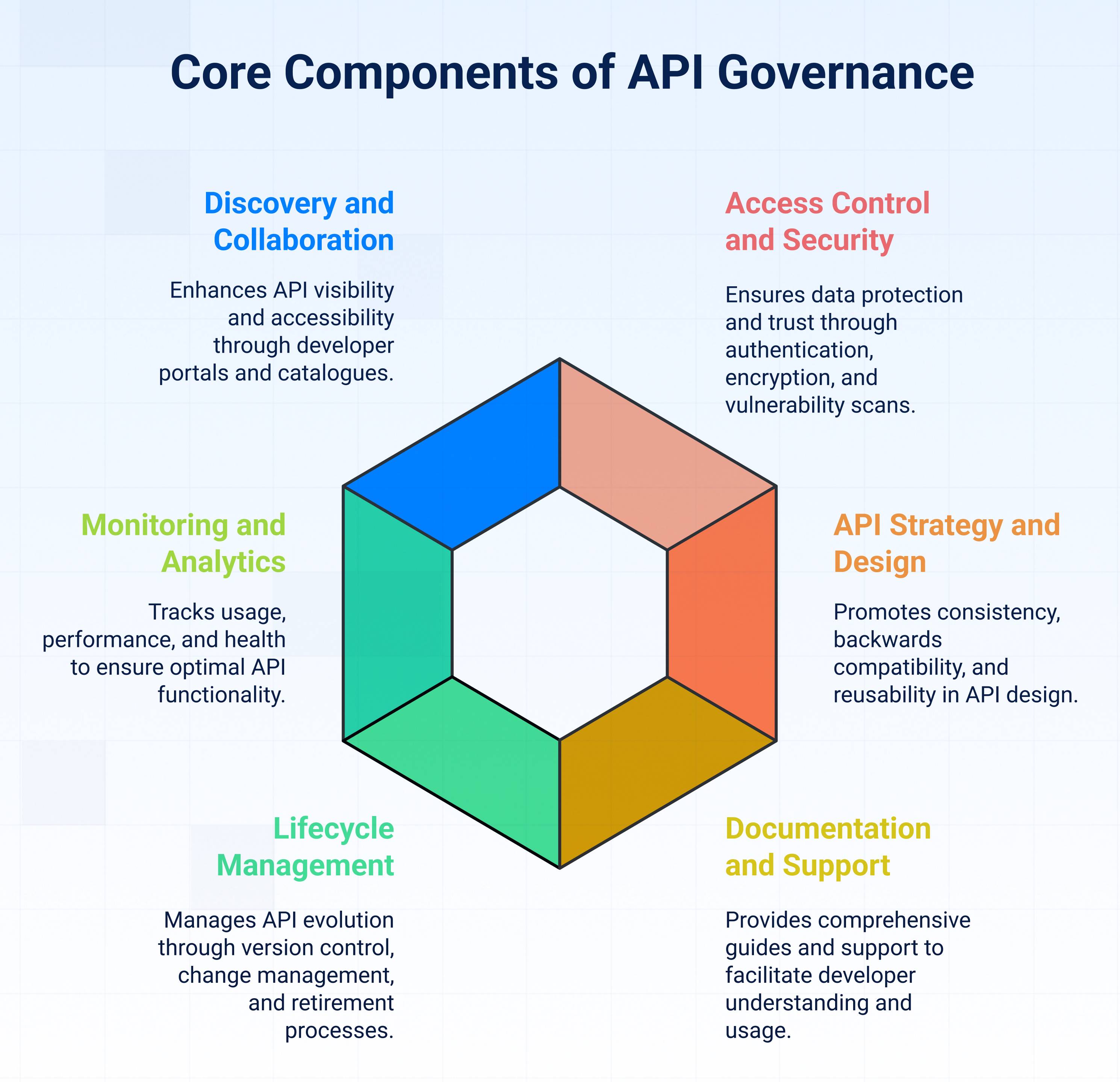
The key components of API governance include access control and security, API strategy and design principles, API documentation and support, API lifecycle management, monitoring, and analytics.
Here is an in-depth look at each component:
1. Access control and security
Security is the cornerstone of any API strategy. Without strong access control, APIs can become gateways for data breaches and system compromise. Access control and security involve the following:
- Authentication and authorisation are the first line of defence. Think of authentication as confirming a user’s identity, while authorisation ensures they only access what they’re allowed to. OAuth 2.0 and API keys are common methods here.
- Encryption protects sensitive data in transit (between systems) and at rest (in storage). HTTPS and TLS are standard protocols to make sure no one intercepts data mid-transmission.
- Regular vulnerability scans and penetration tests help identify potential weaknesses before attackers do. It’s about being proactive, not reactive.
In practice, secure APIs are not just safer; they build trust. When developers know their data is protected, they’re more likely to use and recommend the API.
2. API strategy and design principles
Good API governance begins with a clear strategy and consistent design. This component of API governance emphasises the following:
- Consistency is key. APIs should follow the same structure, naming conventions, and error responses. This reduces confusion and makes it easier for developers to work with different APIs across the organisation.
- Backwards compatibility ensures updates don’t break existing applications. Changes should be additive, not destructive—like adding new fields rather than renaming or deleting them.
- Reusability encourages developers to build once and reuse often. Instead of creating new APIs for every function, shared building blocks can speed up development and ensure uniform behaviour.
A well-thought-out design makes your APIs more maintainable, scalable, and developer-friendly, an essential goal in modern API ecosystems.
3. API documentation and support
Even the most powerful API is useless without proper documentation. Good documentation explains how the API works, what parameters are required, what responses to expect, and includes sample requests. But beyond just listing endpoints, it should tell a story—what problem does the API solve, and how can developers use it effectively?
Supporting developers also means offering FAQs, SDKs, and code samples, plus a clear process for reporting bugs or asking questions. A developer portal can serve as a hub for all this.
The better the documentation, the fewer support tickets your team will handle—and the faster developers can get up and running.
4. API lifecycle management
Managing the full lifecycle of an API, from design to retirement, is essential to keeping things orderly. It involves the following:
- Version control helps you introduce updates without breaking older integrations. Developers can choose which version works best for their needs.
- Change management provides a structured way to introduce updates, with clear communication and rollback plans if something goes wrong.
- Retirement processes are just as important. Outdated APIs should be sunset with an advanced notice, allowing developers time to migrate.
This structured approach ensures APIs evolve without causing chaos, helping both internal teams and external partners stay on track.
5. Monitoring and analytics
Once your APIs are in use, monitoring them is key. Here’s how monitoring and analytics work:
- Usage tracking tells you who is using the API, how often, and for what purpose. This helps prioritise improvements or spot potential abuse.
- Performance monitoring ensures APIs are fast, responsive, and available. Slow APIs can create bottlenecks and ruin the user experience.
- Health checks let you know if an API is down or struggling before users start complaining.
Real-time dashboards and alerts are critical here. Monitoring tools let you respond to issues quickly and keep your API consumers happy.
6. API discovery and collaboration
Finally, collaboration and discoverability bring it all together with the following capabilities:
- Developer portals are a one-stop shop where developers can explore APIs, read documentation, test endpoints, and get updates.
- API catalogues offer a searchable inventory of all available APIs, both internal and external. This helps teams avoid reinventing the wheel.
- Discovery tools and tagging systems help developers find the right APIs faster, improving adoption and encouraging reuse.
In larger organisations especially, APIs often become siloed. Governance ensures they stay visible and accessible, turning them into assets instead of hidden tools.

Common API Governance Failures (And Why Most Frameworks Break)
Most API governance frameworks don’t fail because the idea is wrong — they fail because execution is fragmented, manual, and disconnected from how APIs are actually built and shipped. As API programs scale across teams, clouds, and gateways, even small governance gaps compound into enterprise-wide risk. Below are the most common reasons API governance frameworks break in real-world environments.
1. Governance Exists Only at the Gateway (Not at Design Time)
Many organisations apply governance only at the API gateway — rate limits, auth, and throttling — but leave design completely ungoverned. This means:
- Poor API contracts reach production
- Inconsistent naming and response formats proliferate
- Backward compatibility breaks consumers
Why this breaks: Governance must start before code is written, not after traffic starts flowing.
2. No Central API Ownership Model
When APIs don’t have clearly defined owners:
- Nobody is accountable for security or uptime
- Deprecations fail
- Documentation goes stale
- Incident response becomes chaotic
Why this breaks: Every API must have a named business owner and technical owner mapped from day one.
3. Manual Documentation & Policy Enforcement
Many teams still rely on:
- Wikis
- Spreadsheets
- Email-based approvals
- Manual checklist reviews
Why this breaks: Manual governance does not scale across hundreds of APIs, environments, and teams. Automation is mandatory.
4. Shadow APIs and Unregistered Services
Teams often deploy APIs without:
- Central registration
- Standard documentation
- Security review
- Governance approval
These become:
- Invisible to platform teams
- Unprotected by security standards
- High-risk attack surfaces
Why this breaks: You can’t govern what you can’t discover.
5. No Enforced Versioning & Deprecation Policies
Without strict lifecycle governance:
- Breaking changes leak into production
- Consumers are forced to scramble
- Old versions live forever
- Tech debt compounds rapidly
Why this breaks: Version chaos erodes developer trust and platform stability.
6. Security Policies Vary by Team or Gateway
Different teams apply:
- Different OAuth rules
- Different token standards
- Different rate policies
- Different IP protections
Why this breaks: Inconsistent security creates unpredictable attack surfaces and compliance risk.
7. Governance Is Not Embedded in CI/CD
If governance checks are not part of the build pipeline:
- Bad contracts ship
- Policy violations reach production
- Security reviews become reactive
Why this breaks: Governance must be enforced as code inside CI/CD, not as post-deployment audits.
API Governance Strategy: Step-by-Step Implementation
To implement an effective API governance strategy, define API governance objectives, take inventory of your API landscape, establish API governance policies and processes, establish an API governance team, and choose the right API management platform. From there, establish standards for API design and development, regularly review and update your policies, provide training and resources to stakeholders, and then regularly monitor, analyse API usage and iterate.
Here is an in-depth look at each step:
1. Define your API governance objectives
Before jumping into policies and tools, start by answering a fundamental question: What are we trying to achieve with API governance?
Your goals might include:
- Improving API quality and consistency
- Enforcing security and compliance standards
- Boosting developer productivity
- Reducing technical debt
- Ensuring scalability and reusability
It’s okay if your objectives evolve later. What matters is setting a clear direction. Involving key stakeholders like product owners, API developers, and security teams early in this step helps align everyone’s expectations.
Pro tip: Avoid aiming for perfection right away. Start small, with achievable goals, then refine them as you learn.
2. Take inventory of your API landscape
You can't govern what you don’t know exists. Take time to map out your existing APIs. This includes both internal and external APIs, public-facing endpoints, and partner APIs. Include the following details in your inventory:
- Who owns each API?
- What it does.
- Where it's hosted?
- How it’s documented?
- Which version is live?
- Who consumes it?
This inventory will give you visibility into potential overlaps, security risks, or underutilised APIs. It also lays the groundwork for tracking usage and performance later.
Many companies are surprised by how many “shadow APIs” exist—APIs built by teams without centralised oversight. Discovering these early helps bring them under a common governance umbrella.
3. Establish API governance policies and processes
Now that you know what APIs you have and what you want to achieve, it’s time to create the rules of the road.
Your API governance policies should cover:
- Design standards (naming conventions, versioning, URL structure)
- Security protocols (authentication, authorisation, rate limits)
- Documentation requirements
- Testing and validation procedures
- Approval workflows (who reviews and approves APIs before release)
Think of these as guardrails. The goal is to guide teams, not stifle them.
Processes should also define how policies are applied, such as:
- When an API needs a review
- How to submit changes
- What happens when an API fails to meet standards?
Keep your governance lightweight at first. Overly rigid rules can discourage adoption. Start with minimum viable policies and build from there.
4. Establish an API governance team
Governance doesn't happen on autopilot. You need a dedicated group to drive it.
Your API governance team should include people from:
- Architecture
- Security
- Product/engineering
- Developer experience (DevEx)
Their job is to maintain and evolve governance standards, review and approve APIs, serve as advisors for teams building APIs, and track compliance and adoption.
In some organisations, this is called a Centre of Excellence (CoE) for APIs. It doesn’t have to be a big team—what matters is having clear ownership.
A quick tip: If you’re in a smaller company, the team could be a rotating group of senior engineers or tech leads.
5. Choose the right API management platform
To enforce your governance policies effectively, you need the right tools. An API management platform helps you centralise and automate much of the governance process.
Look for a platform that supports:
- API discovery and cataloguing
- Security policies and access control
- Documentation and developer portals
- Version control
- Usage analytics
- Governance rule enforcement (e.g., linting, contract validation)
Popular tools include DigitalAPI, Postman, Apigee, and SwaggerHub. Choose one that fits your tech stack and team size.
Don't chase the biggest or most expensive platform. Choose what your team will actually use and integrate well into your current development workflow.
6. Establish standards for API design and development
Consistency is one of the biggest benefits of good governance. That’s why design standards are so important.
Here’s what you should standardise:
- Naming conventions (e.g., kebab-case for URLs, camelCase for JSON)
- Versioning approach (e.g., v1 in the URL vs. headers)
- Error formats (use structured error messages)
- Authentication method (OAuth2, API keys, JWT, etc.)
- Request/response structure (e.g., pagination, envelope formatting)
You might also want to provide API design templates, reusable components, and linting tools to automatically check for violations.
Tip: Document these standards in a centralised place (like a wiki or internal style guide) and make them easy to understand. When teams know what’s expected up front, they’re more likely to build things right the first time.
7. Regularly review and update your policies
Governance is not “set it and forget it.” Your organisation, tech stack, and business goals will evolve and so should your governance strategy.
Set a regular cadence (e.g., quarterly) to review what’s working and what’s not, get feedback from API consumers and builders, update standards and tools as needed, and retire outdated policies.
Treat your governance policies like living documents, encourage contributions and keep the language friendly. You want teams to see it as help, not red tape.
8. Provide training and resources to stakeholders
One of the most overlooked aspects of API governance is education. Even the best governance strategy will fall flat if developers and stakeholders don’t understand it or, worse, don’t know it exists.
Make sure to hold onboarding sessions for new devs, create easy-to-follow guides and FAQs, offer hands-on workshops or internal API “office hours,” and share checklists or templates for common tasks.
Also, use your internal documentation portal or chat tools (like Slack or Teams) to answer questions in real time.
Remember to make training engaging. Use real examples from your API landscape and celebrate teams who follow best practices.
9. Monitor, analyse, and iterate on your API governance
Finally, governance is a loop, not a line. Track key metrics like:
- API response times and error rates
- Policy compliance levels
- API adoption rates
- Time-to-market for new APIs
- Developer satisfaction (send internal surveys!)
Use this data to find patterns, identify pain points, and guide your next improvements.
Also, don’t be afraid to iterate. If a policy causes bottlenecks or confusion, fix it. If a tool isn’t being used, reevaluate it.
APIs are a product. Like any product, they improve over time through feedback and iteration.
Best Practices for Crafting Killer API Governance Strategy
The best practices for implementing a powerful API governance strategy include defining clear guidelines for API design and development, establishing strong security measures, establishing a centralised API governance framework, and prioritising security and compliance.
Additional practices include standardising API lifecycle management, promoting cross-functional collaboration, leveraging metrics and analytics for continuous improvement, comprehensive documentation, automation, and testing.
1. Define clear guidelines for API design and development
First things first: if your APIs don’t follow a standard design, users (internal or external) will struggle to use them. Without guidelines, every team might name things differently, handle errors their own way, or even use different protocols.
A good governance strategy starts with a design style guide.
It should cover:
- Naming conventions (e.g., snake_case vs camelCase)
- Resource structures (/users/123/orders vs /orders?userId=123)
- Standardised status codes and error formats
- Versioning (e.g., /v1/ in the URL or via headers)
- API protocols (REST, GraphQL, gRPC, etc.)
But here’s the key: keep it developer-friendly. Avoid overly complex rules. Use real code examples. Make your standards a tool, not a textbook.
Tip: Tools like DigitalAPI's Governance can help automate design checks so that every new API aligns with your design rules before it even hits production.
2. Establish strong security measures
APIs are frequent targets for cyberattacks, especially public-facing ones. Thus, security is non-negotiable.
Your governance strategy should include:
- Authentication: Use industry-standard approaches like OAuth 2.0 or API keys.
- Authorisation: Enforce role-based or scope-based access control (e.g., not every user should access admin APIs).
- Input validation: Sanitise incoming data to prevent injection attacks.
- Rate limiting: Protect endpoints from abuse using quotas or throttling.
- Data encryption: Secure data in transit (HTTPS) and at rest.
- Auditing: Log API usage to detect anomalies or unauthorised access.
Security isn’t something you “bolt on” later. It should be baked into your API lifecycle—from planning to deployment.
Pro tip: Security works best when developers don’t even notice it. Use frameworks and libraries that handle the heavy lifting behind the scenes.
3. Create a centralised API governance framework
As your API program grows, having decentralised ownership often leads to duplication and inconsistency. That’s why a centralised governance body, sometimes called an API council, can help oversee standards and decision-making.
This doesn’t mean one team owns all APIs. Instead, governance provides a hub for:
- Reviewing new APIs and changes
- Managing API catalogues or developer portals
- Enforcing standards through automation
- Facilitating knowledge-sharing across teams
Centralisation brings order without killing autonomy.
Use an internal API portal to catalogue all APIs, document standards, and track ownership.
4. Prioritise security and compliance from the start
If your APIs handle sensitive user data or fall under regulations like GDPR, HIPAA, or PCI-DSS, then compliance needs to be built in, not tacked on later.
Governance should ensure:
- Personally Identifiable Information (PII) is classified and protected.
- APIs collect only the data they need (minimisation).
- Data processing follows user consent guidelines.
- API logs and metadata are stored securely for audits.
- Token policies are enforced (expiration, refresh, revocation).
Why it matters: Waiting until the audit to worry about compliance is like studying the night before a final—you’re asking for trouble. Instead, embed compliance into your design templates, SDKs, and checklists.
5. Standardise API lifecycle management
APIs don’t just get built and forgotten (at least, they shouldn’t). Governance ensures every API follows a standard lifecycle from start to finish.
A typical lifecycle includes:
- Planning: Gather business and tech requirements
- Design: Create and review API specs
- Development & Testing: Build and validate APIs
- Publishing: Document and deploy APIs
- Monitoring & Support: Track usage, performance, and issues
- Deprecation/Retirement: Retire outdated APIs with proper notice
Without a defined process, teams might push half-baked APIs or leave deprecated ones running forever.
Pro tip: Include versioning, backwards compatibility, change log updates, and SLA definitions in your lifecycle governance.
6. Promote cross-functional collaboration
API governance works best when it includes voices from across the organisation. Developers, product managers, security experts, legal/compliance teams, and even customer support all play a role in building high-quality APIs.
Create collaboration touchpoints such as:
- Weekly API design review meetings
- Slack channels for Q&A and decisions
- Shared dashboards for tracking reviews and exceptions
- API design feedback surveys for internal devs
7. Leverage metrics and analytics for continuous improvement
You can’t manage what you don’t measure. Governance needs data to improve.
Key metrics to track include API adoption and usage trends, error rates (e.g., 4xx/5xx status codes), response time and latency, security incident counts, and developer satisfaction scores (yes, those matter too!).
Use these insights to refine your API standards, training programs, and tooling.
Pro tip: Don’t just track API health, track governance performance. Are reviews fast? Are standards too strict or unclear? Let metrics guide improvement.
8. Build comprehensive documentation
This can’t be overstated: good documentation can make or break your APIs. Governance should ensure every API includes:
- Clear purpose and use cases
- Authentication instructions
- Endpoint specs and parameters
- Error codes and what they mean
- Sample requests and responses
- Version history and updates
Also, make sure your docs are easy to maintain. Use API management tools to auto-generate and update as code changes. Embed a "try it out" console in your API portal. Developers love being able to experiment directly.
9. Automate testing and governance enforcement
Manual checks just don’t scale. If you want governance to work without becoming a bottleneck, automate everything you can.
Automation helps with validating API specs against standards, running security scans (e.g., OWASP, static analysis), checking code for sensitive data leaks, generating documentation from code comments, and ensuring proper tagging, ownership, and SLAs.
Integrate these checks into your CI/CD pipelines so that governance happens automatically with every build or pull request.
We get it—API governance has a bad rep. Some teams see it as red tape, slowing down dev cycles. But when it’s done right, governance is a superpower. It helps you ship faster, more secure, and more reliable APIs that everyone, from developers to customers, can trust.
The secret? Don’t just throw rules at your teams. Empower them. Involve them. Automate wherever possible. And most importantly, treat governance as a living, breathing process that adapts as your needs evolve.
API Governance for Internal vs Partner vs Public APIs
Not all APIs require the same level of governance. Internal APIs prioritise speed and standardisation, partner APIs demand controlled access and trust, while public APIs require the highest level of security, stability, and commercial governance. A mature API governance framework adapts policies based on API exposure and business risk.
1. Internal API Governance (Built for Speed & Consistency)
Internal APIs power microservices, internal platforms, and operational systems. Governance here focuses on design consistency, discoverability, version control, and security baselines without slowing down engineering velocity. Strong internal governance prevents API sprawl, reduces integration debt, and enables teams to scale safely across domains.
2.Partner API Governance (Built for Trust & Controlled Access)
Partner APIs expose business capabilities to external organisations under strict agreements. Governance must enforce fine-grained access control, onboarding workflows, SLA tracking, throttling, and contractual version stability. Poor partner governance leads to revenue leakage, trust breakdowns, and operational risk across shared integrations.
3. Public API Governance (Built for Scale, Stability & Monetisation)
Public APIs serve unknown consumers at internet scale. Governance here must be fully automated, covering security policies, abuse prevention, versioning discipline, monetisation controls, legal compliance, and performance guarantees. Weak public governance directly translates into brand damage, security incidents, and revenue loss.
Streamline Your API Governance with DigitalAPI
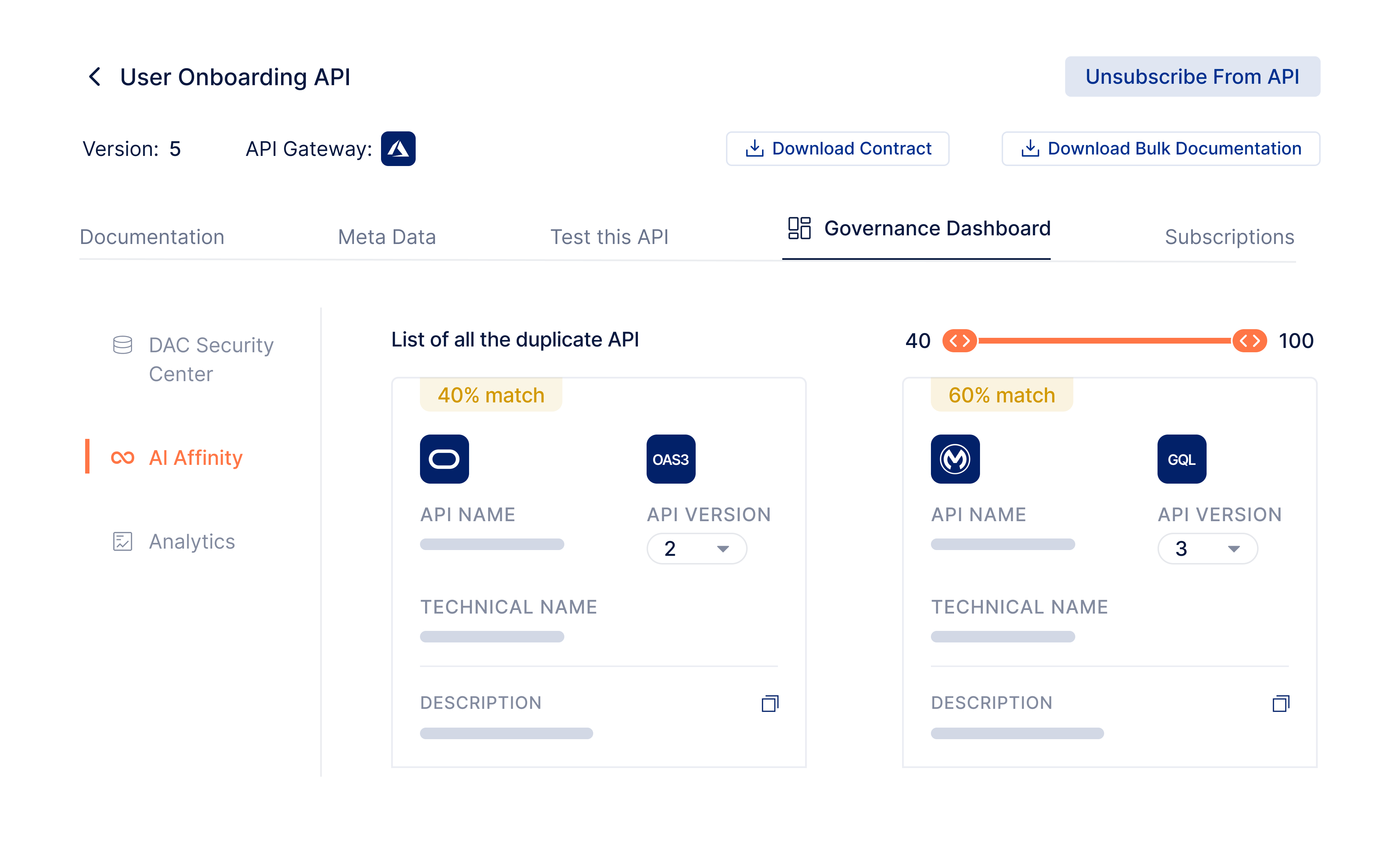
Managing APIs can get messy without the right strategy—security gaps, inconsistent designs, and poor documentation slow down innovation. That’s where DigitalAPI steps in.
With our API Hub, organisations can create a centralised, branded API ecosystem that simplifies discovery, documentation, and collaboration. What really sets the platform apart is how seamlessly it integrates governance policies right into the developer experience—think version control, access management, and approval workflows all under one roof.
Rather than juggling tools or spreadsheets, you get a clear view of your API lifecycle from planning through deprecation. It supports consistency in design, security standards, and usage analytics, so you're not just managing APIs—you’re guiding their growth with purpose.
Teams stay aligned, compliance becomes less of a headache, and you gain better visibility into how APIs are being consumed. DigitalAPI makes governance feel less like a chore and more like a natural extension of your API strategy. It’s smart, streamlined, and built for scale.
Ready to take control of your APIs? Explore DigitalAPI today!
FAQs on API Governance
1. What is governance in API?
API governance is about setting rules and guidelines to make sure APIs are built, maintained, and used consistently across teams. It helps avoid chaos by standardising how APIs handle security, naming, documentation, and versioning. Think of it as quality control that keeps APIs reliable and easy to work with.
2. What is API management vs API governance?
API management focuses on the day-to-day operation of APIs, like usage tracking, rate limiting, and access control. API governance, on the other hand, looks at the bigger picture: setting standards, ensuring consistency, and aligning APIs with business goals. Management runs the APIs; governance keeps them in check.
3. Why is API governance necessary?
Without governance, APIs quickly become messy and hard to scale. Different teams may follow their own rules, making integration painful. Good API governance keeps everything aligned—boosting security, improving developer experience, and saving time by avoiding rework. It’s not about control—it’s about building smarter, not harder.
4. Who needs API governance?
Any organisation with multiple APIs—or plans to scale—needs API governance. Whether you're a startup growing fast or an enterprise juggling micro services, governance ensures your APIs stay consistent, secure, and easy to maintain. It’s especially valuable for teams working across products, platforms, or business units.
Bharath Kumar is the Founder and CEO of DigitalAPI, the multi-gateway API management platform helping organizations unify API discovery, governance, monetization, and AI agent enablement across Apigee, AWS, Azure, Kong, and MuleSoft.
Bharath founded DigitalAPI in 2015 after several years as a Solutions Architect at Apigee, the platform now part of Google Cloud and widely regarded as the foundational product of the modern API management category. At Apigee, he worked across pre-sales, product evangelism, and customer architecture, designing API programs for Fortune 100 customers. Earlier in his career, he held engineering roles at IBM, GalaxE Solutions, and Infinite Computer Solutions.
Under his leadership, DigitalAPI has grown into a globally recognized API management platform and caters to multiple Fortune 500 customers. His perspective on APIs, AI, and developer experience has been featured in Forbes, and he is a recurring speaker at Apidays and other API industry events.
One email a fortnight. Worth opening.
A short digest of what we're writing, what we're learning from customers, and the handful of links you'd actually want from us. No tracking pixels.

.avif)