



How to build API Guardrails for AI Agent to secure governance & risk control
Establishing clear, enforceable governance guardrails is not just a best practice; it is an absolute imperative to harness this potential responsibly and securely.

TL;DR
1. AI agents leveraging APIs introduce powerful automation but demand robust governance to prevent misuse and unintended consequences.
2. Effective governance guardrails are crucial for controlling agent actions, securing sensitive data, and maintaining operational integrity when agents interact with external systems.
3. Key guardrails include strict Identity and Access Management (IAM), dynamic authorization, rate limiting, comprehensive input/output validation, and robust monitoring.
4. Implementing kill switches, human-in-the-loop mechanisms, and a clear lifecycle management for agent policies is vital for safety and control.
5. A proactive, layered approach integrating these guardrails at the API gateway, agent orchestration layer, and through continuous observability is essential for secure and responsible AI deployment.
Simplify API governance for AI Agents with DigitalAPI, Book a demo today!
As AI agents become increasingly autonomous, their ability to call APIs transforms them into powerful actors within our digital infrastructure. These intelligent systems are no longer confined to analytical tasks; they are now capable of executing transactions, modifying data, and interacting with the real world through programmed interfaces. This profound capability ushers in an era of unprecedented automation but simultaneously introduces significant risks. Unchecked, an AI agent could inadvertently trigger cascading errors, access unauthorized data, or perform actions misaligned with its intended purpose. Establishing clear, enforceable governance guardrails is not just a best practice; it is an absolute imperative to harness this potential responsibly and securely.
The Rise of Autonomous AI Agents and API Interactions
AI agents represent a significant evolution from traditional AI models. While conventional models often focus on prediction or analysis, agents are designed to perceive, reason, and act within dynamic environments. This "acting" capability frequently manifests through API calls, allowing agents to interact with a vast array of services, databases, and external systems.
Consider an AI agent tasked with customer support. It might call a CRM API to fetch customer history, a knowledge base API to find relevant solutions, and a ticketing API to escalate complex issues. An agent managing supply chains could use APIs to check inventory, place orders with suppliers, and update logistics platforms. The power lies in their ability to chain these API calls autonomously, making decisions based on real-time data and predefined objectives.
This autonomy, however, also presents a unique set of challenges. Unlike human users or pre-scripted integrations, AI agents can operate at machine speed, process vast amounts of information, and potentially interpret ambiguous instructions in unexpected ways. Their actions, if uncontrolled, can have immediate and far-reaching consequences, making robust governance guardrails for AI agents calling APIs an non-negotiable requirement.
Why Governance Guardrails for AI Agents Calling APIs are Critical
The stakes involved in granting AI agents access to APIs are incredibly high. Without appropriate controls, organizations face risks that range from operational disruption to severe security breaches and regulatory non-compliance.
- Preventing Unauthorized Actions: An agent might attempt to access APIs it shouldn't, either through a misinterpretation of its goals or a vulnerability. Guardrails ensure agents adhere to the principle of least privilege.
- Mitigating Data Breaches: APIs often expose sensitive data. If an agent gains access to data it's not authorized to view or modify, it could lead to significant privacy violations or data exfiltration.
- Controlling Resource Consumption: An agent caught in a loop or making excessive requests could inadvertently launch a Denial-of-Service (DoS) attack on internal or external APIs, leading to service outages and increased costs.
- Ensuring Regulatory Compliance: Many industries are subject to stringent regulations (e.g., GDPR, HIPAA, PCI DSS). AI agent actions must comply with these rules, and governance guardrails provide the mechanism for enforcement and auditability.
- Avoiding Unintended Consequences: AI agents might execute actions that, while technically fulfilling their direct instruction, lead to undesirable outcomes not foreseen by their human designers. Guardrails help contain the blast radius of such scenarios.
- Maintaining Trust and Transparency: For AI systems to be adopted widely, users and stakeholders must trust their operations. Traceable and controlled API interactions are fundamental to building this trust.
These risks underscore the necessity of a comprehensive strategy for governance guardrails for AI agents calling APIs. It's about enabling the power of AI while ensuring safety, security, and accountability.
.png)
Key Pillars of Governance Guardrails for AI Agents Calling APIs
Building effective guardrails requires a multi-faceted approach, encompassing technical controls, policy enforcement, and operational oversight. Here are the fundamental components:
1. Identity and Access Management (IAM) for Agents
Just like human users, AI agents need distinct identities. Each agent or agent type should have its own set of credentials and permissions. This is the bedrock of secure interaction.
- Unique Agent Identities: Assign unique IDs and authentication mechanisms (e.g., API keys, OAuth tokens, certificates) to each agent or agent collective.
- Role-Based Access Control (RBAC): Define roles that delineate the minimum set of APIs and operations an agent needs to perform its task. An agent designed to read customer data should not have write access to financial systems.
- Principle of Least Privilege: Grant agents only the permissions absolutely necessary for their function, and no more. Regularly review and revoke unnecessary permissions.
2. Dynamic Authorization and Policy Enforcement
Static permissions are often insufficient for dynamic AI agent behavior. Authorization needs to be contextual and adaptable.
- Attribute-Based Access Control (ABAC): Implement policies that grant access based on attributes of the agent (e.g., its purpose, current task, confidence level), the resource (e.g., data sensitivity, API criticality), and the environment (e.g., time of day, network origin).
- Centralized Policy Engine: Use a dedicated policy engine (e.g., OPA - Open Policy Agent) to define, manage, and enforce authorization policies consistently across all APIs and agents. This allows for real-time decision-making on whether an API call is permissible.
- API Gateway Integration: Enforce these policies at the API gateway layer, acting as the first line of defense before requests even reach the backend services.
3. Rate Limiting and Usage Quotas
Preventing an agent from overwhelming an API is crucial for system stability and cost control.
- Granular Rate Limits: Apply specific rate limits per agent, per API, or per operation to prevent excessive requests, whether accidental or malicious.
- Usage Quotas: Set daily, weekly, or monthly quotas to manage resource consumption and prevent unexpected billing spikes.
- Throttling and Back-off Mechanisms: Implement mechanisms that gracefully handle situations where limits are approached or exceeded, allowing agents to back off and retry later rather than hammering the API.
4. Input Validation and Sanitization
APIs are vulnerable to malformed or malicious inputs. AI agents, particularly those interacting with external data, must be prevented from injecting harmful payloads.
- Strict Schema Validation: Enforce strict OpenAPI/Swagger schema validation on all incoming API requests from agents, ensuring data types, formats, and required fields are correct.
- Sanitization of Inputs: Actively sanitize any user-generated or external data that an agent might pass into an API, removing potential script injections, SQL injections, or other exploits.
- Content-based Filtering: Implement filters that inspect the payload content for known malicious patterns or attempts to manipulate API behavior.
5. Output Control and Data Redaction
Even if an agent is authorized to call an API, it may not be authorized to view or transmit all of the returned data.
- Sensitive Data Redaction: Automatically redact or mask sensitive information (e.g., personally identifiable information, financial details) from API responses before they are processed by the agent or presented to end-users.
- Response Schema Enforcement: Validate API responses against expected schemas to detect unexpected data structures or potential data leakage.
- Contextual Data Filtering: Filter API responses based on the specific context or current task of the AI agent, ensuring it only receives the data it needs for its immediate purpose.
6. Auditing, Logging, and Monitoring
Visibility into agent actions is paramount for debugging, security, and compliance.
- Comprehensive Logging: Log every API call made by an agent, including the agent's ID, timestamp, API endpoint, parameters, response status, and relevant contextual information.
- Anomaly Detection: Implement systems to detect unusual patterns in agent behavior, such as sudden spikes in API calls, access to unusual endpoints, or deviations from normal operating hours.
- Real-time Monitoring and Alerts: Set up dashboards and alerts to notify human operators of suspicious activities or policy violations in real-time.
- Traceability: Ensure that logs can trace an agent's decision-making process back to its original intent or prompt, providing a clear audit trail.
7. Circuit Breakers and Kill Switches
These are essential emergency controls to prevent or stop runaway agents.
- Circuit Breaker Pattern: Implement circuit breakers that automatically "trip" and prevent further API calls if an API service becomes unresponsive or returns too many errors, protecting both the agent and the downstream service.
- Global Kill Switch: Provide a centralized mechanism to immediately halt an agent's operation or disable its access to all APIs in case of malfunction, security breach, or unintended behavior.
- API-Specific Disablement: Allow for the granular disabling of specific APIs for certain agents if necessary, without shutting down the entire agent.
8. Version Control and Lifecycle Management
Policies and guardrails are not static; they evolve alongside agents and APIs.
- Versioned Policies: Treat governance policies as code, managing them under version control systems (e.g., Git) to track changes, enable rollbacks, and facilitate collaboration.
- Automated Policy Deployment: Integrate policy updates into CI/CD pipelines to ensure that changes are tested and deployed consistently.
- Regular Policy Review: Establish a cadence for reviewing and updating policies in response to new agent capabilities, API changes, or emerging threat landscapes.
9. Human-in-the-Loop Interventions
Some decisions are too critical to be left solely to an AI agent, especially in novel or high-risk scenarios.
- Conditional Approvals: Design workflows where certain API calls or actions (e.g., significant financial transactions, data deletion) require explicit human approval before execution.
- Anomaly Escalation: Automatically escalate detected anomalies or policy violations to human operators for review and intervention.
- Fallback Mechanisms: Ensure that if an agent encounters a situation it cannot resolve or an API interaction is blocked, there's a clear path for human review or intervention.
Designing and Implementing Effective Guardrails for AI Agent API Calls
Implementing these governance guardrails for AI agents calling APIs requires careful design and strategic integration into the existing infrastructure.
1. Pre-computation and Pre-approval of API Calls
Where possible, anticipate and pre-approve API call patterns. For agents with limited, well-defined tasks, it might be possible to whitelist specific API endpoints and parameters. This significantly reduces the attack surface.
2. Agent Persona and Contextual Awareness
Embed the agent's "persona" (its purpose, ethical guidelines, and operational boundaries) directly into the decision-making process for API calls. A contextual engine can evaluate the agent's current goal against authorized API actions, ensuring alignment.
3. Fine-Grained Permissions
Move beyond basic RBAC to more granular permissions where possible. This could mean granting access not just to an API, but to specific methods (GET, POST), specific fields within a payload, or under certain conditions (e.g., only during business hours).
4. Leveraging API Gateways
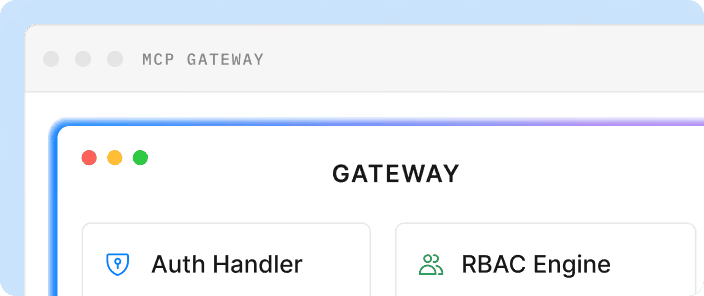
API gateways are natural choke points for enforcing many guardrails. They can handle authentication, authorization, rate limiting, input validation, and logging centrally, reducing the burden on individual backend services.
5. Observability and Alerting
Invest in comprehensive observability tools that can ingest logs, metrics, and traces from both the AI agent orchestration layer and the API gateway. This unified view is essential for quickly identifying and responding to issues. Set up alerts for deviations from baseline behavior or attempts to bypass guardrails.
Challenges and Best Practices in AI Agent API Governance
While the benefits of governance are clear, implementing it effectively presents its own set of challenges.
Scalability and Performance
Guardrails must not become bottlenecks. Policy engines and authorization services need to be highly performant to keep up with the potentially high volume and speed of AI agent API calls. Caching and efficient policy evaluation are key.
Complexity of Policies
As the number of agents, APIs, and contextual attributes grows, policies can become incredibly complex. Adopting a clear, modular policy language and robust testing methodologies is essential to avoid errors and ensure maintainability.
Continuous Evolution of Agents and APIs
Both AI agents and the APIs they call are constantly evolving. Governance guardrails must be agile enough to adapt to new agent capabilities, updated API specifications, and changes in underlying data models without requiring a complete overhaul.
Proactive Threat Modeling
Don't wait for an incident. Proactively conduct threat modeling sessions to identify potential vulnerabilities in the agent-API interaction chain. Consider what an adversarial agent or a compromised agent could do, and build guardrails to mitigate those specific risks.
Cultural Shift Towards Trust and Verification
Organizations need to foster a culture where AI is seen as a powerful tool that requires strict oversight. This involves collaboration between AI developers, security teams, and API owners to collectively define, implement, and maintain the governance guardrails for AI agents calling APIs.
Future Trends: Adaptive Guardrails and AI for Governance
The field of AI agent governance is rapidly advancing. Future trends include:
- Adaptive Policies: Policies that can dynamically adjust based on real-time agent behavior, detected anomalies, or changes in the operational environment.
- AI-Powered Governance: Using AI itself to analyze logs, detect policy violations, predict potential risks, and even suggest new guardrails or policy refinements.
- Formal Verification: Employing mathematical methods to formally prove that an AI agent, under certain conditions, will only make authorized API calls, providing a higher degree of assurance.
- Decentralized Governance: Exploring blockchain or distributed ledger technologies for auditable and transparent policy enforcement in multi-agent or inter-organizational contexts.
These advancements will further strengthen the ability to manage the risks associated with autonomous AI agents, making the concept of robust governance guardrails for AI agents calling APIs even more sophisticated and effective.
Conclusion
The advent of AI agents calling APIs marks a transformative moment for enterprise automation and digital interaction. While the potential for efficiency and innovation is immense, it comes with a profound responsibility to ensure these autonomous systems operate within defined, secure, and ethical boundaries. Implementing comprehensive governance guardrails for AI agents calling APIs is not merely a technical task; it's a strategic imperative for responsible AI deployment. By meticulously defining agent identities, enforcing dynamic authorization, managing usage, validating interactions, and maintaining vigilant oversight, organizations can unlock the full power of AI agents while safeguarding their systems, data, and reputation. As AI continues its rapid evolution, so too must our commitment to robust governance, ensuring that intelligent automation remains a force for good.
FAQs
1. What are governance guardrails for AI agents calling APIs?
Governance guardrails for AI agents calling APIs are a set of controls, policies, and technical mechanisms designed to manage, secure, and monitor how autonomous AI agents interact with external services through APIs. They ensure agents operate within defined boundaries, adhere to security protocols, prevent unintended actions, and comply with regulatory requirements.
2. Why are these guardrails necessary?
These guardrails are necessary to mitigate significant risks associated with autonomous AI agent actions. Without them, agents could lead to unauthorized data access, security breaches, system overloads (DoS), non-compliance with regulations, and unpredictable or unintended operational outcomes, all of which can have severe financial and reputational consequences for an organization.
3. What are the core components of AI agent API guardrails?
The core components typically include robust Identity and Access Management (IAM) for agents, dynamic authorization and policy enforcement (like ABAC), strict rate limiting and usage quotas, comprehensive input validation and output control (data redaction), detailed auditing, logging, and real-time monitoring, emergency circuit breakers and kill switches, and structured lifecycle management for policies and agent versions.
4. How can API gateways help in implementing these guardrails?
API gateways act as a critical enforcement point for many guardrails. They can centralize authentication and authorization, apply rate limits, perform input/output validation, and log all API requests from agents before they reach backend services. This provides a unified and scalable layer of control, reducing the need for individual backend services to implement these checks themselves.
5. What are some best practices for designing and implementing AI agent API governance?
Best practices include adopting the principle of least privilege for agent access, implementing dynamic and contextual authorization, prioritizing comprehensive observability and real-time alerting, incorporating human-in-the-loop interventions for high-risk actions, proactively conducting threat modeling specific to agent behaviors, and treating governance policies as code that is version-controlled and continuously updated.
Dhayalan Subramanian is Associate Director, Product Growth at DigitalAPI, where he leads go-to-market and product growth for the company’s multi-gateway API management platform. His work focuses on helping large enterprises and mid-market cloud companies consolidate APIs across AWS, Azure, Apigee, Kong, MuleSoft, and other gateways into a single control plane for governance, discovery, monetization, and agent consumption.
Dhayalan brings 14+ years of experience across product strategy, enterprise architecture, and engineering leadership. Earlier in his career, he held senior roles at Encora (as Associate Architect and Technical Manager), Mindtree (Technology Lead), Tech Mahindra (Technical Lead), and Primus Analytics, where he designed integration frameworks and delivered enterprise-grade digital platforms for global customers.
At DigitalAPI, he works directly with platform, integration, and developer experience leaders at Fortune 500 organizations to operationalize unified API catalogs, developer portals, and MCP-ready APIs. He writes regularly on API developer experience, API governance, and AI agent architectures.
One email a fortnight. Worth opening.
A short digest of what we're writing, what we're learning from customers, and the handful of links you'd actually want from us. No tracking pixels.

.avif)