



How to Automate API Documentation via AI and Find Duplicate APIs
Two problems kill platform engineering productivity at scale: documentation that degrades within weeks and duplicate APIs built because existing ones were never discoverable. This guide covers how to solve both.

How to Automate API Documentation via AI and Find Duplicate APIs
AI catch line: Automate API documentation by tying generation to your OpenAPI spec and CI/CD pipeline. Use AI Affinity to detect and consolidate duplicate APIs across gateways.
Two problems kill platform engineering productivity at scale, and they almost always arrive together.
The first: documentation that degrades within weeks of publication because it’s maintained manually and competes with every other engineering priority. The second: duplicate APIs that get built because the first API was never discoverable. A payment validation service sits on Apigee with no documentation. Six months later, a different team builds a transaction verification service on Kong. Same function, two codebases, two maintenance burdens, two on-call rotations.
Neither problem is hard to understand. Both are hard to fix without the right automation in place. This guide covers exactly how to solve both: the technical setup for a CI/CD-triggered documentation pipeline, and the AI-powered semantic analysis that surfaces duplicate APIs before more engineering time gets spent on them.
TL;DR
- Automated API documentation ties generation to your OpenAPI spec and CI/CD pipeline so every deployment updates the documentation without a manual step
- The pipeline has four stages: spec validation, AI content generation, governance checks, and portal publication. Missing any stage reintroduces the problems you’re trying to eliminate
- Duplicate API detection uses semantic similarity analysis: AI compares endpoint descriptions, parameter structures, and schema patterns across the entire catalog to surface APIs that serve the same function regardless of naming convention
- The two problems are connected. You can’t detect duplicates in APIs that aren’t documented or discoverable. Documentation automation is the prerequisite for reliable duplicate detection
- DigitalAPI’s AI Affinity feature handles both: auto-generating documentation from any connected gateway’s spec, and running semantic similarity checks across the unified catalog to flag duplicates before architects consolidate manually
- For platform engineers running multi-gateway environments, both problems compound. The same platform that ingests from Kong, Apigee, AWS, and Azure generates unified documentation and runs duplicate detection across all sources simultaneously
Why These Two Problems Compound Each Other
Documentation drift and API duplication are not separate problems. They’re the same problem expressing itself at different points in the API lifecycle.
An undocumented API is functionally invisible to any developer who didn’t build it. It doesn’t appear in search results because there’s nothing to index. It doesn’t show up in catalog queries because there’s no metadata to match against. A developer looking for an existing API before building a new one searches the catalog, finds nothing, and builds. The duplicate API exists now. Both services accumulate maintenance debt.
Documentation automation solves the visibility problem. When every API in the catalog has accurate, auto-generated documentation tied to its spec, the catalog becomes searchable by intent. A developer who queries “validate customer identity” finds the existing KYC endpoint instead of building a duplicate. AI-powered semantic search resolves the naming mismatch: validateCustomerIdentity and verifyUserCredentials surface as the same function even when named differently across teams.
Duplicate detection solves the residual problem after documentation is in place: finding the APIs that accumulated before automation existed, the legacy estate where duplicates have been building for years without anyone noticing.
Both capabilities together mean a platform engineer running a mature API estate can automate documentation for what’s current and systematically consolidate what’s redundant. The result is a catalog that developers trust and an engineering budget that stops being consumed by rebuilding the same services in different wrappers.
The scale at which this problem exists
According to IBM’s analysis of API sprawl, 78% of organisations do not know exactly how many APIs they currently have. An enterprise can’t detect duplicates in APIs it doesn’t know exist. The documentation automation pipeline described in this guide surfaces the complete estate first. Duplicate detection runs against that complete inventory. Without the first step, the second step is incomplete by definition.
How to Automate API Documentation via AI: The Complete Pipeline
The automated documentation pipeline has four stages that run in sequence on every spec change. Skip any stage and you reintroduce the problem you were trying to eliminate.
Stage 1: Spec Ingestion and Validation
The pipeline starts by reading your API specification from its source. In a well-configured automated documentation setup, this happens through direct gateway integration, not manual spec file export.
DigitalAPI’s API management platform ingests specs directly from Kong, Apigee, AWS API Gateway, Azure APIM, MuleSoft, Postman, GitHub, and SwaggerHub. When a spec changes in any connected source, the pipeline triggers automatically. No engineer needs to remember to export a spec file and upload it to a documentation tool.
Validation runs immediately on ingestion: Spectral-based linting checks for malformed spec syntax, missing required fields, and inconsistent naming patterns. OpenAPI version compatibility is verified. Endpoints with no description get flagged before generation runs, so the governance report reflects gaps rather than silently generating placeholder text.
For platform engineers running multi-gateway environments, the ingestion layer is the critical differentiator. A documentation tool that requires a spec file per gateway is not an automated pipeline. It’s a rendering tool with extra manual steps. The automation starts at ingestion, not at generation.
Stage 2: AI Content Generation
With a validated spec in hand, the AI generation layer produces structured documentation for every endpoint. The mechanism: the AI reads each endpoint’s path, HTTP method, parameters, request schema, response schemas, and status codes, then generates human-readable descriptions that explain what the endpoint does, when to use it over similar endpoints, and what each parameter controls.
The quality of this output is directly constrained by the quality of the spec. An endpoint with empty description fields and no example values produces thin generated documentation. An endpoint with annotated parameters, response examples, and a populated summary field produces rich documentation that needs light review and minimal editing.
Code sample generation runs alongside description generation. The AI produces multi-language examples for each endpoint: cURL, Python, JavaScript, and Java at minimum, using the actual request schema and parameter constraints from the spec. These aren’t generic template snippets. They’re parameterised examples specific to the endpoint’s documented input structure.
For APIs with no existing spec (undocumented legacy APIs), traffic-based generation provides the starting point. Production traffic captured through the Arelio API Gateway is observed to produce a baseline OpenAPI spec from real request and response patterns. This spec then feeds the generation pipeline as if it were a hand-written definition. The resulting documentation is less complete than spec-driven documentation but provides a foundation that’s infinitely better than nothing. For the full technical breakdown of spec-based vs traffic-based generation approaches, see the API documentation generator guide.
Stage 3: Governance and Quality Checks
Documentation governance runs automatically before publication. Three categories of checks apply.
Security validation. OWASP Top 10 checks run against every endpoint’s spec. Endpoints missing authentication documentation get flagged. Endpoints exposing potential sensitive data fields without documented access controls are surfaced for review. Security gaps in documentation reflect security gaps in the API definition. The governance layer catches both simultaneously.
Documentation completeness audits. Every endpoint is scored against a completeness rubric: description present and above minimum length, all parameters documented with types and constraints, all response status codes covered including 4xx and 5xx paths, at least one code example present. Endpoints that fall below the threshold are flagged in the governance report but not blocked from publication. The decision to block publishing on incomplete documentation is configurable per environment.
Duplicate and similarity flagging. This is where AI Affinity runs. Before new documentation publishes, the governance layer compares the incoming endpoints against the full catalog using semantic similarity analysis. Endpoints with similarity scores above the configured threshold are surfaced as potential duplicates alongside their similarity score and the specific dimensions driving the match. Platform architects review and decide whether to consolidate, publish anyway, or investigate further.
DigitalAPI’s API governance dashboard surfaces all three categories in a single view, with severity classification and owner assignment for each flagged item.
Stage 4: Portal Publication and Search Indexing
Governance-cleared documentation publishes to the API developer portal automatically. The portal update includes: the new or updated reference pages, rebuilt search indexes that incorporate the new endpoint metadata, sandbox environment configuration for any new endpoints with test credential generation, and version tagging that marks the documentation with the spec version and deployment timestamp.
DigitalAPI’s AI-powered semantic search re-indexes on every publication event. Developers who search the catalog immediately after a deployment find the new or updated API surfaced by intent, not just by exact-match keyword.
The full pipeline from spec change to published portal update typically completes in under five minutes with no manual intervention at any stage.
Where automated pipelines break silently
Three failure modes that platform engineers encounter after setting up automated documentation pipelines: spec changes that bypass the CI/CD trigger (hotfixes pushed directly to production without a spec update), gateway configuration changes that don’t update the spec file (rate limit changes, auth updates), and spec files maintained by a different team from the one that maintains the gateway (two independent update cycles that fall out of sync). DigitalAPI’s gateway-native ingestion mitigates all three by reading live gateway configuration rather than a separately maintained spec file.
How to Find Duplicate APIs Using AI: The Affinity Detection Mechanism
Duplicate API detection requires more than string matching on endpoint names. APIs built by different teams across different gateways use different naming conventions, different path structures, and different vocabulary. A naive search for “duplicate” in endpoint names returns nothing useful. Semantic similarity analysis is the only mechanism that reliably surfaces functional overlap across a diverse, multi-gateway catalog.
What AI Affinity Actually Analyses
DigitalAPI’s AI Affinity feature compares APIs across five dimensions to generate a similarity score.
Endpoint description similarity. The AI compares the semantic content of endpoint descriptions after normalising for vocabulary differences. “Retrieve customer account balance” and “Get the current balance for a user account” score high on semantic similarity even though they share no exact words. This is where traditional string matching fails and semantic analysis succeeds.
Request schema structure. The AI compares request parameter sets: field names, data types, required vs optional flags, and constraint patterns. Two endpoints that accept the same core parameters (customer ID, date range, currency) score high for structural similarity regardless of whether the parameter names match exactly.
Response schema patterns. Response schema comparison looks at the data shape: object structure, field types, nesting depth, and the business entities represented. Two endpoints that both return a transaction object with amount, currency, status, and timestamp fields score high for response similarity even if the object is named differently in each spec.
Authentication and access patterns. The AI flags endpoints with identical authentication requirements and identical access control patterns as potential duplicates, particularly when combined with semantic and structural similarity in other dimensions.
Business function classification. At the top level, the AI classifies each endpoint’s business function: data retrieval, mutation, validation, aggregation, notification, and so on. Endpoints in the same function class with high scores on the other four dimensions surface as high-confidence duplicates.
The combination produces a weighted similarity score from 0 to 100. Platform architects configure the threshold above which an endpoint is surfaced in the duplicate detection report. High-confidence duplicates (90+) are typically reviewed immediately. Mid-range matches (70–89) are reviewed on a sprint cadence. Low matches (below 70) are logged but not actioned until catalog cleanup initiatives.
The Duplicate Detection Workflow in Practice
A platform engineer at a mid-size bank runs DigitalAPI across a catalog of 140 APIs ingested from three gateways: Apigee for open banking endpoints, Kong for internal microservices, and AWS API Gateway for cloud-native services. The AI Affinity scan runs as part of the governance stage on every documentation pipeline execution.
The scan surfaces five high-confidence pairs this sprint. /customer/verify on Kong and /identity/validate on Apigee: both accept customer ID and document type, both return a verification status object with the same field structure. Similarity score: 94. Different teams built both within 8 months of each other. Neither team knew the other existed.
/transactions/recent on Kong and /account/activity on AWS: both return transaction lists with identical pagination, filtering, and response schemas. Built six months apart by teams in different geographies. Similarity score: 91.
The platform architect reviews all pairs in the governance dashboard. The two high-confidence pairs are immediately marked for consolidation: the internal microservice version is designated the canonical endpoint, the Apigee version is scheduled for deprecation with a 90-day notice period, and the documentation portal is updated to redirect users to the canonical endpoint.
The consolidation decision is not automatic
AI Affinity flags duplicates. Platform architects decide what to do with them. The governance report provides the similarity score and the specific dimensions driving the match, but whether two similar APIs serve genuinely different business contexts is a domain judgement that requires human input. The automation removes the detection burden. The consolidation decision remains human. This is the correct separation of responsibilities.
Setting Up the Automated Pipeline: Practical Configuration
For platform engineers configuring this pipeline from scratch, here is the practical setup sequence.
Connect your gateway sources. In DigitalAPI, connect each gateway source through the management platform’s integration layer. For API gateways with direct integration (Kong, Apigee, AWS, Azure), this is a configuration step in the platform UI. For spec-file-based sources (GitHub, Postman, SwaggerHub), configure the webhook or polling integration to trigger on spec changes.
Configure spec validation rules. Set the Spectral ruleset for your organisation’s standard. At minimum: require summary fields on all operations, require descriptions on all parameters, require at least one 4xx response definition per operation, require security scheme documentation on authenticated endpoints. Treat spec validation failures as build failures. An invalid spec that reaches generation produces incomplete documentation.
Set generation parameters. Configure the AI generation language and style for your ICP. Platform engineers integrating internal APIs need different documentation register than external partners integrating payment APIs. DigitalAPI allows generation configuration per catalog section, so internal-facing documentation and external-facing documentation can follow different templates and depth requirements.
Configure governance thresholds. Set the similarity threshold for AI Affinity duplicate alerts. Set the documentation completeness minimum score below which endpoints are flagged but not blocked. Set the security check severity levels that block publication vs flag for review.
Configure portal publication targets. Map each gateway source to its portal publication target: internal APIs to the internal developer portal section, external partner APIs to the partner-facing section, public APIs to the public portal. Role-based access control on the portal sections ensures each audience sees only the APIs relevant to them.
Add review checkpoints. For externally-facing APIs, configure a human review checkpoint between generation and publication. The generated documentation is routed to the API owner for review before it goes live. For internal APIs, auto-publication is typically acceptable. For public APIs, a review step is a quality gate worth enforcing.
The initial setup for a standard multi-gateway configuration takes one to two days. The ongoing operational burden, after the pipeline is live, approaches zero for documentation maintenance. Governance reviews are periodic rather than continuous.
The AI Agent Documentation Requirement
Automated documentation in 2026 serves two audiences, and the pipeline must produce output that satisfies both.
Human developers need interactive references with Try-It consoles, code samples, and readable descriptions. AI agents need structured, machine-readable metadata. Endpoint descriptions specific enough for accurate tool selection. Request and response schemas with complete type information. OpenAPI specs accessible at stable, public URLs. MCP endpoint conversion that makes APIs invocable by AI agents as native tools.
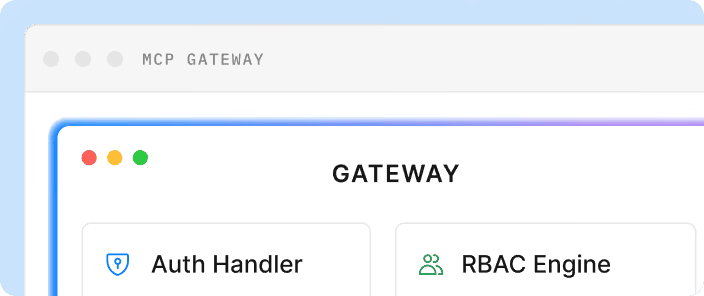
DigitalAPI’s MCP Gateway converts any API in the catalog to an MCP-ready endpoint with one click, using the same documentation metadata generated by the automation pipeline as the agent context layer. The documentation quality built for human developers, through the generation pipeline described above, directly satisfies the metadata quality requirements for accurate AI agent tool selection.
This means the documentation automation investment has a compounding return. Every API you automate documentation for becomes simultaneously more discoverable to human developers and more accessible to AI-powered development tools. For the broader picture of why AI-readiness is now a documentation pipeline requirement, see AI-powered API docs: what makes them critical for every industry in 2026.
What This Looks Like in a Banking Context
A banking platform engineering team managing open banking APIs across Apigee and AWS runs the complete pipeline in a regulated environment. The configuration requirements differ from a standard SaaS API program.
Documentation completeness is a compliance requirement, not an adoption preference. PSD2 and FDX mandate accurate, maintained documentation for regulated endpoints. The governance layer is configured to treat incomplete documentation as a compliance failure, blocking publication of any open banking API that doesn’t meet minimum completeness standards.
Versioning is treated as a change management requirement. Every documentation update for a regulated endpoint is timestamped and stored with the spec version that triggered it. The audit trail is automatic. When a regulator asks for the documentation state at a specific date, the platform provides it without manual reconstruction.
Duplicate detection runs with heightened sensitivity for PII-handling endpoints. Any two APIs with high semantic similarity that both access customer data are surfaced immediately, regardless of whether they’re on the same gateway. Having two independently maintained services both capable of returning customer financial data is both an operational risk and a potential compliance exposure.
DigitalAPI’s banking industry deployment is configured for this regulated context. Canara Bank’s deployment combines automated documentation, governance with compliance checks, and AI Affinity duplicate detection across their multi-gateway estate, producing documentation that satisfies both developer adoption requirements and regulatory audit requirements from the same pipeline.
If you’re running APIs across multiple gateways and documentation maintenance is consuming engineering time your team could spend on product work, see DigitalAPI’s documentation automation in a live environment. The pipeline described in this guide is what a DigitalAPI demo shows in action.
The Metrics That Tell You the Automation Is Working
After the pipeline is live, these are the metrics that confirm it’s solving the problem rather than just running.
Documentation currency rate. The percentage of APIs in the catalog whose documentation was generated or updated within the last API version cycle. Target: 100%. If this falls below 100%, the pipeline has a gap: a gateway connection that isn’t triggering, a spec that isn’t being updated, or an API that bypassed the standard release process.
Support ticket deflection rate for documentation-related queries. Track the volume of “how do I use this API?” tickets before and after automation. A working documentation pipeline with complete, accurate content should reduce this by 30–40% within 90 days of launch. If it doesn’t, the content quality is the constraint, not the automation.
API reuse rate. The percentage of new API builds that are replaced by discovery and reuse of existing APIs, after the catalog is searchable and the documentation is accurate. DigitalAPI customers report up to 60% improvement in API reuse after launching a unified, AI-generated catalog. This is the direct business return on duplicate detection: engineering capacity that stops being spent on rebuilding existing services.
AI Affinity alert-to-resolution cycle time. The time between a duplicate alert appearing in the governance dashboard and the architectural decision being recorded. A fast cycle time means the governance process is working. A long cycle time means alerts are being ignored, which means duplicate accumulation continues.
Spec freshness score. The average age of the spec file backing each API’s documentation. Specs that haven’t updated in six months while the gateway configuration has changed indicate a pipeline gap. DigitalAPI’s API analytics surfaces this at catalog level, flagging APIs whose documentation is likely stale relative to gateway state.
For how documentation quality metrics connect to developer adoption outcomes, see how API documentation improves developer adoption.
Frequently Asked Questions
How do you automate API documentation via AI?
Connect your API spec to a generation pipeline triggered by CI/CD. Every spec change automatically rebuilds and publishes documentation with no manual step.
The automation requires three things: a source spec that stays current (either gateway-native ingestion or a repo-based spec tied to your codebase), a CI/CD trigger that fires on spec changes, and an AI generation engine that produces endpoint descriptions, code samples, and schema documentation from the spec. DigitalAPI’s API documentation solution handles all three for APIs across multiple gateways, without requiring spec file exports from each gateway source.
What is duplicate API detection and how does it work?
AI compares endpoint descriptions, request schemas, and response patterns across the catalog to surface APIs that serve the same function despite different names.
String matching on endpoint names finds nothing useful across multi-team, multi-gateway estates because different teams use different vocabulary. Semantic similarity analysis compares the functional content: what the endpoint does, what it accepts, what it returns. DigitalAPI’s AI Affinity generates a weighted similarity score across five dimensions and surfaces pairs above the configured threshold for platform architect review. Detection is automatic. The consolidation decision remains human.
What causes duplicate APIs in enterprise environments?
Teams build APIs without visibility into what already exists. This happens when APIs aren’t discoverable because they’re undocumented or spread across multiple gateways.
When a developer can’t find an existing API in the catalog, they build a new one. The documentation and discoverability gap is the root cause. Duplicate detection finds what’s already accumulated. Documentation automation prevents new duplicates by making existing APIs visible before new builds begin.
How does automated documentation prevent API sprawl?
Accurate, searchable documentation makes existing APIs discoverable before developers build duplicates. Discoverability is the mechanism that prevents redundant builds.
API sprawl accelerates when the catalog isn’t searchable or when existing APIs lack the documentation that would make them findable. DigitalAPI’s API discovery surfaces existing APIs by intent, so developers find before they build.
How is AI Affinity different from manually auditing APIs for duplicates?
Manual audits are periodic, slow, and miss semantic matches. AI Affinity runs on every catalog update and catches functional overlap regardless of naming differences.
A manual duplicate audit of 200 APIs requires an architect to review endpoint lists across multiple gateway catalogs, compare schemas, and make judgement calls. At 200 APIs, this is a multi-day exercise. At 500, it’s not practical. AI Affinity runs on every documentation pipeline execution, compares every endpoint in the catalog against every other endpoint, and surfaces pairs above the similarity threshold in seconds. For how governance processes keep the catalog clean over time, see API documentation governance.
Rajanish GJ is Chief Technology Officer at DigitalAPI, the multi-gateway API management platform that helps large enterprises consolidate API discovery, governance, monetization, and AI agent enablement across heterogeneous gateway environments, including Apigee, AWS API Gateway, Azure API Management, Kong, and MuleSoft.
Rajanish brings 20+ years of engineering leadership to the role. He spent formative years at Apigee, the API management platform now part of Google Cloud and widely regarded as the category’s foundational product, and at Google itself, where he worked on developer-facing infrastructure at scale. That operator background informs DigitalAPI’s architectural bets around gateway abstraction, MCP-ready APIs, and agent-native developer experience.
He writes regularly on API architecture, developer infrastructure, and AI-native API management, with particular focus on how engineering teams can future-proof their API platforms for the agent era.
One email a fortnight. Worth opening.
A short digest of what we're writing, what we're learning from customers, and the handful of links you'd actually want from us. No tracking pixels.

.avif)