



API Documentation Portal: How to Build and Manage One Effectively
Learn how API documentation portals improve adoption, reduce support load, and enable faster onboarding with AI-powered search, sandbox testing, and automation.

An API documentation portal is a centralised, self-serve hub where developers discover, test, and integrate your APIs without emailing your team.
You built the API. It works. It's secure. It handles production load without flinching. Then a partner emails to ask how authentication works. An internal developer rebuilds an endpoint that already existed. A support ticket arrives because an error code was never documented.
None of those problems are engineering failures. They're documentation portal failures. And at scale, the cost compounds fast: slow onboarding, duplicated builds, support queues that don't empty, and partners who quietly choose a competitor with clearer docs.
This guide covers what an API documentation portal actually needs to do, how to build one that works from day one, and how to stop it from degrading the moment your API program grows.
TL;DR
1. An API documentation portal is a centralised platform housing API references, onboarding guides, sandbox testing, and access management for every developer audience
2. The leading cause of slow API adoption is not poor API design. It's scattered, outdated, or inaccessible documentation
3. A complete portal covers: interactive API reference, getting-started guide, sandbox environment, version control, role-based access, AI-powered search, and subscription workflows
4. Long-term management requires automation: docs must update when APIs change, governance must run continuously, and analytics must guide where to invest
5. In 2026, your portal serves two audiences: human developers and AI agents. Both require clean, structured, machine-readable metadata
What Is an API Documentation Portal?
An API documentation portal is a centralised, web-based platform that gives developers everything they need to discover, understand, test, and integrate with an API: technical references, authentication guides, sandbox environments, code samples, version history, and access management, all in one searchable, self-service interface.
It's the full ecosystem built around your API reference. The reference itself tells developers what endpoints exist. The portal tells them why the API matters, how to call it correctly, what happens when something breaks, and how to get access without contacting anyone.
The distinction worth making clearly: a documentation portal is not the same as a documentation site. A documentation site shows you information. A portal lets you act on it: request access, generate credentials, run a test call, check your usage. The portal is the complete developer experience. The documentation site is one layer inside it.
Don't confuse these two: An API reference document lists your endpoints. An API documentation portal combines that reference with sandbox testing, self-serve credentials, version control, RBAC, and usage analytics. Missing any of those layers means developers still need to contact your team to complete an integration. That's the problem a portal solves.
Why Documentation Quality Determines API Adoption
Poor documentation is the leading friction point in API adoption, not security, not performance, and not pricing. Every gap in your portal translates directly into either a support ticket or a lost integration.
The failure modes follow a predictable pattern. A developer can't find the right endpoint because there's no searchable catalog. They build a service that already exists. Another developer abandons the integration after 30 minutes because the authentication flow isn't explained. A partner takes three weeks to onboard because the sandbox didn't exist and credentials required manual provisioning.
What makes this expensive at enterprise scale is the compounding effect. An API estate with 50 APIs and no central portal generates support noise across every team that ever built one of those 50 APIs. Every engineering team becomes a documentation support desk.
The fix isn't writing better documentation. It's building a portal that makes documentation discoverable, testable, and automatically accurate. DigitalAPI customers using a unified portal report a 25% increase in API adoption rates and up to a 60% increase in API reusability across their organisations. Those numbers come from making APIs findable, understandable, and testable in one place, not from rewrites.
The Four Developer Audiences Your Portal Must Serve
Before building a portal, identify who will use it. Most enterprises serve at least three audiences simultaneously. Portal design fails when all three are forced into the same experience.
Internal developers need a governed catalog of every API the organisation owns. Their primary problem is discoverability: they rebuild endpoints that already exist because there's no single place to look. For banking and insurance platforms managing hundreds of internal microservices, this is the most expensive documentation failure of all.
External partners need verified, tiered access to APIs relevant to their use case. They don't need to see everything: just the APIs their partnership agreement covers, with clear authentication instructions, sandbox access, and self-serve credential management. Manual onboarding for partners is the norm without a portal. With one, it becomes a self-service workflow.
Public developers need a branded, professional experience that builds confidence. The quality of your documentation portal is often the first product impression a developer has of your API program. A poor portal at this stage signals that the API itself may not be production-ready.
AI agents are now a fourth audience. In 2026, LLMs, coding assistants, and CI/CD automation tools crawl API documentation directly to generate integration code. An API that lacks machine-readable metadata, clean OpenAPI specs, and MCP-ready endpoints is invisible to agentic workflows. This isn't a future concern. It's a current one.
If your API catalog is split across Apigee for external APIs, Kong for internal microservices, and AWS API Gateway for cloud services, you don't have one portal problem. You have three. DigitalAPI's API management platform ingests from all three, normalises everything into a single catalog, and generates a unified portal that serves all four audiences from one interface. No rebuilding. No migration.
Core Components Every API Documentation Portal Needs
These are the features that separate a portal developers return to from one they quietly stop trusting. Each serves a distinct function in the developer journey from first discovery to production integration.
1. Interactive API Reference
The API reference is the technical backbone. It covers every endpoint, HTTP method, request parameter, authentication mechanism, response schema, and error code in a structured, navigable form.
What separates a useful reference from a mediocre one is interactivity. Developers expect to authenticate and test an endpoint directly inside the documentation, not switch to Postman or curl to verify a response. A "Try It" console that returns live or mocked responses eliminates ambiguity and reduces time-to-first-call from hours to minutes.
For teams generating references automatically from OpenAPI specs, the generation step is covered in detail in our API documentation generator guide. The portal layer takes that generated reference and wraps it with search, access control, and sandbox testing.
2. Getting-Started Guide
The getting-started guide is what most developers read first. It should cover authentication, explain the most common use case, and get a developer to their first successful API call in under 10 minutes.
The failure mode here is front-loading. Teams write getting-started guides that cover every edge case before covering the simple case. The developer who needs to authenticate and call one endpoint gets buried under architecture diagrams and compliance notes. The goal is confidence, not completeness. Completeness belongs in the reference.
A practical test: hand your getting-started guide to a developer who has never seen your API and start a timer. If they haven't made a successful call within 10 minutes, the guide isn't working.
3. Sandbox Testing Environment
A sandbox gives developers an isolated space to test API calls against realistic or mocked data without touching production. It's not optional for externally-facing APIs and it's especially critical in regulated industries.
In banking and insurance, a production error during an integration test carries real consequences: failed transactions, regulatory flags, or data exposure incidents. A proper sandbox removes all of that risk. Developers test freely, confirm behaviour, and arrive at production integration having already validated their integration logic.
DigitalAPI's API sandboxing provides secure, isolated testing environments for each API in the catalog, regardless of which gateway it sits behind. Canara Bank used this as part of a deployment that doubled transaction volume while cutting infrastructure costs by 50%.
4. Role-Based Access Control
Not every API belongs in front of every audience. Internal APIs need authenticated, team-scoped access. Partner APIs require verified credentials. Public APIs can be open to any visitor. A portal without RBAC either exposes too much or forces manual access management that doesn't scale.
(scroll to view full table)
DigitalAPI's API developer portal supports all three tiers under full custom branding. Zurich Insurance uses this structure to manage a partner-facing API marketplace where each partner sees only the APIs relevant to their commercial agreement.
AI-Powered Search and Discovery
Search is where most portals fail silently. A portal with 50 APIs and a keyword-only search engine forces developers to know the exact name of what they're looking for. A developer who types "get recent payment failures" and gets no results assumes the API doesn't exist. It probably does.
DigitalAPI's AI-powered search ranks results by intent and context. It understands that "retrieve failed transactions" and "get payment errors" are the same query pointed at the same endpoint. This is the kind of discovery capability that the API discovery and management layer is built around: surfacing the right API to the right developer the first time.
Subscription and Access Workflows
The final gap most portals leave open is the handoff from "I read the docs" to "I have credentials and I'm building." Without automated subscription workflows, that handoff requires a human: a developer emails your team, someone provisions an API key, someone else sets usage limits, and the process takes days.
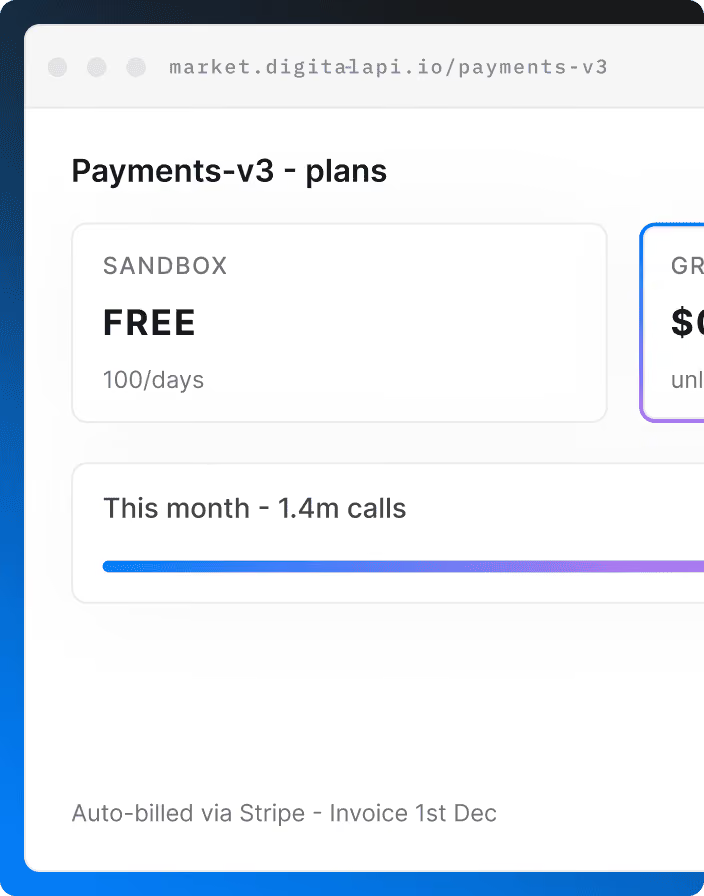
Self-serve subscription workflows handle this automatically. A developer finds the API, selects a plan, requests access, and receives credentials, all without involving your engineering team. For organisations monetising their APIs to external partners or customers, this workflow is also where billing, tier selection, and usage tracking connect. See API monetisation for the commercial layer on top of this.
What breaks without a proper portal: Without a documentation portal: developers email your team for credentials (manual overhead), integration bugs appear in production because no sandbox existed (support cost), duplicate APIs get built because the catalog wasn't discoverable (engineering waste), partners spend weeks onboarding instead of days (churn risk), and AI agents can't consume your APIs because metadata is missing (agentic revenue gap). Every one of these is a measurable cost. The portal eliminates them by automating the developer journey end to end.
How to Build an API Documentation Portal: Step by Step
Follow this process in order. Skipping the audit phase is the most common reason portal projects fail: teams build a portal for the APIs they know about, not the ones that actually exist.
Step 1: Audit Your Existing API Estate
Before building anything, map what you have. Identify which APIs are documented, which have partial coverage, and which have nothing. Most enterprise teams discover more gaps than they expected at this stage, including shadow APIs that exist outside any official catalog.
The audit output is a prioritised list: tier-one APIs that drive the most integration volume, tier-two APIs with moderate usage, and undocumented APIs that represent risk. Build the portal in that priority order.
Step 2: Ingest APIs into a Unified Catalog
Connect your existing gateways to a single management platform. DigitalAPI ingests API definitions from Kong, AWS, Azure, Apigee, MuleSoft, Postman, GitHub, and SwaggerHub without requiring you to rebuild existing infrastructure. Everything flows into one unified catalog, normalised and searchable from day one.
The operational value here is immediate: one search box covers your entire API estate, regardless of how many gateways it spans. For teams running a mixed gateway environment, this is the moment the portal stops being a documentation project and starts being a governance platform.
Step 3: Auto-Generate Documentation for Undocumented APIs
For every API with missing documentation, DigitalAPI's AI Documentation Generator creates structured references directly from the specification. One click converts an undocumented endpoint into a fully structured page covering parameters, response schemas, authentication, and usage context.
This process eliminates the "black box" problem: APIs that exist inside your organisation but whose behaviour is only known to the team that built them. Auto-generation is the starting point. Human enrichment is the next step.
Step 4: Enrich with Human Context
Auto-generated documentation is the floor. Assign documentation owners to each API and task them with adding business context, use-case-specific getting-started guides, multi-language code samples, and error-handling guidance. The more context a portal contains, the lower the support ticket volume.
A practical structure for each API page: what the API does (one sentence), who it's for, the most common use case, a getting-started guide, the full reference, code examples in at least three languages, error code explanations, and a changelog.
Step 5: Configure Governance, RBAC, and Security
Set up role-based access so each audience sees only what's relevant to them. Enable automated governance checks through DigitalAPI's API governance layer: continuous linting, OWASP security scanning, and documentation completeness audits. Every published API gets validated before it reaches developers.
For regulated industries, governance is not optional. Banking, insurance, and healthcare platforms need documented evidence that APIs meet compliance standards. A governance layer that runs automatically and generates audit trails handles this at scale.
Step 6: Enable Sandbox and Subscription Workflows
Activate sandbox environments for all externally-facing APIs. Configure subscription workflows so access requests, approvals, and API key issuance happen without manual intervention. For commercial APIs, configure billing and usage tiers inside the subscription layer.
This step is where the portal transitions from a documentation resource to a product. Developers who can test and subscribe independently, without contacting anyone, have a fundamentally different adoption experience than those who have to wait for a human response.
Step 7: Brand and Publish
Apply your organisation's branding: logo, colours, custom domain. DigitalAPI's white-label capabilities mean the finished portal is indistinguishable from a proprietary product. Partners and external developers experience your brand, not a vendor tool.
For organisations in regulated industries, a branded portal also signals professionalism and stability. A generic-looking documentation site raises questions about the maturity of the API program it represents. A polished, branded portal does the opposite.
If you're managing APIs across multiple gateways and the goal is to launch a production portal fast, DigitalAPI's API developer portal deploys in days, not months. It handles ingestion, generation, RBAC, sandbox, and branding in a single platform without requiring a dedicated portal engineering team.
How to Manage a Documentation Portal Over Time
Building the portal solves 40% of the problem. Keeping it accurate, complete, and useful as your API program grows solves the other 60%. These are the practices that separate portals teams trust from ones they quietly abandon.
1. Automate Documentation Updates
Outdated documentation is actively harmful. It misleads developers into incorrect integrations, erodes trust in your entire API program, and generates support load that never fully clears. The only sustainable fix is automation.
DigitalAPI ties documentation directly to the API specification. Every change, whether a new endpoint, a modified parameter, or a deprecated method, propagates automatically without a manual documentation task. Documentation drift stops being a risk because it stops being a manual process. For a technical breakdown of how the generation and sync process works, see how to document an API.
2. Run Continuous Governance Audits
Schedule automated governance scans to catch missing documentation, inconsistent metadata, security vulnerabilities, and specification gaps before they surface to developers. DigitalAPI's AI Affinity feature detects duplicate APIs across the estate, so architects can identify redundancies and make informed deprecation decisions before the catalog becomes cluttered.
A clean, well-governed catalog signals professionalism. A catalog with deprecated endpoints still listed as active, missing error codes, and inconsistent authentication docs signals that the API program isn't under active management.
3. Use Analytics to Guide Investment
DigitalAPI's API analytics gives teams visibility into which APIs receive the most documentation traffic, where developers exit the portal without completing an integration, which search queries return no results, and which endpoints generate the most support tickets.
These signals tell you exactly where to invest documentation effort next. A high-traffic API with low integration success rates has a documentation gap. A frequently searched query that returns nothing is a content gap waiting to be filled. Without analytics, documentation decisions are guesswork.
4. Assign Documentation Ownership
Documentation without an owner degrades. Every API in the catalog needs a named owner, whether a technical writer, product manager, or the engineering team that built it. Owners are accountable for accuracy, completeness, and updates through every API version change.
Industry scenario: financial services: A financial services platform managing open banking APIs across Apigee (for regulated PSD2 endpoints), Kong (for internal microservices), and AWS (for data services) faces a common problem: three portals with inconsistent formatting, different access control models, and no unified search. A banking partner onboarding to use payment initiation APIs navigates three separate experiences to find what they need. DigitalAPI's banking deployment consolidates all three into a single branded portal with unified RBAC, auto-generated documentation, and a sandbox for each API. Partner onboarding time drops from weeks to days.
Build vs Buy: The Honest Comparison
Some teams consider building a custom documentation portal. Here is what that decision actually looks like in practice.
(scroll to view full table)
Building gives control. Buying gives speed, proven infrastructure, and maintained enterprise capabilities. For most organisations, building delays time-to-value by over a year and carries significant delivery risk.
The ROI framing is straightforward: your API estate cost millions to build. The portal that surfaces it doesn't need to cost millions more. If you're evaluating DigitalAPI against a gateway-native portal option, see how it compares to Kong's portal, where the multi-gateway and documentation-generation gap is most visible.
API Documentation Portals and AI Readiness in 2026
The documentation portal is evolving beyond the developer experience. Two shifts define its trajectory.
AI-maintained documentation is no longer experimental. DigitalAPI auto-generates documentation from API specs, keeps it synchronised as APIs change, and flags inconsistencies before they surface to developers. The manual documentation lifecycle is becoming optional for teams with the right platform.
Agentic API consumption is the second shift. AI agents don't browse documentation the way human developers do. They parse metadata, reason over descriptions, and call endpoints autonomously. An AI agent can't execute a poorly described endpoint: it either fails silently or produces incorrect output.
The requirements are specific. Clean OpenAPI specs available at a stable, public URL. Machine-readable output that LLMs can parse accurately. MCP server registration that lets AI coding agents discover and invoke your APIs as native tools.
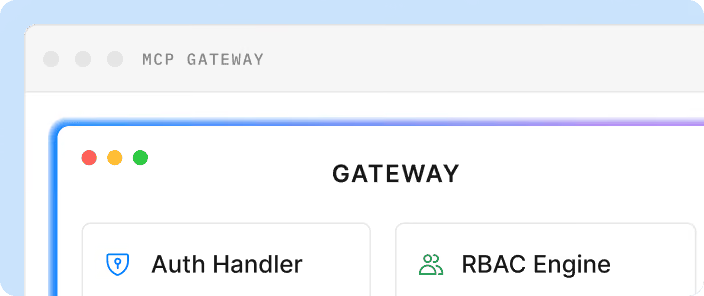
DigitalAPI's MCP Gateway converts any cataloged API into an MCP-ready endpoint with one click, making it immediately queryable by AI agents through structured, spec-derived context. The documentation generated for human developers becomes the same context used by agents. No separate MCP documentation layer is required.
The practical implication: teams that invest in documentation quality today are not just improving developer experience. They're building the metadata layer that makes their APIs accessible to every agentic workflow that runs on top of them tomorrow.
API Documentation Portal Checklist
Before launch, verify the following are in place:
- Unified catalog: all APIs from all gateways are visible in one searchable interface
- Auto-generated references: every API has a structured, accurate reference page
- Interactive Try-It console: developers can test endpoints without leaving the portal
- Getting-started guide: a developer reaches their first successful call within 10 minutes
- Sandbox environment: all externally-facing APIs have an isolated testing environment
- RBAC configured: internal, partner, and public audiences see only what's relevant to them
- Self-serve subscription: developers can request access and receive credentials without contacting your team
- Governance scans active: linting, security, and completeness checks run on every published API
- Analytics enabled: traffic, search queries, exit points, and support ticket volume are tracked
- Version control: current and deprecated API versions are clearly labeled and accessible
- Custom branding: the portal reflects your organisation's domain, logo, and design
- MCP readiness: APIs are convertible to MCP endpoints for agentic consumption
Frequently Asked Questions
1. What is an API documentation portal?
A centralised platform giving developers everything to discover, test, and integrate your APIs without contacting your team.
An API documentation portal combines interactive API references, authentication guides, sandbox testing, self-serve credential management, version history, and usage analytics in a single interface. It's the complete developer experience built around your API reference, not just the reference itself. Without the surrounding portal layer, developers still need manual assistance to complete an integration.
2. What should an API documentation portal include?
Interactive API reference, getting-started guide, sandbox, version control, RBAC, search, and self-serve subscription workflows.
Each component serves a distinct stage of the developer journey. The reference tells developers what exists. The getting-started guide gets them to a working call in under 10 minutes. The sandbox lets them test without production risk. RBAC ensures each audience sees only what's relevant. Analytics reveal where documentation is failing. Missing any layer means your team fills the gap manually.
3. How do you keep an API documentation portal accurate over time?
Tie documentation to your API specification so every change to the API automatically updates the portal. Automation is the only reliable fix.
Manual documentation updates fail at scale because someone always forgets. DigitalAPI keeps documentation synchronised with the underlying spec so every endpoint change, deprecated method, or new parameter propagates automatically. Continuous governance scans catch gaps and inconsistencies before they reach developers. For teams with multiple gateways, this automation runs across all connected sources simultaneously.
4. What is the difference between an API documentation portal and a developer portal?
An API documentation portal focuses on reference and guides. A developer portal adds credentials, sandbox, subscriptions, and analytics.
The terms are often used interchangeably, but a developer portal is the broader category. It includes API documentation as one layer alongside self-serve key management, sandbox testing, subscription workflows, usage analytics, and RBAC. A documentation-only portal covers the information layer. A full developer portal covers the entire self-service experience from discovery through active integration. For the full breakdown of what a developer portal includes, see the API developer portal guide.
5. How does a documentation portal help with AI agent readiness?
Clean metadata and machine-readable specs let AI agents discover and call your APIs. Portals with MCP support serve agents directly.
AI agents don't browse documentation like humans. They parse structured metadata, reason over endpoint descriptions, and execute calls autonomously. A portal with clean OpenAPI specs, accurate descriptions, and MCP-ready endpoints is directly accessible to agentic workflows. A portal with poor metadata forces agents to guess, producing incorrect API calls. DigitalAPI's MCP Gateway converts any cataloged API into an MCP endpoint with one click, using portal documentation as the agent's context layer.
Dhayalan Subramanian is Associate Director, Product Growth at DigitalAPI, where he leads go-to-market and product growth for the company’s multi-gateway API management platform. His work focuses on helping large enterprises and mid-market cloud companies consolidate APIs across AWS, Azure, Apigee, Kong, MuleSoft, and other gateways into a single control plane for governance, discovery, monetization, and agent consumption.
Dhayalan brings 14+ years of experience across product strategy, enterprise architecture, and engineering leadership. Earlier in his career, he held senior roles at Encora (as Associate Architect and Technical Manager), Mindtree (Technology Lead), Tech Mahindra (Technical Lead), and Primus Analytics, where he designed integration frameworks and delivered enterprise-grade digital platforms for global customers.
At DigitalAPI, he works directly with platform, integration, and developer experience leaders at Fortune 500 organizations to operationalize unified API catalogs, developer portals, and MCP-ready APIs. He writes regularly on API developer experience, API governance, and AI agent architectures.
One email a fortnight. Worth opening.
A short digest of what we're writing, what we're learning from customers, and the handful of links you'd actually want from us. No tracking pixels.

.avif)