



AI-Powered API Docs: Why Every Industry Needs Them in 2026
Learn what AI powered API docs are, how they work across industries, and why teams ship faster with automated documentation. See it in action.

AI-powered API docs auto-generate, sync, and maintain accurate API documentation from your OpenAPI spec without manual updates after every release.
Most API documentation degrades within 30 days of publication. Not because nobody cares. Because the team that ships the API is the same team responsible for keeping the docs accurate, and documentation maintenance competes with every other engineering priority and loses. Every time.
The consequence isn't abstract. A partner integration stalls because the authentication docs describe a deprecated token flow. An internal developer rebuilds a service that already exists because the catalog never mentioned it. A fintech partner escalates a production incident because an error code their integration hit returned no documentation. These aren't edge cases. In organisations with more than 20 APIs and no automated documentation pipeline, they're weekly occurrences.
AI-powered API documentation changes the mechanism. Documentation generates from the spec. It updates when the spec changes. It surfaces through a searchable portal that serves both human developers and AI agents. The manual maintenance cycle is replaced by an automated one. This article covers why that shift has become critical in 2026, what it looks like in practice across specific industries, and what happens to teams that haven't made it yet.
TL;DR
1. AI-powered API docs use machine learning to auto-generate reference content from OpenAPI specs, keep it synchronised with live API behaviour, and serve it through an intelligent, searchable portal
2. The core problem they solve: documentation drift. Every team that maintains docs manually sees the same pattern: accurate at launch, degraded within weeks, misleading within months
3. The criticality varies by industry: banking has regulatory compliance requirements; healthcare has PHI-adjacent documentation standards; insurance has partner onboarding volume; enterprise has API sprawl at scale
4. In 2026, AI-powered documentation serves two audiences: human developers and AI agents. Structured metadata and MCP-readiness are now baseline requirements alongside interactive portals
5. The shift from manual to AI-powered documentation is not primarily a quality improvement. It's a maintenance model change: documentation that can keep pace with the API because it's generated from the same source
What AI-Powered API Docs Are and What They Actually Do
AI-powered API documentation uses machine learning to generate, maintain, and surface API reference content automatically. The input is your API specification: an OpenAPI YAML or JSON file, GraphQL schema, or AsyncAPI definition. The output is a complete, structured, interactive documentation portal that stays accurate as your API changes.
The "AI-powered" label covers three distinct capabilities, and it's worth being precise about each one.
Spec-driven auto-generation reads your OpenAPI definition and produces human-readable endpoint descriptions, parameter explanations, request/response schema documentation, error code guidance, and multi-language code samples. It's not sophisticated prose writing. It's structured content extraction: taking the machine-readable information in your spec and rendering it as developer-readable documentation with enough context to be useful without manual input.
Automated sync connects documentation generation to your CI/CD pipeline. Every merge that changes the spec triggers a documentation rebuild. New endpoints appear. Modified parameters update. Deprecated operations get flagged. The documentation follows the API rather than lagging behind it. This is the feature that breaks the drift cycle.
AI-powered search and discovery understands intent rather than matching keywords. A developer who queries "get a list of failed transactions from the last 24 hours" finds the right endpoint even if its formal name is retrieveTransactionHistory. DigitalAPI's API-GPT takes this further: natural language queries against your entire API catalog return structured, contextually accurate answers rather than a list of pages to scroll through.
What AI-powered documentation does not do: Auto-generation handles reference content: endpoints, parameters, schemas, error codes, auth flows. It doesn't write conceptual guides, architecture overviews, getting-started tutorials, or changelog narratives. Those still require human writing. The shift is that engineers stop spending time generating boilerplate reference content and start spending that time on higher-value documentation work. For the full breakdown of what complete documentation includes, see external API documentation best practices.
Why Manual Documentation Cannot Keep Pace in 2026
The documentation maintenance problem is structural, not behavioural. It doesn't get solved by asking engineers to be more diligent about updating docs after each release. The incentive structure is wrong: documentation updates are invisible to users until they're wrong, generate no credit for the engineer who does them, and compete directly with work that is visible, credited, and tied to sprint goals.
The result is a predictable decay pattern. Documentation is most accurate at the moment of initial publication, when someone specifically tasked with writing it sat down and documented the current state. From that point, every API change that doesn't include a documentation update degrades accuracy. In fast-moving teams, that decay reaches the point of misleading users within weeks.
The specific points where manual documentation fails:
1. Authentication changes:
Token formats, scopes, and auth flows change more often than most teams document. A partner integration that worked with the documented auth flow hits a 401 when the flow changes without a documentation update. The partner opens a support ticket. The support team has to explain that the docs are out of date. Trust erodes.
2. Error code coverage:
Manual documentation almost always documents the success path in detail and error codes partially. The 400 and 401 responses get covered. The 422, 429, and 503 responses don't. Every undocumented error code is a support ticket for every developer who encounters it.
3. New endpoint visibility:
Endpoints added after the initial documentation sprint often don't make it into the published docs. Internal developers don't know they exist. They build something that already exists. The duplicate API sits alongside the original, creating maintenance overhead for two services that solve the same problem.
4. Deprecation handling:
Deprecated endpoints remain documented without deprecation notices. Developers continue integrating against them. The removal creates production incidents that were preventable with accurate documentation.
AI-powered documentation eliminates all four failure modes by generating from the same source the API is built from. The spec is the truth. The documentation reflects the spec. When the spec changes, the documentation changes. For how documentation quality connects to measurable adoption outcomes, see how API documentation improves developer adoption.
The Five Components That Make API Documentation AI-Powered
Not every tool that claims AI capabilities delivers the same functionality. These are the five components that separate genuine AI-powered documentation from a spec renderer with marketing copy.
Component 1: Auto-Generation from OpenAPI Specification
The generator reads every endpoint in your OpenAPI file and produces structured documentation: endpoint descriptions that explain what the operation does and when to use it, parameter documentation with type constraints and example values, request schema documentation with field-level descriptions, response documentation for every HTTP status the endpoint can return, and multi-language code samples showing the request in cURL, Python, JavaScript, and Java at minimum.
Quality varies significantly across platforms. The test is straightforward: feed your actual production spec, not a demo spec, to the generator and evaluate whether the output is usable without heavy rewriting. Outputs that require complete rewriting of every description aren't saving documentation time. They're shifting it.
Component 2: CI/CD Sync Pipeline
Documentation generation triggers automatically on every spec change. No manual step between "API updated" and "documentation updated." The pipeline catches the change, regenerates the affected content, validates the output, and publishes to the developer portal.
The sync mechanism is the most operationally important feature. Generation quality matters for launch day. Sync reliability matters for every day after launch. A platform with excellent generation but unreliable sync produces great documentation at launch and documentation drift within weeks.
Component 3: AI-Powered Search and Semantic Discovery
Developers search in natural language. The search returns the relevant endpoint, parameter, or guide, not a list of pages to scroll through. For organisations managing 50+ APIs, semantic search is the difference between a catalog developers actually use and one they search once, fail to find what they need, and ask a colleague instead.
DigitalAPI's API discovery layer uses semantic search to surface the right API based on intent. A developer who queries "check payment status" finds the getTransactionStatus endpoint even if the naming convention uses technical rather than business vocabulary.
Component 4: Governance and Quality Validation
The documentation governance layer runs automated quality checks before content publishes. Missing descriptions get flagged. Undocumented error codes get caught. Parameter constraints without examples get highlighted. Security issues in the spec surface through OWASP validation.
For regulated industries, this governance layer also produces audit-ready evidence that APIs meet documentation standards at a specific point in time. DigitalAPI's API governance runs these checks continuously, not as a pre-launch activity, so documentation quality is maintained as the API estate evolves.
Component 5: AI Agent and MCP Readiness
AI coding assistants, LLMs, and agentic workflows now read API documentation directly to generate integration code and select endpoints autonomously. A documentation platform that produces only human-readable HTML is leaving a growing portion of your developer audience without accurate access to your APIs.
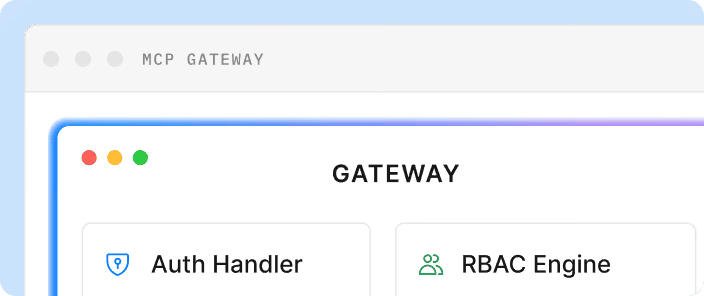
AI-ready documentation requires: structured OpenAPI specs accessible at stable, publicly discoverable URLs; endpoint descriptions specific enough for accurate agent tool selection; and MCP endpoint generation that converts your cataloged APIs into tools AI agents can invoke through standardised protocols. DigitalAPI's MCP Gateway handles this conversion with one click, using the same documentation metadata as the agent context layer.
AI generation quality is directly constrained by spec quality. An OpenAPI file with missing descriptions, no example values, and undocumented error codes produces AI-generated documentation with the same gaps. The automation doesn't fill empty fields. It organises and renders what's there. Before investing in an AI documentation platform, audit your spec quality. Specs that need significant enrichment benefit from governance checks and AI Affinity gap detection before generation runs.
Why AI-Powered API Docs Are Critical in Banking
Banking is the industry where documentation failure carries the highest direct cost. A partner integration stalled by outdated auth documentation doesn't just cause a support ticket. In open banking, it delays a commercial partnership, potentially costs a regulatory deadline, and creates an audit finding.
1. The open banking compliance requirement:
PSD2, FDX, and DPDP all require financial institutions to publish and maintain accurate developer-facing API documentation for their open banking endpoints. "Maintain" is the operative word. A documentation portal that was accurate at launch and has drifted since doesn't satisfy the requirement. AI-powered sync keeps the published documentation accurate with every API change, automatically generating audit trails that show documentation state at each update.
2. The partner onboarding volume:
Banks exposing APIs to fintech partners and third-party data aggregators need to onboard dozens to hundreds of partner developers with minimal engineering intervention. Every documentation gap creates a support ticket. At partner program scale, documentation gaps create an engineering bottleneck that slows the entire partner ecosystem. Self-sufficient, accurate, interactive documentation with sandbox testing is the only approach that scales. DigitalAPI's open banking sandbox and marketplace combines AI-generated documentation with live sandbox environments for exactly this scenario.
3. The legacy API problem:
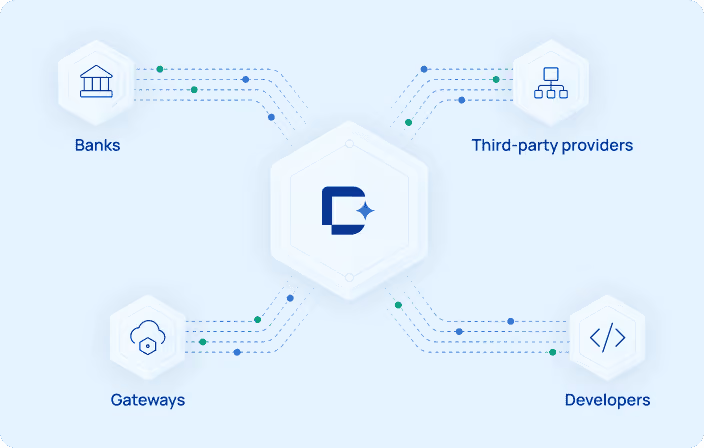
Most established banks run APIs built across multiple generations of technology. APIs on Apigee sit alongside APIs on Kong, alongside core banking integrations on MuleSoft, alongside cloud-native services on AWS API Gateway. Each source has a different spec format, a different documentation standard, and a different maintenance process. A unified AI-powered documentation layer that ingests from all sources and publishes a consistent, searchable catalog is the only approach that makes this estate navigable.
Canara Bank uses DigitalAPI's banking deployment to manage exactly this scenario: a multi-gateway API estate with diverse spec sources, published to a unified developer portal with auto-generated documentation, sandbox access, and governance across all connected sources.
The regulatory documentation clock: Open banking regulations require documentation to reflect current API behaviour, not the behaviour at launch. In practice, this means documentation updates need to happen on the same schedule as API releases, which in modern banking can be weekly. Manual documentation update processes can't meet this cadence reliably. AI-powered sync tied to CI/CD handles the cadence automatically. For platform engineers building or maintaining open banking infrastructure, this isn't optional. It's the mechanism that keeps the documentation compliant with the same frequency as the API itself.
Why AI-Powered API Docs Are Critical in Healthcare
Healthcare API documentation carries a specific compliance requirement that manual documentation processes handle poorly: the intersection of rapidly evolving FHIR/HL7 specifications with strict access controls on what documentation can expose about underlying data structures.
1. FHIR spec complexity:
FHIR R4 and R5 define hundreds of resource types, each with complex schemas, relationship structures, and mandatory vs optional field rules. Maintaining accurate, complete documentation for a FHIR-compliant API manually is a dedicated technical writing role. AI-powered generation from a well-maintained FHIR OpenAPI spec handles this scale automatically, producing schema documentation for every resource type with field-level descriptions and cardinality constraints.
2. PHI-adjacent documentation standards:
Healthcare API documentation must be precise about what fields contain or derive from protected health information, what authentication scopes are required to access those fields, and what logging and audit requirements apply to each endpoint. AI generation from a well-annotated spec surfaces these constraints consistently. Manual documentation typically handles them inconsistently, creating compliance risk when developers integrate without understanding PHI scope.
3. Interoperability API documentation:
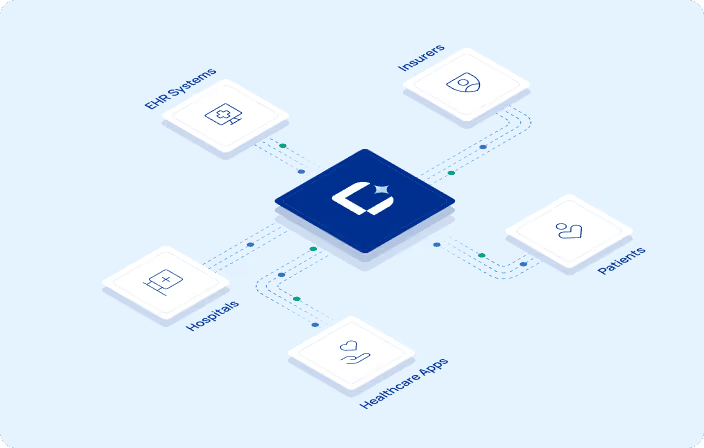
Hospital systems, EHR vendors, payers, and pharmacy networks exchange data through increasingly standardised APIs, but the documentation of how each organisation's implementation maps to the standard is where interoperability breaks down. AI-powered documentation that reflects each organisation's specific implementation, generated from their actual spec rather than the generic FHIR reference, closes this gap.
For healthcare platform teams building APIs that handle patient data, the documentation question is inseparable from the governance question. DigitalAPI's healthcare industry deployment handles both: AI-generated documentation from FHIR-compatible specs alongside governance checks that validate PHI-adjacent endpoint documentation completeness before publication.
Why AI-Powered API Docs Are Critical in Insurance
Insurance API programs are scaling fast, driven by insurtechs integrating with incumbent carriers and broker networks accessing underwriting and claims APIs through digital channels. Documentation quality is the direct bottleneck in this scaling process.
1. Claims and underwriting API complexity:
A claims API returns dozens of status codes, each corresponding to a specific point in the claims lifecycle. An underwriting API accepts dozens of input parameters, each with specific validation rules that vary by product line and jurisdiction. Manual documentation of this complexity is incomplete by default. AI generation from a complete spec produces documentation for every parameter combination and every status code, eliminating the gaps that generate support tickets.
2. Broker partner onboarding at scale:
An insurer exposing APIs to broker networks may be onboarding hundreds of partner developers across dozens of integration partner organisations. Each partner needs to authenticate, understand the API's data model, test in a sandbox, and complete production integration without involving the insurer's engineering team. That self-service flow depends entirely on documentation quality. AI-powered documentation with sandbox environments is what makes broker partner programs scalable rather than bottlenecked on engineering.
Zurich Insurance uses DigitalAPI's platform to manage their partner-facing API documentation across their insurance API program, with auto-generated references and tiered sandbox access separating partner types. DigitalAPI's insurance industry deployment handles the documentation layer alongside subscription management and access control for the complete partner experience.
3. Regulatory reporting API documentation:
Insurance API programs increasingly include reporting APIs used by brokers and regulators to access policy and claims data. The documentation for these APIs must be accurate enough to support regulatory audits. AI-powered sync ensures that every documentation update is timestamped and associated with a specific spec version, producing the audit trail that manual documentation cannot reliably generate.
Why AI-Powered API Docs Are Critical in Enterprise API Programs
Enterprise organisations running 50+ APIs across multiple teams and gateways face a documentation problem that is categorically different from the single-API documentation problem. It's not about the quality of any one API's documentation. It's about the discoverability and accuracy of the entire estate.
1. The API sprawl documentation gap:
In large enterprises, new APIs are built without checking whether equivalent APIs already exist because the existing APIs aren't documented in any discoverable format. The result is redundant APIs: multiple services solving the same problem, each maintained by a different team, each creating its own documentation debt. AI-powered documentation combined with duplicate detection closes this loop. DigitalAPI's AI Affinity feature identifies APIs with overlapping function across the catalog, giving platform architects the signal to consolidate before the estate becomes unmanageable.
2. Multi-team documentation consistency:
When documentation is a manual process owned by individual engineering teams, the output varies enormously. One team documents every error code. Another team documents none. One team provides code samples in five languages. Another provides none. AI generation from a consistent spec standard produces documentation that meets a baseline quality level across all teams without requiring centralised technical writing oversight.
3. Self-service discovery for internal developers:
The internal developer who can't find an existing API builds a new one. The cost of that build, in engineering time and ongoing maintenance, is the direct cost of undiscoverable documentation. A searchable, AI-generated catalog of every internal API, surfaced through DigitalAPI's API developer portal, is the mechanism that converts API sprawl into API reuse. DigitalAPI customers report up to 60% improvement in API reuse rate after launching a unified, AI-powered internal catalog.
The standard documentation generation workflow assumes one spec, one portal. Enterprise reality is: 20 APIs on Apigee, 15 on Kong, 10 on AWS API Gateway, and 8 on a legacy MuleSoft instance. Each source uses a different spec format. Each has a different update cadence. DigitalAPI's API management platform ingests from all four simultaneously, normalises spec formats, runs AI generation across the unified catalog, and publishes a single searchable portal. That's not a documentation project. That's an API governance project with documentation as the output.
The MCP and Agentic Documentation Layer
In 2026, AI-powered documentation serves two audiences simultaneously and the gap between how they consume documentation is growing.
Human developers read documentation, evaluate it, test in sandboxes, and integrate manually. They tolerate some documentation imperfection because they can ask questions, check forums, and experiment with the API directly.
AI agents don't do any of that. They parse structured metadata, reason over endpoint descriptions, and execute calls autonomously. When the description is vague, they guess. When schemas are incomplete, they infer. When the guess or inference is wrong, the result is an incorrect API call that produces a hard-to-debug error in whatever workflow the agent is running.
The documentation requirements for AI agent accuracy are specific:
Endpoint descriptions must be concrete. "Returns user data" is not parseable by an agent in a way that produces accurate tool selection. "Returns the authenticated user's profile including display name, verified email, account tier, and last login timestamp" is.
Schemas must be complete. Every field with a type, description, and example. Sparse schemas force agents to infer field purpose from field names, which produces errors for non-obvious fields.
OpenAPI specs must be publicly accessible at stable, discoverable URLs. AI tools crawl documentation sites alongside human developers. A spec that isn't publicly served can't be indexed or consumed by AI coding assistants.
MCP endpoints must be available. The Model Context Protocol is the standard mechanism through which AI agents discover and invoke APIs as tools. An API without an MCP endpoint is invisible to agentic workflows that use MCP for tool discovery.
DigitalAPI's MCP Gateway converts any API in the catalog to an MCP-ready endpoint with one click, using existing documentation metadata as the agent context layer. The documentation quality built to the human standard described in this guide satisfies the agent standard automatically. No separate MCP documentation layer is required.
For the buyer's perspective on how to evaluate platforms against these criteria, see the AI-powered API docs buyer guide.
What Happens to Teams That Don't Automate Documentation
The teams that continue with manual documentation in 2026 face a compounding cost structure. The cost per documentation gap doesn't decrease as the API estate grows. It increases, because each gap creates support overhead across every developer who integrates with the affected API.
The specific outcomes are predictable:
Partner onboarding time stays measured in weeks instead of days, because every new partner needs guided help navigating documentation that has gaps. The engineering team becomes a documentation support function for their own APIs.
Internal API reuse stays low, because developers can't find existing APIs in a catalog that isn't searchable or consistently documented. New APIs get built alongside existing ones. Maintenance overhead accumulates.
AI agent integrations fail to materialise, because the documentation metadata isn't structured or comprehensive enough for agents to reason over accurately. The APIs are excluded from the agentic workflows that could be consuming them.
Regulatory documentation audits become expensive manual exercises, because documentation history isn't automatically versioned and timestamped with each API change. Reconstructing the documentation state at a specific point in time requires manual work that could have been automated.
The alternative, automated documentation tied to the spec, managed through a governed platform with analytics that surface gaps, is the infrastructure investment that prevents all four outcomes. For how to build the portal layer that surfaces this to developers, see how to build and manage an API documentation portal.
How DigitalAPI Delivers AI-Powered Documentation Across Every Source
DigitalAPI's API documentation solution is not a standalone documentation tool. It's a documentation layer built into a full API management platform, which means documentation is generated from the same source that governs, secures, and monitors the API, not from an exported spec file maintained separately from the gateway.
The workflow:
APIs are ingested from all connected gateways and repositories: Kong, Apigee, AWS, Azure, MuleSoft, Postman, GitHub, SwaggerHub. Spec formats are normalised. A unified API catalog is built.
AI generation runs across every ingested API. Endpoint descriptions, parameter documentation, error code guidance, and code samples are produced from each spec. APIs with missing documentation get AI-generated first drafts flagged for review.
Governance checks run automatically: OWASP security validation, documentation completeness audits, and AI Affinity duplicate detection across the catalog. Gaps get surfaced before publication. Duplicates get flagged before more engineering time is spent on them.
Everything publishes to a white-labelled API developer portal with AI-powered semantic search, role-based access control separating internal and external audiences, sandbox testing, and self-serve subscription management for partner and commercial API programs.
API analytics tracks documentation engagement: which pages developers use, which search queries return no results, which endpoints generate the most support traffic. The feedback loop between documentation gaps and developer friction is closed with data rather than guesswork.
For teams monetising APIs alongside documenting them, the API monetisation layer connects subscription management and billing directly to the documented portal, so the developer journey from reading documentation to active integration to paid subscription is a single self-service flow.
If your team manages APIs across multiple sources and documentation maintenance is already a bottleneck, see DigitalAPI's AI documentation approach in a live environment.
Frequently Asked Questions
1. What are AI-powered API docs?
API documentation auto-generated from an OpenAPI spec using machine learning to produce endpoint descriptions, schemas, and code samples automatically.
AI-powered API documentation uses ML models to read your API specification and produce structured reference content: endpoint descriptions, parameter tables, response schemas, error code guidance, and multi-language code samples. The output updates automatically when the spec changes, eliminating the documentation drift that makes manual docs inaccurate within weeks of publication.
2. Why do industries like banking and healthcare need AI-powered API docs?
Regulatory compliance requires documentation to stay current. Manual processes can't keep pace with the release cadence that compliance demands.
In banking, open banking regulations (PSD2, FDX) require accurate, maintained API documentation for regulated endpoints. In healthcare, FHIR-compliant APIs require complete schema documentation with PHI-adjacent field annotations. Both industries operate under documentation standards that manual update processes consistently fail to meet at the scale and cadence modern API programs demand. AI-powered sync closes the gap between regulatory requirement and operational reality.
3. How is AI-powered API documentation different from auto-generated docs?
Auto-generation renders a spec into HTML. AI-powered documentation adds semantic enrichment, intent-based search, governance, and MCP agent readiness.
A basic spec renderer converts your OpenAPI file into formatted documentation. An AI-powered platform does more: it generates human-readable descriptions that a spec file alone wouldn't contain, runs governance validation on the output, powers semantic search that understands developer intent, and produces machine-readable output for AI agent consumption. The difference is between a documentation page and a governed documentation platform.
4. Does AI-powered API documentation replace technical writers?
No. It replaces boilerplate reference writing. Technical writers shift to conceptual guides, tutorials, and documentation architecture.
AI handles the structured reference layer: endpoint descriptions, parameter tables, schema documentation, error code coverage. Technical writers focus on higher-value content that requires human judgement: getting-started guides, conceptual overviews, architecture explanations, and onboarding flows. The ratio of documentation time shifts from 80% boilerplate and 20% high-value content to the inverse.
5. How does AI-powered API documentation support AI agents in 2026?
Structured metadata, complete schemas, and MCP endpoint generation let AI agents accurately discover and invoke your APIs as tools.
AI agents read documentation to select and call API endpoints autonomously. Vague descriptions, incomplete schemas, and inaccessible OpenAPI specs produce incorrect tool selection and hallucinated API calls. AI-powered documentation built to the standards described above, with specific endpoint descriptions and complete schemas, satisfies agent accuracy requirements using the same documentation written for human developers. DigitalAPI's MCP Gateway converts any cataloged API to an MCP-ready endpoint, making it accessible to any agent that uses MCP for tool discovery.
6. What makes DigitalAPI's AI documentation different from documentation-only tools?
Documentation generates from the same source that governs and monitors the API, not from an exported spec file maintained separately.
Most documentation-only platforms require you to export a spec file and upload it manually. DigitalAPI ingests directly from all connected gateways (Kong, Apigee, AWS, Azure, MuleSoft) and generates documentation automatically from the live API configuration. Documentation stays synchronised with gateway state, not with a manually maintained spec file. For multi-gateway enterprises, this eliminates the coordination overhead of keeping multiple spec exports aligned with multiple gateway deployments.
One email a fortnight. Worth opening.
A short digest of what we're writing, what we're learning from customers, and the handful of links you'd actually want from us. No tracking pixels.

.avif)