





API Visibility & Governance: Best Practices for Your Estate
Without comprehensive visibility into APIs, your organization operates in the dark, leading to inefficiencies, security vulnerabilities, and missed opportunities.

TL;DR
1. True API visibility involves a unified API catalog that aggregates APIs from all sources: gateways, Git, and internal services.
2. Robust API governance ensures consistency, security, and compliance across your entire API estate, preventing chaos and mitigating risks.
3. Centralized API documentation, metadata, and lifecycle management are crucial for both visibility and effective governance.
4. Automation in syncing, testing, and policy enforcement is key to scaling visibility and governance efforts, especially in distributed environments.
5. DigitalAPI.ai offers a comprehensive platform to achieve complete visibility and build sustainable governance, unifying disparate API sources and enforcing policies automatically.
Gain complete control over your API estate with DigitalAPI. Book a Demo!
In a world increasingly powered by interconnected services, the growth of API estates within organizations has become exponential. While APIs unlock agility and innovation, their rapid proliferation often creates a complex web that's difficult to navigate, control, or secure. Developers struggle to find existing services, leading to duplication and wasted effort, while security teams face an ever-expanding attack surface. Leadership, in turn, loses sight of critical digital assets, hindering strategic decision-making and exposing the business to unnecessary risks. The challenge isn't just about having APIs; it's about seeing and governing them effectively.
Why API Visibility is Non-Negotiable for Your Estate
You can't manage what you can't see. This fundamental truth applies acutely to your API estate. Without comprehensive visibility, your organization operates in the dark, leading to inefficiencies, security vulnerabilities, and missed opportunities. Achieving full API visibility means knowing every API you own, its purpose, its dependencies, and its current state.
1. Preventing API Sprawl and Duplication
As development teams operate independently, they often create new APIs without realizing a similar service already exists. This leads to API sprawl, a chaotic landscape of redundant services that are costly to maintain and confusing for consumers. Visibility tools provide a holistic view, enabling teams to discover existing APIs and promote reuse, saving time and resources.
2. Enhancing Developer Experience and Adoption
A clear, searchable inventory of APIs vastly improves the experience for internal and external developers. When APIs are easily discoverable with clear documentation, developers can integrate faster, innovate more rapidly, and contribute more value. This directly impacts API adoption rates and the speed of product development.
3. Improving Security Posture and Risk Management
Shadow APIs, undocumented or unknown APIs pose significant security risks. They can expose sensitive data or provide unauthorized access points. Comprehensive visibility allows security teams to identify all APIs, assess their vulnerabilities, and apply consistent API security policies, dramatically reducing the attack surface and ensuring compliance.
4. Enabling Strategic Decision-Making and Monetization
Understanding which APIs are available, how they are used, and their business impact is crucial for strategic planning. Visibility helps identify high-value APIs for API monetization, resource allocation, and future development roadmaps. It provides the data needed to treat APIs as true products.
Key Pillars to Achieving API Visibility
Building visibility isn't a one-off task; it's an ongoing process supported by robust tools and practices. These pillars form the foundation for a truly observable API estate.
1. Unified API Catalog and Inventory
A centralized API catalog is the single most important tool for visibility. It aggregates all APIs, regardless of where they live (API gateways, Git repositories, internal services, cloud functions), into a single, searchable source of truth. This catalog should include:
- API Specifications: OpenAPI/Swagger, AsyncAPI, etc.
- Metadata: Owners, teams, domains, lifecycle status, business criticality.
- Endpoints: URLs, environments (dev, staging, prod).
- Dependencies: Upstream/downstream services.
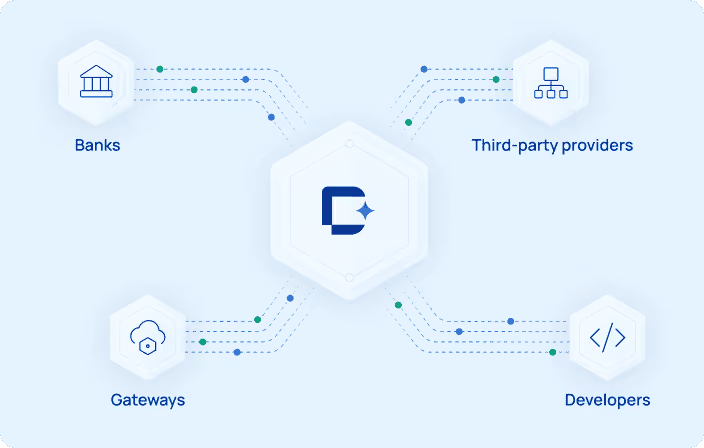
DigitalAPI.ai excels in providing a unified catalog that pulls from diverse sources, creating a comprehensive inventory without requiring complex migrations.
2. Centralized, Automated Documentation
Outdated or scattered documentation is a major hindrance to API adoption. Visibility requires documentation that is always current and easily accessible. Solutions that can generate rich API documentation directly from specifications and keep it in sync are essential. This ensures developers always have accurate information at their fingertips.
3. API Discovery Platforms
Beyond a static list, a true API discovery platform offers robust search, filtering, and categorization capabilities. Developers should be able to find APIs based on keywords, domains, business capabilities, or technical specifications. This transforms the catalog from a mere inventory into an active tool for exploration and integration.
4. API Monitoring and Analytics
Visibility extends to understanding API performance and usage patterns. API monitoring tools track uptime, latency, error rates, and traffic volumes. Analytics provide insights into who is using which APIs, how frequently, and for what purpose, offering valuable data for both operational health and business strategy.
Why API Governance is Indispensable for Your Estate
Visibility tells you what you have; governance dictates how it should behave. Without robust API governance, even a perfectly visible estate can quickly descend into chaos, leading to inconsistent experiences, security breaches, and compliance failures.
1. Ensuring Consistency and Standardization
Governance establishes clear rules and guidelines for API design, development, and deployment. This ensures that APIs across your organization adhere to common standards, making them easier to understand, consume, and maintain. Consistency reduces developer friction and improves overall reliability.
2. Mitigating Risks and Ensuring Compliance
From data privacy regulations (GDPR, CCPA) to industry-specific mandates, APIs must comply with a complex web of rules. API governance provides the framework to enforce security policies, manage access, and audit usage, ensuring your organization meets its legal and ethical obligations while preventing potential breaches or fines.
3. Streamlining API Lifecycle Management
APIs have a lifecycle, from design and development to deprecation. Governance defines clear processes for each stage, including versioning, updates, and retirement strategies. This prevents breaking changes, ensures smooth transitions, and allows for efficient API lifecycle management across the estate.
4. Accelerating Innovation Safely
While some might view governance as a bottleneck, effective governance actually accelerates innovation. By providing clear guardrails, developers can build new services with confidence, knowing they adhere to organizational standards and security requirements. This reduces rework and allows teams to focus on delivering value rather than fixing preventable issues.
.png)
Building Robust API Governance in Your Estate
Implementing effective API governance requires a multi-faceted approach, combining policies, processes, and technology. It needs to be integrated into the development pipeline, not bolted on as an afterthought.
1. Establishing API Style Guides and Standards
Define clear guidelines for API naming conventions, error handling, data formats, and response structures. These guidelines should be easily accessible and ideally enforced through automated tools. Establishing these standards from the outset is crucial for achieving API consistency.
2. Implementing Role-Based Access Control (RBAC)
Not all users should have the same level of access to your APIs or their management. Implement robust API access management using RBAC to ensure that only authorized individuals or applications can discover, consume, or administer specific APIs. This is a critical security measure.
3. Enforcing Security Policies and Authentication
Integrate security checks throughout the API lifecycle. This includes mandating strong API authentication methods (like OAuth, API keys), implementing rate limiting to prevent abuse, and regularly scanning for vulnerabilities. Adherence to security best practices, like those outlined in the OWASP Top 10, should be a core governance principle.
4. Strategic API Versioning and Deprecation
APIs evolve, and new versions are inevitable. Governance should define a clear API versioning strategy and a transparent process for API deprecation. Communicating changes effectively to consumers is vital to prevent disruption and maintain trust.
5. Automated Testing and Validation
Integrate automated API contract testing and validation into your CI/CD pipelines. This ensures that APIs always conform to their specifications and adhere to governance rules before deployment. Automated checks catch inconsistencies early, preventing them from reaching production.
6. Centralized API Management Platform
A dedicated API management platform acts as the control plane for your entire API estate. It enables you to apply policies, enforce rate limits, handle security, and provide a developer portal for consumption. Choosing from the best API management platforms can significantly streamline governance efforts.
DigitalAPI: Your Partner for API Visibility and Governance
DigitalAPI.ai understands that modern enterprise API estates are distributed, diverse, and dynamic. We provide a comprehensive solution designed to bring clarity and control to even the most complex environments, ensuring you can scale your API programs securely and efficiently. Our platform directly addresses the core challenges of visibility and governance by offering a unified approach.
1. Unified API Catalog Across All Gateways and Clouds
DigitalAPI.ai creates a single, accurate build an API catalog by connecting to all your existing API gateways (Apigee, MuleSoft, Kong, AWS, Azure, etc.), Git repositories, and other sources. This eliminates shadow APIs and provides a complete picture of your entire API estate, ensuring no API goes unnoticed.
2. Automated Documentation and Discovery
Our platform automatically generates and keeps API documentation in sync with your specifications, eliminating manual effort and documentation drift. The integrated unified API developer portal offers powerful search and filtering, making API discovery effortless for developers across your organization and with partners.
3. Comprehensive and Enforced Governance
DigitalAPI.ai allows you to define and automatically enforce API governance policies across your entire estate. This includes:
- Design Standards: Ensure all APIs adhere to your organizational style guides.
- Security Policies: Enforce authentication, authorization, and strong API gateway governance rules.
- Lifecycle Management: Automate processes for govern risky API changes, versioning, and deprecation.
- Ownership and Metadata: Centralize and manage critical API information.
This ensures effective API governance is consistently applied, even for distributed teams.
4. Advanced Analytics and Reporting
Gain deep insights into API usage, performance, and compliance. DigitalAPI.ai provides dashboards and reports on key API metrics, helping you understand API value, identify bottlenecks, and make data-driven decisions for your API program. This enhances both visibility and the ability to refine governance policies based on real-world usage.
5. Future-Proofing Your API Estate
With DigitalAPI.ai, your API estate isn't just visible and governed for today; it's prepared for tomorrow's innovations. Our platform ensures your APIs are well-defined, easily discoverable, and securely managed, laying the groundwork for integration with AI agents and new digital initiatives.
Conclusion
The complexity of modern API estates demands a proactive approach to visibility and governance. Without a clear understanding of what APIs exist and robust controls over how they are built and used, organizations risk stifling innovation, exposing themselves to security threats, and failing to capitalize on their digital assets. By investing in a unified API catalog, automated documentation, strong governance policies, and a comprehensive API management platform like DigitalAPI.ai, enterprises can transform their sprawling API landscape into a well-organized, secure, and highly effective ecosystem. This shift is not merely an operational improvement; it's a strategic imperative for sustained growth and competitiveness in the digital economy.
FAQs
1. What is the primary benefit of achieving API visibility?
The primary benefit of achieving API visibility is gaining a complete, accurate, and real-time understanding of all APIs within your organization. This prevents duplication, improves developer experience by making APIs easily discoverable, enhances security by identifying shadow APIs, and enables strategic decision-making by revealing the true scope and impact of your digital assets.
2. How does API governance contribute to API security?
API governance significantly enhances API security by establishing and enforcing consistent security policies, authentication standards, and authorization rules across the entire API estate. It ensures that all APIs adhere to best practices, such as the OWASP Top 10, and includes processes for vulnerability assessment, access control (RBAC), and monitoring, thereby reducing the attack surface and protecting sensitive data.
3. Can a developer portal help with both visibility and governance?
Yes, a developer portal for better RBAC is a critical tool for both visibility and governance. For visibility, it acts as the primary interface for developers to discover, learn about, and consume APIs through searchable catalogs and comprehensive documentation. For governance, it can enforce access controls, display API lifecycle status, provide versioning information, and communicate API usage policies, ensuring developers interact with APIs according to defined rules.
4. What are the common pitfalls when trying to implement API governance?
Common pitfalls in implementing API governance include treating it as a one-time project, failing to involve all relevant stakeholders (development, security, business), creating overly rigid policies that stifle innovation, lacking automation for policy enforcement, and neglecting to tie governance to the API's entire lifecycle. To avoid these, focus on an iterative approach, ensure buy-in, and use tools that integrate governance into existing workflows.
5. How does DigitalAPI.ai support an enterprise's visibility and governance needs?
DigitalAPI.ai provides a comprehensive platform that addresses both visibility and governance by unifying all API sources into a single, searchable catalog, automating documentation, and enabling the consistent enforcement of governance policies across all APIs. It offers advanced features for API discovery, lifecycle management, security, and analytics, ensuring enterprises have complete control and insight over their entire API estate without requiring complex migrations or re-architecture.
Dhayalan Subramanian is Associate Director, Product Growth at DigitalAPI, where he leads go-to-market and product growth for the company’s multi-gateway API management platform. His work focuses on helping large enterprises and mid-market cloud companies consolidate APIs across AWS, Azure, Apigee, Kong, MuleSoft, and other gateways into a single control plane for governance, discovery, monetization, and agent consumption.
Dhayalan brings 14+ years of experience across product strategy, enterprise architecture, and engineering leadership. Earlier in his career, he held senior roles at Encora (as Associate Architect and Technical Manager), Mindtree (Technology Lead), Tech Mahindra (Technical Lead), and Primus Analytics, where he designed integration frameworks and delivered enterprise-grade digital platforms for global customers.
At DigitalAPI, he works directly with platform, integration, and developer experience leaders at Fortune 500 organizations to operationalize unified API catalogs, developer portals, and MCP-ready APIs. He writes regularly on API developer experience, API governance, and AI agent architectures.
One email a fortnight. Worth opening.
A short digest of what we're writing, what we're learning from customers, and the handful of links you'd actually want from us. No tracking pixels.

.avif)