



API Management vs API Governance: What's the Difference?
API management and API governance are often treated as one budget line, but they answer different questions. Management runs APIs in production; governance decides what a good API looks like and checks every API against it. This guide compares them row by row and shows who should own each.

TL;DR:
What is the difference between API management and API governance?
In the API management vs API governance question, management is the operational layer: it publishes, secures, routes and measures APIs in production.
Governance is the rulebook: it defines the standards every API must meet and checks APIs against them, from design to retirement.
Management platforms are one of the main places where governance rules get enforced.
Your platform team runs three gateways and a developer portal. Traffic is metered, keys are rotated and dashboards are green. Then an audit asks a simple question: do all 400 APIs follow the same naming, versioning and authentication rules? Nobody can answer.
That gap is the core of the API management vs API governance debate. You can manage every API well and still have no governance. Management keeps APIs running. Governance makes them consistent, safe and findable.
This guide gives you a short definition of each, a 10-row comparison, the overlap, and an operating model that says who owns what.
API management vs API governance: what is the difference?
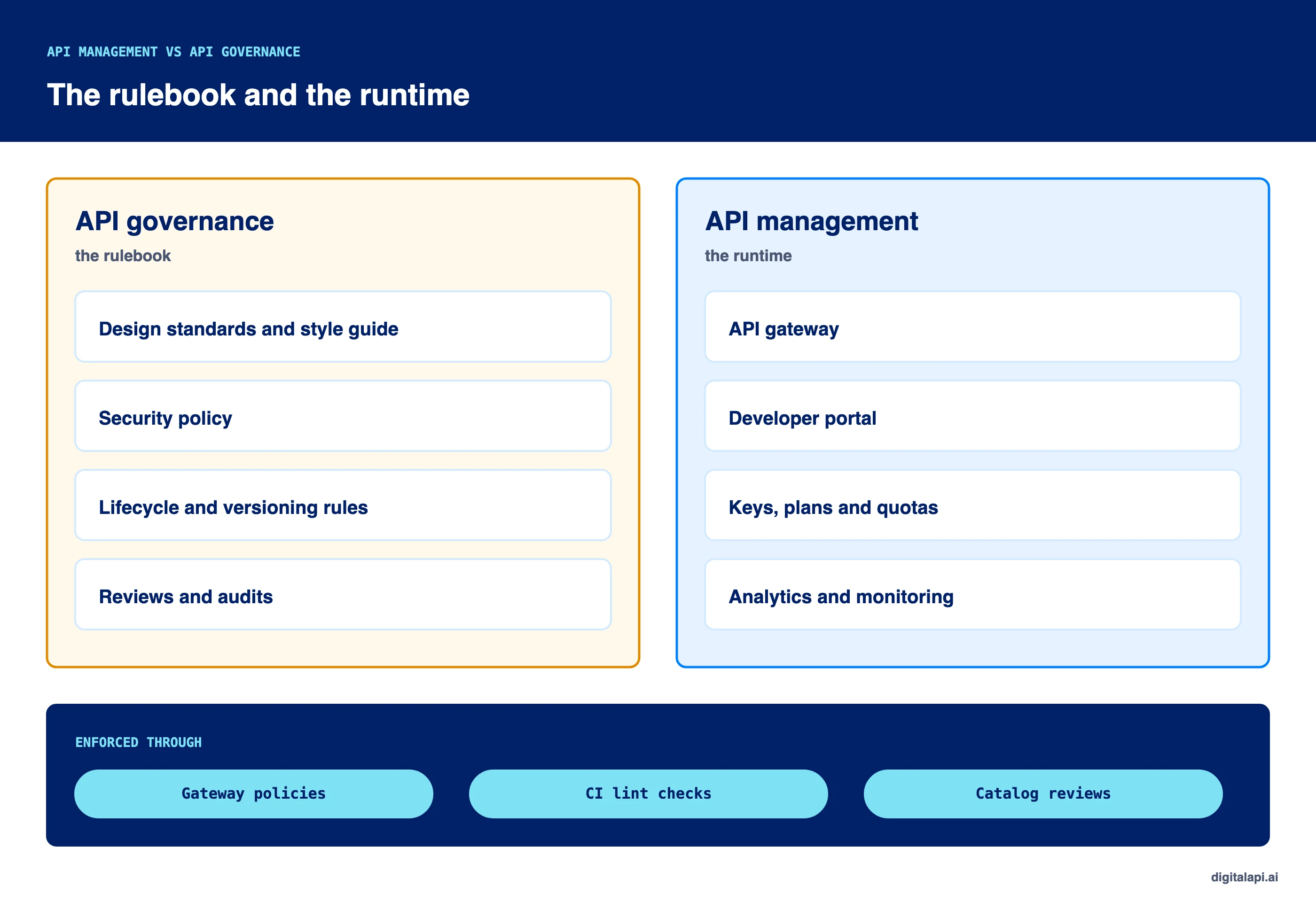
API management operates APIs. API governance sets the rules those APIs must follow. Management answers "is this API running, secure and used?" Governance answers "is this API built and run the way we agreed?"
Think of it as law and policing. Governance writes the law: naming conventions, required security schemes, versioning rules, deprecation timelines. Management is one of the forces that enforces it at runtime, through gateway policies, access plans and monitoring.
The two fail in different ways:
- Management without governance: APIs run well, but each team invents its own style. You get duplicate APIs, inconsistent auth and docs nobody trusts.
- Governance without management: the standards exist in a wiki, but nothing enforces them. Rules drift the moment a deadline hits.
What does API management mean?
API management is the set of tools and processes that publish, secure, control and monitor APIs across their runtime life. It is mostly a platform, owned by a platform or integration team.
A typical API management stack has four parts:
- API gateway: enforces authentication, rate limits and routing on every call.
- Developer portal: where consumers find APIs, read docs and get credentials.
- Access and plans: API keys, OAuth clients, quotas and subscription tiers.
- Analytics: usage, latency, errors and adoption per API and per consumer.
If you are still separating the gateway from the wider platform, read API gateway vs API management: the core difference.
What does API governance mean?
API governance is the set of standards, policies and checks that make every API consistent, secure and compliant, from design to retirement. It is mostly a discipline, owned by architects and a governance group.
API governance usually covers:
- Design standards: naming, error formats, pagination and versioning in the API contract.
- Security policy: required auth schemes, data classification and exposure rules.
- Documentation rules: every API has an owner, a description and examples.
- Lifecycle rules: review gates, deprecation notice periods and retirement.
The gap shows up in survey data. The Postman 2025 State of the API report found 55% of respondents struggle with inconsistent documentation. The same report says 34% are unable to find existing APIs. For the full guide, see what is API governance.
API management vs API governance: how do they compare?
Governance is broader in scope and starts earlier. Management is narrower and lives in production. The table compares them on the ten points architects ask about most.
Read the "timing" row twice. Most API governance vs API management confusion comes from treating governance as a runtime-only concern. The cheapest place to fix a bad API is the spec, before any code ships.
Where do API management and API governance overlap?
They overlap wherever a governance rule has to be enforced on live traffic. In those places, the management platform is the enforcement point and governance is the source of the rule.
Common overlap areas:
- Authentication: governance says "all external APIs use OAuth 2.0". The gateway rejects anything else.
- Rate limits and quotas: governance sets tiers per consumer type. The gateway applies them.
- Versioning and deprecation: governance sets the notice period. The portal and gateway announce and then retire the old version.
- Catalog and ownership: governance requires an owner for every API. The catalog or portal shows it.
- Audit and logging: governance defines what to log and for how long. The gateway and analytics layer record it.
Security frameworks draw the same line. ISO/IEC 27001:2022 Annex A lists organizational controls such as access control (5.15). It also lists technological controls such as logging (8.15) and secure development life cycle (8.25).
Governance maps each control to an API rule. Management produces the runtime evidence.
What is the difference between design-time and runtime API governance?
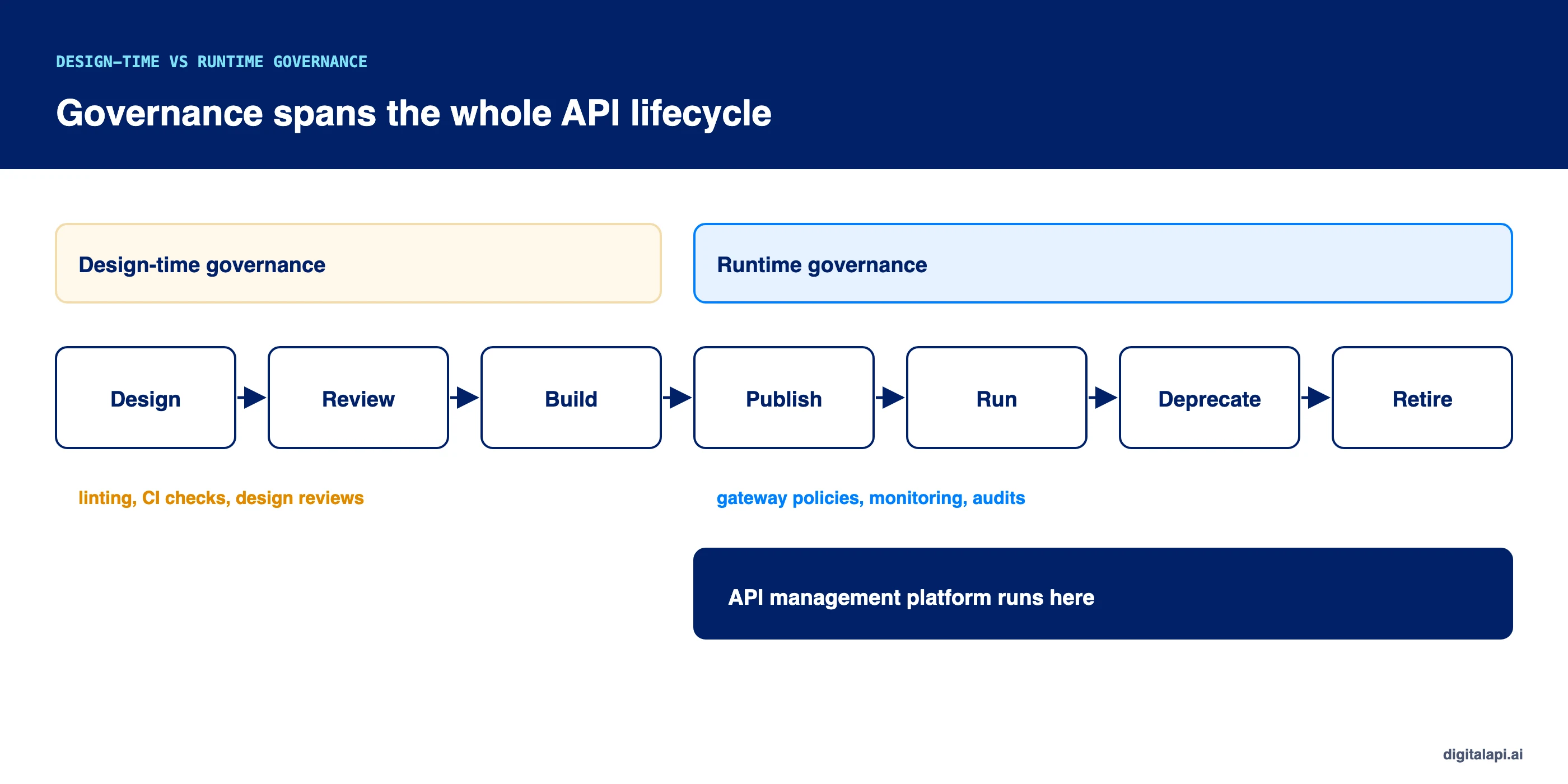
Design-time governance checks the API contract before it ships. Runtime governance checks how the API behaves in production. You need both, because each catches problems the other misses.
NIST SP 800-228 makes the same split. It recommends API protection controls for the "pre-runtime" and "runtime" stages of the API life cycle.
Design-time rules work only if the contract exists. That is why most API governance best practices start with "every API has an OpenAPI Specification document in version control". The OWASP API Security Top 10 is a useful source for runtime rules, such as broken object level authorization.
How do API management platforms enforce API governance?
They turn written rules into automated checks at three points: the spec, the pipeline and the gateway. Rules that only live in a wiki don't get followed under deadline pressure.
- Lint the OpenAPI spec. Encode your style guide as a ruleset. Spectral, an open-source JSON and YAML linter, ships with a built-in OpenAPI ruleset that you can extend.
- Block bad specs in CI. Run the linter on every pull request and fail the build on errors.
- Publish only through the catalog. An API that skipped linting or has no owner doesn't get a portal listing.
- Apply standard gateway policies. Attach auth, rate limits and logging from shared policy templates, not per-team configs.
- Monitor for drift. Compare live traffic against the contract and alert on undeclared endpoints or fields.
A small Spectral ruleset that extends the OpenAPI defaults and adds two house rules:
And the CI step that fails the build when a spec breaks a rule:
Linters are only one category of API governance tools. For a full comparison, see the top 10 API governance tools. For pipeline patterns, read API governance automation.
See how DigitalAPI enforces governance across every gateway you run → Book a Demo
Who owns API management and who owns API governance?
Governance owns the rules. Management owns the runtime. API teams own compliance for their own APIs. The open question is whether governance is central or federated.
A centralized model puts one team in charge of every rule and review. It is consistent but slow once you pass a few dozen teams. A federated model sets a small core of global rules centrally. Domains add their own rules and run their own reviews, with automated checks as the shared safety net.
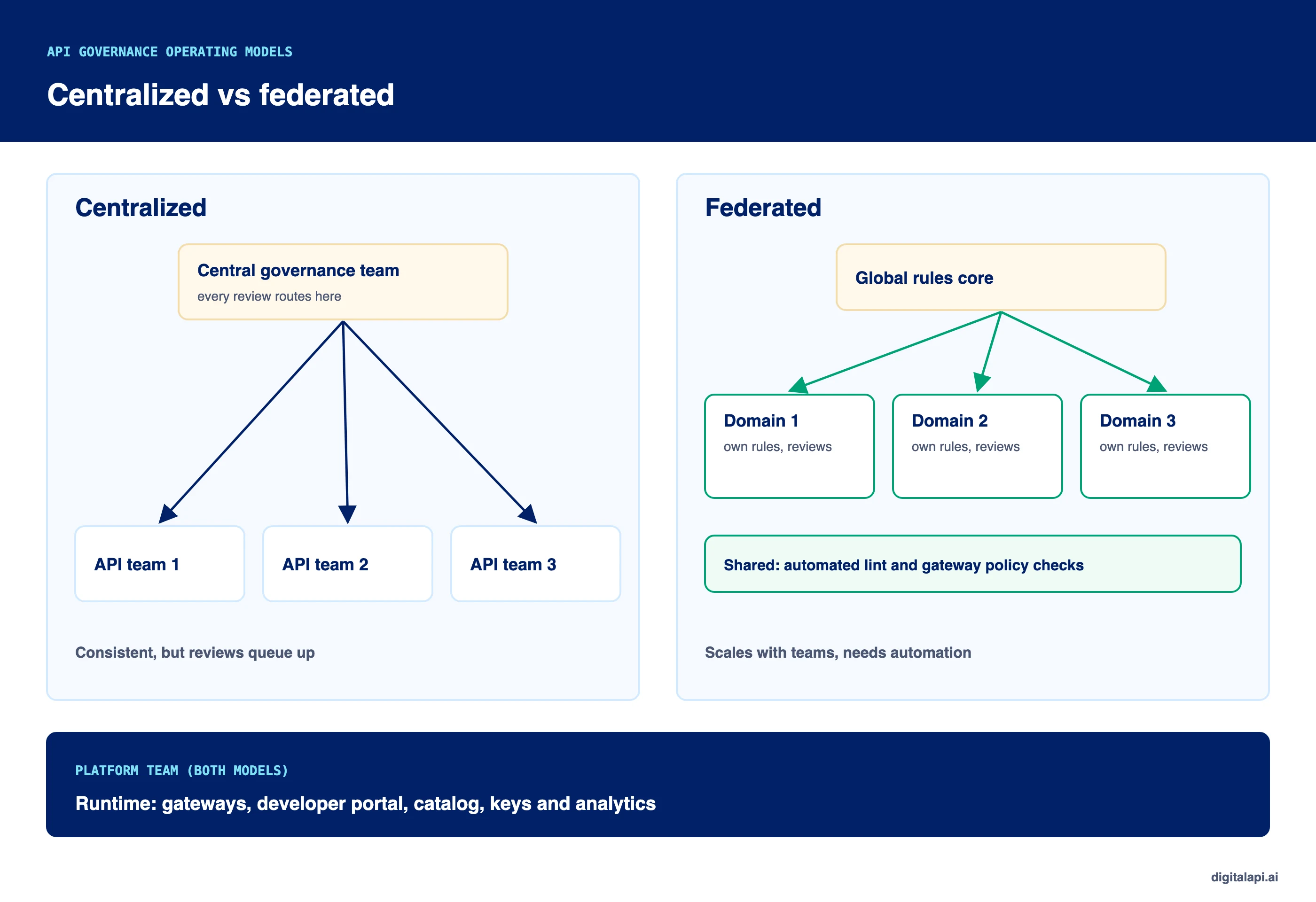
For the trade-offs, see centralized vs federated API governance. For a step-by-step build, use the API governance framework guide.
Should you focus on API management or API governance first?
Start with whichever gap is costing you more today. Most enterprises need management in place first and governance soon after. Use these signals to decide.
Choose API management first if:
- APIs are exposed without a gateway. You can't enforce auth or rate limits on every call.
- Consumers can't self-serve. Partners wait days for keys and docs.
- You can't see usage. Nobody knows which APIs are called, by whom, or how often.
Choose API governance first if:
- You already run one or more gateways, but every team designs APIs differently.
- You find duplicates. Teams rebuild APIs that already exist because they can't find them.
- Breaking changes reach consumers. Postman's 2025 report found only 26% of respondents use semantic versioning.
- An audit is coming. You must show that every API meets the same security controls.
If you run several gateways, governance gets harder, because each gateway has its own config format. A shared catalog across gateways gives governance one place to check every API.
DigitalAPI's API Marketplace creates one searchable hub for APIs across multiple gateways. It keeps docs standardised with AI-generated documentation and flags governance violations in its dashboards. Pair it with the DigitalAPI API Gateway to apply runtime policies.
Key takeaways
- API management vs API governance is not either-or. Management runs APIs in production. Governance defines the rules they follow from design to retirement.
- Governance starts earlier. Design-time checks on the OpenAPI spec catch problems before any code ships.
- Management is a key enforcement point. Gateway policies, plans and logs turn governance rules into runtime controls.
- Automate the rules. Lint specs with a ruleset, fail CI on errors and publish only through the catalog.
- Split ownership clearly. A governance group owns the rules, the platform team owns the runtime, and API teams own compliance.
Frequently asked questions
1. What is the difference between API management and API governance?
API management publishes, secures, routes and monitors APIs in production through gateways, portals and analytics. API governance defines the standards every API must meet and checks APIs against them, from design to retirement. Management answers whether an API is running and secure. Governance answers whether it was built and run the way the organization agreed.
2. What does API governance mean?
API governance means setting rules for how APIs are designed, secured, documented, versioned and retired, then checking every API against those rules. It covers design time, where linters check the OpenAPI contract, and runtime, where gateway policies and monitoring check live behavior. Its goal is consistent, secure and reusable APIs across all teams.
3. What does API management mean?
API management means running APIs as products. A gateway enforces authentication, rate limits and routing. A developer portal lets consumers find APIs and get credentials. Analytics track usage, latency and errors. Plans and quotas control who can call each API and how often. It is mostly a runtime platform owned by a platform team.
4. Is API governance part of API management?
Partly. API management platforms enforce many governance rules at runtime, such as authentication, rate limits and logging. Governance is wider, because it also covers design standards, review gates and lifecycle rules that apply before an API ever reaches the gateway. Treat management as one enforcement layer of governance, not the whole of it.
5. What is design-time vs runtime API governance?
Design-time governance checks the API contract, usually an OpenAPI document, before it ships. Linters and CI checks flag naming errors, missing auth schemes and breaking changes. Runtime governance checks live behavior in production through gateway policies, monitoring and alerts. Design-time catches problems early and cheaply. Runtime catches drift and misuse that a spec can't show.
6. What are API governance tools?
API governance tools automate standards checks across the API lifecycle. They include OpenAPI linters such as Spectral, CI pipelines that block non-compliant specs, API catalogs that track ownership and versions, and scorecards that report compliance per team. API gateways and management platforms enforce the runtime side, such as authentication, rate limits and audit logging.
7. Who should own API governance in an enterprise?
A governance group or API center of excellence should own the standards, rulesets and exception process. The platform team owns the gateways, portal and shared policy templates. API product teams own compliance for their own APIs. In a federated model, domains add their own rules on top of a small core of global standards.
8. What are API governance best practices?
Store an OpenAPI document for every API in version control. Encode your style guide as a lint ruleset and fail CI on errors. Publish APIs only through a catalog that records an owner. Apply gateway policies from shared templates. Set clear deprecation periods. Review the rules regularly, and keep the global core small so teams can follow it.
Conclusion
The API management vs API governance question has a clear answer: you need both, and they do different jobs. Management keeps APIs running, secure and measured. Governance makes sure every API is designed and run to the same standard.
The two meet at enforcement. Write the rules once, lint them at design time and enforce them at the gateway. Then report compliance across every team.
Start small. Pick five rules that matter most, such as auth scheme, naming, error format, owner and versioning. Lint every new spec against them. Then extend the same rules to the runtime policies on every gateway you run.
See DigitalAPI governance in action: one catalog for APIs across all your gateways, with standardised docs and governance violation alerts. Enforce governance across every gateway
Prefer a walkthrough? Book a Demo
Dhayalan Subramanian is Associate Director, Product Growth at DigitalAPI, where he leads go-to-market and product growth for the company’s multi-gateway API management platform. His work focuses on helping large enterprises and mid-market cloud companies consolidate APIs across AWS, Azure, Apigee, Kong, MuleSoft, and other gateways into a single control plane for governance, discovery, monetization, and agent consumption.
Dhayalan brings 14+ years of experience across product strategy, enterprise architecture, and engineering leadership. Earlier in his career, he held senior roles at Encora (as Associate Architect and Technical Manager), Mindtree (Technology Lead), Tech Mahindra (Technical Lead), and Primus Analytics, where he designed integration frameworks and delivered enterprise-grade digital platforms for global customers.
At DigitalAPI, he works directly with platform, integration, and developer experience leaders at Fortune 500 organizations to operationalize unified API catalogs, developer portals, and MCP-ready APIs. He writes regularly on API developer experience, API governance, and AI agent architectures.
One email a fortnight. Worth opening.
A short digest of what we're writing, what we're learning from customers, and the handful of links you'd actually want from us. No tracking pixels.