






API Discovery in Microservices: All you need to know!
API discovery in microservices is complex. Combat sprawl, inconsistency, and duplication with a unified API catalog, strong governance, and DigitalAPI's platform for efficient, clear access.


TL;DR
1. API discovery in microservices is complex due to fragmentation, decentralized ownership, and the sheer volume of APIs.
2. Without proper mechanisms, teams suffer from duplication, integration hurdles, and decreased development velocity.
3. A unified API catalog, robust documentation, and strong governance are essential for effective discovery.
4. Manual approaches or relying solely on API gateways will fail in a true microservices environment.
5. DigitalAPI helps centralize, govern, and make discoverable all your microservices APIs, bridging the gap between disparate systems.
Unlock Seamless API Discovery with DigitalAPI today. Book a Demo!
The promise of microservices architecture is compelling: independent teams, faster deployments, and scalable, decoupled components. Yet, as organizations embrace this paradigm, a subtle but significant challenge often emerges: locating and understanding the very APIs that enable microservice collaboration. What starts as a handful of well-known endpoints quickly evolves into a sprawling network of services, each with its own quirks, documentation, and lifecycle.
Navigating this intricate web isn't just about finding an endpoint; it's about discerning its purpose, capabilities, ownership, and reliability. This journey into API discovery in microservices is far from a trivial task, it’s a complex endeavor that, if overlooked, can cripple development velocity and lead to significant operational overhead.
Why Microservices Make API Discovery Intensely Difficult?
Microservices inherently promote a decentralized approach, breaking down monolithic applications into smaller, manageable services. While this offers immense benefits in terms of agility and scalability, it simultaneously introduces a unique set of challenges for API discovery. The very characteristics that make microservices powerful also make it harder to gain a holistic view of your API landscape.
- Explosive Growth and API Sprawl: Each microservice potentially exposes one or more APIs. As the number of services scales, the total count of APIs grows exponentially, quickly leading to API sprawl. Developers struggle to keep track of what exists, its purpose, and its location, often leading to confusion and duplicated effort.
- Decentralized Ownership and Inconsistent Standards: Microservices architecture empowers independent teams to own and develop their services. While this fosters autonomy, it often results in varied approaches to API design, documentation, and lifecycle management. Without a centralized authority, standards can diverge, making cross-team discovery and integration a significant hurdle.
- Dynamic Nature and Versioning Complexity: Microservices are designed for continuous evolution, meaning APIs are frequently updated, new versions are released, and older ones are deprecated. Keeping track of the correct, stable, or active version of an API across a large estate becomes a complex task, leading to integration issues and delayed API adoption if not managed diligently.
- Lack of a Single Source of Truth: In many microservices environments, there isn't one definitive place to find information about all APIs. Specifications might live in different repositories, documentation on various wikis, and metadata scattered across multiple systems. This fragmentation necessitates ad-hoc searching and communication, wasting valuable developer time.
- Varied Security and Access Control Mechanisms: Different microservices might implement diverse authentication mechanisms and authorization policies. Discovering an API is one step; understanding how to securely access it is another. Without clear, discoverable security guidelines, developers face delays and potential API security risks.
The Illusion of Simple Discovery vs. The Harsh Reality
Many organizations enter the microservices journey with optimistic, yet often unrealistic, expectations about API discovery. The reality on the ground quickly exposes the shortcomings of conventional approaches.
1. Just Browse the Code
This method assumes developers can simply navigate service repositories to find API definitions. However, codebases can be vast and complex, often lacking the high-level business context, ownership details, or lifecycle status needed for effective integration. Furthermore, access restrictions across teams can make this approach impractical, leading to frustration and delays.
2. Our API Gateway Has the List
An API Gateway is crucial for managing external traffic, routing, and applying policies. However, it's rarely a comprehensive discovery solution for an entire microservices estate. Many internal microservices communicate directly, bypassing the gateway entirely. Additionally, gateways typically store routing configurations, not rich documentation or essential metadata like ownership and business domain. Relying solely on a gateway for discovery provides an incomplete, and often misleading, view of your API landscape, especially in a distributed API Gateway in Microservices environment.
3. Just Ask the Owning Team
While direct communication is sometimes necessary, relying on it as the primary discovery mechanism is inherently unscalable. It creates constant interruptions for API owners, leads to inconsistent answers, and fosters tribal knowledge rather than institutional clarity. As the number of microservices and teams grows, this ad-hoc approach becomes a significant bottleneck, eroding development velocity and team morale.
The Tangible Costs of Poor API Discovery
The challenges of API discovery in microservices aren't just technical annoyances; they translate directly into substantial operational and business costs.
1. Increased Duplication and Redundancy
When developers can’t easily find an existing API, they are more likely to build a new one with similar functionality. This leads to redundant services, duplicated effort, and unnecessary maintenance burdens, wasting valuable resources and exacerbating API sprawl across the organization.
2. Slowed Development Velocity
Time spent searching for APIs, waiting for documentation, or deciphering undocumented interfaces directly detracts from time spent building new features. This cumulative delay significantly impacts development velocity, extends project timelines, and slows down the organization's ability to innovate and respond to market demands.
3. Fragile Integrations and Technical Debt
Integrating with APIs that are poorly understood or documented leads to errors, rework, and fragile dependencies. Developers might misuse endpoints or misinterpret data contracts, resulting in frequent bugs and increasing technical debt. Debugging these issues often requires extensive cross-team effort, further draining resources.
4. Heightened Security and Compliance Risks
A fragmented API landscape makes it incredibly difficult to enforce consistent API security policies and monitor for vulnerabilities. Undiscovered or "shadow" APIs can become critical blind spots, exposing the organization to unauthorized access and data breaches. Meeting compliance requirements, especially in regulated industries, becomes a daunting task without full visibility.
5. Lost Opportunities for Reuse and Innovation
One of the primary advantages of microservices is the ability to compose new solutions from existing building blocks. Poor API discovery hinders this potential, forcing teams to reinvent the wheel. This prevents the synergistic combination of services that drives innovation and limits the ROI from your microservices investment.
Key Pillars of Effective API Discovery in Microservices
To truly master API discovery in a microservices environment, organizations must adopt a strategic framework built on several foundational pillars.
1. A Centralized, Unified API Catalog
This is the cornerstone. A centralized API catalog serves as the single source of truth for all APIs, regardless of where they are deployed or who owns them. It provides comprehensive information, including functional descriptions, ownership details, lifecycle status, and links to detailed documentation, making every API easily findable and understandable.
2. Robust and Standardized Documentation
Consistent, accurate, and easily accessible documentation is non-negotiable. Every API should have clear specifications (e.g., OpenAPI), detailed usage instructions, examples, error codes, and authentication methods. Automating API documentation generation is crucial to keep it in sync with evolving APIs.
3. Strong API Governance and Design Principles
Establishing and enforcing API governance ensures consistency in API design, naming, versioning, and security policies across all microservices. This predictability makes APIs easier to consume and reduces the cognitive load for developers, streamlining the discovery process.
4. Automated Discovery and Rich Metadata
Manual cataloging is unsustainable. Solutions must be in place to automatically discover APIs from various sources (code repositories, CI/CD pipelines, gateways) and extract rich metadata. This automation ensures the catalog remains up-to-date and accurate without human intervention.
5. A Developer Portal for Seamless Consumption
A developer portal provides an intuitive, self-service interface to the API catalog. It enables developers to easily search, explore, test (via sandboxes), and subscribe to APIs. A well-designed portal significantly enhances the user experience, reduces onboarding time, and promotes API reuse.
6. Effective API Lifecycle Management
APIs are living entities. Proper API lifecycle management ensures that the catalog accurately reflects the current status of each API, from design to deprecation. This clarity helps consumers avoid integrating with outdated or unstable APIs and facilitates smooth transitions between versions.
Implementing a Solution: Practical Steps for Organizations
Navigating the complexities of microservices API discovery requires a structured, actionable plan. Here are practical steps to establish an efficient discovery mechanism:
- Conduct a Thorough API Inventory: Begin by identifying every API across your organization – including internal, external, and partner APIs. This involves scanning codebases, reviewing existing gateway configurations, and gathering input from all development teams.
- Adopt a Unified API Management Platform: Invest in a platform capable of aggregating and normalizing API information from diverse sources. This platform should support rich metadata, automated documentation, and robust search to create a single source of truth for all APIs. Such a platform is key for effective microservices API management.
- Define and Enforce API Standards: Establish clear guidelines for API design, naming conventions, versioning, and security. Integrate these API governance standards into your development and CI/CD pipelines to ensure consistent application across all services.
- Automate Documentation and Metadata: Implement tools that automatically generate documentation from API specifications (like OpenAPI) and extract essential metadata. This ensures documentation is always current and comprehensive without manual effort.
- Launch and Promote a Developer Portal: Create a user-friendly developer portal that serves as the central hub for API discovery and consumption. Populate it with interactive documentation, code samples, and self-service capabilities, actively promoting its use across teams.
- Foster a Culture of API-First and Discoverability: Encourage teams to prioritize documenting their APIs and making them discoverable. Integrate API-first principles into your development lifecycle, emphasizing the importance of well-defined interfaces and clear communication.
DigitalAPI: Your Ally in Microservices API Discovery
At DigitalAPI, we understand the intricate complexities of API discovery in microservices. Our platform is specifically engineered to cut through the noise and provide clarity across your entire API estate, no matter how fragmented or distributed it may be. We empower organizations to transform their API discovery challenges into strategic advantages.
1. Unified Catalog Across All Gateways and Repositories
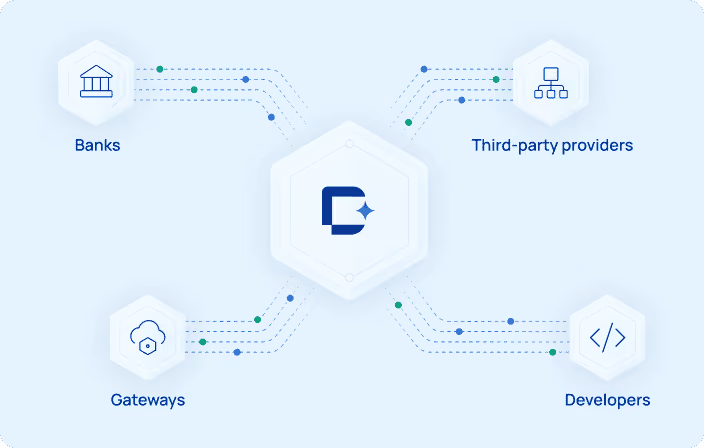
DigitalAPI plugs into Apigee, Kong, AWS, Git repositories, and internal services, automatically pulling and normalizing every API you have. No more partial inventories or gateway-only views. Every API, from legacy to serverless to partner-facing, lands in one clean, searchable space without friction or rework.
2. Automated Documentation and Rich Metadata
Our platform standardizes API specifications, validates structure, repairs inconsistencies, and enriches each API with ownership, lifecycle, domain, and SLAs. Documentation is generated directly from specs, ensuring accuracy and eliminating drift. You get a catalog you can trust, without chasing teams for manual updates.
3. Integrated Governance and Compliance
DigitalAPI embeds robust API governance capabilities directly into the catalog. We help you define, enforce, and monitor compliance with your organizational standards and regulatory requirements. This proactive approach minimizes risks and ensures that all APIs, regardless of their origin, adhere to consistent quality and security benchmarks.
4. Developer-Centric Portal Experience
With DigitalAPI, you can launch a branded, intuitive developer portal that serves as the central hub for API consumption. This portal features powerful search, interactive documentation, API sandboxes, and self-service registration, drastically improving the API development experience for both internal and external consumers. Accelerate adoption and foster a thriving ecosystem around your APIs.
Conclusion
API discovery in a microservices environment is undeniably harder than it seems on the surface. The inherent benefits of microservices—agility, independence, and scalability—can quickly turn into a liability if developers cannot efficiently find, understand, and integrate with the APIs they need. The proliferation of services, decentralized ownership, and inconsistent practices create a chaotic landscape that directly impacts development velocity, increases costs, and introduces significant risks. However, by embracing a strategic approach centered around a unified API catalog, robust documentation, strong governance, and a developer-centric portal, organizations can transform this challenge. Investing in effective API discovery isn't just about managing complexity; it’s about unlocking the true potential of your microservices architecture, fostering innovation, and accelerating your digital transformation journey.
FAQs
1. What makes API discovery particularly hard in microservices?
API discovery is harder in microservices due to the sheer volume and constant evolution of APIs, decentralized ownership across many teams, inconsistent documentation practices, and the lack of a single, comprehensive registry. Services are often deployed independently, leading to fragmentation and making it difficult for developers to find, understand, and trust the APIs they need without extensive manual effort or tribal knowledge.
2. What are the main consequences of poor API discovery in microservices?
Poor API discovery leads to significant consequences, including duplication of existing services, slowed development cycles, integration errors, increased technical debt, and heightened security risks. It also stifles innovation by preventing developers from leveraging existing API capabilities and reduces overall operational efficiency, ultimately diminishing the strategic advantages of adopting a microservices architecture.
3. How can a centralized API catalog help with microservices API discovery?
A centralized API catalog acts as a single source of truth, consolidating information about all APIs from various microservices, regardless of their deployment location or owning team. It provides structured metadata, standardized documentation, and powerful search capabilities, enabling developers to quickly find, evaluate, and understand APIs. By automating synchronization with source systems, it ensures the catalog remains accurate and up-to-date, drastically improving discoverability.
4. What role does an API developer portal play in enhancing discovery?
An API developer portal is the user-facing interface for your API catalog. It provides a highly intuitive and interactive environment where developers can explore APIs, access rich documentation, view code examples, use "try-it-out" features, and manage their applications and API keys. By offering a self-service experience, a portal significantly reduces the burden on API owners and accelerates API adoption, making discovery seamless and efficient.
5. What are common mistakes to avoid when addressing API discovery in microservices?
Common mistakes include treating the API catalog as a one-time project, relying solely on API gateways for all API listings, using manual spreadsheets as a long-term solution, ignoring critical metadata in favor of just specifications, and failing to enforce consistent API governance across teams. To succeed, organizations must adopt an automated, unified, and continuous approach that prioritizes developer experience and keeps the catalog evergreen.
Dhayalan Subramanian is Associate Director, Product Growth at DigitalAPI, where he leads go-to-market and product growth for the company’s multi-gateway API management platform. His work focuses on helping large enterprises and mid-market cloud companies consolidate APIs across AWS, Azure, Apigee, Kong, MuleSoft, and other gateways into a single control plane for governance, discovery, monetization, and agent consumption.
Dhayalan brings 14+ years of experience across product strategy, enterprise architecture, and engineering leadership. Earlier in his career, he held senior roles at Encora (as Associate Architect and Technical Manager), Mindtree (Technology Lead), Tech Mahindra (Technical Lead), and Primus Analytics, where he designed integration frameworks and delivered enterprise-grade digital platforms for global customers.
At DigitalAPI, he works directly with platform, integration, and developer experience leaders at Fortune 500 organizations to operationalize unified API catalogs, developer portals, and MCP-ready APIs. He writes regularly on API developer experience, API governance, and AI agent architectures.


One email a fortnight. Worth opening.
A short digest of what we're writing, what we're learning from customers, and the handful of links you'd actually want from us. No tracking pixels.

.avif)