

What Is an API Product? Everything you need to know!
What is an API product? Learn how it differs from an API, the seven parts every API product needs, real examples and who should own it.

TL;DR
An API product is one or more APIs packaged for a named group of users, with docs, self-service access, a plan, a service commitment and one accountable owner.
An API is the interface. An API product is everything that lets someone outside your team find it, sign up and rely on it.
One API product manager should own it, with platform, engineering and security each owning a part.
An enterprise can run 300 APIs and have zero API products.
The APIs exist, and they work. But a partner who wants one has to email someone, wait for a key and read docs in a Git repo. That's an API. It isn't a product. This guide explains what an API product is, what it includes and who should own it.
What is an API product?
An API product is a bundle of one or more APIs, packaged for a specific audience and offered with docs, access, a plan and an owner. It's built around a job the consumer wants done, not around how your systems are split. One API product can combine APIs from several teams, services or gateways.
Here's the key shift. Your engineering teams think in endpoints: /orders, /shipments, /invoices. A logistics partner thinks in jobs: "track my orders end to end". The API product is the bridge. It bundles the three endpoints into one "Order Tracking" product that the partner can find, understand and subscribe to.
What's the difference between an API and an API product?
An API is a technical interface between two systems. An API product is that interface plus everything a consumer needs to use it without your help. The API answers "can systems talk?" The API product answers "can a partner, customer or other team use this on their own, and rely on it?"
API product vs "API as a product" vs API productization
These three terms get mixed up. They mean different things:
- API product: The thing itself, a packaged bundle of APIs with an audience, plan and owner.
- API as a product: The mindset of treating APIs like products, with users, a roadmap and success metrics. See our guide to API as a product.
- API productization: The process of turning existing APIs into API products. Our API productization guide covers it step by step.
What does an API product include?
An API product includes seven parts: a named audience, a bundle of APIs, docs and a sandbox, self-service access, plans, a service commitment and usage metrics. Miss one, and consumers fall back to email and meetings. Each part answers a question a new consumer will ask.
- A named audience: Who is it for? Logistics partners, mobile teams or paying customers. One product, one primary audience.
- A bundle of APIs: Which endpoints, grouped around one job, even if they come from different services or gateways.
- Docs and a sandbox: How do I use it? A quickstart, reference, examples and a test environment with sample data.
- Self-service access: How do I get in? Sign-up, an approval step and credentials without a support ticket.
- Plans and quotas: What do I get? Rate limits, quotas and, if it's paid, the price.
- A service commitment: Can I rely on it? Uptime targets, a versioning policy and a notice period before breaking changes.
- Usage metrics: Is it working? Active consumers, calls, errors and revenue, per product and per plan.
If you charge for the product, the plan is where pricing lives. Our guide to API monetization models covers the options.
What are examples of API products?
API products come in three types: internal products for your own teams, partner products for named companies and public products for anyone who signs up. The parts are the same. What changes is the audience, the approval step and whether there's a price.
- Internal API product: A "Customer 360" product that bundles profile, accounts and preferences APIs for every team building customer-facing apps. Free, with an internal SLA and an owner other teams can call.
- Partner API product: An "Order Tracking" product for logistics partners. It bundles orders, shipments and events APIs, with partner sign-up, approval by the partnerships team and a contract plan.
- Public API product: A paid data API with a free tier, usage-based pricing, self-service sign-up and a public status page. Stripe's payments API and Twilio's messaging API are well-known examples of this type.
Most enterprises start with partner products. That's where the cost of not having a product shows up first: every partner integration becomes a custom project.
Why do companies with hundreds of APIs have so few API products?
Most companies have few API products because their APIs were built to connect systems, not to be consumed by others. The APIs work. Nobody packaged them. So every new consumer goes through people: an email for access, a call to explain the docs and a manual key.
The scale makes this hard to fix by hand. Akamai's 2026 API Security Impact Study puts the median enterprise at more than 5,900 APIs. Few of those have an audience, a plan or an owner.
We see the same pattern across the enterprises we talk to:
- APIs exist, but partners can't find them: There's no catalog outside the engineering team.
- Access goes through email: A partner asks, someone forwards it and a key arrives days later.
- Docs live where engineers work: In Git, Confluence or a PDF, not where partners look.
- Nobody owns the consumer experience: Each team owns its API. Nobody owns the product a partner sees.
The demand is there. Postman's 2025 State of the API report, based on more than 5,700 developers and leaders, found that 65% of organizations generate revenue from their API programs. 82% have adopted some level of API-first development, but only 25% operate as fully API-first. The gap between those numbers is mostly packaging.
Every partner onboarded by hand has a real cost. Our breakdown of partner onboarding cost shows where the hours go.
Who should own an API product?
One API product manager should own each API product and be accountable for its adoption, roadmap and results. Platform, engineering and security teams each own a part, but one person decides what the product is, who it's for and when it changes. Shared ownership with no single owner is a common reason API products go stale.
What does an API product manager do?
An API product manager decides what an API product is, who it serves and how it grows. The role is like any product manager's, but the users are developers, partners and, increasingly, AI agents. Day to day, an API product manager:
- Talks to consumers: Finds out what partners and developers are trying to do, and where they get stuck.
- Shapes the bundle: Decides which APIs belong in the product and what's missing.
- Sets plans: Defines tiers, quotas and pricing with the business sponsor.
- Owns the experience: Docs, onboarding and time to first call.
- Tracks the numbers: Active consumers, usage, errors and revenue per plan.
- Manages change: Versions, deprecations and notice to consumers.
What if you don't have an API product manager yet?
Most companies don't, at first. Start small:
- Name one owner per product: Often the lead of the team that builds most of it.
- Write a one-page product brief: Audience, job to be done, APIs included and the plan.
- Hold a quarterly review: Usage, consumer feedback and what changes next.
- Keep a changelog: Every change consumers would notice, with dates.
When you have more than three or four products, or when products start earning revenue, that's the point to hire a dedicated API product manager.
How do you know an API is ready to be a product?
An API is ready to be a product when someone outside the team that built it needs it, and you can say who they are and what they want to do. If no one outside the team uses it, packaging it adds cost without value. If several groups ask for it by email, it's overdue.
Check these before you package an API:
- Demand: At least one team, partner or customer has asked for it.
- Stability: The API won't change shape every sprint.
- A spec: It has an OpenAPI definition, or you can write one.
- Security review: You know what data it exposes and to whom.
- An owner: Someone will answer for it after launch.
This is right for you if partners or other teams ask for your APIs by email, you onboard partners by hand, or you want to charge for API access.
This is not right for you if your APIs only connect your own systems, with one team on each side. Good internal docs are enough there.
How does DigitalAPI help you package and run API products?
Packaging API products by hand breaks down once APIs live on more than one gateway. Teams using DigitalAPI bundle APIs from Apigee, Kong, AWS, Azure and other gateways into products, attach plans and publish them in a self-service portal, without rebuilding their APIs.
- Products from any gateway: Group APIs into products with descriptions, usage rules and docs, ready for subscription.
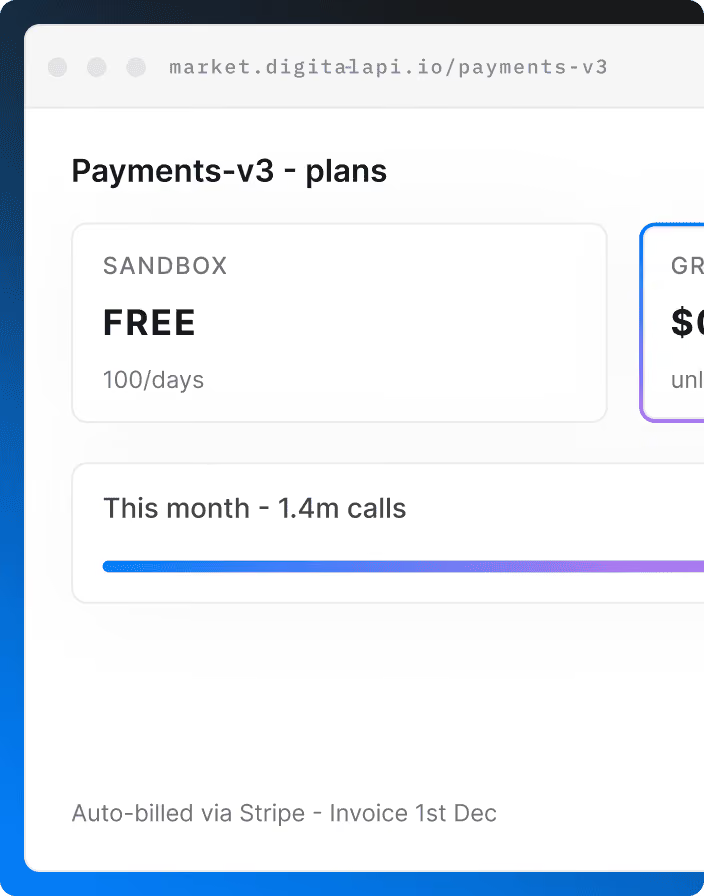
- Plans per product: Free, tiered, usage-based or contract plans, with rate limits, quotas and access rules per plan.
- Self-service access with approval: Access requests go to the API owner or product lead for one-click approval. Sandbox plans can approve themselves, and production plans can require review.
- Metrics per product: Usage, latency, errors and adoption per developer, per API and per endpoint.
See how it works on our API developer portal and API monetization pages.
Turn the APIs you already run into products partners can find and sign up for
Book a DigitalAPI demo.
FAQs
What is an API product in simple terms?
An API product is a set of APIs packaged so other people can use them without asking for help. It has a clear audience, docs, self-service access, a plan with limits or pricing, a service commitment and one owner who is accountable for it.
Is an API product the same as an API?
No. An API is the technical interface that lets two systems exchange data. An API product wraps one or more APIs with everything a consumer needs: docs, sign-up, plans, an SLA and an owner. Every API product contains APIs, but most APIs aren't products.
What is an API product in Apigee?
In Apigee and some other API gateways, an API product is a configuration object that bundles API resources with access rules and quotas, so developers' apps can get keys for that bundle. It's the technical side of an API product. The business side, such as audience, pricing, docs and ownership, sits around it.
Who owns an API product?
An API product should have one accountable owner, usually an API product manager. The platform team runs the portal and access workflows, engineering teams run the APIs inside the product, security sets the guardrails and a business sponsor owns the targets.
What does an API product manager do?
An API product manager decides what an API product includes, who it serves and how it grows. They talk to developers and partners, choose which APIs go in the bundle, set plans and pricing, own docs and onboarding, track adoption and manage versions and deprecations.
Do API products have to be paid?
No. Many API products are free, such as internal products shared across teams or partner products that support a commercial relationship. A plan can be free and still set quotas, rate limits and an SLA. Pricing is one part of an API product, not the definition of it.
Final word
An API becomes a product when someone outside your team can find it, sign up and rely on it, and one person is accountable for that experience. Start with the API partners ask for most, give it an owner and package it properly. Then do the next one.
If your APIs are spread across several gateways and you want them packaged as products partners can use.
See how DigitalAPI does it.
Dhayalan Subramanian is Associate Director, Product Growth at DigitalAPI, where he leads go-to-market and product growth for the company’s multi-gateway API management platform. His work focuses on helping large enterprises and mid-market cloud companies consolidate APIs across AWS, Azure, Apigee, Kong, MuleSoft, and other gateways into a single control plane for governance, discovery, monetization, and agent consumption.
Dhayalan brings 14+ years of experience across product strategy, enterprise architecture, and engineering leadership. Earlier in his career, he held senior roles at Encora (as Associate Architect and Technical Manager), Mindtree (Technology Lead), Tech Mahindra (Technical Lead), and Primus Analytics, where he designed integration frameworks and delivered enterprise-grade digital platforms for global customers.
At DigitalAPI, he works directly with platform, integration, and developer experience leaders at Fortune 500 organizations to operationalize unified API catalogs, developer portals, and MCP-ready APIs. He writes regularly on API developer experience, API governance, and AI agent architectures.


One email a fortnight. Worth opening.
A short digest of what we're writing, what we're learning from customers, and the handful of links you'd actually want from us. No tracking pixels.