



MCP vs RAG: The Difference, When to Use Each, and How They Work Together
MCP vs RAG explained simply: RAG adds knowledge, MCP adds tools and actions. The differences, when to use each, and how they work together in AI agents.

TL;DR
RAG and MCP are not competitors. RAG (retrieval augmented generation) adds knowledge to a model by pulling relevant text from a knowledge base before it answers. MCP (Model Context Protocol) adds tools by letting a model call live APIs and systems to fetch real-time data and take actions. RAG is the what, MCP is the how, and an AI agent decides when to use each. Most production AI systems use both.
Search "mcp vs rag" and you will find a lot of posts framing them as rivals. They are not. They solve different problems, they run at different moments, and the strongest AI systems combine them.
This guide explains what each one is, the key differences side by side, when to use RAG, MCP, or both, and what changes for governance once your agents start taking real actions.
MCP vs RAG in one sentence
RAG gives a model knowledge. MCP gives a model tools. RAG retrieves relevant information and pastes it into the prompt before the model answers. MCP lets the model call external systems during a task to read live data or do something. If you only remember one line: RAG is what the model knows, MCP is what the model can do.
What is RAG (retrieval augmented generation)?
RAG is a technique for feeding external information into a model at the moment you ask a question. Instead of relying only on what the model learned during training, RAG pulls relevant passages from a knowledge base you control and adds them to the prompt, so the answer is grounded in your data.
How RAG works
A typical RAG pipeline has three stages:
- Retrieve: Your documents are split into chunks, converted to embeddings, and stored in a vector database. At query time, the system runs a similarity search to find the chunks most relevant to the question.
- Augment: Those retrieved chunks are added to the prompt as context.
- Generate: The model answers using that added context.
RAG is built for knowledge. It shines over stable, unstructured content such as product documentation, an employee handbook, policy PDFs, or a library of past support tickets. Its data is only as fresh as your last indexing run, and it is read-only. RAG cannot do anything in the outside world, it can only inform the answer.
What is MCP (Model Context Protocol)?
MCP is an open standard that lets AI models and agents connect to external tools, APIs, databases, and systems through one consistent interface, instead of a custom integration for each. Think of it as a universal adapter between AI models and the tools they need to call.
How MCP works
MCP uses a client and server model:
- MCP client: the AI application or agent that wants to use a tool.
- MCP server: a lightweight program that exposes a specific capability, for example a database query, a payments API, or a calendar.
- The call: at runtime, the model invokes a tool through the MCP server, passes structured inputs, and gets a structured response back, which it can act on or use to continue the task.
MCP is built for action and live data. It handles structured, dynamic, real-time work: fetch the current order status, create a ticket, send a notification, submit a form. Where RAG retrieves text by similarity before generation, MCP invokes tools by structure and permission during the task. That difference, read-only knowledge versus live action, is the heart of the rag vs mcp question.
MCP vs RAG: the key differences
Here is the side-by-side. The short version: RAG informs, MCP acts.
| Dimension | RAG | MCP |
|---|---|---|
| What it is | A technique to inject knowledge | A protocol to connect tools and APIs |
| Primary job | Add relevant knowledge to the prompt | Let the model fetch live data and act |
| Data type | Unstructured, mostly static (documents) | Structured, dynamic, real-time |
| When it runs | Before generation (retrieve, then answer) | During the task (live tool calls) |
| Can it take action? | No, read-only | Yes, read and write |
| How it fetches | Vector similarity search | Direct tool or API call via an MCP server |
| Freshness | As fresh as the last index build | Live, on demand |
| Best for | Search and Q&A over a knowledge base | Agents doing tasks across systems |
| Governance surface | Read access to a corpus | Auth, rate limits, and audit on every action |
Do MCP and RAG work together?
Yes, and this is the part most comparisons rush past. RAG and MCP operate at different layers of the stack, so they complement each other rather than compete. A useful way to hold it: RAG provides knowledge, MCP provides tools, and the agent is the decision loop that chooses when to use which.
A worked example: a support agent using both
Picture a customer support agent that handles "please refund my last order."
- RAG (knowledge): The agent retrieves your refund policy from the knowledge base to check whether the order qualifies.
- MCP (action): The agent calls your order API through an MCP server to look up the order, then calls the payments API to issue the refund.
- The agent (decision): It sequences the steps, reads the policy first, confirms eligibility, then acts.
RAG alone could explain the policy but never issue the refund. MCP alone could issue a refund but would not know the policy. Together they produce an assistant that both knows and does.
Where AI agents fit (the MCP vs RAG vs AI agents question)
People often search "mcp vs rag vs ai agents" as if all three are alternatives. They are layers, not rivals. The agent is the reasoning loop that plans and decides. RAG is one source of knowledge it can draw on. MCP is the interface it uses to act. You can even run mcp-powered RAG, where an MCP server performs the retrieval itself, so the agent gets RAG results through the same tool interface it uses for everything else.
When to use RAG, MCP, or both
| Your goal | Use |
|---|---|
| Answer questions from internal documents | RAG |
| Ground responses in a large, stable corpus | RAG |
| Let an agent take actions in real systems | MCP |
| Fetch live, structured data on demand | MCP |
| Connect a model to many tools through one interface | MCP |
| Build a full agent that both knows and does | Both |
A simple rule: If the job is answering from a body of knowledge, reach for RAG. If the job is doing something or reading live data, reach for MCP. The moment you want an assistant that researches and then acts, you want both.
Governing MCP and RAG in production
This is where the comparison stops being academic. RAG is read-only, so its main risks are retrieval quality and keeping sensitive documents out of the index. MCP is different in kind, because MCP tools take actions. A model that can issue refunds, send emails, or change records is now an actor in your systems, and that raises the governance bar sharply.
Why MCP raises the governance bar
Every MCP tool call needs the same controls you would demand of any production API, applied per agent identity:
- Authentication: Scoped tokens per agent using OAuth machine-to-machine flows, not a shared key.
- Authorization: RBAC so an agent can only reach the tools and data it is entitled to.
- Rate limits and quotas: Per-agent limits so an autonomous loop cannot run away with your systems or your budget.
- Audit logging: An attributable record of which agent called which tool, when, exportable to your SIEM.
RAG never required any of this, because it never acted. MCP does, which is why an MCP rollout quickly becomes a governance project.
How DigitalAPI governs agent tool calls
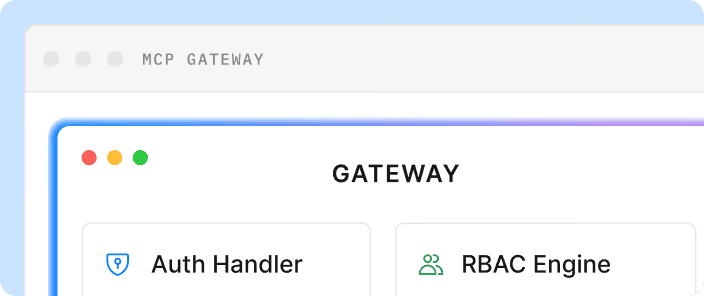
DigitalAPI puts a governed MCP gateway in front of your tools, so agents get the live access they need without losing control.
- Auto-generate governed MCP endpoints: Turn your existing OpenAPI specs into MCP-ready tools, so a server is governed the moment it is exposed.
- Identity and limits per agent: OAuth 2.0 machine-to-machine authentication, RBAC, scoped tokens, and per-agent rate limits on every call.
- Audit and compliance: Immutable audit logs that export to Splunk, Datadog, or any SIEM, SOC 2 Type II ready, with data residency across EU, US, and APAC.
- Gateway-agnostic: Works across Apigee, Kong, AWS, and Azure, as a Google Apigee Premier Partner, so you govern MCP traffic alongside the APIs you already run.
If you are pairing RAG for knowledge with MCP for action and need to keep those actions controlled and auditable, book a demo and we will map it to your stack.
MCP vs RAG vs fine-tuning (quick note)
A third option sometimes enters the conversation. Fine-tuning changes the model's weights by training it further on your data, so the knowledge is baked in. RAG adds knowledge at query time without retraining, which keeps it current and cheaper to update. MCP adds tools and live actions. They are not mutually exclusive: a team might fine-tune for tone, use RAG for current knowledge, and use MCP for actions, all in one system.
FAQs
1. Is RAG the same as MCP?
No. RAG is a technique for adding knowledge to a prompt by retrieving relevant text. MCP is a protocol for connecting a model to tools and APIs so it can fetch live data and act. They solve different problems.
2. Does MCP replace RAG?
No. MCP does not retrieve and rank documents the way RAG does, and RAG cannot take actions the way MCP does. They are complementary and frequently used together.
3. Can you use RAG and MCP together?
Yes. A common pattern is an agent that uses RAG to ground its understanding and MCP to act, for example retrieving a policy with RAG and executing a transaction through an MCP tool.
4. Is MCP better than RAG?
It is the wrong question, because they do different jobs. Use RAG for knowledge, MCP for action. For a full assistant, use both.
5. What is MCP-powered RAG?
It is a setup where an MCP server performs the retrieval, so the agent receives RAG results through the same MCP interface it uses for other tools. MCP handles the communication, the retrieval system handles the search.
6. MCP vs RAG vs fine-tuning, what is the difference?
Fine-tuning retrains the model so knowledge is built in. RAG injects knowledge at query time without retraining. MCP gives the model tools and live actions. They can be combined.
7. Which is better for enterprise search?
RAG, because enterprise search is a knowledge-retrieval problem. Add MCP when the assistant also needs to take actions or pull live, structured data.
8. Do I need a gateway for MCP?
If your agents take actions in production, yes. A gateway applies authentication, RBAC, rate limits, and audit logging to MCP tool calls, which RAG retrieval never required.
Dhayalan Subramanian is Associate Director, Product Growth at DigitalAPI, where he leads go-to-market and product growth for the company’s multi-gateway API management platform. His work focuses on helping large enterprises and mid-market cloud companies consolidate APIs across AWS, Azure, Apigee, Kong, MuleSoft, and other gateways into a single control plane for governance, discovery, monetization, and agent consumption.
Dhayalan brings 14+ years of experience across product strategy, enterprise architecture, and engineering leadership. Earlier in his career, he held senior roles at Encora (as Associate Architect and Technical Manager), Mindtree (Technology Lead), Tech Mahindra (Technical Lead), and Primus Analytics, where he designed integration frameworks and delivered enterprise-grade digital platforms for global customers.
At DigitalAPI, he works directly with platform, integration, and developer experience leaders at Fortune 500 organizations to operationalize unified API catalogs, developer portals, and MCP-ready APIs. He writes regularly on API developer experience, API governance, and AI agent architectures.
.png)
One email a fortnight. Worth opening.
A short digest of what we're writing, what we're learning from customers, and the handful of links you'd actually want from us. No tracking pixels.

.avif)