



How Developer Portals Must Evolve in the Age of AI
AI agents now consume your APIs, not just human developers. Here is what an AI-ready developer portal looks like, what to keep, what to drop, and a checklist to build one.


TL;DR
AI-ready developer portals are portals redesigned so autonomous AI agents, not only human developers, can discover, understand, and consume APIs.
The change is small to describe and large in effect: traditional portals sell APIs to people through UI, search, and test consoles, while agents need clean machine-readable context, scoped access, and a single programmable entry point.
This guide covers what changes, what to keep, and a checklist to get there.
What Is an AI-Ready Developer Portal?
An AI-ready developer portal is a developer portal designed so AI agents can discover APIs, read their documentation, obtain scoped credentials, and call endpoints with little or no human help. It keeps serving human developers, and it adds a clean, machine-readable path for autonomous software. The difference is not a new coat of paint. It is a different consumer with different needs.
What Is a Developer Portal?
A developer portal is the front door to an organization's APIs: a place to browse the API catalog, read documentation and specifications, sign up, get API keys, and test calls before building. For a decade, that front door was built for people who click, read, and reason.
That assumption is breaking. Gartner projects that 33% of enterprise software applications will include agentic AI by 2028, up from less than 1% in 2024 (Gartner, 2025). As agents take over integration work, the portal's primary visitor changes from a developer to a piece of software. Developer portal evolution is no longer optional. It is a response to who, or what, now shows up to consume your APIs.
For an agent, the context is more required than ever. Humans can interpret, think through, and search somewhere else. An agent takes what you give it.
Dhayalan Subramanian, Associate Director - Product Growth at DigitalAPI
How Is AI Changing Developer Portals?
AI changes the developer portal by changing its reader. A human developer wants a UI to browse, a console to test, and guides to learn from. An AI agent wants none of that chrome. It wants accurate context, working endpoints, and a fast way in. Developer portals for AI agents succeed or fail on the quality of their information, not the polish of their interface.
Here is the hard part. A human catches a mistake in the docs and works around it. An agent does not. If the documentation is wrong, the agent repeats the error without question, because no one is steering it.
Any wrong information will be taken as wrong information. It won't correct it. Since we are not controlling it, it may go wrong.
Dhayalan Subramanian, Associate Director - Product Growth at DigitalAPI
The shift is more demanding than it looks, because agents are becoming a large share of who, or what, hits your endpoints. Automated traffic from bots accounted for nearly half of all internet traffic (49.6%) in 2023, the highest level on record (Imperva, 2024). A portal that assumes a patient human on the other side is designing for a shrinking audience.
What agents need instead is narrow and clear:
- Clean documentation with consistent, predictable naming (getUser for one user, getAllUsers for many).
- Structured workflows and working, versioned endpoints.
- Context over chrome: the test console, the three-column layout, and the marketing UI are optional. The information is not.
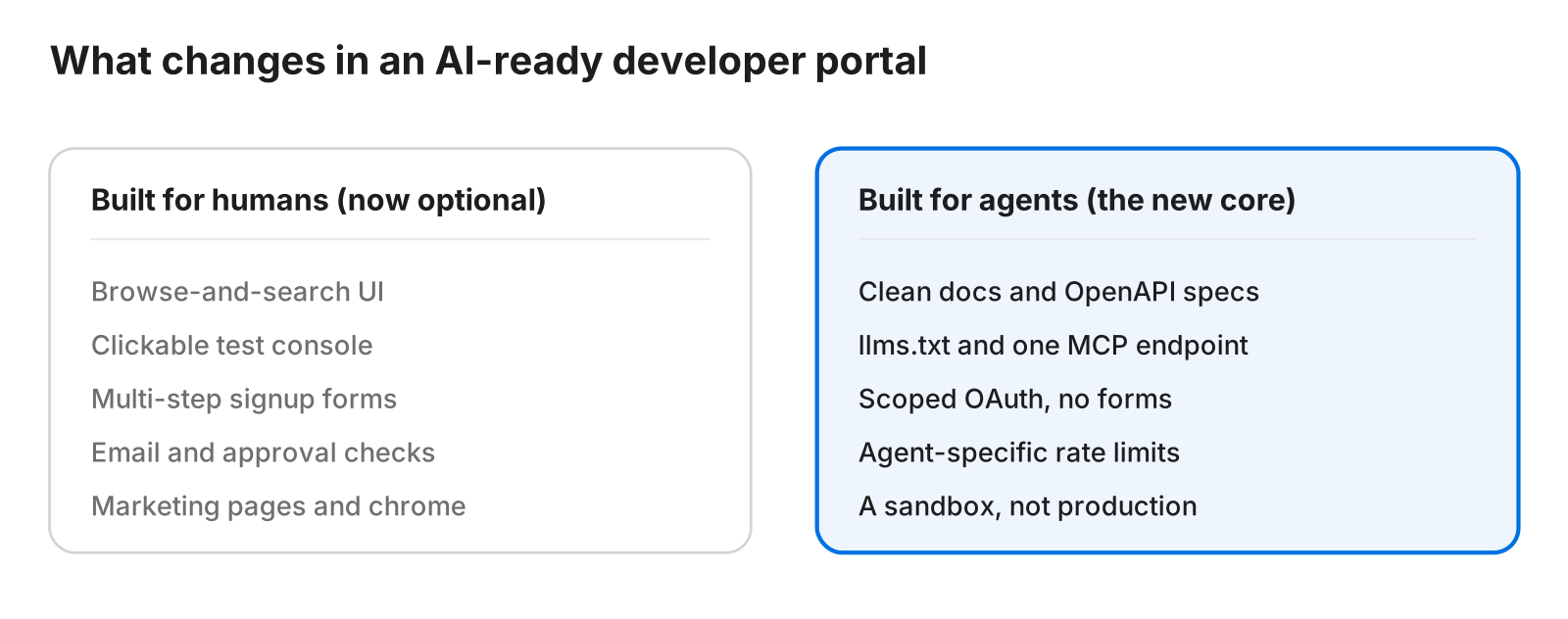
Built for humans (now optional): browse-and-search UI, a clickable test console, multi-step signup forms, email and approval checks, and marketing chrome.
Built for agents (the new core): clean docs and complete OpenAPI specs, llms.txt and a single MCP endpoint, scoped OAuth with no forms, agent-specific rate limits, and a sandbox instead of production.
Both keep the API catalog, accurate documentation, and governance.
Why Does Context Matter More for AI Agents Than for Humans?
Context matters more for agents because they cannot fill gaps the way people can. A developer who hits a missing detail will infer it, search for it, or ask a colleague. An agent has none of those escape routes. It works with the context you give it, which means the completeness of that context sets the ceiling on what the agent can do.
This flips an old habit. For human portals, teams could ship good-enough docs and trust developers to work out the rest. For agents, every gap is a failure point, and the portal has to carry the full load.
It is highly required to provide very clean documentation, structured workflows, and working endpoints for agents.
Dhayalan Subramanian, Associate Director - Product Growth at DigitalAPI
Strong context for an AI-ready developer portal has a few non-negotiables:
- Complete and current information for every API, with nothing assumed.
- Consistent naming so an agent reads intent without guessing (getUser for one, getAllUsers for many).
- Structured workflows and examples that show how calls fit together, not only what each endpoint does.
- Working, versioned endpoints, because an agent cannot tell a stale example from a live one.
The payoff is direct: the richer the context, the faster an agent integrates, and the less it has to invent. That last point leads to the real risk when context runs thin.
How Do You Stop AI Agents From Hallucinating About Your APIs?
You stop hallucination by removing what causes it: missing context and no guardrails. An AI agent hallucinates when it does not know the answer and has no instruction to admit that, so it produces a plausible-sounding guess instead. Hallucination is not a mystery. It is what any system does when it is pushed to answer past what it knows.
The behavior mirrors people. In an interview, a candidate who does not know an answer may invent a confident one rather than admit the gap. An agent does the same with your API, and without a human reviewer, the wrong answer flows straight into the integration.
If you do not know, say you do not know. Set those rules and context properly, and you reduce hallucination.
Dhayalan Subramanian, Associate Director - Product Growth at DigitalAPI
Four controls keep agents honest about your APIs:
- Complete context. The first fix for hallucination is leaving no gap to guess into.
- Explicit guardrails. Instruct the agent to say when it does not know, rather than invent.
- Clear specifications and naming. Standards-based specs with examples give the agent facts to stand on.
- An llms.txt map and current docs. Point the agent to the right source so it does not improvise from memory.
Models are improving, and hallucination rates are falling. But for a brand-new or niche API the model has never seen, context remains the deciding factor. A well-documented, well-governed AI-ready developer portal is the strongest defense against an agent making things up about your APIs.
How Is AI-Powered API Discovery Changing?
AI-powered API discovery is moving from humans browsing catalogs to agents integrating APIs directly. Developers increasingly skip search engines and documentation sites and ask an AI assistant to wire up an integration. The discovery page, once the center of the portal, is becoming a step the agent handles on its own.
One practitioner pattern makes the change concrete: instead of searching and reading, paste the API or portal URL into the model and let it read the page itself.
There is a catch worth naming. This works smoothly for well-known products the model already knows. For a brand-new portal the model has never seen, it will guess, and a guess with missing context becomes a hallucination. So discovery for agents has two jobs: be found, and be understood.
That is where llms.txt comes in. An llms.txt file is a machine-readable map of your portal, the way an XML sitemap guides search engines. It points an agent to the documentation, specs, and instructions it should read. Pair it with standards-based specs, and discovery stops depending on whether a model happened to memorize your API.
To reduce hallucination, provide context and guardrails, not hope:
- Give complete, structured context for every API.
- Set explicit rules: if the agent does not know, it should say so, not invent.
- Publish an llms.txt file and keep specifications current.
What Does AI-Ready API Documentation Look Like?
AI-ready API documentation is complete, consistent, and machine-readable, so an agent can integrate without a human filling gaps. It keeps everything that helps a person, and removes nothing an agent needs. For agents, thorough documentation is not a nice-to-have. It is the interface.
Keep the parts that help discovery and judgment:
- Catalog filters and domain classification (banking, finance, insurance) so agents can narrow thousands of APIs.
- Clear tagging: production or staging, version, lifecycle stage, and environment.
- Complete request and response detail: every status code (200, 202, 400, 500) with example payloads and how to interpret them.
Follow the standards without exception. OpenAPI specifications with real examples let an agent integrate faster, because the more complete the spec, the less the agent has to infer.
The more information you give on the API spec, the lesser the time for the agents to integrate the APIs.
Dhayalan Subramanian, Associate Director - Product Growth at DigitalAPI
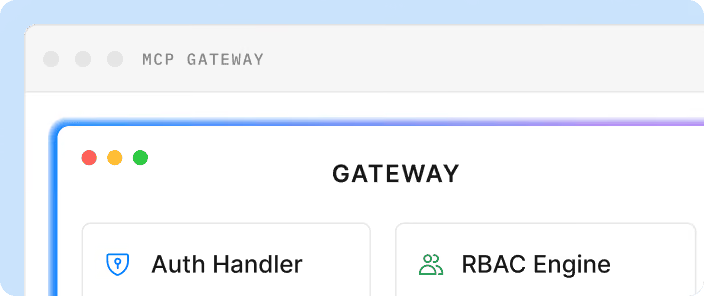
One capability to retire, or rebuild: the clickable test console. An agent does not click. If you keep testing, drive it through the agent itself, as a chat-based or command-line step. And as catalogs grow, MCP-based discovery is emerging: the agent sends a query and receives only the matching tools, instead of crawling a full documentation tree. Teams on an MCP-native platform like DigitalAPI expose any published API as a governed MCP server, so agents consume tools instead of pages, which removes most of the manual work of making docs agent-ready.
How Should API Onboarding Change for AI Agent API Integration?
AI agent API integration starts with access, and human onboarding blocks it. You cannot ask an agent for a company registration number or a VAT ID, and an agent will not fill a first-name, last-name signup form. The onboarding path for agents has to be short, programmatic, and scoped.
Replace the human gauntlet with a machine handshake:
- Identify the agent. A human usually sits behind an agent, but that human context is missing at the portal. New mechanisms are emerging to recognize and verify agents.
- Use OAuth, machine-to-machine. Exchange client credentials so only that agent can reach the portal, with no email verification or manual approval chain.
- Scope tightly. Grant access to the specific endpoints the agent needs, not the whole surface. Agents probe deep and will use everything you expose.
For an agent, remove the typical steps. Go to the OAuth flow, exchange the keys, give access to the APIs, and limit the scope.
Dhayalan Subramanian, Associate Director - Product Growth at DigitalAPI
This is not only about convenience. Developer concern about uncontrolled agent access is real, and tight scoping is the answer, not a locked door. A governed portal lets an agent in through a narrow, revocable door, rather than forcing a choice between full access and no access.
Why Do AI Agents Need Sandboxes and Agent-Specific Governance?
AI agents need sandboxes and agent-specific governance because they behave nothing like human callers. A person makes a request and moves on. An agent retries, polls, and generates its own test cases until something works, hitting endpoints far harder than a human would. Without controls built for that behavior, agents can overwhelm, or take down, production.
Two controls become mandatory:
- Agent-specific rate limits. Set limits tuned to how agents call, not how humans do, so retries and auto-generated tests do not flood your APIs.
- A sandbox, not production. Give agents a safe place to explore and build. Let them loose on live APIs and a stress test becomes an outage.
A sandbox becomes mandatory now. If you allow them to test and build something, your production site will go down.
Dhayalan Subramanian, Associate Director - Product Growth at DigitalAPI
Security stakes rise with agent traffic. Already, 44% of account-takeover attacks target API endpoints, up from 35% a year earlier (Imperva, 2024). As more non-human callers arrive, governance, access control, and monitoring stop being back-office concerns and become the front line of an AI-ready developer portal.
What Are Companies Getting Wrong, and What Is the Future of Developer Portals?
The biggest mistake is treating agents like humans under the same old rules. Many enterprises, banks in particular, keep strict, human-era governance and block agents from their APIs. That caution feels safe. It is the main blocker to progress.
The problem is not technology. It is policy. Agents interact with systems differently, so the rules have to change for them. Gartner warns that more than 40% of agentic AI projects will be canceled by the end of 2027, citing unclear business value and inadequate risk controls (Gartner, 2025). Governance that is too loose fails. Governance designed only for humans blocks everything. The teams that win build policy for agents first.
They still think the process will be the same for agents. People have to focus more on how to govern agents. Once that is sorted out, all the remaining things are easier.
Dhayalan Subramanian, Associate Director - Product Growth at DigitalAPI
So, What Is the Future of Developer Portals?
It is less interface and more endpoint. As agents take over consumption, the UI falls away and the portal collapses toward a single programmable entry point. Instead of a sprawling site at developerportal.yourbank.com, an agent may need only developer.yourbank.com/mcp. Asked where portals land in five years, the view from the field is blunt.
Five years down the line, it will just be an endpoint.
Dhayalan Subramanian, Associate Director - Product Growth at DigitalAPI
The AI-Ready Developer Portal Checklist
An AI-ready developer portal comes down to a short list of shifts. Use this as a build or audit checklist. Each item moves the portal from a human destination to a machine-usable interface.
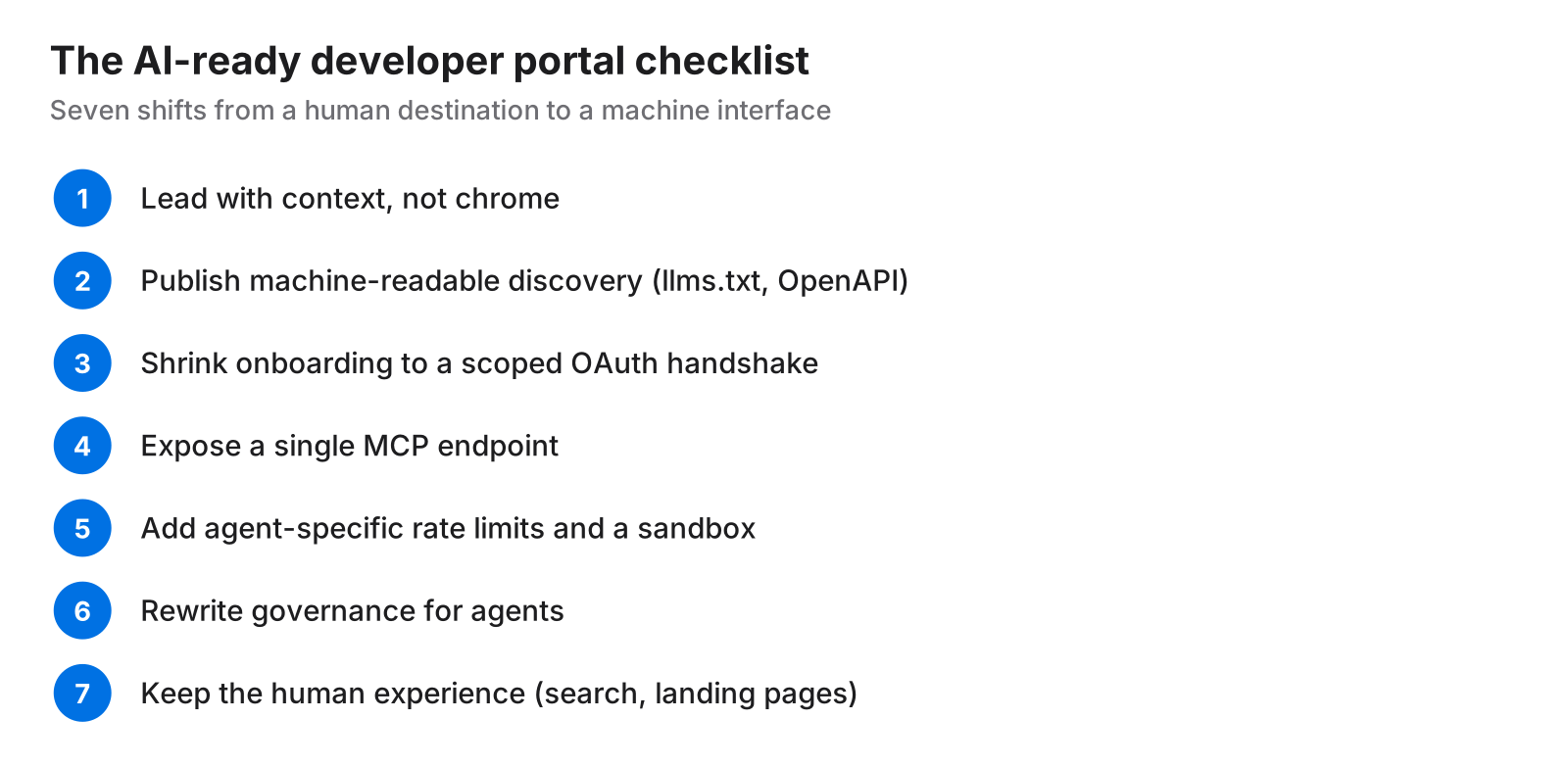
- Lead with context, not chrome. Clean docs, consistent naming, working endpoints. Drop or automate the test console.
- Publish machine-readable discovery. An llms.txt file, complete OpenAPI specs, and clear catalog tagging.
- Shrink onboarding to a scoped OAuth handshake. No forms, no manual approval, least-privilege access.
- Expose an MCP endpoint. Let agents query for tools instead of crawling documentation.
- Add agent-specific rate limits and a sandbox. Protect production from retry-heavy, auto-testing agents.
- Rewrite governance for agents. Policy, compliance, and access control designed for non-human callers.
- Keep the human experience. Search, landing pages, and recommendations still drive awareness and trust.
This is right for you if: you expose APIs that partners, internal teams, or agents integrate, and you want to be found and used as AI agents take over integration work.
This is not right for you if: your APIs are fully private with no external or agent consumers, and you have no plans to support automated callers. In that case, prioritize internal reliability first.
Putting It Into Practice
Rebuilding a portal for agents sounds like a large program. It is smaller when the platform is agent-native from the start. The goal is to add a machine-readable path without ripping out what already serves human developers.
This is where DigitalAPI fits. Teams use DigitalAPI to expose any existing API as a governed MCP server with no custom code, so agents become first-class consumers with the same credentials, plans, and scoped rate limits as people. Governance scoring, sandboxes, and agent monetization are built in, which turns a months-long rebuild into a configuration step. The result is a portal that serves humans and agents from one place, with control intact.
If your APIs will meet AI agents in the next year, the portals that get found and used will be the ones that are AI-ready now.
See how DigitalAPI makes developer portals agent-ready. Request a demo.
Frequently Asked Questions
1. What is an AI-ready developer portal?
An AI-ready developer portal is a portal built so AI agents, not only humans, can discover APIs, read docs, get scoped credentials, and make calls with little human help. It keeps a human experience while adding a clean, machine-readable path for autonomous software.
2. How are AI agents changing developer portals?
AI agents change the portal by changing its primary reader. Agents need accurate, structured context and programmatic access, not a UI, a test console, or marketing pages. Portals that assume a human reader are designing for a shrinking share of their traffic.
3. What is llms.txt and why does a developer portal need it?
llms.txt is a machine-readable file that maps your site for AI models, similar to an XML sitemap for search engines. A developer portal uses it to point agents to the right documentation, specs, and instructions, which lowers the chance an agent guesses or hallucinates.
4. Do AI agents still need API documentation?
Yes, and they need it more than humans do. An agent cannot work around gaps or errors, so complete, standards-based documentation, with every status code and real examples, becomes the integration interface rather than a reference.
5. How should API onboarding work for AI agents?
Onboarding for AI agents should replace signup forms and manual approvals with a scoped, machine-to-machine OAuth handshake. The agent exchanges client credentials and receives least-privilege access to only the endpoints it needs.
6. Why do AI agents need an API sandbox?
AI agents retry, poll, and auto-generate test cases, which can overwhelm live APIs. A sandbox gives them a safe place to explore and build, and agent-specific rate limits protect production from being taken down by automated traffic.
The Portal Is Not Dying. Its Job Is Changing.
Developer portals are not disappearing. They are shifting from a destination people visit to an interface software consumes. The organizations that treat this as a governance and documentation problem, not a UI refresh, will be the ones AI agents can find, trust, and use. Build for the machine reader now, keep the human one, and let the portal become what agents require: a clean, governed, programmable front door.
Dhayalan Subramanian is Associate Director, Product Growth at DigitalAPI, where he leads go-to-market and product growth for the company’s multi-gateway API management platform. His work focuses on helping large enterprises and mid-market cloud companies consolidate APIs across AWS, Azure, Apigee, Kong, MuleSoft, and other gateways into a single control plane for governance, discovery, monetization, and agent consumption.
Dhayalan brings 14+ years of experience across product strategy, enterprise architecture, and engineering leadership. Earlier in his career, he held senior roles at Encora (as Associate Architect and Technical Manager), Mindtree (Technology Lead), Tech Mahindra (Technical Lead), and Primus Analytics, where he designed integration frameworks and delivered enterprise-grade digital platforms for global customers.
At DigitalAPI, he works directly with platform, integration, and developer experience leaders at Fortune 500 organizations to operationalize unified API catalogs, developer portals, and MCP-ready APIs. He writes regularly on API developer experience, API governance, and AI agent architectures.
One email a fortnight. Worth opening.
A short digest of what we're writing, what we're learning from customers, and the handful of links you'd actually want from us. No tracking pixels.

.avif)