



Choosing an Open Banking API Gateway: What to Look For
In Open Banking, security isn't a feature; it's the foundation upon which trust and functionality are built. Given the sensitive nature of financial data, an Open Banking API Gateway must adhere to the highest security standards and regulatory mandates.


TL;DR
1. An Open Banking API Gateway is the central hub for managing secure, compliant, and performant financial data exchange.
2. Prioritize robust security (OAuth2, FAPI), regulatory compliance (PSD2, CDR), and high performance/scalability.
3. Look for a strong developer experience, including comprehensive documentation, sandboxes, and integration tools.
4. Essential features include traffic management, analytics, monitoring, monetization capabilities, and a flexible architecture.
5. DigitalAPI's Arelio API Gateway offers a modern, federated approach, unifying security, compliance, and developer experience across diverse API landscapes.
Learn how DigitalAPI Arelio can empower your Open Banking strategy. Book a Demo!
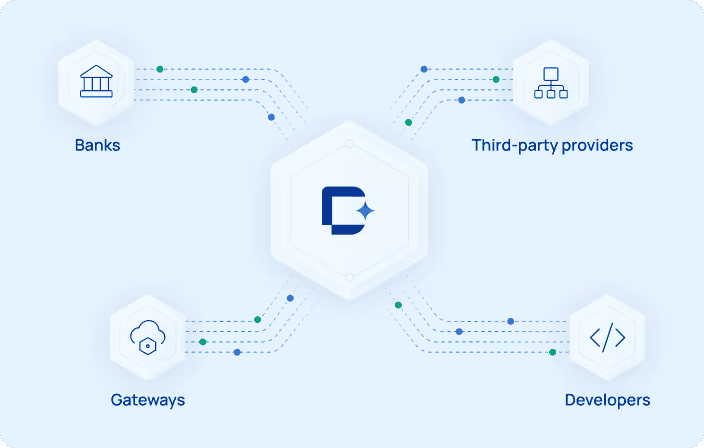
Navigating the intricate landscape of Open Banking requires more than just exposing financial data; it demands a robust, secure, and highly efficient intermediary. For banks, fintechs, and third-party providers, the API Gateway isn't merely a traffic cop – it's the fortified nerve center that orchestrates seamless and compliant interactions. Choosing the right Open Banking API Gateway is a strategic decision that underpins security, ensures regulatory adherence, and ultimately dictates your agility in an evolving financial ecosystem. As organizations seek to unlock the potential of the Open Banking API economy, understanding the critical attributes of such a gateway becomes paramount.
This guide delves into the essential characteristics and capabilities you should scrutinize when selecting an Open Banking API Gateway. From the iron-clad security protocols specific to financial transactions to the nuances of developer experience and operational efficiency, we'll explore what truly makes a gateway an indispensable asset in the Open Banking revolution.
Security and Compliance: The Non-Negotiables
In Open Banking, security isn't a feature; it's the foundation upon which trust and functionality are built. Given the sensitive nature of financial data, an Open Banking API Gateway must adhere to the highest security standards and regulatory mandates. This is arguably the most critical area of consideration.
1. Robust Authentication and Authorization
- OAuth 2.0 and OpenID Connect (OIDC): These are fundamental for secure delegation of access. The gateway must fully support and enforce these protocols, particularly the Financial-grade API (FAPI) profiles, which add extra security layers specific to financial services. This includes client registration, token issuance, and validation, ensuring only authorized applications can access data. Comprehensive robust authentication mechanisms are vital.
- Mutual TLS (mTLS): Essential for securing communication channels, mTLS ensures that both the client and the server authenticate each other using X.509 digital certificates. This prevents man-in-the-middle attacks and ensures data integrity.
- Strong Key and Certificate Management: The gateway should provide secure storage, rotation, and management of API keys, client secrets, and SSL/TLS certificates. This is critical for maintaining cryptographic hygiene.
2. Threat Protection and Vulnerability Management
- OWASP API Security Top 10: The gateway must offer built-in protections against common API threats outlined in the OWASP API Security Top 10. This includes injection flaws, broken authentication, excessive data exposure, and security misconfiguration.
- Data Encryption: Encryption of data in transit (TLS 1.2/1.3) and at rest is paramount. The gateway should facilitate and enforce these encryption standards for all sensitive information passing through it.
- DDoS and Bot Protection: Capabilities to detect and mitigate Distributed Denial of Service (DDoS) attacks and malicious bot traffic are crucial to maintain service availability and prevent abuse.
- Input Validation and Schema Enforcement: The gateway should rigorously validate all incoming requests against defined API schemas to prevent malformed requests and potential injection attacks.
3. Regulatory Adherence
- PSD2 (Europe), CDR (Australia), and other regional mandates: The gateway must be designed with explicit features and configurations to comply with specific Open Banking regulations in relevant jurisdictions. This includes consent management, strong customer authentication (SCA), and detailed audit logging. Understanding Open Banking security standards is key.
- Audit Trails and Logging: Comprehensive, immutable audit trails of all API access, consent decisions, and data flows are essential for regulatory compliance and forensic analysis. This helps demonstrate adherence to data privacy and security requirements.
- Consent Management: A robust mechanism for capturing, storing, and enforcing customer consent for data sharing is non-negotiable. The gateway should integrate with or provide consent management functionalities, ensuring data is only shared with explicit user permission.
Ultimately, the chosen gateway must serve as the first line of defense, proactively enforcing security policies and compliance rules before any financial data is exposed or exchanged. A strong API Gateway security posture is foundational.
.png)
Performance and Scalability: Handling Financial Traffic
Open Banking APIs are expected to handle high volumes of real-time transactions and data requests. The gateway must be engineered for exceptional performance and seamless scalability to prevent bottlenecks and ensure a smooth user experience, even during peak loads.
1. Low Latency and High Throughput
- Efficient Request Routing: The gateway should employ intelligent routing mechanisms to minimize latency and ensure requests reach their target services quickly.
- High Throughput Capacity: It must be capable of processing a large number of concurrent requests without degradation in performance, essential for payment initiation and account information services.
- Caching: Support for caching responses from backend services can significantly reduce load and improve response times for frequently accessed, non-real-time data.
2. Scalability and Elasticity
- Horizontal Scalability: The ability to easily scale horizontally by adding more instances of the gateway is crucial for handling fluctuating traffic demands. Cloud-native designs often excel here.
- Elasticity: Automatic scaling capabilities (e.g., auto-scaling groups in cloud environments) ensure that resources are provisioned and de-provisioned dynamically based on demand, optimizing cost and performance.
3. Traffic Management and Load Balancing
- API Rate Limiting and Throttling: Essential for protecting backend services from overload and preventing abuse. The gateway should allow granular control over rate limits per API, application, or user.
- Load Balancing: Integration with load balancers or built-in load balancing features to distribute traffic efficiently across multiple backend service instances, ensuring high availability and optimal resource utilization.
- Circuit Breakers and Retries: Mechanisms like circuit breakers help prevent cascading failures by temporarily blocking calls to unresponsive services, while retry policies can enhance resilience for transient errors.
Developer Experience (DX): Fostering Adoption
For Open Banking to thrive, third-party developers need to find, understand, and integrate with APIs easily. A superior developer experience driven by the API Gateway is critical for encouraging adoption and innovation.
1. Comprehensive Developer Portal
- User-friendly Developer Portal: A well-designed, intuitive portal is the central hub for developers. It should provide a clear catalog of available APIs, comprehensive documentation, and self-service registration.
- Interactive Documentation: Auto-generated, up-to-date documentation (e.g., OpenAPI/Swagger UI) that allows developers to explore endpoints, understand parameters, and test API calls directly within the portal.
- Code Samples and SDKs: Providing code samples in multiple programming languages and client SDKs can drastically reduce integration time and effort for developers.
2. Testing and Sandbox Environments
- API Sandboxes: Dedicated, realistic sandboxes are indispensable. They allow developers to test their applications against mock data and simulate various scenarios (e.g., successful transactions, error conditions, consent flows) without impacting live systems.
- Open Banking specific sandboxes: For Open Banking, sandboxes must accurately reflect the complexities of FAPI, OAuth 2.0, and specific data models.
- Testing Tools Integration: Support for popular API testing tools and frameworks, enabling developers to integrate their testing pipelines seamlessly.
3. Ease of Onboarding and Management
- Self-service API Key/Credential Management: Developers should be able to register applications, generate API keys, and manage their credentials independently.
- Clear API Versioning Strategy: The gateway should support and clearly communicate API versioning, allowing developers to smoothly migrate between versions and understand deprecation policies.
- Support and Community Features: Access to support resources, FAQs, forums, and community discussions can significantly enhance the developer journey.
Flexibility and Integration: Adapting to Your Ecosystem
An Open Banking API Gateway doesn't operate in isolation; it must integrate seamlessly with existing infrastructure, backend systems, and external services. Flexibility in deployment and integration options is key to long-term success.
1. Deployment Options
- Hybrid and Multi-Cloud Support: The ability to deploy the gateway on-premises, in private clouds, public clouds (AWS, Azure, GCP), or a hybrid combination, allows organizations to align with their existing infrastructure strategy.
- Containerization and Orchestration: Support for Docker containers and Kubernetes orchestration simplifies deployment, management, and scaling in modern microservices architectures.
2. Integration Capabilities
- Backend Service Connectivity: The gateway should support various protocols (HTTP/REST, SOAP, gRPC, Kafka) to connect with diverse backend systems, including legacy systems, microservices, and event streams.
- API Transformation and Protocol Bridging: Capabilities to transform request/response formats (e.g., XML to JSON), mediate between different protocols, and enrich data on the fly.
- API Orchestration: Advanced features for composing multiple backend services into a single, unified API endpoint, simplifying consumption for developers.
- Identity Provider Integration: Seamless integration with existing Identity and Access Management (IAM) systems and identity providers (e.g., Active Directory, LDAP, Okta) for user and application authentication.
3. Extensibility
- Custom Policy Development: The ability to define and implement custom policies (e.g., for specific business logic, advanced security checks, or custom transformations) using scripting or plug-ins.
- Webhook and Event-driven Integration: Support for webhooks to notify external systems of API events (e.g., new application registration, API usage alerts) and integration with event streaming platforms.
Monetization and Analytics: Unlocking Value
Beyond compliance and connectivity, Open Banking presents opportunities for new business models. An API Gateway can facilitate these by providing the tools for monetization and offering deep insights into API usage.
1. Monetization Features
- Flexible Pricing Models: Support for various API monetization strategies, including tiered pricing, usage-based billing, freemium models, and subscription plans.
- Billing and Metering: Accurate tracking and metering of API consumption (e.g., per call, per data volume, per unique user) to support billing and invoicing.
- Developer Account Management: Features for managing developer accounts, subscriptions, and payment information within the portal.
2. Analytics and Monitoring
- Real-time Dashboards: Dashboards that provide real-time visibility into API performance, traffic patterns, error rates, and latency.
- Usage Analytics: Detailed insights into how APIs are being consumed by different applications and developers, helping to identify popular APIs, potential areas for improvement, and monetization opportunities.
- Alerting and Notifications: Configurable alerts for performance degradation, security incidents, excessive usage, or other critical events.
- Integration with Monitoring Tools: Compatibility with external API monitoring tools and observability platforms for comprehensive operational insights.
Governance and Lifecycle Management: Maintaining Control
Managing a growing portfolio of Open Banking APIs requires robust governance and a clear lifecycle strategy. The gateway plays a pivotal role in enforcing standards and managing APIs from design to deprecation.
1. API Governance
- API Governance Policies: The ability to define and enforce organizational standards for API design, naming conventions, security policies, data formats, and documentation.
- Policy Enforcement: Policies should be enforceable at various stages, from design-time validation to runtime enforcement by the gateway.
- Audit and Reporting: Tools for auditing policy compliance and generating reports for internal and external stakeholders.
2. API Lifecycle Management
- Version Control: Support for managing multiple versions of an API concurrently and directing traffic to appropriate versions.
- API Lifecycle Management: Features to manage APIs through their entire lifecycle – from design and development to deployment, retirement, and deprecation, ensuring smooth transitions and communication to consumers.
- API Catalog/Discovery: A centralized, searchable catalog of all managed APIs, including their documentation, versions, and metadata, to facilitate discovery by internal and external developers.
3. Operational Management
- Centralized Management Console: An intuitive console for administrators to configure, monitor, and manage all aspects of the API Gateway.
- Role-Based Access Control (RBAC): Granular RBAC to control who can access and manage different parts of the gateway configuration and API definitions.
Cost-Effectiveness and Vendor Support
While features are critical, the total cost of ownership (TCO) and the quality of vendor support are also significant factors in selecting an Open Banking API Gateway.
1. Total Cost of Ownership
- Licensing Models: Understand the licensing costs, whether it's subscription-based, usage-based, or perpetual, and how it scales with API traffic and features.
- Operational Costs: Consider the resources required for deployment, maintenance, monitoring, and scaling. Cloud-native solutions often offer cost efficiencies in this regard.
- Integration and Development Costs: Factor in the effort and cost associated with integrating the gateway with existing systems and developing custom policies or connectors.
2. Vendor Support and Community
- Technical Support: Evaluate the vendor's technical support, including response times, available channels, and expertise in Open Banking-specific challenges.
- Documentation and Training: Availability of comprehensive documentation, tutorials, and training programs for developers and administrators.
- Community Ecosystem: A vibrant community around the gateway can be valuable for troubleshooting, sharing best practices, and accessing third-party extensions.
DigitalAPI's Arelio API Gateway: Powering Your Open Banking Future
When considering what to look for in an Open Banking API Gateway, DigitalAPI's Arelio API Gateway emerges as a compelling solution designed specifically to address the complex requirements of regulated industries like financial services. Arelio isn't just another gateway; it's a strategic platform built on the principles of federation, compliance, and developer empowerment.
DigitalAPI understands that modern enterprises operate with a diverse API landscape, often spanning multiple gateways, clouds, and legacy systems. Unlike traditional monolithic gateways, Arelio API Gateway excels in unifying this disparate environment. For Open Banking, this means it can pull and normalize APIs from various source, be it an existing Apigee instance, a set of microservices on AWS, or a legacy banking system, into a single, secure, and compliant control plane. This federated approach ensures that your Open Banking initiatives aren't hampered by architectural silos.
Security and compliance are at the core of Arelio. It provides robust, out-of-the-box support for financial-grade security standards, including advanced OAuth 2.0 profiles, OpenID Connect, and mutual TLS, which are critical for PSD2, CDR, and other Open Banking mandates. The platform offers granular policy enforcement, threat protection against OWASP Top 10 vulnerabilities, and comprehensive audit logging, ensuring that every financial transaction and data exchange is secure and auditable. With Arelio, you gain a purpose-built best API Gateway that understands the nuances of financial regulations.
Beyond security, Arelio prioritizes developer experience. Its unified developer portal aggregates documentation, provides interactive sandboxes (including those tailored for Open Banking flows), and offers self-service tools, drastically reducing the time-to-market for third-party integrations. This empowers fintechs and partners to innovate faster within a compliant framework. Furthermore, Arelio's advanced analytics capabilities provide real-time insights into API usage, performance, and monetization opportunities, allowing banks to track the value generated by their Open Banking ecosystem.
Choosing DigitalAPI's Arelio API Gateway means selecting a future-proof platform that not only meets today's stringent Open Banking requirements but also provides the flexibility, scalability, and governance necessary to adapt to tomorrow's evolving financial landscape. It's the intelligent choice for organizations looking to leverage Open Banking securely, efficiently, and strategically.
Conclusion
Selecting an Open Banking API Gateway is a pivotal decision that will shape your organization's ability to participate effectively and securely in the evolving financial ecosystem. The ideal gateway must be a powerhouse of security, a champion of performance, a beacon of developer experience, and a master of integration and governance. It's not enough for it to simply route traffic; it must intelligently secure sensitive data, enforce complex regulatory compliance, and provide the insights needed for strategic growth.
By prioritizing features like robust FAPI-compliant security, scalable architecture, a rich developer portal with dedicated Open Banking sandboxes, flexible integration capabilities, and comprehensive analytics, you can lay a solid foundation for your Open Banking initiatives. Platforms like DigitalAPI's Arelio API Gateway are purpose-built to navigate these complexities, offering a federated and compliant solution that empowers financial institutions to unlock the full potential of Open Finance API use cases and drive innovation in the digital economy. The right gateway is not just a technology choice; it's an investment in your financial future.
FAQs
1. What is an Open Banking API Gateway?
An Open Banking API Gateway acts as a central control point for managing and securing API access to financial data and services. It enforces security policies (like FAPI), handles authentication and authorization, manages traffic, ensures regulatory compliance (e.g., PSD2, CDR), and provides a developer interface for third-party providers to securely access banking APIs.
2. Why is security so critical for an Open Banking API Gateway?
Security is paramount because Open Banking involves sharing highly sensitive financial data. An API Gateway must implement stringent security measures like FAPI-compliant OAuth 2.0, mutual TLS, strong encryption, and protection against common API threats to prevent fraud, data breaches, and unauthorized access, thereby maintaining customer trust and regulatory compliance.
3. What regulatory standards should an Open Banking API Gateway support?
An Open Banking API Gateway must support the specific regulatory standards of the regions in which it operates. Key examples include PSD2 (Revised Payment Services Directive) in Europe, CDR (Consumer Data Right) in Australia, and other local frameworks. This involves adherence to standards for consent management, strong customer authentication (SCA), data privacy, and auditability.
4. How important is the developer experience for an Open Banking API Gateway?
Developer experience (DX) is crucial for driving adoption and innovation. A good Open Banking API Gateway provides a user-friendly developer portal with clear, interactive documentation, code samples, and robust API sandboxes (including those tailored for Open Banking scenarios). This enables fintechs and third-party developers to easily discover, test, and integrate with financial APIs, accelerating the creation of new services.
5. Can an existing API Gateway be adapted for Open Banking?
While many existing API Gateways offer foundational features, adapting them for Open Banking requires significant enhancements, particularly around financial-grade security profiles (FAPI), specific regulatory compliance mandates (like consent management and SCA), and specialized developer tools. It's often more efficient to choose a gateway specifically designed or highly capable of meeting these unique, stringent Open Banking requirements.
Dhayalan Subramanian is Associate Director, Product Growth at DigitalAPI, where he leads go-to-market and product growth for the company’s multi-gateway API management platform. His work focuses on helping large enterprises and mid-market cloud companies consolidate APIs across AWS, Azure, Apigee, Kong, MuleSoft, and other gateways into a single control plane for governance, discovery, monetization, and agent consumption.
Dhayalan brings 14+ years of experience across product strategy, enterprise architecture, and engineering leadership. Earlier in his career, he held senior roles at Encora (as Associate Architect and Technical Manager), Mindtree (Technology Lead), Tech Mahindra (Technical Lead), and Primus Analytics, where he designed integration frameworks and delivered enterprise-grade digital platforms for global customers.
At DigitalAPI, he works directly with platform, integration, and developer experience leaders at Fortune 500 organizations to operationalize unified API catalogs, developer portals, and MCP-ready APIs. He writes regularly on API developer experience, API governance, and AI agent architectures.
One email a fortnight. Worth opening.
A short digest of what we're writing, what we're learning from customers, and the handful of links you'd actually want from us. No tracking pixels.

.avif)