





How to Secure Open Banking APIs in Lending Platforms
Open banking allows banks to securely share customer financial data with authorized third-party applications through APIs.


TL;DR
1. Open banking APIs give lenders real-time bank data for faster underwriting and income verification.
2. Weak security can expose financial data, enable fraud, and create compliance risks.
3. Key risks include broken authentication, data overexposure, API abuse, and insecure integrations.
4. Security requires OAuth authentication, API gateways, encryption, and continuous monitoring.
5. DigitalAPI helps secure and manage banking integrations through a unified API layer.
Book a demo to see how DigitalAPI helps fintech teams securely scale open banking integrations.
Open banking is transforming how lending platforms access financial data. Instead of relying on manual documents, lenders can securely connect to bank accounts through APIs. This allows faster underwriting, automated income verification, and better fraud detection.
However, this connectivity also introduces new security challenges. Lending platforms must handle sensitive financial data, manage customer consent, and protect API integrations from attacks. Poorly secured open banking implementations can expose transaction data, enable fraudulent loan applications, or create compliance risks.
Security is therefore a core requirement when building open banking-enabled lending systems. Teams must protect APIs, authentication flows, and financial data while maintaining a seamless borrower experience.
In this guide, you’ll learn how lending platforms secure open banking integrations using layered security architecture, strong authentication, and API protection strategies. We will also break down the most common risks fintech teams face and the security controls that help mitigate them.
What is Open Banking, and why do lending platforms use it?
Open banking allows banks to securely share customer financial data with authorized third-party applications through APIs. This access happens only after a customer gives explicit consent, and it enables fintech platforms to retrieve real-time financial information directly from bank accounts.
For lending platforms, open banking replaces slow manual verification processes with automated, API-based financial data access. Instead of asking borrowers to upload bank statements or income documents, lenders can securely analyze transaction data to evaluate creditworthiness faster and more accurately.
How open banking works in lending platforms
Open banking in lending typically follows a structured workflow where borrower consent triggers secure API data sharing.
Inputs
- Customer consents to share banking data
- Bank APIs provided by financial institutions
- Lending platform requesting financial information
Process
- The borrower connects their bank account during the loan application.
- The platform redirects the borrower to their bank to authenticate.
- The bank issues a secure authorization token.
- The lending platform retrieves account and transaction data via APIs.
Outputs
- Verified income and cash-flow data
- Faster underwriting decisions
- Reduced document fraud
Why lenders rely on open banking data?
Access to real financial data improves the accuracy and speed of credit decisions. Instead of relying on static credit reports or uploaded documents, lenders can evaluate real-time financial behavior.
Common lending use cases include:
- Income verification for loan applicants
- Cash-flow analysis for underwriting decisions
- Fraud detection by validating financial history
- Credit risk assessment using transaction patterns
Open banking has seen rapid adoption across fintech and financial services. According to Open Banking Limited, more than 7 million consumers and businesses were using open banking services in the UK in 2023, reflecting the growing reliance on API-driven financial data.
For lending platforms, this shift enables faster onboarding, better risk modeling, and more inclusive lending decisions for borrowers with limited credit history.
Why is Open Banking security critical for lending platforms?
Open banking security is critical for lending platforms because these systems process highly sensitive financial data through APIs. If security controls are weak, attackers could access transaction histories, manipulate loan applications, or exploit API endpoints to commit fraud.
Lending platforms rely on open banking integrations to retrieve real-time bank data during onboarding and underwriting. This makes API endpoints, authentication tokens, and consent flows key security targets. Without strong protection, a single vulnerability can expose both borrower data and the lender’s infrastructure.
The expanding attack surface in open banking
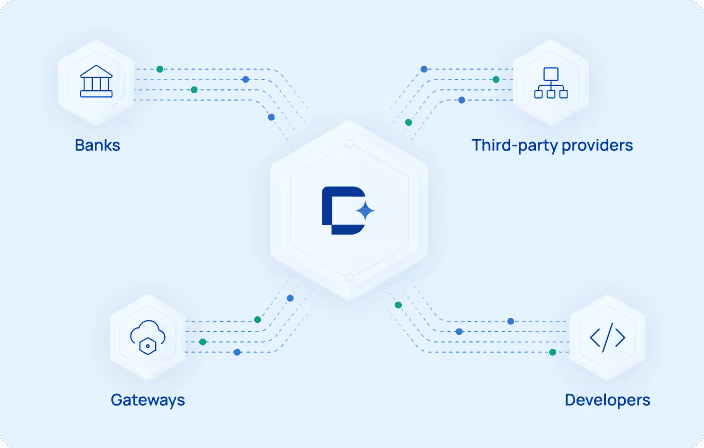
Open banking increases connectivity between multiple systems:
- Banks
- Fintech lending platforms
- Third-party data providers
- API gateways and integration layers
Every connection introduces a potential entry point for attackers. Financial APIs are especially attractive targets because they provide access to transaction data, identity information, and payment infrastructure.
Why lending platforms are high-value targets
Lending platforms handle several categories of sensitive information during loan applications:
- Bank account balances
- Transaction histories
- Income and employment data
- Personal identity information
If attackers gain access to this data, they can attempt account takeovers, loan fraud, or identity theft.
According to IBM Security, the average cost of a data breach involving multiple environments costs an average of $5.05 million in 2025, making it one of the most expensive industries for cyber incidents.
At the same time, API security incidents are increasing as financial services rely more heavily on digital integrations. Research from Salt Security found that 94% of organizations experienced security problems in production APIs in 2023.
Regulatory and compliance risks
Financial data is heavily regulated, which means security failures can trigger regulatory penalties in addition to financial losses.
Key regulatory frameworks influencing open banking security include:
- PSD2 (Europe) – Requires strong customer authentication and secure APIs
- Open Banking UK standards – Defines security and data-sharing protocols
- Data protection laws such as GDPR
Lending platforms must therefore design security controls that protect borrower data while meeting regulatory requirements.
Security failures can impact both trust and growth
Beyond regulatory penalties, security incidents can damage user trust. Borrowers expect lending platforms to handle their financial data safely, especially when they connect their bank accounts during the application process.
Strong open banking security helps lenders:
- Protect sensitive financial data
- Prevent fraudulent loan applications
- Maintain regulatory compliance
- Build borrower trust in digital lending services
Because of these risks, lending platforms typically implement layered API security, strong authentication mechanisms, and continuous monitoring to protect open banking integrations.
What are the biggest security risks in Open Banking APIs?
Open banking APIs enable lenders to access financial data in real time, but they also introduce new security risks. Because these APIs connect banks, fintech platforms, and third-party services, attackers often target them to gain access to sensitive financial information or manipulate transactions.
For lending platforms, the most common risks involve authentication weaknesses, API abuse, and insecure third-party integrations. Understanding these threats helps teams design stronger security controls before launching open banking integrations.
1. Broken authentication and token misuse
Open banking relies heavily on authorization protocols such as OAuth tokens. If these tokens are stolen, leaked, or poorly managed, attackers can impersonate legitimate users and access financial data.
Common causes include:
- Long-lived or unrotated tokens
- Poor token storage practices
- Weak session validation
When authentication controls fail, attackers may gain unauthorized access to borrower transaction data or account information.
2. Excessive data exposure
APIs sometimes return more information than necessary for a specific request. This issue, often called over-exposure of financial data, can increase the risk of data leaks.
Examples include APIs exposing:
- Full transaction histories instead of recent records
- Personally identifiable information (PII)
- Unnecessary account metadata
Limiting responses to only the required data helps reduce this risk.
3. API abuse and automated attacks
Open banking APIs are designed for frequent automated access, which makes them vulnerable to bot-driven attacks.
Attackers may attempt:
- Credential stuffing attacks
- High-volume API scraping
- Automated account takeover attempts
Without rate limiting and behavioral monitoring, malicious actors can overwhelm APIs or extract financial data at scale.
4. Insecure third-party integrations
Open banking ecosystems involve multiple participants, including fintech apps, data aggregators, and infrastructure providers. A vulnerability in any integration partner can create security exposure.
Risks often appear when:
- Third-party apps use weak security controls
- API credentials are shared improperly
- Partner systems lack monitoring or logging
Strong partner verification and integration governance are essential to reduce these risks.
5. Consent manipulation and social engineering
Open banking depends on user consent to authorize financial data sharing. Attackers may attempt to trick users into granting access to malicious applications that mimic legitimate fintech services.
These attacks often involve:
- Fake financial apps requesting data access
- Phishing pages imitating bank login portals
- Misleading consent screens
Clear consent flows and user education can help prevent these attacks.
Why understanding these risks matters
Open banking security is not just about protecting APIs, it is about safeguarding the entire data-sharing ecosystem. Lending platforms must consider risks across authentication, data exposure, integrations, and user consent flows.
By identifying these threats early, fintech teams can implement security measures that protect borrower data while maintaining reliable open banking connectivity.
What architecture secures Open Banking in lending platforms?
A secure open banking architecture uses multiple security layers to protect APIs, identities, and financial data throughout the lending workflow. Instead of relying on a single control, lending platforms combine authentication, API protection, data encryption, and continuous monitoring to reduce risk.
This layered approach helps fintech teams securely access bank data while maintaining regulatory compliance and protecting borrower information.
Core components of a secure open banking architecture
A typical open banking security architecture for lending platforms includes four key layers.
Step-by-step flow of a secure open banking request
Understanding the architecture becomes easier when looking at how a typical lending request flows through the system.
- Customer authorization: The borrower grants permission to connect their bank account during the loan application process.
- Secure authentication: The borrower authenticates directly with their bank using secure protocols such as OAuth2 and Strong Customer Authentication (SCA).
- Token-based API access: The bank issues a temporary access token that allows the lending platform to request specific financial data.
- API validation and monitoring: API gateways verify the request, apply rate limits, and monitor traffic for suspicious patterns.
- Data processing for underwriting: The platform analyzes transaction and income data to evaluate loan eligibility.
Security design principles fintech teams follow
Leading lending platforms typically follow several architectural principles when implementing open banking.
- Zero-trust access: Every API request is verified regardless of where it originates.
- Least-privilege data access: Applications only retrieve the financial data necessary for underwriting.
- Short-lived credentials: Authorization tokens expire quickly to reduce the risk of misuse.
- Continuous monitoring: API activity is analyzed to detect abnormal behavior or potential attacks.
Common architectural mistakes to avoid
Even well-designed systems can introduce risk if security is not consistently enforced.
Typical mistakes include:
- Exposing internal APIs without proper gateways
- Using long-lived authentication tokens
- Allowing unrestricted API request volumes
- Failing to monitor partner integrations
Avoiding these issues helps lending platforms maintain a secure open banking infrastructure while scaling their API integrations
What security controls should fintech teams implement?
Fintech teams must implement a combination of preventive, detective, and response controls to secure open banking integrations. Because lending platforms process sensitive financial data through APIs, security controls should protect every stage of the data flow—from authentication to monitoring.
The most effective approach is to combine identity security, API protection, data encryption, and continuous monitoring.
1. Strong authentication and authorization
Authentication controls ensure that only authorized users and applications can access financial data.
Common security mechanisms include:
- OAuth 2.0 authorization for secure API access
- OpenID Connect for identity verification
- Multi-factor authentication (MFA) for borrower login
- Strong Customer Authentication (SCA) is required under PSD2
Short-lived access tokens and secure token storage also help reduce the risk of unauthorized API access.
2. API gateway and traffic controls
API gateways act as the first line of defense for open banking integrations. They enforce security policies and monitor API traffic before requests reach backend systems.
Important API protections include:
- Rate limiting to prevent API abuse
- Request validation to block malformed inputs
- Bot detection systems to stop automated attacks
- IP allowlists for trusted integrations
These controls help prevent attacks such as API scraping, credential stuffing, and denial-of-service attempts.
3. End-to-end data protection
Financial data must remain protected both in transit and at rest.
Key data protection measures include:
- TLS encryption for all API communications
- Tokenization of sensitive financial identifiers
- Encrypted data storage for transaction records
- Data minimization to limit exposure
Restricting how long data is stored and who can access it further reduces risk.
4. Continuous monitoring and threat detection
Security monitoring helps detect suspicious behavior before it causes damage.
Monitoring systems should track:
- Unusual API request patterns
- Sudden spikes in authentication failures
- Abnormal access to financial data endpoints
- High-frequency data extraction attempts
Automated alerts and anomaly detection systems allow security teams to respond quickly to potential attacks.
5. Third-party integration governance
Open banking ecosystems involve multiple participants, including banks, fintech platforms, and data providers. Weak security controls from a single partner can introduce risk.
Fintech teams should implement:
- Third-party security assessments before integration
- API credential rotation policies
- Access logs for partner systems
- Strict data access permissions
Regular audits of partner integrations help ensure that security standards remain consistent across the ecosystem.
Real-world examples of open banking API security
Several fintech infrastructure providers have built robust security frameworks to protect open banking APIs. These platforms handle sensitive financial data at scale, so their architectures emphasize strong authentication, encrypted data exchange, and strict API governance.
Below are three widely recognized examples of how open banking security is implemented in real financial technology platforms.
1. Stripe (OAuth authorization and encrypted API communication)
Stripe supports open banking payments and financial data integrations through secure API infrastructure designed for fintech applications.
Its security architecture focuses on user consent, token-based access, and encrypted API communication.
Key security practices include:
- OAuth-based authorization flows to ensure customers explicitly approve data access
- Short-lived access tokens that limit the risk of credential misuse
- TLS encryption for all API communications between applications and financial institutions
- Granular API permissions that restrict what data each application can access
These controls help ensure that financial data shared through open banking APIs remains secure while still enabling seamless payment and data connectivity.
2. Plaid (Secure bank connectivity and consent management)
Plaid connects fintech applications with thousands of financial institutions through a secure API infrastructure. Because it acts as an intermediary between banks and apps, its platform emphasizes secure authentication and strict consent management.
Important security mechanisms include:
- Direct bank authentication, where users sign in with their financial institution rather than sharing credentials with third parties
- Encrypted data transfer and storage to protect sensitive financial information
- User-controlled permission scopes that determine which account data can be accessed
- Continuous monitoring of API traffic to detect suspicious behavior
This approach allows fintech platforms to retrieve financial data while maintaining strong privacy and security controls.
3. Open Banking Limited (Standardized security protocols across banks)
The UK open banking ecosystem operates under technical standards developed by Open Banking Limited. These standards define how banks and third-party providers securely exchange financial data.
Key security requirements include:
- Strong Customer Authentication (SCA) for verifying user identity
- OAuth2 authorization frameworks to control API access
- Mutual TLS encryption between financial institutions and third-party providers
- Standardized API specifications that reduce security inconsistencies
By enforcing these security protocols across the ecosystem, the framework helps ensure that banks and fintech platforms follow consistent security practices when sharing financial data.
Key takeaways for lending platforms
Across these examples, several security principles consistently appear:
- Token-based authorization instead of shared credentials
- Explicit user consent for financial data access
- Encrypted API communication between platforms and banks
- Continuous monitoring of API activity
How does DigitalAPI help secure Open Banking integrations?
Securing open banking integrations becomes complex as lending platforms connect with multiple banks and financial data providers. Each integration may involve different authentication flows, API standards, and monitoring requirements. DigitalAPI helps simplify this process by providing a centralized infrastructure that manages banking integrations through a secure API layer.
1. Centralized control for banking integrations
DigitalAPI provides a unified orchestration layer that allows lending platforms to manage multiple banking APIs from a single system. This approach helps enforce consistent security policies across integrations while reducing the complexity of managing authentication, API routing, and data access for each bank connection.
2. Secure authentication and consent management
Open banking relies on strong authentication and explicit user consent for financial data access. DigitalAPI supports secure authorization flows and token management, helping lending platforms ensure that financial data is accessed only with proper user permissions and that authorization credentials are handled securely.
3. Monitoring and visibility across API activity
Monitoring API activity is essential for detecting unusual behavior or potential security threats. DigitalAPI provides centralized visibility into API traffic across banking integrations, allowing teams to track requests, identify anomalies, and maintain audit logs for compliance and security monitoring.
4. Scaling secure financial data connectivity
As lending platforms expand their open banking capabilities, managing integrations securely becomes more difficult. DigitalAPI enables fintech teams to scale banking connectivity while maintaining consistent security controls and operational visibility across their financial data infrastructure.
Book a demo to see how DigitalAPI helps fintech teams securely scale open banking integrations.
FAQs
1. Is Open Banking safe for lending platforms?
Yes, open banking can be safe for lending platforms when strong security controls are implemented. Secure open banking systems use authentication frameworks such as OAuth, encrypted API communication, and strict user consent mechanisms to protect financial data. When combined with continuous monitoring and API security controls, these measures help prevent unauthorized access and protect borrower information.
2. What authentication methods secure Open Banking?
Most open banking systems rely on OAuth 2.0 authorization frameworks and OpenID Connect to manage secure API access. Many financial institutions also implement Strong Customer Authentication (SCA), which requires multi-factor verification before financial data can be shared with third-party applications.
3. How does Open Banking reduce lending fraud?
Open banking allows lenders to access verified financial data directly from bank accounts with user consent. This helps reduce fraud by eliminating reliance on uploaded documents that can be manipulated. Lenders can analyze real transaction histories, income patterns, and spending behavior to make more accurate credit decisions.
4. What regulations apply to Open Banking security?
Open banking security is influenced by several regulatory frameworks, depending on the region. In Europe, PSD2 regulations require strong customer authentication and secure API access. Many countries also enforce financial data protection rules through broader privacy laws such as GDPR and national open banking standards.
5. What is the biggest risk in Open Banking APIs?
One of the biggest risks in open banking APIs is unauthorized access due to weak authentication or poorly secured endpoints. If API tokens are compromised or security policies are misconfigured, attackers may attempt to access sensitive financial data. Proper token management, encryption, and API monitoring help mitigate these risks.
Dhayalan Subramanian is Associate Director, Product Growth at DigitalAPI, where he leads go-to-market and product growth for the company’s multi-gateway API management platform. His work focuses on helping large enterprises and mid-market cloud companies consolidate APIs across AWS, Azure, Apigee, Kong, MuleSoft, and other gateways into a single control plane for governance, discovery, monetization, and agent consumption.
Dhayalan brings 14+ years of experience across product strategy, enterprise architecture, and engineering leadership. Earlier in his career, he held senior roles at Encora (as Associate Architect and Technical Manager), Mindtree (Technology Lead), Tech Mahindra (Technical Lead), and Primus Analytics, where he designed integration frameworks and delivered enterprise-grade digital platforms for global customers.
At DigitalAPI, he works directly with platform, integration, and developer experience leaders at Fortune 500 organizations to operationalize unified API catalogs, developer portals, and MCP-ready APIs. He writes regularly on API developer experience, API governance, and AI agent architectures.
One email a fortnight. Worth opening.
A short digest of what we're writing, what we're learning from customers, and the handful of links you'd actually want from us. No tracking pixels.

.avif)