



API Monetization Strategies: Best Practices & Billing Guide
Unpack simple API sandboxes: architecture, functionality, and benefits for safe, cost-free API testing and faster development. Learn essential implementation practices.


TL;DR
1. Successful API monetization starts with understanding your API's unique value proposition and target audience.
2. Common monetization strategies include Freemium, Pay-as-you-Go, Tiered Subscriptions, and Revenue Share, often combined for optimal impact.
3. Best practices for choosing a strategy involve aligning with business goals, prioritizing developer experience, and ensuring pricing predictability.
4. Robust API billing requires granular metering, transparent pricing, automated invoicing, and proactive usage alerts to prevent bill shock.
5. DigitalAPI's platform provides the essential foundation, a unified API catalog, governed access, and a seamless developer portal, crucial for implementing any monetization strategy effectively.
Get started with DigitalAPI today. Book a Demo!
The digital economy thrives on connectivity, and at its heart lies the API. Once primarily a technical tool, APIs have rapidly evolved into strategic business assets, opening new revenue streams and fostering innovation. Yet, unlocking their full financial potential requires more than just exposing endpoints; it demands a sophisticated approach to API monetization. Many organizations grapple with how to effectively price, package, and bill for their API services, risking either leaving money on the table or alienating potential users. This guide delves into the core strategies and best practices for API monetization strategy, alongside essential billing best practices, empowering you to transform your APIs into sustainable growth engines.
What is API Monetization and Why It's Crucial for Growth?
API monetization is the process of generating revenue from your Application Programming Interfaces. It involves defining a pricing model, packaging API access, and implementing a billing system to charge consumers (developers, businesses, or internal teams) for their usage. This isn't just about direct revenue; it can also encompass indirect benefits like driving adoption of core products, expanding market reach, fostering innovation through a developer ecosystem, or enhancing operational efficiency within an enterprise.
In today's interconnected landscape, APIs are the building blocks of digital transformation. For many companies, they represent not just a cost center but a significant opportunity for direct profit and strategic advantage. Effective API monetization allows businesses to:
- Create new revenue streams: Directly charge for API calls, data access, or premium features.
- Expand market reach: Enable partners and third-party developers to build on your platform, accessing new customer segments.
- Drive product adoption: Use free or low-cost API access to onboard users onto a primary product or service.
- Enhance competitive advantage: Offer differentiated API products and superior developer experiences.
- Fund API development: Generate revenue to reinvest in further API innovation and infrastructure.
Laying the Groundwork: Before You Monetize
Before diving into specific monetization strategies, a foundational understanding of your API's landscape is critical. Skipping this step often leads to misaligned pricing, developer frustration, and ultimately, failed monetization efforts.
Identify Your API's Core Value Proposition
What unique problem does your API solve? What data or functionality does it provide that is difficult or expensive for others to replicate? Is it access to proprietary datasets, complex algorithms, or simply a highly reliable and performant service? Understanding this intrinsic value is paramount. For example, a weather API's value might be its hyperlocal accuracy, while a payment API's value is its security and seamless integration.
Understand Your Target Audience and Use Cases
Who are you building this API for? Are they large enterprises needing high-volume, mission-critical access, or individual developers building hobby projects? Their budget, technical sophistication, and expected usage patterns will heavily influence your pricing model. What specific applications or services will be built using your API? The more you know about the "why" and "how" of consumption, the better you can align your pricing to perceived value.
Assess Your Costs and Market Landscape
Calculate the true cost of serving your API, including infrastructure, maintenance, support, and development. This helps ensure your pricing covers expenses and generates profit. Simultaneously, research what competitors (direct and indirect) are charging for similar services. Are you positioning yourself as a premium offering, a budget-friendly option, or a specialized niche provider? Your pricing needs to be competitive yet reflective of your unique value.
.png)
Popular API Monetization Strategies (and When to Use Them)
There's no one-size-fits-all approach to API monetization. The most effective strategies often combine elements from different models, tailored to the API's specific value and target market. Here are the primary monetization strategies:
1. Freemium Model: Lure and Upsell
The Freemium model offers a basic tier of API access for free, often with limitations on usage, features, or support, while charging for advanced tiers or higher usage. It's an excellent way to attract a broad developer base, encourage experimentation, and demonstrate value before requiring a financial commitment.
- Pros: Low barrier to entry, fosters adoption, allows developers to test without risk, acts as a strong marketing tool.
- Cons: High cost of supporting free users, conversion to paid tiers can be challenging, risk of "freeloader" problem.
- Best For: APIs with broad appeal, high marginal value for increased usage or features, and a clear path for upselling to premium offerings. Examples: Many mapping APIs, communication APIs.
2. Pay-as-You-Go (Usage-Based) Model: Scalability & Fairness
This model charges API consumers based on their actual usage, such as the number of API calls, amount of data transferred, compute time, or specific resource consumption. It's highly flexible and scales directly with usage.
- Pros: Fair for users (only pay for what they use), easily scalable for providers, clear cost structure.
- Cons: Can lead to unpredictable costs for users (bill shock), requires robust metering and tracking infrastructure.
- Best For: APIs where usage varies significantly between consumers, or where the cost to serve scales directly with consumption (e.g., AI/ML inference APIs, data processing APIs). Often combined with volume discounts.
3. Tiered/Subscription Model: Predictability & Value Packaging
With this model, users subscribe to different tiers (e.g., Basic, Pro, Enterprise), each offering a predefined set of features, usage limits, performance guarantees (SLAs), and support levels for a fixed recurring fee (monthly or annually).
- Pros: Predictable revenue for providers, predictable costs for users, easy to understand value propositions for each tier.
- Cons: Users might pay for unused capacity, can be difficult to define appealing tiers, may deter very low-usage or very high-usage customers.
- Best For: APIs with distinct user segments requiring different levels of service or features. Examples: SaaS platforms exposing APIs, CRM integrations. Often includes a usage-based component for overage charges.
4. Revenue Share Model: Partnership & Ecosystem Growth
In a revenue share model, the API provider takes a percentage of the revenue generated by the application or service built using their API. This creates a strong incentive for the provider to ensure the API's success and for the partner to drive sales.
- Pros: Aligns incentives between provider and consumer, can foster deep partnerships, reduces upfront costs for partners.
- Cons: Requires trust and transparent reporting, complex to implement and track, success is tied to partner performance.
- Best For: APIs that are integral to a partner's business model, platform APIs, or marketplaces where the API directly facilitates transactions. Examples: E-commerce platform APIs, payment gateway APIs (though they typically use transaction fees).
5. Hybrid Models: Best of Both Worlds
Many successful API providers combine elements of the above strategies. For instance, a common hybrid model might offer a free tier, a basic subscription with included usage, and then charge for additional usage beyond the tier's limit (tiered + pay-as-you-go). This allows for flexibility and caters to a wider range of user needs and budgets.
Choosing the Right Strategy: Best Practices for Success
Selecting the optimal API monetization strategy involves careful consideration of several best practices:
Align with Business Goals and Overall Strategy
Is your primary goal direct revenue, market penetration, ecosystem growth, or a combination? Your monetization model should directly support these overarching business objectives. If the API is meant to drive adoption of a core product, a generous free tier might be more appropriate than aggressive per-call pricing.
Focus on Developer Experience (DX)
Developers are your primary customers. A confusing pricing structure, unexpected charges, or poor documentation will quickly lead to abandonment. Pricing should be simple, predictable, and transparent. The path from discovery to integration to billing should be seamless and intuitive. A robust developer portal is crucial here.
Ensure Transparency and Predictability
No one likes surprises, especially when it comes to billing. Clearly communicate your pricing model, usage limits, and any potential overage charges. Provide tools that allow developers to monitor their usage and estimate costs in real-time. Predictability builds trust and encourages long-term adoption.
Plan for Evolution and Flexibility
The API economy is dynamic. What works today might not work tomorrow. Design your pricing model to be flexible enough to adapt to market changes, new features, and evolving customer needs without requiring a complete overhaul. Start simple and iterate based on user feedback and usage data.
API Billing Best Practices: A Guide to Fair & Efficient Operations
Implementing your chosen monetization strategy effectively hinges on robust billing best practices. A poor billing experience can negate even the most attractive pricing model.
1. Granular Metering & Data Accuracy
Accurate tracking of every API call, data transfer, and resource consumed is non-negotiable for usage-based models. Invest in a reliable metering infrastructure that captures all relevant metrics precisely. This data is the foundation of fair billing and also provides valuable insights into API usage patterns.
2. Clear Pricing Tiers & Documentation
Publish your pricing tiers and associated features/limits clearly and prominently within your developer portal. Use plain language, provide examples, and include FAQs. Ambiguity in pricing is a major source of friction and customer support inquiries.
3. Automated Invoicing & Payment Processing
Manual billing is prone to errors, slow, and unscalable. Automate invoice generation, payment collection, and dunning (handling overdue payments). Integrate with reputable payment gateways (Stripe, PayPal, Adyen) that support recurring payments, various currencies, and secure transactions.
4. Proactive Usage Alerts & Spend Management
Prevent "bill shock" by allowing developers to set usage thresholds and receive automated alerts when they approach or exceed limits. Provide dashboards where they can monitor their real-time consumption, projected costs, and current spend. This empowers users to manage their budgets effectively.
5. Robust Security & Fraud Prevention
Protect your billing system from fraud and abuse. Implement strong authentication for API access, monitor for suspicious usage patterns, and use secure payment processing practices. This safeguards your revenue and maintains the integrity of your platform.
6. Self-Service Portal for Billing Management
Give developers control over their billing information. A self-service portal should allow them to update payment methods, view past invoices, download usage reports, change subscription tiers, and manage their account details without needing to contact support. This improves efficiency and satisfaction.
7. Comprehensive Reporting & Analytics
Leverage billing data to gain insights into revenue trends, popular APIs, customer churn, and payment success rates. These analytics are crucial for optimizing your pricing, identifying areas for improvement, and informing future API strategy decisions.
Common Mistakes in API Monetization (and How to Avoid Them)
While the rewards of effective API monetization are significant, several pitfalls can derail your efforts:
- Underestimating API Value: Pricing too low or giving away too much for free can devalue your API and lead to unsustainable business models. Accurately assess your API's worth.
- Over-complicating Pricing: Complex pricing structures with too many variables or hidden fees confuse developers and erode trust. Keep it simple and transparent.
- Ignoring Developer Experience (DX): A clunky developer portal, poor documentation, or non-existent support will deter adoption, regardless of pricing. Prioritize DX at every touchpoint.
- Lack of Transparency in Billing: Unclear billing statements, unexpected charges, or difficulty tracking usage are major turn-offs. Transparency builds long-term relationships.
- Poor Billing Infrastructure: Relying on manual processes or an inadequate billing system will lead to errors, delays, and frustrated customers as you scale. Invest in robust automation.
- Failure to Iterate: The market evolves. Sticking to an outdated pricing model without analysis or adjustment can lead to missed opportunities or declining adoption. Continuously review and refine.
Empowering Your API Monetization with DigitalAPI
While DigitalAPI doesn't directly handle payment processing, its core strengths provide an indispensable foundation for any successful API monetization strategy while it does allow you to integrate a billing provider of your choice. Effective monetization begins with clear discovery, robust governance, and a seamless developer experience, all areas where DigitalAPI excels.
Unified API Catalog for Clarity
Before you can monetize an API, you need to know it exists and what it does. DigitalAPI's enterprise-grade API catalog unifies all your APIs across diverse gateways and environments. This single source of truth ensures that you have a complete, accurate inventory of every monetizable asset, preventing duplication and ensuring consistent value propositions across your offerings.
Developer Portal for Onboarding & Pricing Visibility
DigitalAPI's advanced developer portal provides the perfect interface for exposing your API products and their associated pricing tiers. You can clearly showcase your freemium options, subscription packages, or usage-based rates with comprehensive documentation, usage examples, and direct links to sign-up and billing systems. A superior DX encourages adoption, which is the precursor to monetization.
Governance & Analytics for Strategy Refinement
Effective monetization requires ongoing optimization. DigitalAPI's governance capabilities ensure your APIs adhere to consistent standards, making them easier to consume and bill for. Furthermore, by integrating with runtime analytics, you gain insights into API usage patterns, which APIs are popular, who's using them, and how. This data is invaluable for refining your pricing models, identifying opportunities for new tiers, and understanding the true value your APIs deliver.
AI-Readiness for Future Revenue Streams
As the landscape shifts towards AI agents and automated API consumption, DigitalAPI ensures your APIs are structured and documented for machine readability. This future-proofs your monetization efforts, enabling your APIs to be easily discovered and consumed by AI systems, potentially opening up entirely new revenue channels.
Billing quotas and SLAs in API monetisation
Subscription plans without enforced quotas are not subscription plans. They are suggestions. Quota enforcement is the mechanism that makes subscription pricing economically viable.
What to enforce at the gateway
Every API gateway in your stack should enforce the following:
- Rate limits: Maximum calls per second or minute per subscription plan. Prevents a single consumer from impacting other consumers' performance.
- Monthly call quotas: Total calls allowed per billing period. Triggers an overage charge or upgrade prompt when reached.
- Burst limits: Maximum calls in a one-minute window, separate from the per-second rate limit. Manages unexpected traffic spikes without triggering the monthly quota.
SLA design for monetised APIs
For paid subscription tiers, define SLAs explicitly in your developer portal and subscription agreement:
- Availability SLA: The percentage of time the API is available. For example, 99.9 per cent equals 8.7 hours of downtime per year.
- Latency SLA: Maximum p95 latency for a successful API response.
- Support SLA: Response time for support tickets by subscription tier. For example, Enterprise may have a 4-hour response and Growth a 24-hour response.
Important: Do not publish SLAs you cannot measure. Instrument your gateway to track availability and latency per API per subscription tier and surface this data in the developer portal. Developers on paid plans expect SLA reporting, not just SLA promises.
Overage handling
When a developer exceeds their monthly quota, you have three options:
Hard cap: Requests above the quota return a 429 error. Simple to implement but creates a poor experience if the cap is hit unexpectedly in production.
Soft cap with overage billing: Requests above the quota are served at a higher per-call rate. The application does not break, but requires the developer to have accepted overage billing terms.
Upgrade prompt: Requests above quota trigger an automated upgrade prompt by email and in-portal notification, offering a plan upgrade before the cap is enforced. This is the most effective model for retention because the developer has a path forward rather than a broken application.
Enforcing usage policies for monetised APIs
Usage policies are the rules that govern how your API can be used. Enforcing them at the gateway layer, not the application layer, is the only approach that scales.
Types of usage policies
Access policies: Define which endpoints a consumer can call based on their subscription plan. A Starter plan subscriber should not be able to call premium endpoints even if they know the URL.
Rate and quota policies: Defined per subscription plan, enforced at the gateway, and reset on the billing cycle.
Geographic policies: Restrict API access to specific countries or regions. Required for regulatory compliance in regulated industries.
Data sensitivity policies: Define which response fields are returned based on subscription tier. A free tier might return anonymised data while a paid tier returns full records.
Policy enforcement architecture
Policies should be configured once in your API gateway's policy engine and applied automatically to every request. Manual policy enforcement in application code is error-prone, difficult to audit, and impossible to maintain at scale.
The correct enforcement model works as follows:
- Developer subscribes to a plan in the developer portal
- The portal provisions the subscription in the gateway's subscription store
- The gateway applies the plan's policies to every request from that developer's API key, automatically
- The developer portal surfaces real-time consumption to the developer
Note: The developer portal and gateway's policy engine must be synchronised. If a developer upgrades their plan in the portal and the gateway takes 24 hours to update the policy, the developer experiences a broken window. This is a common failure point in homebuilt portal and gateway integrations.
Self-serve developer experience as a monetisation lever
The single largest predictor of API monetisation conversion is whether developers can subscribe and start using a paid plan without speaking to a human.
The self-serve conversion funnel
- Developer discovers your API in the portal
- Developer reads documentation and tests in the sandbox
- Developer selects a subscription plan and provides payment details
- Developer generates an API key within the portal
- Developer makes their first production API call
Every step that requires human intervention reduces conversion. A developer who must email sales to get a key, wait 24 hours for provisioning, or contact support to upgrade will not convert. They will find an alternative.
What self-serve subscription management requires
- Plan comparison page: A clear, scannable comparison of all subscription tiers with pricing, limits, and features
- In-portal checkout: Payment capture integrated directly into the developer portal with no redirect to a separate billing system
- Instant key provisioning: API keys generated and available immediately after subscription confirmation
- Self-serve upgrades and downgrades: Plan changes applied automatically without engineering involvement
- Real-time usage dashboard: The developer can see current consumption against their plan limit at any time
Tip: Treat the subscription flow as a product design problem, not a billing problem. Map the developer journey from discovering the API to making the first paid call and identify every friction point. Each friction point is a conversion drop-off. Fix them in priority order.
API monetisation tactics to increase API product revenue
Tactical decisions in how you present, price, and communicate your API directly affect conversion and revenue. These six tactics are consistently effective across B2B API programmes.
- Offer a free tier that creates upgrade pressure. Design your free tier so that any developer building a production application needs to upgrade. The call limit should be sufficient for development and testing, but not for production traffic.
- Send automated usage alerts at 80 per cent of quota. Developers who receive a notification at 80 per cent of their monthly quota have time to upgrade before hitting the cap. Automated upgrade prompts at this threshold consistently outperform hard caps as a conversion mechanism.
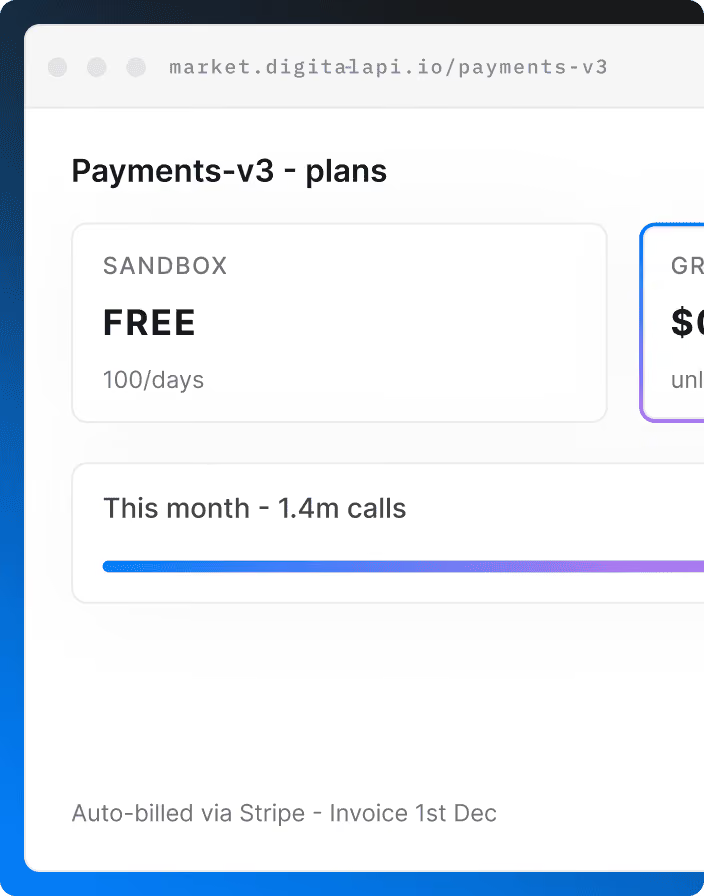
- Create a permanent sandbox plan. Developers should be able to test in sandbox without a paid plan, forever. This removes time pressure on evaluation and increases the quality of integrations that reach production.
- Surface usage data prominently in the developer portal. A usage dashboard showing current-month calls, error rate, and quota utilisation with a clear upgrade prompt at 75 per cent or higher utilisation is a passive upsell mechanism that works at scale.
- Add premium endpoints as the upgrade differentiator. If tiers are differentiated only by call volume, low-volume power users have no reason to upgrade. Adding premium endpoint access covering higher-quality data, AI-powered features, or webhook support gives high-value, low-volume users a reason to pay for higher tiers.
- Publish a public changelog. Developers who can see that your API is actively maintained are more likely to commit to a paid plan. A public changelog updated with every new endpoint and feature signals investment and longevity, reducing churn from developers who worry about depending on an API that might be abandoned.
FAQs
1. What is an API monetization strategy?
An API monetization strategy is a planned approach to generate revenue from your APIs. It involves selecting a pricing model (e.g., freemium, pay-as-you-go, subscription), defining how API access is packaged, and establishing the systems for billing and payment collection. It also considers indirect value, such as driving product adoption or expanding market reach.
2. What are the most common API monetization strategies?
The most common strategies include the Freemium model (free basic access with paid upgrades), Pay-as-you-Go or usage-based pricing (charging per API call or resource consumed), Tiered or Subscription models (fixed fees for different feature/usage levels), and Revenue Share models (taking a percentage of revenue generated by API users). Hybrid approaches are also very popular.
3. What are billing best practices for APIs?
Key API billing best practices include implementing granular and accurate metering, ensuring transparent and predictable pricing, automating invoicing and payment processing, providing proactive usage alerts to prevent bill shock, ensuring robust security and fraud prevention, and offering a self-service portal for developers to manage their billing information.
4. How do I choose the right API monetization strategy?
Choosing the right strategy involves several best practices: aligning with your overall business goals, thoroughly understanding your target audience and their specific use cases, clearly defining your API's unique value, assessing your operational costs and competitive landscape, prioritizing a positive developer experience, and designing for flexibility to adapt over time.
5. Why is a developer portal important for API monetization?
A developer portal is crucial for API monetization because it serves as the central hub for developers. It enables clear communication of pricing models and tiers, provides comprehensive documentation and code samples for easy integration, offers tools for usage monitoring, and often includes self-service options for managing billing and account information. A strong DX directly impacts adoption and, consequently, monetization success.
Dhayalan Subramanian is Associate Director, Product Growth at DigitalAPI, where he leads go-to-market and product growth for the company’s multi-gateway API management platform. His work focuses on helping large enterprises and mid-market cloud companies consolidate APIs across AWS, Azure, Apigee, Kong, MuleSoft, and other gateways into a single control plane for governance, discovery, monetization, and agent consumption.
Dhayalan brings 14+ years of experience across product strategy, enterprise architecture, and engineering leadership. Earlier in his career, he held senior roles at Encora (as Associate Architect and Technical Manager), Mindtree (Technology Lead), Tech Mahindra (Technical Lead), and Primus Analytics, where he designed integration frameworks and delivered enterprise-grade digital platforms for global customers.
At DigitalAPI, he works directly with platform, integration, and developer experience leaders at Fortune 500 organizations to operationalize unified API catalogs, developer portals, and MCP-ready APIs. He writes regularly on API developer experience, API governance, and AI agent architectures.

One email a fortnight. Worth opening.
A short digest of what we're writing, what we're learning from customers, and the handful of links you'd actually want from us. No tracking pixels.

.avif)