



How to build RBAC for transaction sandbox access (dev vs QA vs finance)
A step-by-step guide to implementing RBAC for transaction sandbox access across dev, QA, and finance teams to improve security and control.

TLDR
1. Transaction sandboxes require distinct access controls for developers, QA engineers, and finance teams, since each role carries different risk exposure and testing scope.
2. RBAC must extend beyond portal login to govern which APIs can be invoked, what data is visible, and which environments are accessible.
3. Finance teams require read-only access to synthetic transaction data for validation, not sandbox execution rights.
4. Role definitions must be enforced at the gateway level, not just the UI layer.
5. Audit trails should capture which role accessed which sandbox resource and when.
Govern sandbox access by role. Book a demo
Transaction sandboxes are a critical layer in any financial API development cycle. They simulate payment flows, account operations, and ledger events that downstream teams depend on before production goes live. But when developers, QA engineers, and finance reviewers share the same sandbox environment without clearly defined boundaries, access control breaks down silently. The result is test data contamination, unauthorized execution of mock transactions, and gaps in audit coverage. RBAC for transaction sandbox access is not a security formality. It is an architectural decision that protects test integrity and ensures each team operates within defined boundaries without disrupting others.
What is RBAC in a transaction sandbox?
Role-based access control restricts which personas can invoke, view, and manage sandbox APIs based on predefined role definitions. In transaction sandboxes, RBAC governs execution rights, dataset visibility, environment boundaries, and approval authority across dev, QA, and finance workflows to prevent role bleed.
Why role segmentation matters in transaction sandbox environments
Transaction sandboxes are shared infrastructure. Developers push code changes, QA runs regression flows, and finance teams validate synthetic ledger records, frequently in the same environment and against the same endpoints. Without clearly enforced role segmentation, these workflows interfere with each other in ways that are difficult to trace after the fact.
The problem is not that roles conflict in theory. It is that without technical boundaries, a developer can inadvertently invoke a QA test suite flow, or a finance reviewer can trigger a transaction execution they were only meant to observe. A structured RBAC model, grounded in API governance principles, converts role boundaries into a technical constraint rather than a behavioral expectation. Organizations building on open banking infrastructure can reference RBAC enforcement patterns for sandbox and portal access as a governance baseline.
Where access control breaks down without role segmentation
Most access control gaps in transaction sandboxes do not come from missing policy documents. They come from environments where role boundaries were never technically enforced. When multiple teams share the same sandbox without scoped credentials, every action becomes harder to trace and every misconfiguration becomes harder to attribute. These are the patterns that surface most frequently across uncontrolled sandbox environments.
- Developers with full admin rights overwriting QA test configurations
- Finance teams accessing raw mock payloads not intended for their review scope
- Shared API keys with no role scope, creating untraceable execution logs
- No separation between read access and write access in transaction endpoints
- Missing audit trails when synthetic transaction records are modified
Defining roles for transaction sandbox access
The starting point for any RBAC model is a clear definition of what each role needs, what it should never touch, and which actions require explicit approval. In transaction sandbox contexts, three primary roles drive most of the access policy design. Each role should be mapped to a specific set of permissions before any technical enforcement is configured.
Developer role
Developers need full execution access within their own environment scope. This means the ability to invoke sandbox transaction APIs, generate and rotate test credentials, push configuration changes, and debug mock response payloads. Developer access should not extend to QA-managed test suites or finance-validated datasets without a formal handoff process. Default permissions should cover API key generation, sandbox invocation rights, mock configuration editing, and error log access. Proper API key management ensures that developer credentials remain scoped to their designated environment.
QA role
QA engineers operate at the intersection of test design and production readiness validation. They need read and execute rights across specific transaction flows, but must not be able to modify base mock configurations or alter synthetic data records that finance teams are reviewing concurrently. This boundary protects the integrity of test evidence across parallel workstreams. QA access should cover execution of predefined test cases, read access to transaction response logs, and the ability to flag sandbox responses as pass or fail. Write access to mock payloads or ledger records belongs to the developer or admin role.
Finance role
Finance teams use transaction sandboxes primarily to validate synthetic ledger outputs against expected accounting logic. Their access pattern is read-heavy. They need visibility into simulated balances, transaction records, and reconciliation outputs. Execution rights granted to finance reviewers expand the risk surface without adding operational value. Finance access should be scoped to read-only views of designated sandbox datasets, reconciliation reports, and API analytics outputs relevant to their review mandate.
Building the RBAC model: role matrix and permission boundaries
A documented role matrix is the reference point for both technical enforcement and audit validation. It translates role definitions into clear permission assignments across environment access, API invocation, and data visibility layers. This matrix should be reviewed as part of any API lifecycle management governance cycle, especially before a new service is added to the transaction sandbox.
Enforcing RBAC at the gateway and policy layer
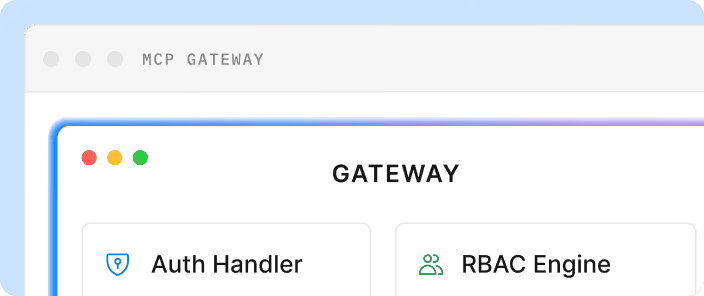
Role matrices defined at the portal level are only effective when enforced at the gateway. Portal-level RBAC controls what users see and what actions are available in the interface. Gateway-level enforcement controls which API calls are actually routed and executed. Both layers must stay synchronized for access control to hold across all consumption patterns.
This is where API sandbox testing discipline intersects with security architecture. Many teams apply RBAC only at the UI layer and leave gateway routing open, meaning a developer with a raw API key can bypass role restrictions entirely. Structured API authentication and token-scoping close this gap at the enforcement layer.
Gateway-level enforcement controls
- Scoped OAuth tokens bound to role definitions, not just user identity
- Rate limits differentiated by role to prevent developer testing from disrupting QA runs
- Request filtering that blocks finance-role tokens from invoking write or execute endpoints
- Audit event logging at the gateway level, capturing role scope alongside request metadata
- Automated alerts when token scope does not match the expected role boundary for the invoked endpoint
These controls should align with your broader API security framework and not be treated as sandbox-specific exceptions. If enforcement is inconsistent with production patterns, governance overhead increases when teams promote workflows from sandbox to live.
Audit and traceability requirements
Transaction sandboxes in financial environments carry implicit audit obligations even when they hold synthetic data. If the sandbox connects to a test process that feeds a compliance sign-off, every access action must be traceable. This applies especially when finance teams are involved, since their interactions with sandbox data can form part of a broader audit trail reviewed by risk and compliance functions.
Clean API access management records in the sandbox protect the integrity of those downstream processes. Access logs should capture role, timestamp, invoked endpoint, response status, and any configuration change events, regardless of whether the environment data is synthetic.
How DigitalAPI supports RBAC for transaction sandbox access
DigitalAPI brings RBAC enforcement and sandbox governance into a single management layer across environments and gateway types, without requiring architectural changes to existing transaction testing infrastructure.
Key capabilities include:
- API sandboxing that provisions isolated environments with configurable access scopes per role, enabling developers, QA engineers, and finance teams to access only the sandbox resources aligned with their defined responsibilities
- An API management platform that centralizes role policy definition across multiple gateways, ensuring gateway enforcement stays synchronized with portal-level role definitions
- API governance tooling that enforces structured approval workflows for privilege changes, environment promotion, and access reviews, keeping sandbox access aligned with compliance requirements
- A developer portal with role-based access controls that provides role-scoped catalog visibility so each team sees only the sandbox APIs and documentation appropriate for their workflow
.png)
Frequently Asked Questions
1. Can developers and QA engineers share sandbox credentials?
Shared credentials destroy role traceability. When the same API key is used by developers and QA, access logs lose attribution and any misconfiguration cannot be reliably traced back to its source. Each role should hold independently scoped credentials with permissions aligned to their specific sandbox workflow and environment scope to maintain clean audit trails across all sessions.
2. Should finance teams have any execution rights in the transaction sandbox?
Finance teams should not hold sandbox execution rights. Their role in transaction sandbox workflows is validation and review, not invocation. Execution access for finance reviewers expands the risk surface with no operational benefit. Read-only scoped access to synthetic transaction records and reconciliation outputs covers all legitimate finance use cases within a well-governed sandbox environment.
3. How do you prevent privilege escalation in a shared sandbox environment?
Privilege escalation is prevented through scoped OAuth tokens, gateway-level enforcement that validates role permissions per request, approval-gated workflows for any temporary elevation, and automated expiry on elevated access grants. Technical controls must make unauthorized escalation structurally impossible rather than relying on procedural guidance, manual conventions, or informal naming standards that erode over time.
4. What happens when a developer needs temporary access to a QA dataset?
Temporary access elevation should follow a structured approval workflow with documented justification and a defined expiry window. The access should be logged at both the portal and gateway level throughout its duration. After expiry, elevated permissions must be revoked automatically rather than manually. Relying on cleanup by individuals creates access hygiene gaps that compound in active multi-team development environments.
5. How should role changes be managed as teams scale?
Role changes should be governed lifecycle events, not informal updates. Any change to a team member's sandbox role should follow an approval process, be reflected in gateway policies within a defined SLA, and produce an audit record. Stale or unapproved role assignments are among the most common access hygiene failures in growing sandbox environments with multiple concurrent workstreams.
Rajanish GJ is Chief Technology Officer at DigitalAPI, the multi-gateway API management platform that helps large enterprises consolidate API discovery, governance, monetization, and AI agent enablement across heterogeneous gateway environments, including Apigee, AWS API Gateway, Azure API Management, Kong, and MuleSoft.
Rajanish brings 20+ years of engineering leadership to the role. He spent formative years at Apigee, the API management platform now part of Google Cloud and widely regarded as the category’s foundational product, and at Google itself, where he worked on developer-facing infrastructure at scale. That operator background informs DigitalAPI’s architectural bets around gateway abstraction, MCP-ready APIs, and agent-native developer experience.
He writes regularly on API architecture, developer infrastructure, and AI-native API management, with particular focus on how engineering teams can future-proof their API platforms for the agent era.
One email a fortnight. Worth opening.
A short digest of what we're writing, what we're learning from customers, and the handful of links you'd actually want from us. No tracking pixels.

.avif)