




Best API Monetization Platforms for Usage-Based Billing
Usage-based billing, often referred to as "pay-as-you-go," charges API consumers based on their actual consumption of the API resources.

TL;DR
1. Usage-based billing aligns API costs directly with value, fostering transparency and scalability for both providers and consumers.
2. The best API monetization platforms offer precise metering, flexible pricing models, robust billing, and developer-friendly portals.
3. Accurate usage tracking, secure access, and comprehensive analytics are non-negotiable features for successful monetization.
4. Choosing a platform requires assessing integration needs, scalability, developer experience, and cost-effectiveness.
5. DigitalAPI provides a unified, intelligent platform for seamless API monetization, featuring advanced usage-based billing, robust API lifecycle management, and a powerful developer portal.
Ready to elevate your API monetization strategy? Explore DigitalAPI today!
In an era where APIs power everything from microservices to sophisticated AI applications, how organizations charge for their API usage has become a critical strategic decision. Simply offering APIs isn't enough; monetizing them effectively ensures sustainability, encourages innovation, and accurately reflects the value provided. Among various API monetization models, usage-based billing stands out, offering unparalleled fairness and flexibility. This approach allows businesses to scale their costs in direct proportion to their consumption, creating a transparent and equitable exchange. But implementing usage-based billing requires robust infrastructure and specialized platforms. Identifying the best API monetization platform for usage-based billing is paramount for maximizing revenue, enhancing developer experience, and maintaining long-term growth.
Understanding Usage-Based Billing for APIs
Usage-based billing, often referred to as "pay-as-you-go," charges API consumers based on their actual consumption of the API resources. Instead of flat fees or subscription tiers that might not align with real value, this model ties the cost directly to specific metrics like the number of requests, data transferred, compute time, or unique transactions. It's a highly effective API pricing strategy because it ensures fairness for both providers and consumers.
For providers, it means earning more as their API's value and adoption grow, directly correlating revenue with utility. For consumers, it means they only pay for what they use, making it ideal for variable workloads, testing new applications, or scaling on demand. This model fosters trust and encourages broader adoption, as the barrier to entry is often lower than with rigid subscription plans. However, its success hinges on sophisticated API monitoring and billing capabilities to accurately track and process diverse usage metrics.
Benefits of Usage-Based Billing for APIs
- Fairness and Transparency: Customers only pay for the value they extract, making the pricing model highly transparent and equitable.
- Scalability: Easily accommodates varying usage patterns, from small-scale testing to enterprise-level operations, without requiring frequent plan changes.
- Flexibility: Allows providers to offer granular pricing based on different API endpoints, data types, or service levels.
- Reduced Barrier to Entry: Often includes a freemium tier or low initial cost, encouraging wider adoption and experimentation.
- Revenue Optimization: Captures revenue from high-volume users that might otherwise be capped by fixed-tier subscriptions, leading to accelerated API monetization.
Challenges of Implementing Usage-Based Billing
- Accurate Metering: Requires precise and real-time tracking of various usage metrics without errors or discrepancies.
- Complex Pricing Logic: Implementing different rates for various services, tiers, or volumes can be intricate.
- Billing and Invoicing: Generating accurate invoices based on dynamic usage data can be a significant operational overhead.
- Transparency for Users: Users need clear dashboards and alerts to understand their consumption and avoid bill shock.
- Fraud and Abuse: Mechanisms to prevent API abuse and ensure secure usage are critical.
.png)
Key Features of a Best API Monetization Platform
To overcome the challenges and fully leverage the benefits of usage-based billing, a robust API monetization platform is indispensable. The best API monetization platform for usage-based billing will offer a comprehensive suite of features designed to automate and streamline the entire process. Here’s what to look for:
1. Accurate Metering and Usage Tracking
At the core of usage-based billing is the ability to precisely measure API calls, data payload sizes, processing time, unique users, or any other relevant metric. The platform must provide:
- Real-time Data Collection: Capture usage data as it happens, ensuring up-to-the-minute accuracy.
- Granular Metering: Support for various metrics across different APIs and endpoints.
- Auditability: Detailed logs and records of all usage data for transparency and dispute resolution.
2. Flexible Pricing Models
Beyond simple per-call pricing, a top-tier platform supports a variety of complex usage-based models:
- Tiered Pricing: Different rates apply as usage crosses certain thresholds.
- Volume Pricing: Unit cost decreases with higher usage volumes.
- Freemium & Free Trial Management: Seamless transition from free to paid usage.
- Custom Metrics & Complex Logic: Ability to define unique billing parameters and implement custom rules, including billing quotas and SLAs.
3. Robust Billing and Invoicing Capabilities
Processing usage data into accurate invoices is crucial. Essential features include:
- Automated Invoicing: Generate and send invoices based on aggregated usage.
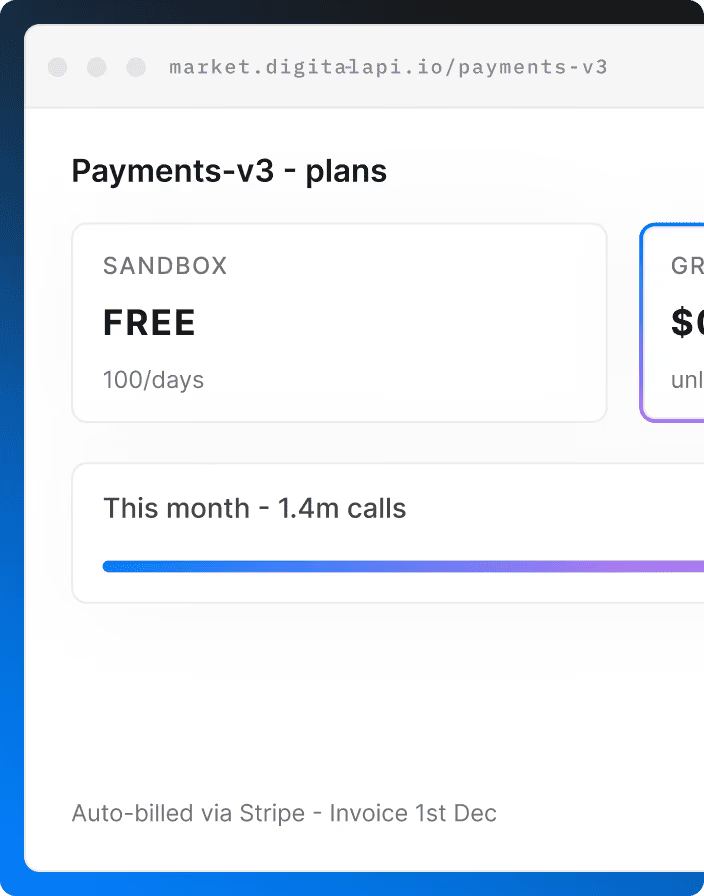
- Payment Gateway Integration: Connects with popular payment processors (Stripe, PayPal, etc.).
- Subscription Management: Handle recurring payments and plan changes seamlessly.
- Proration: Adjust billing automatically for mid-cycle plan changes or cancellations.
4. Developer Portal Integration
A developer-friendly experience is key to API adoption. The platform should integrate billing features directly into the developer portal:
- Self-Service Dashboards: Allow developers to monitor their usage, view bills, and manage payment methods.
- Usage Alerts & Notifications: Proactive warnings when usage approaches limits or thresholds.
- API Key Management: Streamlined management of API keys and access controls.
5. Analytics and Reporting
Understanding usage patterns and revenue trends is vital for optimization:
- Usage Trends: Visualize consumption over time.
- Revenue Forecasting: Predict future earnings based on current usage.
- Customer Segmentation: Identify high-value users and tailor strategies.
- Key Performance Indicators (KPIs): Track essential metrics for API analytics and business health.
6. Security and Access Management
Protecting APIs and billing data is paramount:
- Role-Based Access Control (RBAC): Define who can access and manage billing configurations.
- Data Encryption: Secure sensitive customer and payment information.
- Threat Protection: Integrate with API security measures to prevent unauthorized access or DDoS attacks.
7. Scalability and Performance
The platform must handle growing API traffic and complex billing logic without performance degradation.
- High Throughput: Process millions of API calls per second for metering.
- Low Latency: Ensure metering doesn't introduce noticeable delays for API consumers.
8. Integration with Existing Systems
A robust platform should seamlessly integrate with your existing tech stack:
- CRM & ERP: Synchronize customer data and financial records.
- Data Warehouses: Export usage data for further analysis.
- API Management Platforms: Work in tandem with existing API gateways and management tools.
DigitalAPI: A Leading API Marketplace with support for Usage-Based Billing
When seeking the best API monetization platform for usage-based billing, enterprises often encounter solutions that are either too basic for complex pricing models or too fragmented to provide a holistic view. This is where DigitalAPI emerges as a comprehensive, intelligent solution designed specifically for the nuanced demands of the modern API economy. DigitalAPI centralizes and streamlines your entire API monetization strategy, making usage-based billing not just feasible, but effortless and optimized.
DigitalAPI integrates seamlessly with your existing API infrastructure, whether you're using multiple gateways or a unified API management platform. It provides granular metering capabilities, allowing you to define and track any custom usage metric relevant to your APIs. From simple call counts to complex data transformation operations, DigitalAPI ensures every unit of value is accurately measured and attributed. Its flexible pricing engine supports a wide array of models, including tiered, volume, and custom pricing structures, enabling you to tailor your monetization strategy precisely to your business objectives and market demands.
Moreover, DigitalAPI's integrated developer portal empowers your API consumers with transparent usage dashboards, real-time cost estimations, and self-service options for managing their subscriptions and payment methods. This focus on developer experience reduces support overhead and fosters greater adoption. For you, robust analytics provide deep insights into API usage trends, revenue generation, and customer behavior, enabling data-driven decisions to further optimize your monetization efforts. With DigitalAPI, you gain a powerful, scalable, and secure platform that turns your APIs into reliable revenue streams, effectively bridging the gap between value creation and value capture through sophisticated usage-based billing.
Choosing the Right Platform: Key Considerations
Selecting the ideal API monetization platform is a strategic decision that impacts revenue, developer relations, and operational efficiency. Beyond the core features, several critical factors should guide your choice:
- Scalability Needs: Assess your current and projected API traffic. Does the platform reliably handle millions of API calls and complex billing calculations without degradation?
- Integration with Existing Tech Stack: How well does the platform integrate with your current API gateways, CRM, ERP, and payment processors? Seamless integration minimizes friction and operational overhead.
- Pricing Model Flexibility: Beyond basic usage, can it support tiered, volume, custom, and outcome-based models as your strategy evolves?
- Developer Experience: Is the developer portal intuitive? Does it provide clear usage insights, billing transparency, and self-service options? A positive developer experience drives adoption.
- Security and Compliance: Evaluate the platform's security posture, data privacy features, and compliance certifications, especially for sensitive data or regulated industries.
- Analytics and Reporting: Does it offer actionable insights into usage, revenue, and customer behavior, allowing you to refine your API monetization tools and strategies?
- Cost of Ownership: Consider not just the licensing fees but also implementation costs, maintenance, and the potential for increased revenue versus operational savings.
- Vendor Support and Ecosystem: Look for a vendor with strong support, continuous updates, and a vibrant community or partner ecosystem.
FAQs
1. What is API monetization?
API monetization refers to the process of generating revenue from your APIs by charging users for access and usage. This can involve various API monetization strategies, including subscription models, tiered pricing, freemium, and usage-based billing, where fees are directly tied to how much an API is consumed.
2. Why choose usage-based billing for APIs?
Usage-based billing offers fairness and transparency, as customers only pay for the actual value they derive from an API. It's highly scalable, accommodating diverse usage patterns without requiring frequent plan adjustments. This model often lowers the barrier to entry, encouraging broader adoption and direct correlation between API value delivered and revenue generated.
3. What features are essential in an API monetization platform for usage-based billing?
Key features include accurate, real-time metering of various usage metrics; flexible pricing models (tiered, volume, custom); automated billing and invoicing with payment gateway integration; a self-service developer portal for usage monitoring; comprehensive analytics and reporting; robust security and access management; and scalability to handle high transaction volumes.
4. How does DigitalAPI support usage-based billing?
DigitalAPI provides a unified platform that offers granular, real-time usage metering for diverse API metrics. It features a flexible pricing engine to implement various usage-based models, integrates billing seamlessly, and offers a developer portal for transparency. DigitalAPI's analytics provide deep insights, helping businesses optimize their monetization strategies and ensure accurate revenue capture.
5. Can I integrate a monetization platform with my existing API gateway?
Yes, the best API monetization platforms are designed for seamless integration with existing API gateways (like Apigee, Kong, AWS API Gateway, etc.) and other infrastructure components. This ensures that usage data is accurately captured from your API traffic flow, without requiring significant changes to your current API management setup.
Dhayalan Subramanian is Associate Director, Product Growth at DigitalAPI, where he leads go-to-market and product growth for the company’s multi-gateway API management platform. His work focuses on helping large enterprises and mid-market cloud companies consolidate APIs across AWS, Azure, Apigee, Kong, MuleSoft, and other gateways into a single control plane for governance, discovery, monetization, and agent consumption.
Dhayalan brings 14+ years of experience across product strategy, enterprise architecture, and engineering leadership. Earlier in his career, he held senior roles at Encora (as Associate Architect and Technical Manager), Mindtree (Technology Lead), Tech Mahindra (Technical Lead), and Primus Analytics, where he designed integration frameworks and delivered enterprise-grade digital platforms for global customers.
At DigitalAPI, he works directly with platform, integration, and developer experience leaders at Fortune 500 organizations to operationalize unified API catalogs, developer portals, and MCP-ready APIs. He writes regularly on API developer experience, API governance, and AI agent architectures.


One email a fortnight. Worth opening.
A short digest of what we're writing, what we're learning from customers, and the handful of links you'd actually want from us. No tracking pixels.

.avif)