



Freemium Pricing Model for API Monetization: Strategy, Benefits, and Best Practices
The freemium model, a portmanteau of "free" and "premium," allows users to access a basic version of a service or product at no cost, while offering advanced features, higher usage limits, or enhanced support for a fee.

TL;DR
1. Freemium is a potent strategy for API monetization, lowering entry barriers and fostering developer adoption.
2. A successful freemium model hinges on a thoughtfully designed free tier that offers real value without cannibalizing premium.
3. Craft compelling premium tiers by identifying clear upgrade triggers and offering advanced features, higher limits, or superior support.
4. Developer experience, clear documentation, robust analytics, and scalable infrastructure are crucial for conversion and retention.
5. Continuously monitor usage data, conversion rates, and user feedback to iterate and optimize your freemium strategy for long-term success.
Ready to transform your API monetization? Get Started with DigitalAPI's API Marketplace!
In the intricate web of digital services, where connectivity fuels innovation, APIs have emerged as the foundational infrastructure of modern software. They are the conduits through which applications communicate, data flows, and new digital experiences are built. As businesses increasingly recognize the strategic value of their programmatic interfaces, the question of effective monetization becomes paramount. Beyond simple transactional models or rigid subscriptions, a more nuanced approach often unlocks greater adoption and sustained growth: the freemium business model. This strategy, balancing accessibility with premium value, offers a compelling pathway for API providers to cultivate a vibrant developer ecosystem and convert engaged users into paying customers, thereby establishing a resilient revenue stream in a competitive landscape.
Understanding the Freemium Pricing Model for API Monetization
The freemium model, a portmanteau of "free" and "premium," allows users to access a basic version of a service or product at no cost, while offering advanced features, higher usage limits, or enhanced support for a fee. For APIs, this translates into providing developers with a free tier of access, enabling them to explore the API's capabilities, integrate it into their applications, and even launch their products, all before committing any financial resources. Once they experience the value and encounter limitations, they are encouraged to upgrade to a premium plan.
What is Freemium in the API Context?
In the realm of APIs, freemium typically involves offering a free tier that includes:
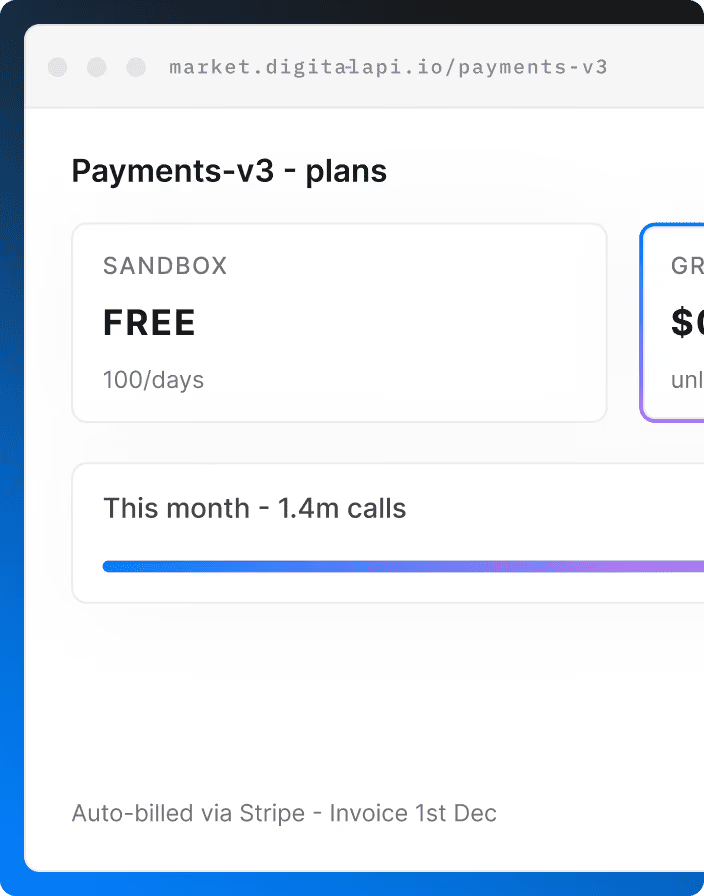
- A limited number of API calls per month/day.
- Access to core functionalities, but not advanced features.
- Standard or community support.
- Restricted data access or lower data transfer limits.
- Potentially, branding requirements (e.g., "Powered by X API").
The goal isn't just to give away functionality, but to provide enough value to allow developers to build, test, and even deploy smaller-scale applications, proving the API's utility and becoming accustomed to its usage. This "try before you buy" approach dramatically lowers the barrier to entry, a critical factor in developer adoption.
Why It's a Game-Changer for APIs
The API economy thrives on network effects and developer adoption. A freemium model excels here because it:
- Reduces friction: Developers can start building immediately without sales cycles or payment hurdles.
- Expands reach: Attracts a broader audience, including hobbyists, startups, and academic projects, who might eventually grow into enterprise clients.
- Fosters innovation: Enables experimentation, leading to unforeseen use cases and broader ecosystem growth.
- Builds trust: Allows developers to thoroughly evaluate the API's reliability, performance, and documentation before committing financially.
- Generates leads: Free users are a fertile ground for lead generation, providing valuable insights into usage patterns and potential upgrade opportunities.
Key Benefits of the Freemium Pricing Model for API Monetization for Providers and Consumers
For API Providers:
- Accelerated Adoption: A frictionless entry point means more developers engaging with your API.
- Market Validation: Real-world usage data from free users helps validate demand and identify valuable features.
- Reduced Sales Cycle: Developers "sell themselves" on the API's value through direct experience.
- Higher Conversion Rates: Engaged free users are significantly more likely to convert to paid plans than those without prior experience.
- Competitive Advantage: Differentiates your API in a crowded market by offering immediate value.
For API Consumers:
- Risk-Free Exploration: Developers can test and integrate without financial commitment.
- Faster Time to Market: Quickly prototype and launch applications using the API.
- Cost-Effective Development: Ideal for bootstrapping startups or personal projects.
- Informed Decisions: Make purchasing decisions based on actual usage and performance.
.png)
The Core Components of an API Freemium Strategy
A successful freemium strategy isn't accidental; it's a carefully crafted balance between giving enough value to attract and retain, and reserving enough value to incentivize upgrades. It requires thoughtful consideration of several key elements. Explore the most effective API monetization models and how they support freemium growth
1. Defining Your Free Tier: The Hook
The free tier is your primary marketing tool. It must offer tangible value, allowing developers to achieve a meaningful outcome. Considerations include:
- Usage Limits: How many calls per second, minute, or month? This is often the most common limitation.
- Feature Set: Which endpoints are available? Are advanced capabilities like batch processing, real-time streaming, or specific data filters excluded?
- Data Access: Is the data limited in scope, quality, or historical depth?
- Support Level: Community forums vs. dedicated email or phone support.
- Service Level Agreements (SLAs): Free tiers typically come without performance guarantees or uptime commitments.
The free tier should be generous enough to demonstrate value but restrictive enough that professional or high-volume users will naturally hit its ceiling, prompting an upgrade.
2. Crafting Your Premium Tiers: The Value Proposition
Premium tiers are where the real monetization happens. They must offer clear, compelling advantages over the free tier, justifying the cost. Differentiation can come from:
- Increased Limits: Higher API call volumes, more data storage, faster processing.
- Advanced Features: AI capabilities, analytics dashboards, custom integrations, white-label options, Webhooks, private endpoints.
- Enhanced Support: Priority support, dedicated account managers, faster response times, onboarding assistance.
- Performance & Reliability: Guaranteed uptime, lower latency, higher rate limits, dedicated infrastructure.
- Security & Compliance: Advanced authentication, data encryption, compliance certifications (HIPAA, GDPR).
Each premium tier should address the pain points that free users encounter, providing a clear solution that enhances their application's capabilities or operational efficiency.
3. Measuring Success: Metrics That Matter
Without proper measurement, your freemium strategy is just a guess. Key metrics to track include:
- User Acquisition Rate: How many new developers are signing up for the free tier?
- Activation Rate: What percentage of signed-up users make their first API call or integrate successfully?
- Engagement Rate: How often are free users returning to use the API?
- Conversion Rate: The percentage of free users who upgrade to a paid plan.
- Churn Rate: How many paid customers cancel their subscriptions?
- Average Revenue Per User (ARPU): The total revenue divided by the number of active users.
- Customer Lifetime Value (CLTV): The predicted revenue that a customer will generate throughout their relationship with the API.
These metrics provide insights into the health of your freemium funnel and highlight areas for optimization.
Designing an Effective Free Tier
The free tier is where developers get their first taste of your API. It needs to be enticing, useful, and carefully balanced to avoid becoming a financial drain or a perpetual "free lunch" for users who should be paying.
1. Balancing Generosity and Sustainability
This is the eternal challenge of freemium. Too generous, and users may never need to upgrade. Too restrictive, and they won't experience enough value to get hooked. The sweet spot is a free tier that allows developers to:
- Build a proof-of-concept.
- Develop and test a basic integration.
- Launch a small-scale application with limited but meaningful functionality.
- Experience the API's core benefit without requiring extensive infrastructure from your side.
The goal is to create a "growth ceiling" that encourages, rather than forces, an upgrade.
2. Common Free Tier Models
Several models can be employed to limit the free tier:
- Rate Limits (most common): Restricting the number of API calls per unit of time (e.g., 1,000 calls/day, 50,000 calls/month). This is highly effective as usage naturally scales with success.
- Feature Limits: Providing access to only a subset of endpoints or basic functionality, reserving advanced features for premium.
- Time Limits: Offering a full-featured trial for a limited period (e.g., 30 days), then reverting to a restricted free tier or requiring payment. Less common for APIs as it disrupts ongoing integrations.
- Data Limits: Restricting the amount of data processed, stored, or transferred. Relevant for data-intensive APIs.
- Branding Requirements: Requiring free users to display "Powered by Your API" branding. This can serve as a form of marketing.
- Project Limits: Allowing a certain number of projects or applications to be built per free account.
3. Onboarding and Documentation for Free Users
A smooth onboarding experience is paramount. Even if it's free, developers won't stick around if they can't figure out how to use your API. Ensure:
- Clear, comprehensive documentation: Easy-to-follow guides, code samples in multiple languages, API reference.
- Interactive tools: "Try-it-out" consoles, SDKs, quickstart guides.
- Accessible support: Community forums, FAQs, knowledge base, basic email support.
- Usage dashboards: Allow users to monitor their current usage against free tier limits.
Proactive communication about approaching limits is also critical, gently nudging users toward upgrade paths.
Crafting Compelling Premium Tiers
Once developers are hooked on the free tier, the premium offerings need to provide compelling reasons to open their wallets. This requires understanding user needs and structuring value propositions effectively.
1. Identifying User Needs for Upgrade
Monitor your free users. What are their pain points? When do they hit the limits of the free tier? Common upgrade triggers include:
- Scaling Usage: Their application grows, and they need more API calls.
- Advanced Features: They need specific functionalities not available in the free tier (e.g., analytics, real-time data, webhooks).
- Reliability & Performance: They require guaranteed uptime and faster response times for critical applications.
- Dedicated Support: They need faster, more personalized help for debugging or integration issues.
- Security & Compliance: Their business needs mandate higher security standards or regulatory compliance features.
- Branding Removal: They want to remove your branding from their application.
Each premium tier should directly address one or more of these upgrade triggers.
2. Pricing Strategies
How you price your premium tiers is as important as what you include:
- Tiered Pricing: Offering different packages (e.g., Basic, Pro, Enterprise) with varying limits and features. This allows users to choose a plan that best fits their current needs.
- Usage-Based Pricing (Pay-as-you-go): Charging per API call, data unit, or processed item, often with volume discounts. This is highly flexible but can be unpredictable for users. Often combined with tiered pricing (e.g., first X calls free, then per-call pricing).
- Subscription-Based: A fixed monthly or annual fee for a set amount of usage or features. Predictable for both provider and user.
- Per-User Pricing: Charging based on the number of team members accessing the API or platform. Relevant for developer tools built around the API.
- Hybrid Models: Combining elements, e.g., a base subscription fee plus usage-based overage charges.
Clarity in pricing is essential. Developers appreciate transparency and predictability.
3. Premium Features and Benefits
- Higher Rate Limits: Significantly increased call volumes.
- Advanced Functionality: Access to specialized algorithms, AI models, custom integrations, enterprise connectors.
- Enhanced Support: 24/7 dedicated support, faster SLAs, access to engineering teams.
- Performance Guarantees: Uptime SLAs, guaranteed response times.
- Security Enhancements: VPC access, custom firewall rules, advanced threat detection.
- Analytics & Reporting: Detailed usage statistics, performance metrics, custom reports.
- Customization & Branding: White-labeling, custom domains, personalized dashboards.
The perceived value of these premium features should far outweigh their cost, making the upgrade a clear business decision for the user.
Key Considerations for API Freemium Success
Beyond the basic structure, several strategic elements dictate the long-term success of an API freemium model.
1. Value Proposition
What unique problem does your API solve? Why should developers choose yours over competitors? Clearly articulate the core value your API provides, and ensure this value is tangible even in the free tier.
2. Developer Experience (DX)
This is non-negotiable. A seamless, enjoyable developer experience from signup to integration is paramount. This includes:
- Intuitive API design.
- Comprehensive and up-to-date documentation.
- Easy-to-use SDKs and code samples.
- Responsive support channels.
- Clear error messages and debugging tools.
A poor DX will kill adoption, regardless of your pricing model.
3. Scalability
Your infrastructure must be able to handle a potentially large influx of free users without compromising the performance of your paid users. Plan for scalability from day one, segmenting resources if necessary.
4. Analytics and Monitoring
Implement robust analytics to track every step of the user journey. Understand:
- Which features are most popular in the free tier?
- Where do users drop off?
- What are the common usage patterns before an upgrade?
- Which pricing tiers are most popular?
This data is invaluable for optimizing your API, documentation, and pricing strategy.
5. Pricing Psychology
How you present your pricing matters. Consider:
- Anchoring: Present a higher-priced plan first to make others seem more reasonable.
- Value Framing: Emphasize the benefits and ROI rather than just features and costs.
- Clear Tiers: Make it easy for users to understand which plan is right for them.
6. Communication
Proactive and clear communication with free users is vital. Notify them when they're approaching limits, highlight the benefits of upgrading, and provide clear paths to premium tiers. Transparent communication builds trust.
7. Avoiding the "Perpetual Free User" Trap
Some free users may never convert, and that's okay to an extent. However, you need strategies to encourage conversion:
- Value-Added Nudges: Periodically introduce new premium features that might appeal to free users.
- Limited-Time Offers: Provide discounts or extended trials for premium features.
- Usage-Based Notifications: Gently remind users when they are consistently hitting limits and highlight the cost-effectiveness of upgrading.
- Targeted Outreach: Identify highly engaged free users and offer personalized assistance or migration support.
Common Freemium API Monetization Challenges and How to Avoid Them
Even well-intentioned freemium strategies can stumble. Being aware of common pitfalls can help you navigate them effectively.
1. Too Generous or Too Restrictive Free Tier
- Pitfall: If the free tier offers too much, users have no incentive to upgrade. If it offers too little, they won't experience the value and will churn quickly.
- Avoid: Continuously analyze usage data. Identify the "sweet spot" where users can achieve a meaningful outcome but will hit natural limitations as their needs grow. Iterate based on conversion rates.
2. Lack of Clear Upgrade Path
- Pitfall: Free users don't understand what they gain by upgrading or how to do it.
- Avoid: Clearly articulate the differences between free and premium tiers. Highlight specific benefits that solve problems free users are experiencing. Make the upgrade process simple and intuitive from your developer portal.
3. Poor Developer Experience
- Pitfall: Even a free API with great features won't get adopted if it's hard to use, integrate, or debug.
- Avoid: Invest heavily in DX: clean documentation, robust SDKs, helpful error messages, and accessible support. Treat free users as future paying customers.
4. Ignoring Analytics and User Feedback
- Pitfall: Launching a freemium model and not tracking key metrics or listening to what users say.
- Avoid: Implement comprehensive analytics. Regularly review conversion rates, churn, and feature usage. Actively solicit and incorporate user feedback to refine your offerings.
5. Pricing That Doesn't Align with Value
- Pitfall: Premium tiers are too expensive for the value offered, or the pricing structure is confusing.
- Avoid: Research competitor pricing. Price your tiers based on the tangible value they provide. Offer clear, transparent pricing models that resonate with your target audience. Test different pricing points.
Monetize your APIs with DigitalAPI’s Marketplace
DigitalAPI’s API Marketplace is built to help teams turn API adoption into sustainable revenue, without adding friction for developers. It gives you everything needed to design freemium tiers, manage upgrades, and monetise APIs as products, not just technical endpoints. From discovery to subscription to scale, monetisation becomes a native part of the API lifecycle.
- Freemium-ready plans and subscriptions: Define free, paid, and enterprise tiers with clear usage limits, feature access, and upgrade paths. DigitalAPI makes it easy to offer a generous free tier while introducing natural monetisation triggers as usage grows.
- Built-in usage metering and analytics: Track API consumption, rate-limit breaches, and adoption trends across users and applications. These insights help you identify when free users are ready to upgrade and which APIs are driving real business value.
- Seamless self-serve upgrades for developers: Developers can discover APIs, subscribe to plans, and upgrade tiers directly from the marketplace, without tickets or manual approvals. This reduces friction and shortens the path from experimentation to revenue.
- Enterprise-grade governance and access control: Apply policies, approvals, and entitlements across free and paid plans while maintaining security and compliance. Monetisation doesn’t come at the cost of control, even in large, regulated environments.
- Designed to scale with your API estate: Whether you’re monetising a handful of public APIs or managing hundreds across multiple gateways, DigitalAPI’s Marketplace scales with your ecosystem, supporting growth without rethinking your pricing or platform.
Conclusion
The freemium business model offers a powerful, sustainable pathway for API monetization, particularly in today's developer-centric world. By strategically lowering the barrier to entry with a valuable free tier, API providers can cultivate broad adoption, foster a vibrant ecosystem, and generate a robust pipeline of engaged users ready to upgrade. Success hinges on a delicate balance: providing enough value to entice, clear differentiation to incentivize, and a seamless developer experience to retain. Through meticulous design of free and premium tiers, rigorous analytics, and an unwavering focus on developer success, APIs can transcend mere technical interfaces to become thriving, revenue-generating digital products. Embracing freemium isn't just a pricing strategy; it's a commitment to growing your API's community and ultimately, its commercial impact.
FAQs
1. What is the freemium business model for API monetization?
The freemium business model for API monetization involves offering a basic version of your API for free, typically with usage limits or restricted features, while charging for advanced functionalities, higher request volumes, or premium support. This allows developers to try, build, and even launch small applications using your API without upfront costs, aiming to convert them to paid plans as their needs and usage grow.
2. Why is freemium popular for API monetization?
Freemium is popular because it significantly lowers the barrier to entry for developers, fostering widespread adoption and experimentation. It allows developers to validate the API's value and ease of use before committing financially, leading to higher conversion rates for paid plans. For providers, it expands market reach, generates leads, and provides valuable usage data for product development.
3. What are the key components of a successful API freemium strategy?
Key components include a well-defined free tier that offers real value but has clear limitations, compelling premium tiers with differentiated features and benefits, a transparent pricing structure, excellent developer experience (documentation, SDKs), robust analytics for monitoring usage and conversion, and scalable infrastructure to support both free and paid users.
4. How do I determine the right limits for my free API tier?
Determining the right limits involves striking a balance between generosity and sustainability. The free tier should allow developers to build and launch a proof-of-concept or a small-scale application, demonstrating the API's core value. However, it should also introduce natural "growth ceilings" (e.g., rate limits, feature limits) that encourage professional users or scaling applications to upgrade. Continuous monitoring of usage data and conversion rates is crucial for optimization.
5. What are common pitfalls to avoid with API freemium?
Common pitfalls include a free tier that is either too generous (no incentive to upgrade) or too restrictive (developers don't experience value), a lack of clear upgrade paths, poor developer experience and documentation, ignoring user analytics and feedback, and pricing premium tiers incorrectly. Avoiding these requires continuous iteration, transparent communication, and a strong focus on developer success.
Dhayalan Subramanian is Associate Director, Product Growth at DigitalAPI, where he leads go-to-market and product growth for the company’s multi-gateway API management platform. His work focuses on helping large enterprises and mid-market cloud companies consolidate APIs across AWS, Azure, Apigee, Kong, MuleSoft, and other gateways into a single control plane for governance, discovery, monetization, and agent consumption.
Dhayalan brings 14+ years of experience across product strategy, enterprise architecture, and engineering leadership. Earlier in his career, he held senior roles at Encora (as Associate Architect and Technical Manager), Mindtree (Technology Lead), Tech Mahindra (Technical Lead), and Primus Analytics, where he designed integration frameworks and delivered enterprise-grade digital platforms for global customers.
At DigitalAPI, he works directly with platform, integration, and developer experience leaders at Fortune 500 organizations to operationalize unified API catalogs, developer portals, and MCP-ready APIs. He writes regularly on API developer experience, API governance, and AI agent architectures.

One email a fortnight. Worth opening.
A short digest of what we're writing, what we're learning from customers, and the handful of links you'd actually want from us. No tracking pixels.

.avif)