






Scaling APIs: Central Teams' Guide to Retaining Visibility
When an API program is small, visibility is almost organic. A handful of teams build and consume, often communicating directly.

TL;DR
1. As API programs expand, central teams often lose sight of their entire API estate due to decentralization, diverse tech stacks, and sprawl.
2. Retaining visibility is crucial for governance, security, innovation, and a consistent developer experience across the organization.
3. Implementing a unified, automated API catalog is the foundational step, acting as the single source of truth for all APIs, metadata, and documentation.
4. Beyond the catalog, robust API governance, platform engineering principles, and cross-functional collaboration are essential for sustained visibility.
5. Avoiding common pitfalls like manual updates or gateway-only views ensures the catalog remains accurate and trusted.
6. Platforms like DigitalAPI automate the aggregation, normalization, governance, and publication of APIs, providing central teams with complete, real-time visibility as API programs scale.
Gain full control and visibility of your API ecosystem. Book a Demo with DigitalAPI!
The digital heartbeat of an organization, APIs power everything from internal microservices to external partner integrations. As teams across the enterprise independently innovate, consuming and producing APIs at an accelerating pace, a new challenge emerges for central API teams: how to maintain a clear, comprehensive view of the sprawling API landscape. Without robust strategies, this expansion can quickly lead to fragmented knowledge, inconsistent standards, and significant governance gaps, hindering future growth and exposing the organization to unnecessary risk. Retaining this crucial visibility isn't merely an operational task; it's a strategic imperative that directly impacts efficiency, security, and the pace of digital transformation.
The Inevitable Challenge: Why API Visibility Erodes as Programs Scale
When an API program is small, visibility is almost organic. A handful of teams build and consume, often communicating directly. As the organization grows, however, this informal network cracks under pressure. Several factors contribute to the erosion of central visibility:
- Decentralization of API Development: Modern enterprises empower individual product teams or business units to build and manage their own services. While this accelerates development, it naturally fragments the API landscape across numerous teams and tools.
- Heterogeneous Environments and Gateways: APIs often reside across multiple API gateways (Apigee, MuleSoft, AWS API Gateway, Kong, Azure API Management), cloud providers, on-premises systems, and even plain old Git repositories. A central team can't easily see across all these disparate environments.
- Diverse Tooling and Documentation Practices: Different teams use different tools for design, testing, and documentation. Some might use SwaggerHub, others Postman, some simply Git Markdown. This lack of standardization makes it difficult to aggregate and understand the full API estate.
- Rapid Iteration and Versioning: APIs are living entities, constantly evolving. New versions are deployed, old ones deprecated, and endpoints modified. Keeping track of these changes manually is a losing battle, leading to outdated documentation and orphaned APIs.
- Shadow APIs and Uncataloged Services: Developers, under pressure, might deploy APIs that aren't properly registered or documented, creating "shadow APIs" that bypass central governance and pose security risks.
- Lack of Standardized Metadata and Ownership: Without clear, consistent metadata (e.g., owner, domain, lifecycle stage, security tier, SLAs), even discoverable APIs lack crucial context, making them hard to govern or reuse effectively.
For a central API team, this scattered reality translates into a lack of oversight, increased redundancy, inconsistent user experiences, and a slower pace of innovation due to difficulty in discovering and reusing existing services.
Why Central Visibility is Non-Negotiable for Enterprise APIs
Losing visibility isn't just an inconvenience; it carries significant strategic risks and missed opportunities. Central teams need a clear view of their API ecosystem for several critical reasons:
Enhanced Governance, Compliance, and Security
- Policy Enforcement: Visibility allows central teams to ensure all APIs adhere to enterprise-wide standards for design, authentication, authorization, and data handling.
- Risk Management: It enables the identification of outdated, unsecure, or non-compliant APIs, reducing the attack surface and ensuring regulatory adherence (e.g., GDPR, PCI DSS).
- Audit Readiness: A complete inventory with clear ownership and lifecycle status simplifies audit processes and demonstrates control over digital assets.
Accelerated Innovation and Reuse
- Preventing Duplication: With clear visibility, teams can easily discover existing APIs, avoiding the costly re-creation of services that already exist.
- Promoting Composability: A well-cataloged estate encourages developers to compose new solutions from existing building blocks, speeding up development cycles and increasing agility.
- Faster Onboarding: New developers, both internal and external, can quickly find and understand how to use available APIs, accelerating their time to contribution.
Optimized Resource Allocation and Strategic Alignment
- Identifying Redundancy: Visibility helps pinpoint duplicated functionality or underutilized APIs, allowing for rationalization and cost savings.
- Strategic Planning: A clear picture of the API estate informs strategic decisions about investments, technology choices, and future architecture.
- Lifecycle Management: Central teams can effectively manage the full API lifecycle, from design to deprecation, ensuring resources are focused on active, valuable services.
Ultimately, retaining visibility transforms the central API team from a reactive firefighting unit into a proactive enabler of digital strategy, security, and innovation.
.png)
How Central API Teams Retain Visibility as API Programs Scale: A Practical Guide
Retaining visibility as APIs scale is not a single tool implementation, but a multi-faceted strategy combining technology, process, and culture. Here's how central API teams can achieve and maintain it:
1. Establish a Unified API Catalog as the Single Source of Truth
This is the cornerstone. A catalog consolidates all API information, regardless of where the API is hosted or managed, into one searchable, consistent system.
- Aggregating from Disparate Sources: The catalog must be able to pull information from all API gateways (Apigee, MuleSoft, AWS, Kong, Azure), Git repositories, development tools (Postman, SwaggerHub), and even custom-built services. It cannot be gateway-specific.
- Standardizing Specifications and Metadata: All API definitions (OpenAPI, RAML, AsyncAPI) need to be normalized. Crucially, each API must have rich, consistent metadata: owners, domains/business capabilities, lifecycle stages (e.g., experimental, production, deprecated), security classifications, SLAs, and tags. This metadata powers discovery and governance.
- Automated Synchronization and Drift Detection: Manual updates are the enemy of scale. The catalog must automatically sync with source systems (Git, CI/CD pipelines, API gateways) to reflect changes in real-time. It should detect "drift" where documented specs diverge from deployed APIs.
- Comprehensive Documentation Generation: Auto-generate consistent, high-quality documentation directly from specifications, enriched with examples, usage instructions, and authentication details. This ensures accuracy and reduces developer friction.
- Powerful Search and Discovery: Provide intuitive search, filtering by metadata, and logical grouping (by domain, product, team) to help developers quickly find the right API.
2. Implement Robust API Governance Frameworks
Governance provides the rules and guardrails, and visibility shows where those rules are being followed or broken.
- Define and Enforce API Standards: Establish clear guidelines for API design (naming conventions, error handling, versioning), security (authentication, authorization), and documentation.
- Automated Policy Checks: Integrate governance checks into the CI/CD pipeline or directly into the API catalog. This means automatically validating API specs against defined rules before deployment or upon catalog ingestion.
- Clear Ownership and Accountability: Every API in the catalog must have a clearly defined owner. This is non-negotiable for troubleshooting, security incidents, and lifecycle management.
- Lifecycle Management Policies: Establish processes for API creation, versioning, deprecation, and retirement. The catalog should reflect these stages and alert relevant teams.
3. Foster a Culture of API-First Design and Documentation
Technology alone isn't enough; organizational culture must support visibility.
- API-First Mindset: Encourage teams to design APIs before implementation, thinking about their consumers and documenting thoroughly from the outset.
- Internal Developer Portal: Publish the unified API catalog through a user-friendly developer portal. This acts as the primary interface for discovery, enabling self-service and reducing direct inquiries to central teams.
- Training and Education: Provide resources and training on best practices for API design, documentation, and utilizing the central catalog and governance tools.
- Feedback Mechanisms: Establish channels for developers to provide feedback on APIs, documentation, and the catalog itself, fostering continuous improvement.
4. Leverage Observability and Monitoring Tools
Visibility isn't just about what APIs exist; it's about how they're performing and being used.
- Centralized Logging and Tracing: Implement consistent logging and distributed tracing across all APIs to gain insights into runtime behavior, performance, and dependencies.
- Performance Monitoring: Track key metrics like latency, error rates, and throughput to identify issues proactively and understand system health.
- Usage Analytics: Monitor API consumption patterns to understand adoption, identify popular APIs, detect underutilized services, and inform future development.
- Security Monitoring: Integrate security tools that monitor API traffic for anomalies, potential attacks, and policy violations.
5. Embrace Platform Engineering Principles
Central API teams can act as platform providers, offering "golden paths" for API development.
- Developer Tooling and Templates: Provide standardized tools, templates, and CI/CD pipelines that inherently integrate with the API catalog and governance framework.
- Shared Infrastructure Components: Offer shared services like identity management, API gateways (where appropriate), and logging solutions that ensure consistent visibility and adherence to standards.
- Self-Service Capabilities: Enable developers to provision and manage their APIs within defined guardrails, reducing bottlenecks and fostering autonomy while maintaining central oversight.
6. Champion Cross-Functional Collaboration and Communication
Visibility is also about human connection and shared understanding.
- API Guilds or Communities of Practice: Create forums where API developers, architects, and product owners can share knowledge, discuss challenges, and align on best practices.
- Regular Syncs and Reviews: Conduct periodic API portfolio reviews with key stakeholders to assess health, identify redundancies, and plan future initiatives.
- Centralized Communication Channels: Use dedicated channels (e.g., Slack, Teams) for API-related announcements, updates, and support.
Common Pitfalls Central Teams Make When Trying to Retain API Visibility
Many efforts to improve API visibility falter not due to lack of intent, but common missteps. Avoiding these pitfalls is as crucial as implementing the right strategies:
1. Underestimating API Sprawl
- Mistake: Believing APIs are mostly in one or two main gateways and ignoring the "long tail" of internal services, Git-based APIs, or older systems.
- How to Avoid: Assume fragmentation. Conduct a thorough discovery exercise across all potential sources before settling on a catalog solution.
2. Relying on Manual Updates for the Catalog
- Mistake: Expecting developers or central teams to manually update a spreadsheet or wiki whenever an API changes.
- How to Avoid: Prioritize automation. The catalog must sync directly with API gateways, Git repositories, and CI/CD pipelines. Manual intervention should be the exception, not the rule.
3. Focusing Solely on Technical Specs, Ignoring Metadata
- Mistake: Treating OpenAPI files as the end-all-be-all, without enriching them with critical business and operational metadata.
- How to Avoid: Mandate a robust metadata model (owner, domain, lifecycle, security, SLAs). Without this, discovery is difficult, and governance is impossible.
4. Implementing a Gateway-Specific Catalog Solution
- Mistake: Using the native cataloging features of a single API gateway as the enterprise-wide solution.
- How to Avoid: Choose a platform that is gateway-agnostic and designed to aggregate from multiple sources. Your API landscape will always be multi-platform.
5. Treating the Catalog as a "Project" Instead of a "Product"
- Mistake: Launching an API catalog as a one-off initiative and then failing to staff, maintain, and evolve it.
- How to Avoid: Assign a dedicated product owner and team to the API catalog. Treat it as a critical internal product with its own roadmap, metrics, and user base (your developers).
6. Lack of Clear API Ownership and Accountability
- Mistake: Allowing APIs to exist in the catalog without a named, accountable owner.
- How to Avoid: Make ownership mandatory for every API entry. Integrate with HR systems or identity providers to ensure owners are current and reachable.
7. Poor User Experience for Discovery
- Mistake: Building a technically accurate catalog but making it difficult for developers to navigate, search, or understand.
- How to Avoid: Invest in a user-friendly developer portal with powerful search, filtering, and clear categorization. Test the discovery experience with actual developers.
How DigitalAPI Helps Central Teams Retain Visibility at Scale
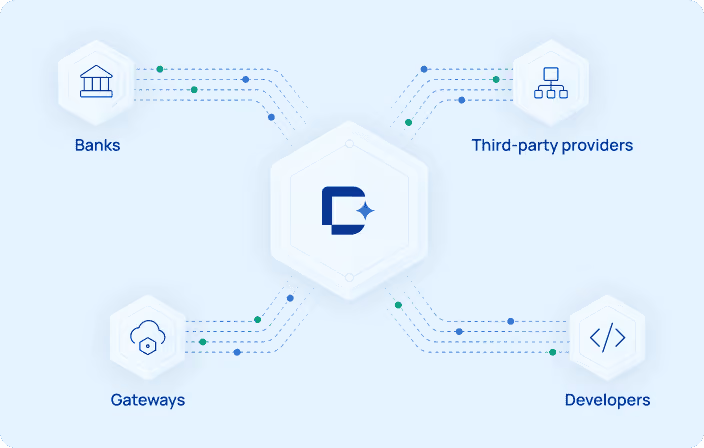
For central API teams struggling to maintain a clear picture of their expanding API landscape, DigitalAPI provides the essential platform to overcome these challenges. It’s designed from the ground up to address the complexities of multi-gateway, multi-cloud API ecosystems, transforming scattered services into a governed, discoverable, and AI-ready asset.
1. Unifies All API Sources into a Single Pane of Glass
DigitalAPI seamlessly connects to your existing API gateways (Apigee, MuleSoft, AWS, Kong, Azure), Git repositories, and other development tools like Postman. It automatically ingests all API specifications and metadata, eliminating the need for manual aggregation and ensuring your catalog is comprehensive and up-to-date, regardless of where your APIs reside.
2. Automates Metadata Enrichment and Documentation Generation
The platform standardizes disparate API specifications and automatically enriches them with crucial metadata such as ownership, domain, lifecycle status, and security classifications. It then generates consistent, high-quality documentation directly from these specs, ensuring accuracy and providing developers with a unified, self-service experience that eliminates documentation drift.
3. Embeds Proactive Governance and Quality Checks
DigitalAPI integrates robust governance capabilities directly into the catalog. It allows central teams to define, apply, and automatically enforce API design standards, security policies, and versioning conventions across the entire API estate. Continuous automated checks detect non-compliance or drift, empowering central teams to maintain consistent quality and security at scale.
4. Powers a Modern, Intuitive Developer Portal for Discovery
Beyond just a list, DigitalAPI provides an enterprise-grade developer portal where internal and external developers can easily discover, understand, and consume APIs. With advanced search, filtering by rich metadata, interactive documentation, and code samples, it significantly enhances the developer experience and accelerates API adoption and reuse.
5. Prepares Your API Estate for the AI-Driven Future
By providing a structured, normalized, and machine-readable view of your entire API landscape, DigitalAPI makes your APIs inherently AI-ready. This foundation is crucial for empowering AI agents and intelligent automation to safely and effectively discover, evaluate, and invoke your services, aligning your API program with the demands of future digital transformation.
FAQs
1. Why is retaining visibility important for central API teams?
Retaining visibility is critical for central API teams because it enables effective governance, enhances security posture, prevents API duplication, accelerates developer productivity, and facilitates strategic decision-making. Without it, API programs risk uncontrolled sprawl, inconsistent standards, security vulnerabilities, and slow innovation.
2. What are the biggest challenges to maintaining API visibility as programs scale?
The biggest challenges include the decentralization of API development, the use of diverse gateways and environments, inconsistent documentation practices, rapid API iteration, the emergence of "shadow APIs," and a lack of standardized metadata or clear ownership.
3. How can a unified API catalog help central teams maintain visibility?
A unified API catalog acts as the single source of truth for all APIs. It aggregates information from disparate sources, normalizes specifications and metadata, provides automated synchronization, generates consistent documentation, and offers powerful search capabilities. This central hub allows teams to see, understand, and govern their entire API estate from one place.
4. Besides a catalog, what other strategies help central teams retain visibility?
Beyond a unified catalog, central teams should implement robust API governance frameworks, foster an API-first culture, leverage observability and monitoring tools, adopt platform engineering principles (e.g., golden paths, self-service tooling), and champion cross-functional collaboration. These strategies create a holistic approach to sustained visibility.
5. How can automation improve API visibility?
Automation is key to preventing visibility erosion. It allows the API catalog to automatically sync with gateways and Git repositories, update documentation, enforce governance policies, and detect drift between specs and deployed APIs. This reduces manual effort, ensures accuracy, and provides real-time insights into the API landscape without human intervention.
Dhayalan Subramanian is Associate Director, Product Growth at DigitalAPI, where he leads go-to-market and product growth for the company’s multi-gateway API management platform. His work focuses on helping large enterprises and mid-market cloud companies consolidate APIs across AWS, Azure, Apigee, Kong, MuleSoft, and other gateways into a single control plane for governance, discovery, monetization, and agent consumption.
Dhayalan brings 14+ years of experience across product strategy, enterprise architecture, and engineering leadership. Earlier in his career, he held senior roles at Encora (as Associate Architect and Technical Manager), Mindtree (Technology Lead), Tech Mahindra (Technical Lead), and Primus Analytics, where he designed integration frameworks and delivered enterprise-grade digital platforms for global customers.
At DigitalAPI, he works directly with platform, integration, and developer experience leaders at Fortune 500 organizations to operationalize unified API catalogs, developer portals, and MCP-ready APIs. He writes regularly on API developer experience, API governance, and AI agent architectures.


One email a fortnight. Worth opening.
A short digest of what we're writing, what we're learning from customers, and the handful of links you'd actually want from us. No tracking pixels.

.avif)