




API Pricing Strategies: The Complete Guide to Monetization
In this blog, we’ll break down the most effective API pricing models, key factors that shape them, and emerging trends reshaping API monetisation, so you can design a pricing strategy that scales with your API ecosystem.

APIs have evolved from being technical connectors to becoming full-fledged digital products, and pricing them right can make or break your monetisation strategy. A well-defined API pricing strategy not only helps you capture the true value of your offering but also drives adoption, retention, and predictable revenue growth.
So, whether you’re building a developer-facing product or monetising partner APIs, choosing the right pricing model is about balancing business goals, user value, and market fit.
In this blog, we’ll break down the most effective API pricing models, key factors that shape them, and emerging trends reshaping API monetisation, so you can design a pricing strategy that scales with your API ecosystem.
The foundation: Treating APIs as products
Treating APIs as products requires a mindset shift: from building endpoints to delivering value experiences. It’s about designing APIs with clarity, usability, and business outcomes in mind, ensuring every API serves a clear purpose, attracts adoption, and sustains engagement through continuous improvement. Here are some key aspects that must be considered when treating APIs as products:
- Clear value proposition: Each API should clearly define what value it delivers and to whom. This clarity helps in positioning the API, aligning pricing, and communicating its impact to potential users.
- Developer experience (DX): Great APIs prioritise usability with intuitive documentation, SDKs, and onboarding flows that reduce friction and encourage faster adoption.
- Versioning and lifecycle management: APIs should evolve in a predictable and controlled way through proper versioning, deprecation policies, and backward compatibility.
- Usage visibility and analytics: Tracking adoption, performance, and consumption metrics helps teams make informed decisions about pricing, scaling, and roadmap improvements.
- Support, governance, and communication: Continuous developer support, transparent policies, and compliance management foster trust and sustain long-term API engagement.
Popular API pricing models with pros and cons
API monetisation isn’t one-size-fits-all, the right pricing model depends on how your API delivers value, who your users are, and how usage scales over time. The most successful API providers blend flexibility with transparency, ensuring developers can predict costs while businesses capture fair value. Here are the most widely used API pricing models, along with their advantages, limitations, and when to use them.
1. Freemium model
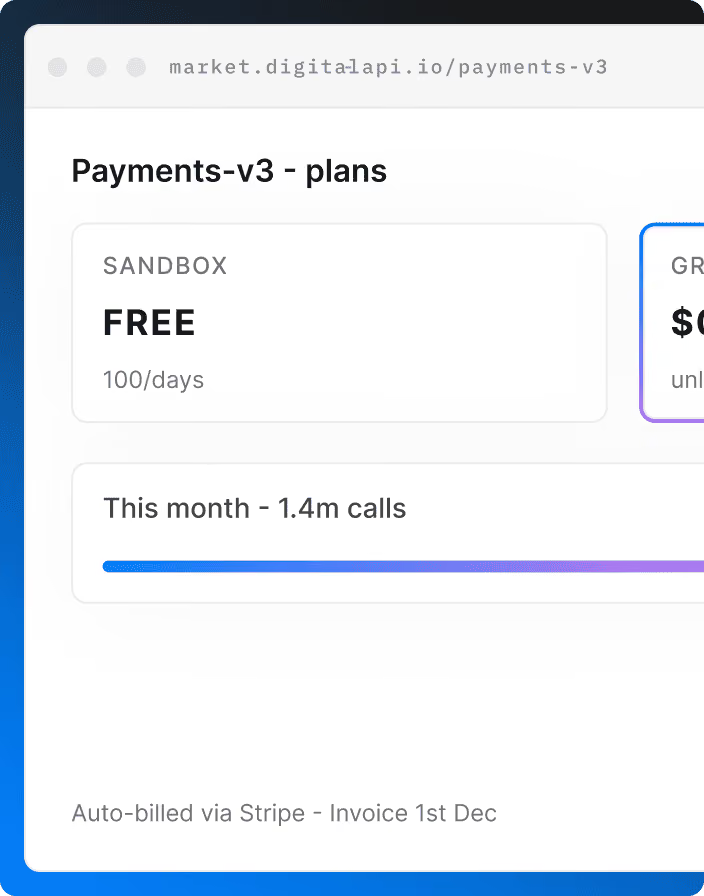
The freemium model allows developers to start using your API for free, with usage limits or restricted features. It’s designed to lower entry barriers and accelerate adoption by letting users experience value before committing financially. Once users hit usage caps or need advanced capabilities, they can upgrade to a paid plan.
Pros
- Encourages developer onboarding and experimentation.
- Builds community adoption and brand awareness.
- Simplifies marketing and reduces sales friction.
Cons
- It can lead to high infrastructure costs if free usage is poorly controlled.
- Risk of non-converting users who stay on free tiers.
- Harder to predict revenue in early stages.
2. Pay-as-you-go model
In this model, users pay strictly based on consumption, such as per API call, per transaction, or per data unit. It’s the most transparent and flexible approach, ideal for APIs with highly variable or unpredictable usage. Customers only pay for what they use, aligning pricing directly with value delivered.
Pros
- Transparent and fair pricing for users.
- Scales revenue with actual usage.
- Ideal for cloud and data-intensive APIs.
Cons
- Revenue can fluctuate significantly month to month.
- Harder for customers to estimate costs in advance.
- May discourage high-volume usage due to unpredictable bills.
3. Tiered pricing model
Tiered pricing offers multiple usage tiers, each with defined quotas and features. For example, “Starter,” “Pro,” and “Enterprise.” It’s one of the most common models in SaaS and API businesses, balancing predictability for users with scalability for providers. Each tier targets a different customer segment based on needs and budgets.
Pros
- Simplifies pricing communication and purchasing decisions.
- Encourages users to upgrade as their usage grows.
- Supports both small developers and large enterprises.
Cons
- May create artificial limits that frustrate growing users.
- Difficult to design fair breakpoints between tiers.
- Requires constant analysis to adjust quotas and pricing.
4. Subscription-based model
Here, customers pay a fixed recurring fee, monthly or annually, for access to the API, usually with predefined limits or bundles. This model provides predictable revenue streams and simplifies budgeting for both provider and user. It works well when APIs offer consistent value regardless of fluctuating usage levels.
Pros
- Predictable and recurring revenue for providers.
- Simple billing and budgeting for customers.
- Strengthens long-term customer relationships.
Cons
- May overcharge light users and undercharge heavy users.
- Lacks flexibility for businesses with seasonal or fluctuating demand.
- It can limit experimentation among smaller developers.
5. Revenue-share model
Under a revenue-share model, the API provider earns a percentage of the revenue generated by apps or services built using the API. This model aligns incentives the more successful the developer or partner, the more both parties earn. It’s popular among platform APIs that enable e-commerce, payments, or marketplaces.
Pros
- Perfectly aligns provider and partner incentives.
- Low barrier to entry, users pay only when they earn.
- Scales naturally with partner success.
Cons
- Requires robust tracking and reporting infrastructure.
- Revenue can take time to materialise.
- Works best only in ecosystems with clear monetizable outcomes.
6. Hybrid or custom models
Many modern API providers combine elements of multiple models, such as a free tier with pay-as-you-go extensions or subscription pricing with usage-based add-ons. This hybrid approach allows providers to balance accessibility, scalability, and profitability across different customer segments.
Pros
- Offers flexibility to match diverse customer needs.
- Maximises reach across both startups and enterprises.
- Enables creative experimentation with pricing strategy.
Cons
- Complex to communicate and manage billing.
- Harder to track and optimise profitability.
- It may confuse customers if pricing isn’t transparent.

How to align API pricing with business goals?
Choosing a pricing model isn’t just about how much to charge, it’s about what outcome you want to achieve. Your API pricing should reinforce broader business objectives such as adoption, retention, revenue growth, or ecosystem expansion. By aligning each pricing model with the right goal, you can turn pricing from a tactical choice into a strategic growth lever.
1. Freemium model (Goal: Accelerate adoption and build developer community)
The freemium approach is ideal for early-stage APIs aiming to attract developers and gain traction. It helps create awareness, foster experimentation, and drive organic adoption without heavy marketing. Companies with a long-term focus on ecosystem growth or network effects use freemium to build a developer base before monetising.
Use cases: Startup APIs, data or communication APIs (e.g. Twilio, SendGrid), and developer-first platforms where viral adoption drives long-term value.
2. Pay-as-you-go model (Goal: Enable usage-based growth and fair value exchange)
This model suits APIs where value is tightly tied to consumption, users pay only for what they use. It supports scalable, usage-driven revenue and encourages experimentation without upfront commitment. Ideal when you want to grow with your customers’ success and usage scale.
Use cases: Cloud infrastructure (AWS, Azure), AI inference APIs, data analytics, and fintech transaction APIs where consumption varies widely.
3. Tiered pricing model (Goal: Drive expansion and predictable scaling)
Tiered pricing helps segment customers effectively, small users start low, and as their needs grow, they naturally upgrade. It’s best for companies seeking predictable growth and structured upsell paths across customer segments. It aligns pricing with business maturity and ensures stability in revenue forecasts.
Use cases: Communication APIs, SaaS connectors, or integration platforms that cater to both startups and enterprises.
4. Subscription-based model (Goal: Build recurring, predictable revenue rtreams)
If your API delivers continuous, stable value over time, like identity management, compliance, or enrichment, a subscription model works best. It helps in long-term customer retention, budget predictability, and steady cash flow, aligning with SaaS-style business goals.
Use cases: Compliance APIs, productivity APIs, or B2B integrations where usage is consistent and predictable.
5. Revenue-Share Model (Goal: Foster ecosystem and partner success)
This model aligns with co-growth strategies where your success depends on your partners’ success. It’s perfect for platform ecosystems or marketplaces where third-party developers generate revenue using your API. The focus is on shared value creation, not upfront fees.
Use cases: Payment gateways, e-commerce APIs, ad-tech platforms, or marketplace integrations (like Shopify or Stripe Connect).
6. Hybrid or Custom Models (Goal: Balance flexibility, reach, and profitability)
A hybrid approach helps you achieve multiple objectives simultaneously, offering free tiers for adoption, subscriptions for stability, and usage-based extensions for scalability. It’s ideal for mature API businesses seeking to balance growth, revenue optimisation, and enterprise flexibility.
Use cases: Large API platforms, open banking ecosystems, or multi-gateway environments that serve both startups and large enterprises.
Emerging trends in API pricing and monetization
As APIs become central to digital ecosystems, pricing models are evolving beyond static tiers and per-call charges. The next wave of API monetization focuses on value, outcomes, and intelligent automation, driven by data insights and AI. These trends are reshaping how enterprises design, price, and deliver APIs for the modern, AI-driven economy.
- Shift from per-call to value-based pricing: Instead of charging for raw API calls, providers are pricing based on the business outcome the API enables, such as transactions processed, insights generated, or leads converted. This approach aligns API value directly with customer success and reduces friction for high-usage customers.
- Outcome-based billing for AI and data APIs: With the rise of AI, APIs now power measurable results. For instance, a recommendation API improving conversion rates or an AI API generating summaries. Providers are adopting performance-linked pricing, where costs depend on the accuracy, efficiency, or results achieved.
- Dynamic and usage-adaptive pricing: Real-time analytics now make it possible to adjust pricing dynamically based on demand, usage peaks, or customer segments. This adaptive model helps optimise infrastructure costs while offering fair, context-aware billing to users.
- API marketplaces and self-serve monetization: Developer portals and marketplaces are emerging as monetization hubs, allowing users to discover, subscribe, and pay for APIs seamlessly. Automated billing, quota management, and analytics enable providers to manage multiple revenue streams effortlessly.
- AI-agent consumption and Model Context Protocol (MCP) readiness: As AI agents begin to autonomously consume APIs, pricing strategies are shifting to support machine-driven usage. Enterprises are exploring MCP-ready monetization, where APIs are billed per autonomous task or workflow completed, reflecting a future where APIs interact with AI systems, not just humans.
Common mistakes to avoid in API monetization
Even the best APIs can fail to generate revenue if the monetization strategy is poorly designed. Many organisations focus heavily on technical delivery but overlook how pricing, experience, and communication impact adoption. Avoiding these common pitfalls ensures your API monetization efforts are scalable, transparent, and developer-friendly. Choosing the right monetization model upfront helps avoid many of these pitfalls.
- Treating monetization as an afterthought: Monetization should be part of your API strategy from day one, not a retrofit once adoption grows. Building pricing, metering, and billing capabilities early helps avoid integration complexity and ensures smooth scalability later.
- Relying only on per-call pricing: Many teams default to simple usage-based pricing without considering value or outcome alignment. This limits revenue potential, especially for APIs that deliver higher business impact than their raw call volume suggests.
- Overcomplicating pricing structures: Excessive tiers, unclear limits, or opaque overage charges can confuse users and deter adoption. Simplicity builds trust, a clear and transparent pricing page often converts better than complex, enterprise-only models.
- Ignoring developer experience and onboarding: Even a well-priced API won’t scale if developers find it hard to integrate or test. Missing documentation, lack of sandboxes, or poor onboarding flows can cause high churn before monetization even begins.
- Lack of visibility and feedback loops: Monetization requires data, without analytics on API usage, customer behaviour, and plan performance, you can’t iterate or optimise. Regularly reviewing usage insights and feedback ensures your pricing stays competitive and aligned with value.
Real-world examples of successful API pricing strategies in action
Many of the world’s most successful technology companies owe part of their growth to well-crafted API pricing strategies. These models balance accessibility with profitability, enabling APIs to scale alongside customer success. Let’s look at how three industry leaders have turned pricing into a strategic advantage.
1. Stripe (Transparent, usage-based simplicity)
Stripe’s pay-as-you-go model charges a small percentage per transaction, aligning revenue directly with user success. This transparent and scalable approach builds trust with developers and businesses alike, making it easy to forecast costs and grow seamlessly. Stripe complements this with enterprise customisation, ensuring pricing evolves with customer maturity.
Key takeaway: Simplicity and transparency can become powerful differentiators in driving adoption and retention.
2. Google Maps API (Tiered pricing for controlled scalability)
After facing uncontrolled usage under its early freemium model, Google Maps transitioned to a tiered pay-as-you-go approach. The new structure introduced clear quotas, predictable billing, and enterprise support, enabling Google to manage infrastructure costs while maintaining developer accessibility.
Key takeaway: Tiered pricing helps balance affordability for small users with sustainability for large-scale adoption.
3. Twilio (Freemium and consumption-driven growth)
Twilio’s early success came from its freemium model that allowed developers to experiment with voice, SMS, and messaging APIs using free credits. Once developers saw value, they naturally scaled into pay-as-you-go usage. Twilio’s pricing strategy, flexible, transparent, and developer-first, became a blueprint for API-driven business growth.
Key takeaway: Combining free access with frictionless consumption-based pricing accelerates adoption and drives organic scaling.
Monetize your APIs with any pricing model of your choice with DigitalAPI
With DigitalAPI, enterprises can transform their APIs into revenue-generating digital products, no matter which pricing model they choose. Whether you prefer freemium, pay-as-you-go, subscription, or hybrid structures, the platform provides built-in tools for billing, subscription management, and metering, all integrated within a unified ecosystem.
DigitalAPIs API Marketplace platform enables monetization across multiple gateways, allowing organisations to offer consistent pricing, enforce access policies, and track usage from a single control plane. Its analytics engine provides deep visibility into API consumption, helping teams optimise pricing based on real-world usage trends and customer value.
Designed for scale and compliance, DigitalAPI supports flexible monetization strategies, from early adoption to enterprise expansion. In short, it gives you everything needed to launch, manage, and monetise APIs confidently, while ensuring governance, transparency, and seamless developer experiences across your ecosystem.
FAQs
1. What is an API pricing strategy?
An API pricing strategy defines how you charge users for accessing your APIs. It aligns your pricing model with business goals, whether driving adoption, generating revenue, or scaling partnerships. A strong strategy considers value delivered, usage behaviour, and competitive positioning to ensure both profitability and developer satisfaction.
2. What are the most common API pricing models?
Popular API pricing models include freemium, pay-as-you-go, tiered, subscription-based, revenue-share, and hybrid models. Each serves different business goals, from encouraging adoption and experimentation to driving predictable revenue or sharing profits with partners. Choosing the right model depends on usage patterns, customer segments, and the overall value your API provides.
3. How do I choose the right API pricing model for my business?
Start by identifying your target users and understanding how they derive value from your API. If your focus is growth, freemium or tiered models work well. For scalable usage-based services, pay-as-you-go fits best. Mature APIs with predictable demand often succeed with subscription or hybrid models combining flexibility and stability.
4. What factors should influence API pricing?
Key factors include your API’s value proposition, operating costs, market demand, and competitive landscape. You should also analyse user behaviour, such as request frequency, peak usage times, and data volume, to determine fair, sustainable pricing. The goal is to balance accessibility for developers with profitability for your organisation.
5. How can I effectively monetise APIs across multiple gateways?
To monetise APIs efficiently across gateways, use a unified platform like DigitalAPI that centralises billing, analytics, and access management. This approach ensures consistent pricing, compliance, and visibility across all environments. It also simplifies subscription management and helps you optimise monetisation through real-time insights into consumption and customer trends.
Dhayalan Subramanian is Associate Director, Product Growth at DigitalAPI, where he leads go-to-market and product growth for the company’s multi-gateway API management platform. His work focuses on helping large enterprises and mid-market cloud companies consolidate APIs across AWS, Azure, Apigee, Kong, MuleSoft, and other gateways into a single control plane for governance, discovery, monetization, and agent consumption.
Dhayalan brings 14+ years of experience across product strategy, enterprise architecture, and engineering leadership. Earlier in his career, he held senior roles at Encora (as Associate Architect and Technical Manager), Mindtree (Technology Lead), Tech Mahindra (Technical Lead), and Primus Analytics, where he designed integration frameworks and delivered enterprise-grade digital platforms for global customers.
At DigitalAPI, he works directly with platform, integration, and developer experience leaders at Fortune 500 organizations to operationalize unified API catalogs, developer portals, and MCP-ready APIs. He writes regularly on API developer experience, API governance, and AI agent architectures.


One email a fortnight. Worth opening.
A short digest of what we're writing, what we're learning from customers, and the handful of links you'd actually want from us. No tracking pixels.

.avif)