



AI-Powered API Docs Buyer Guide: Choose the Right Platform in 2026
An AI-powered API documentation tool uses machine learning to auto-generate, maintain, and optimize API reference docs, guides, and developer portals from your codebase or OpenAPI specifications.

An AI-powered API docs platform auto-generates, syncs, and publishes structured documentation from your spec. This guide helps you choose the right one.
Most platform teams evaluate API documentation tools the wrong way. They look at the demo, admire the UI, check that it reads OpenAPI, and pick the one that feels most polished. Six months later they discover it doesn't support their gateway stack, has no multi-version access control, can't serve AI agents, and costs four times what the free tier implied.
This guide is the structured alternative. It covers what an AI-powered API docs platform actually needs to do in 2026, how to weight evaluation criteria against your specific situation, the questions to ask every vendor before you commit, and how to run a proof-of-concept that surfaces real capability gaps before purchase.
If you want a ranked list of tools, that's in Best API Documentation Tools for 2026. This guide is for the evaluation process that happens before you make that list.
TL;DR
1. AI-powered API docs platforms auto-generate documentation from OpenAPI specs, keep it synchronised with live API behaviour, and deliver it through a searchable, interactive developer portal
2. In 2026, "AI-powered" means more than generation: it includes AI-powered search, AI agent readiness (MCP, llms.txt), and AI-assisted governance across multi-gateway estates
3. Evaluation criteria are not equally weighted for every buyer: single-gateway teams optimise for generation quality; multi-gateway enterprises optimise for ingestion breadth and unified catalog delivery
4. The five evaluation mistakes that cost teams money: choosing on UI alone, ignoring multi-gateway coverage, skipping the agent-readiness check, underestimating pricing at scale, and not testing the sync pipeline under real release conditions
5. Run a structured POC before buying: feed the same spec to your top three platforms, measure generation quality, test the sync pipeline, and have an uninvolved developer attempt first call using only the generated docs
6. For the platform engineer ICP, the question is not "which tool generates the best docs?" It's "which platform keeps docs accurate across all my sources with the least operational overhead?"
What AI-Powered API Documentation Actually Means in 2026
An AI-powered API documentation platform uses machine learning to auto-generate structured reference content from your OpenAPI or AsyncAPI specification, keep that content synchronised with live API behaviour, and surface it through a searchable, interactive developer portal. The "AI" component covers three distinct capabilities, and you need to understand which ones you're actually buying.
AI content generation takes your spec file and produces human-readable endpoint descriptions, parameter explanations, error code guidance, and multi-language code samples. The quality range here is significant: some platforms produce placeholder-quality output that needs complete rewriting; others produce output that needs light review and editing. Generation quality is the most visible feature in every demo. It's also the one most frequently over-indexed during evaluation.
AI-powered search and discovery understands developer intent rather than matching keywords. A developer who types "get failed payment records" should find the right endpoint even if it's formally named retrieveTransactionErrors. This capability matters more than most teams realise at evaluation time. It becomes the reason developers actually use the portal instead of asking colleagues on Slack.
AI agent readiness is the 2026 addition that most platforms are still catching up on. As AI coding assistants, LLMs, and agentic workflows increasingly read documentation directly to generate integration code and select endpoints autonomously, your documentation platform needs to produce structured, machine-readable output that agents can consume accurately. This means clean OpenAPI spec accessibility at stable URLs, support for llms.txt, and in the most capable platforms, one-click MCP server generation from your API catalog. Gartner research projecting that by 2026, 75% of API gateway vendors will have MCP features reflects how rapidly agent-readiness has become a baseline procurement expectation, not a differentiator.
The shift that matters: The documentation workflow has changed from "write docs" to "generate, sync, and govern docs." AI handles the generation. CI/CD handles the sync. Governance handles the quality gates. Human writers shift from writing boilerplate to reviewing AI output and crafting tutorials and conceptual guides. If the platform you're evaluating doesn't make this workflow measurably faster and more reliable than your current process, it isn't adding the value the demo suggests.
The Two Buyer Profiles and Why They Evaluate Differently
Before scoring any platform, identify which buyer profile applies to your team. The evaluation weights differ significantly.
Profile 1: Single-gateway, documentation-first teams:
You run one API gateway (or one primary spec source). Your problem is keeping docs accurate and making them usable for external developers or partners. You need excellent generation quality, a polished portal, good versioning, and reliable CI/CD sync. You don't need multi-gateway ingestion, complex RBAC across internal/external audiences, or governance across hundreds of APIs. The right platform for you is likely a standalone documentation tool with strong OpenAPI support and a good developer experience. Generation quality and portal UX are your highest-weight criteria.
Profile 2: Multi-gateway enterprise teams:
You run APIs across Apigee, Kong, AWS API Gateway, Azure APIM, and possibly MuleSoft. You have internal APIs that need to be discoverable but not public, external partner APIs that need tiered access, and a growing catalog that spans teams and geographies. Your problem is not documentation quality on a single API. It's unified catalog delivery across all sources, with role-based visibility, auto-generated docs for undocumented legacy APIs, and governance that runs continuously without manual intervention. The right platform for you is an API management platform with a documentation layer, not a documentation tool with some management features. Multi-gateway ingestion coverage and governance depth are your highest-weight criteria.
This distinction matters because most vendor demos show you profile 1 functionality, regardless of your actual situation. The portal looks good. Generation is impressive. What the demo doesn't show is whether the platform can ingest from your Apigee instance, normalise the spec format differences, and publish a unified searchable catalog alongside your Kong and AWS endpoints. That's the capability question that separates platforms for enterprise buyers.
If your API estate spans more than one gateway, the documentation question is really an API discovery and management question. You need a control plane that ingests from all sources, not a documentation tool that needs a spec file manually exported from each gateway. DigitalAPI ingests directly from Kong, Apigee, AWS, Azure, MuleSoft, Postman, GitHub, and SwaggerHub, generating a unified portal without requiring you to change your existing infrastructure.
The Eight Evaluation Criteria (Weighted by Buyer Profile)
These are the criteria that matter. Weighted scores are guides, not absolutes. Adjust based on your specific situation.
(scroll to view full table)
The Nine Questions to Ask Every Vendor
These questions separate platforms that will work in your environment from those that look good in a controlled demo.
1. Which of our specific gateways do you ingest from natively?
Name every gateway in your stack. Ask whether ingestion is native, API-based, or requires manual spec export. A platform that requires a spec file export from each gateway every time something changes is not an automated documentation platform. It's a documentation renderer with extra steps.
2. How does the sync pipeline actually work under our CI/CD model?
Don't accept "we have GitHub integration" as a complete answer. Ask specifically: what triggers the documentation update? What happens if a gateway API changes without a spec file update? How long does the update take from trigger to published? What monitoring exists for sync failures?
3. What does your AI generation output look like for our actual spec?
Run your real spec through a trial before any evaluation conversation. If the platform requires a sales call before granting trial access to AI generation, that's a signal. The output quality on your spec, not a demo spec, is the only relevant data point.
4. How do you handle multi-audience access control?
Ask specifically: can internal APIs be hidden from external developers? Can partner APIs be segmented by tier or agreement type? Can we configure different subscription workflows for different API audiences? If the answer is "we support role-based access," ask for a demo with your three audience types configured.
5. What is your MCP and AI agent support story?
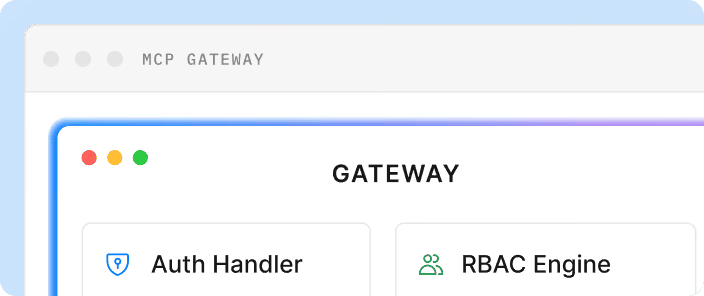
This is now a standard procurement question in 2026. Can APIs in the platform be converted to MCP endpoints? Is that process automatic or manual? Does the platform generate llms.txt? Is the OpenAPI spec served at a stable, publicly discoverable URL? DigitalAPI's MCP Gateway converts any cataloged API to an MCP endpoint with one click, using existing documentation metadata as context. Ask competing vendors to show you their equivalent.
6. How does versioning work when we have deprecated APIs still receiving traffic?
Most platforms handle versioning for current APIs. The harder question is deprecated versions. Ask: can deprecated API versions still be documented and accessible to consumers who haven't migrated yet? Can breaking changes be flagged automatically? How are developer notifications handled when an endpoint is deprecated?
7. What governance checks run automatically, and what do they catch?
Ask for a live demo of the governance layer on a real spec with known gaps: missing endpoint descriptions, undocumented error codes, incomplete request schemas. What gets flagged? What doesn't? Is governance tied to CI/CD, so undocumented APIs can't be published without passing checks? DigitalAPI's API governance layer runs OWASP security checks, documentation completeness audits, and AI-powered duplicate detection automatically, not as a manual review step.
8. What does the pricing model look like at 5x our current scale?
Most platforms publish a starter price that looks reasonable. Enterprise pricing is often per-seat, per-API, per-project, or usage-based, and it scales in ways the starter tier obscures. Before any trial: ask for the fully-loaded cost at three times your current API count, five times your current developer portal monthly active users, and your expected growth over 24 months.
9. What happens when our spec has errors, and who is responsible for documentation quality?
A platform that silently publishes malformed documentation when a spec has validation errors is a risk. Ask: what happens if we push a spec with missing required fields? What validation runs before publication? Who is notified? This question also surfaces whether the platform has spec linting and governance built in, or whether your team is responsible for spec quality manually.
How to Run a Proof of Concept That Actually Surfaces Gaps
Most API documentation platform POCs are too short, too controlled, and too focused on the demo scenario rather than the real-world scenario. This is how to run one that gives you useful signal.
Week 1: Feed your real spec to all three finalists simultaneously:
Don't use a demo spec or a simplified version. Use your actual production spec, including all its gaps, inconsistencies, and edge cases. Grade the AI generation output across at least 15 endpoints using a consistent rubric: accuracy of description, completeness of parameter documentation, quality of code samples, clarity of error code handling. Score each platform 1-5 on each dimension.
Week 1: Test the sync pipeline under real conditions:
Make a spec change in your actual repository or gateway. Time how long it takes for each platform's documentation to reflect the change. Document whether the update required any manual step. Repeat this three times across different change types: adding an endpoint, modifying a parameter, deprecating an endpoint.
Week 2: The uninvolved developer test:
Find a developer who has not been involved in the evaluation and has never seen your API. Give them access to each platform's generated documentation portal, in a random order with platform names removed if possible. Ask them to make a successful API call using only the documentation. Time them. Ask them which portal answered their authentication questions most clearly, which error code documentation was most useful, and which portal they would prefer to use for a real integration.
Week 2: Test the governance and compliance layer:
Intentionally submit a spec with known gaps: three endpoints with no descriptions, one endpoint with no documented error codes, two parameters with no type annotation. Run each platform's governance checks. Score what each catches vs what it misses.
Week 2: Stress test the pricing model:
Use the information from your vendor conversations to model cost at your actual expected usage: your current API count, your current developer portal monthly active users, and your projected 24-month growth. Present the full-loaded cost comparison to your procurement team before any finalist decision.
If you manage APIs across multiple gateways, add one more test: connect the platform to two different gateway sources simultaneously and confirm it produces a unified catalog, not two separate portals. This single test eliminates most documentation-focused platforms from the enterprise multi-gateway evaluation.
The Five Evaluation Mistakes That Cost Teams Money
Mistake 1: Choosing on generation quality alone:
AI generation quality is the most visible feature in every demo. It's also the feature most subject to improvement over time. A platform with excellent generation but no CI/CD sync pipeline will have outdated documentation within weeks. A platform with adequate generation and excellent sync will have accurate documentation indefinitely. Prioritise sync reliability and governance depth over generation polish.
Mistake 2: Ignoring multi-gateway coverage in the evaluation:
Teams running two or more gateways that evaluate documentation-first platforms will need a separate tool or custom integration for each gateway source. That additional complexity, maintenance burden, and consistency risk is rarely visible in a demo. Multi-gateway ingestion isn't a nice-to-have; it's the question that determines whether you're buying a documentation platform or a documentation renderer that requires ongoing engineering support.
Mistake 3: Skipping the agent-readiness check:
Developer tooling adoption has shifted significantly in 2026. AI coding assistants read documentation directly. Teams that choose a platform without llms.txt support, stable OpenAPI spec URLs, and MCP conversion capability are building documentation for today's integration patterns, not tomorrow's. In enterprise procurement cycles, a platform shortlisted today will be in production for 18-36 months. Agent-readiness is a requirement for the full contract period.
Mistake 4: Underestimating pricing at scale:
Per-seat pricing that seems reasonable at 10 developers becomes expensive at 100. Per-API pricing that seems fine at 20 APIs creates budget surprises at 200. Per-project pricing creates incentives to consolidate APIs in ways that break sensible catalog organisation. Always model pricing at 3x and 10x your current scale before signing. Always ask whether your contract includes SLA-backed pricing protection against mid-contract increases.
Mistake 5: Letting the engineering team choose without involving the API product team:
The platform engineer evaluating on technical criteria optimises for CI/CD integration, spec support, and sync reliability. The API product manager evaluating on adoption criteria optimises for developer portal UX, search quality, and onboarding flow. The compliance team evaluating on governance criteria optimises for audit trails, OWASP checks, and access control depth. All three sets of criteria matter. Purchasing decisions made by any one group in isolation consistently miss the requirements of the other two.
The multi-gateway decision test: If your team runs more than one API gateway and is evaluating standalone documentation tools, ask each vendor: "Show me how we ingest from [Gateway A] and [Gateway B] simultaneously into one searchable catalog, with role-based visibility separating internal and external audiences." If the answer involves a manual export workflow, a separate portal per gateway, or a roadmap item, that platform is not a fit for your environment. The API management platform evaluation question is different from the documentation tool evaluation question. Make sure you're answering the right one.
The 2026 Evaluation Criteria That Didn't Exist in 2024
Three capabilities have moved from "advanced feature" to "baseline procurement requirement" in the last 18 months.
MCP and AI agent readiness:
Documentation that serves only human developers covers roughly half of your current developer audience. AI coding assistants, LLMs acting as developer tools, and agentic workflows that autonomously select and call APIs now account for a growing share of API documentation traffic. A platform that can't serve this audience accurately (through structured metadata, stable spec URLs, llms.txt, and MCP conversion) is leaving adoption on the table for every developer using an AI-assisted workflow. Evaluate this capability as a firm requirement, not a nice-to-have. DigitalAPI's API-GPT converts any cataloged API into a natural-language queryable endpoint, using the same documentation metadata that serves human developers as the context layer for AI-powered queries.
Real-time analytics tied to adoption metrics:
The days of treating documentation as a cost centre with no measurable output are over. Enterprise API teams now track time-to-first-call, documentation page exit rates by section, search query success rates, and the correlation between documentation engagement and integration completion. A platform with no analytics, or analytics limited to page views, cannot close the feedback loop between documentation quality and adoption outcomes. Require endpoint-level analytics that show where developers are succeeding, where they're stalling, and which search queries return no results. DigitalAPI's API analytics provides this at endpoint granularity across the full portal.
AI-powered duplicate detection and governance:
In multi-gateway environments, documentation sprawl and API sprawl compound each other. Teams build APIs they don't know already exist, because the existing API was never discoverable. AI Affinity, DigitalAPI's duplicate detection capability, uses spec matching and documentation analysis to identify APIs with similar purpose or overlapping function, giving platform architects the signal they need to consolidate before the catalog becomes unmanageable. Ask every vendor whether their governance layer includes automated duplicate detection. Most don't. The ones that do are solving a problem that documentation-only tools can't address.
For the full picture of what a well-governed, AI-assisted documentation portal looks like in production, see how to build and manage an API documentation portal.
Pricing Models: What to Watch For
API documentation platforms use six distinct pricing structures, and the wrong one for your situation creates predictable budget problems.
- Per-seat pricing charges per developer account on the platform. Manageable for small teams. Expensive as your internal developer count grows. Often excludes external developer portal consumers, which creates a separate cost layer for external-facing portals.
- Per-project pricing charges per API project or documentation site. Simple to model at current scale. Creates incentives to consolidate APIs in ways that reduce catalog clarity. Breaks down when you need separate portal environments for internal vs external audiences.
- Per-API pricing charges per published API. Directly tied to your API estate growth. Predictable if your API count is stable. Creates a disincentive to document shadow APIs and legacy endpoints that need to be cataloged but may not justify the per-API cost.
- Usage-based pricing charges based on portal traffic, API calls to the Try-It console, or documentation page views. Unpredictable at launch. Can spike significantly if an API integration effort goes viral internally or externally. Requires ongoing monitoring to avoid budget surprises.
- Platform fee plus usage combines a base platform fee with usage-based components. More predictable than pure usage-based. The platform fee anchors costs at scale. This is the most common model for enterprise platforms.
- Custom enterprise pricing is negotiated based on API count, developer count, gateway coverage, and required compliance features. Always negotiate based on your 24-month projected growth, not current state. Always ask for price stability guarantees over the contract period.
If you're managing APIs at enterprise scale and documentation is a strategic asset tied to partner revenue or developer adoption metrics, the pricing conversation should happen with a solutions engineer who understands your specific estate, not a standard sales process. Talk to a DigitalAPI solutions engineer to get a cost model for your specific situation.
Decision Framework: Which Platform Type Fits Your Situation
Use this framework to match your situation to the right platform category before building a shortlist.
(scroll to view full table)
For detailed per-tool evaluation across the leading platforms, see the Best API Documentation Tools for 2026 comparison, which covers DigitalAPI, ReadMe, Mintlify, Redocly, Stoplight, Swagger, and others against these exact criteria.
How Documentation Platform Choice Affects Long-Term API Adoption
The documentation platform decision is not a tooling decision. It's an adoption decision. The platform determines whether your APIs are discoverable, testable, and integrable by every developer who encounters them. Get it right and developer adoption scales with your API program. Get it wrong and every new API published creates the same friction, the same support tickets, and the same integration delays regardless of how good the API itself is.
For a detailed breakdown of the mechanisms by which documentation quality drives adoption metrics, see How API Documentation Improves Developer Adoption. For the full picture of external-facing documentation requirements when your audience includes third-party developers and partners, see external API documentation best practices.
The documentation platform you choose today will be the environment your API program operates in for the next two to three years. The POC process and the vendor questions in this guide are designed to make sure that environment is the right one before you're locked in.
If you're managing APIs across multiple gateways and want to see what a unified, AI-generated documentation portal looks like in your specific environment, book a demo with DigitalAPI. The evaluation process described in this guide is exactly what the demo is designed to support.
Frequently Asked Questions
1. What is an AI-powered API documentation platform?
A platform that auto-generates API reference docs from your OpenAPI spec, keeps them synced with live API changes, and serves them through a developer portal.
Unlike traditional tools that render a static spec file into HTML, AI-powered platforms write endpoint descriptions, generate multi-language code samples, flag documentation gaps, and keep content accurate as APIs change, without requiring manual updates after every release. In 2026, leading platforms also produce machine-readable output for AI agents and support one-click MCP server generation.
3. How do I evaluate AI-powered API documentation platforms?
Score on eight criteria: generation quality, multi-source ingestion, CI/CD sync, portal UX, agent-readiness, governance, pricing at scale, and support.
Weight those criteria against your buyer profile. Single-gateway teams optimise for generation quality and portal UX. Multi-gateway enterprise teams optimise for ingestion coverage and governance depth. Run a structured POC: feed your real spec to all finalists simultaneously, test the sync pipeline under live conditions, and have an uninvolved developer attempt first call using only the generated portal.
4. What is the most important feature of an AI API documentation platform in 2026?
CI/CD sync reliability. Documentation that drifts from live API behaviour costs more in support tickets than it saves in generation time.
Generation quality is the most visible feature in every demo. Sync reliability is the feature that determines whether documentation stays accurate after month one. An AI platform that generates impressive initial content but requires manual updates after each release is not solving the documentation maintenance problem. It's delaying it. Ask every vendor: what triggers a documentation update? How long does it take? What happens when the sync fails?
5. Do AI API documentation platforms work for multi-gateway enterprises?
Only if they support native ingestion from all your gateway sources. Platforms requiring manual spec exports per gateway don't scale.
Most documentation-first platforms are designed around a single OpenAPI spec file. Multi-gateway enterprises need a platform that ingests directly from Kong, Apigee, AWS, Azure, and MuleSoft simultaneously, normalises spec format differences, and delivers a unified searchable catalog. DigitalAPI's API management platform handles this natively. Most standalone documentation tools don't. The decision framework in this guide identifies which platform category fits multi-gateway environments.
6. What questions should I ask API documentation vendors before buying?
Ask about gateway ingestion coverage, sync pipeline mechanics, MCP support, pricing at 5x scale, governance checks, and deprecation handling.
The nine vendor questions in this guide cover the evaluation dimensions most likely to produce surprises post-purchase. The most important three: which of your specific gateways does the platform ingest from natively, what does pricing look like at three times your current API count, and can APIs be converted to MCP endpoints for AI agent consumption. These three questions alone eliminate most platforms that won't serve your environment at scale.
Dhayalan Subramanian is Associate Director, Product Growth at DigitalAPI, where he leads go-to-market and product growth for the company’s multi-gateway API management platform. His work focuses on helping large enterprises and mid-market cloud companies consolidate APIs across AWS, Azure, Apigee, Kong, MuleSoft, and other gateways into a single control plane for governance, discovery, monetization, and agent consumption.
Dhayalan brings 14+ years of experience across product strategy, enterprise architecture, and engineering leadership. Earlier in his career, he held senior roles at Encora (as Associate Architect and Technical Manager), Mindtree (Technology Lead), Tech Mahindra (Technical Lead), and Primus Analytics, where he designed integration frameworks and delivered enterprise-grade digital platforms for global customers.
At DigitalAPI, he works directly with platform, integration, and developer experience leaders at Fortune 500 organizations to operationalize unified API catalogs, developer portals, and MCP-ready APIs. He writes regularly on API developer experience, API governance, and AI agent architectures.
One email a fortnight. Worth opening.
A short digest of what we're writing, what we're learning from customers, and the handful of links you'd actually want from us. No tracking pixels.

.avif)