


Tyk vs Gravitee: GraphQL vs Event Streaming for Enterprise APIs
Tyk and Gravitee solve the same API management problem, but they optimize for different priorities once the systems are in production.

TL;DR
Tyk is built for fast, config-driven, request-response APIs in microservice environments.
Gravitee is designed for real-time, event-driven APIs and external exposure.
Tyk relies on external identity providers; Gravitee includes built-in OAuth2 access management.
Tyk fits GitOps and Kubernetes workflows; Gravitee offers a visual, policy-driven studio.
Choose Tyk for internal performance-focused APIs; choose Gravitee for streaming and partner APIs.
Before you finalize your choice, you might find the ultimate API gateway checklist for enterprise teams helpful for refining your technical requirements.
Tyk and Gravitee solve the same API management problem, but they optimize for different priorities once the systems are in production. Tyk is optimized for GraphQL and flexibility, whereas Gravitee specializes in event-driven architectures. These priorities start to matter as traffic grows, integrations expand, and ownership shifts from setup to long-term operation.
The real gap lies in how much responsibility lies with the platform versus the team, influencing rollout effort, maintenance overhead, and how API programs evolve over time. This article breaks down the differences between Tyk Vs Gravitee and what they mean in real-world API environments.
Foundational differences between Tyk and Gravitee
When it comes to API infrastructure, Tyk and Gravitee take two very different paths. Tyk is all about lightweight control, while Gravitee offers a full-stack experience out of the box.
To make a better call, here is what that difference actually means:
The "Builder" vs. The "Platform"
Tyk is a lightweight gateway built for developers who prefer configuration as code. Gravitee delivers a broader platform experience that includes protocol mediation, visual policy control, and built-in identity.
Let’s break it down in practice:
| Feature | Tyk (The Builder) | Gravitee (The Platform) |
|---|---|---|
| Core Philosophy | Code-First Proxy. Built as a lightweight Go binary with a low memory footprint, designed for fast, ephemeral boot times. | Full-Stack Platform. A Java (Vert.x) engine designed to manage the full API lifecycle, including design, API governance, and portals. |
| Configuration | GitOps-Native. Configuration is handled as code (YAML/JSON) via the command line, ideal for developers who avoid GUIs. | Visual Orchestration. Features a low-code "Design Studio" for drag-and-drop policy configuration, accessible to non-engineers. |
| Connectivity | GraphQL Aggregation. Focuses on using a Universal Data Graph to stitch multiple APIs into a single schema. | Event-Native Streaming. Uses protocol mediation to push real-time data (Kafka, MQTT) to clients via WebSockets. |
| Identity & Security | External Delegation. Relies on external brokers (like Okta or Keycloak) to handle user identity. | Native IAM. Includes a built-in Access Management solution to handle identity directly within the platform. |
The fork in the road: Aggregation vs delivery
Pick Tyk when you need to unify downstream data into GraphQL. Pick Gravitee when your apps need real-time data delivery from message queues.
Here’s how those two strategies show up:
Tyk (fetch + aggregate)
Tyk is the specialist for unifying data. Its Universal Data Graph allows you to stitch together disparate backend sources like REST APIs, gRPC services, or legacy databases into a single GraphQL layer. It simplifies frontend development significantly. Clients can query exactly what they need in one request, meaning you do not have to write complex backend logic just to compose data.
Gravitee (push + stream)
Gravitee is built for real-time delivery. It excels at bridging event-driven architectures by taking streams from brokers like Kafka or MQTT and pushing them directly to clients via WebSockets or SSE. This native protocol mediation removes the need for custom middleware to translate binary formats. It makes delivering live updates to browsers and mobile apps much faster and easier to manage.
Core architectural differences: Tyk vs Gravitee
At a technical level, Tyk and Gravitee diverge in how they handle runtime execution, data movement, identity boundaries, and ongoing operations. These choices shape performance behavior, scalability limits, and the operational effort required once systems are live.
Below, let's break down where those differences surface in practice:
The engine room: Go vs Vert.x
Tyk
Tyk ships as a single Go binary. You deploy the gateway and it runs without a JVM, application server, or runtime configuration layer. In practice, this keeps the gateway simple to operate and predictable once traffic starts flowing. Most teams treat it as a stateless component that scales horizontally with minimal tuning.
Gravitee
Gravitee runs on the JVM and uses Vert.x to move traffic through the gateway. That puts runtime management squarely in scope. Heap sizing, garbage collection, and memory behavior matter as load changes. The upside is how Vert.x handles concurrency, especially when connections stay open instead of closing after each request.
Cold start and scaling behavior
| Feature | Tyk (Go) | Gravitee (Java/Vert.x) |
|---|---|---|
| Boot Time | Boots almost instantly (under 3s). Ideal for ephemeral pods. | Slower startup due to JVM warmup. Better for stable pods. |
| Memory | Very low footprint. Efficient for sidecar deployments. | Higher initial memory allocation required for the heap. |
| Scaling | Scales linearly with CPU. Perfect for rapid auto-scaling. | Scales vertically well. Excellent for handling sustained load. |
Why long-lived connections matter
Quick HTTP calls are good for fast processing, but streaming traffic can slow things down. If gateways spend too much time managing connections instead of completing requests, it becomes a problem. Vert.x is better at handling this situation than a basic request-response system.
What to validate in a POC
- Memory footprint: Measure the RAM usage of 100 idle pods. Tyk will likely be significantly lower.
- Cold start latency: Kill a pod and measure the time to the first successful 200 OK response.
- Connection limits: For Gravitee, load test with 10k+ concurrent WebSocket connections to see if the heap remains stable.
Data connectivity models: Universal Data Graph vs protocol mediation
Tyk pulls APIs together so clients can query them in one place. Gravitee moves event data out of brokers and into formats that applications can actually consume.
How Tyk handles connectivity
With Tyk, the gateway sits between clients and a set of existing APIs. Instead of exposing those APIs as-is, you define a GraphQL schema that represents what clients should see. Each field in that schema points to an upstream call, and the gateway handles calling those services and stitching the response together.
This is usually introduced to reduce frontend complexity. Rather than calling three or four services to build a single screen, the client makes one query and lets the gateway handle the rest.
Common characteristics of this setup:
- Backend services stay separate and unchanged
- Aggregation logic moves to the gateway
- Clients control what data they receive per request
Over time, the work shifts to schema ownership. As upstream APIs change, the GraphQL layer needs to be updated to stay in sync. Teams that treat the schema as a stable contract tend to do well here. Teams that let it drift often feel the pain later.
How Gravitee handles connectivity
Gravitee starts from a different assumption. The data already lives in an event broker, and the real problem is that clients cannot consume it directly. Browsers don’t speak Kafka. Mobile apps don’t understand MQTT. That gap is where Gravitee operates.
The gateway subscribes to topics and pushes events out over WebSockets, SSE, or webhooks. It doesn’t try to reshape the data into a unified model. It focuses on delivery.
Typical traits of this model:
- Brokers remain the source of truth
- The gateway translates protocols, not data
- Clients consume streams using familiar web patterns
This approach fits systems where data arrives continuously and users need to see changes as they happen, not by polling APIs.
Where problems usually show up
| Failure Mode | Tyk (UDG) | Gravitee (Streaming) |
|---|---|---|
| Latency | Spikes if you chain too many nested resolvers (A calls B calls C). | Spikes if the broker (Kafka) is slow to acknowledge consumers. |
| Complexity | Schema maintenance becomes hard if upstream REST APIs change formats often. | Backpressure issues occur if producers send data faster than clients can consume. |
| State | Stateless. Easy to restart if a request fails. | Stateful. Client reconnection logic is critical if a connection drops. |
How to choose without overthinking
If your issue is too many APIs and messy client logic, Tyk fits naturally. If your issue is getting event data into apps without custom middleware, Gravitee is the clearer choice. Mixing the two models usually adds complexity instead of removing it.
Identity and built-in capabilities: External IdP vs built-in IAM
Tyk enforces authentication and authorization at the gateway but relies on external identity providers. Gravitee includes Access Management, allowing identity, user management, and access control to live inside the platform.
What “needing an IdP” actually means
In most setups, identity already exists in Okta, Azure AD, or Auth0. The real decision is whether the gateway should only validate identity or also own users, tokens, and login flows. That choice affects operational scope and long-term ownership.
Identity model in Tyk
With Tyk, identity stays outside the gateway. The gateway focuses on token validation, policy enforcement, and access control, while user management and authentication remain the responsibility of an external IdP.
This setup works well when identity is already standardized across the organization and shared by many systems.
- Integrates with OAuth, OIDC, LDAP, and SAML providers
- Uses Tyk Identity Broker for federation and mapping
- No native user lifecycle or credential management
Identity model in Gravitee
Gravitee includes Access Management as part of the platform. That allows teams to manage users, applications, tokens, and access policies without relying on an external identity service.
This model fits teams that want identity and API management tightly coupled, especially in greenfield environments.
- Built-in user and application management
- Native OAuth and OpenID Connect flows
- Identity and API policies configured in one place
Comparison: Where Auth lives
| Feature | Tyk | Gravitee |
|---|---|---|
| Strategy | Delegation. "Bring your own Identity." | Consolidation. "Full stack security." |
| Mechanism | Uses Tyk Identity Broker (TIB) to glue the gateway to your existing provider (LDAP, OIDC). | Uses Access Management (AM) module. A full-fledged IdP built into the platform. |
| User Management | Does not manage users. Expects identity to come from elsewhere. | Can store users, handle MFA, and manage consent screens natively. |
Decision checkpoints
- Do you already operate an enterprise IdP with strong governance and compliance controls?
- Is the platform team expected to run identity infrastructure long term?
- Do API consumers span multiple business units with shared identity needs?
- Are compliance, audit, and access reviews centralized or team-owned?
- Is reducing integration effort more important than minimizing platform surface area?
Setup and day-2 operations: Config files vs Design studio
Tyk fits teams that treat gateway configuration as code. Gravitee fits teams that prefer a UI-driven workflow for designing and applying policies.
Tyk workflow
Tyk is built for teams that work in a config-as-code model. APIs and policies are defined in JSON or YAML files and pushed through CI/CD, commonly using the Tyk Operator with Kubernetes.
- GitOps-native: Because everything lives in files, reviewing and auditing changes in Git is straightforward. You can see exactly what changed in a pull request.
- The dashboard: While a dashboard exists, most experienced teams treat it as a read-only view of what’s already defined in Git.
Gravitee workflow
Gravitee works best when teams want to see and manage traffic flow visually. Its Design Studio provides a low-code interface where policies are applied directly to the request and response path.
- Visual logic: You can follow the flow step by step; request comes in, IP is checked, headers are modified, backend is called.
- Accessibility: This makes it easier for architects or product owners to design API behavior without working directly with Kubernetes manifests.
What day-2 operations look like
| Operation | Tyk | Gravitee |
|---|---|---|
| Upgrades | Simple binary swap with minimal downtime | Multi-component upgrade involving gateway, APIs, UI, and database |
| Debugging | Log inspection and metrics, mostly command-line driven | Request tracing directly in the UI with visual debugging |
| Scaling teams | Scales through Git workflows, well-suited for distributed DevOps teams | Scales through governance, better for centralized platform teams |
The "Ideal User" profile
Different teams adopt API platforms for different reasons. In many cases, the right choice becomes obvious once you look at how a team builds, deploys, and operates systems rather than comparing features in isolation.
Here are the team profiles where Tyk and Gravitee fit the best:
The "Go Shop" architect
Best fit for: Teams that live in Kubernetes and treat infrastructure as code.
To these teams, a 'platform' often signals bloat rather than value. They don't want a heavy ecosystem; they want a sharp, single-purpose tool that fits into an existing CI/CD pipeline. The priority here is autonomy and speed.
- The Workflow: Configurations usually happen in text files (YAML/JSON), not UI consoles. The ideal gateway should be deployable via Helm, manageable via GitOps, and invisible in production.
- Why Tyk fits: Since it compiles to a single Go binary, Tyk behaves exactly like the microservices it proxies. It has no external dependencies and boots instantly. This appeals to architects who need to run sidecars or ephemeral pods without the memory tax of a JVM. If the goal is to define an API in a repo and have it live in seconds, this is the natural choice.
If Tyk doesn’t align with your operational model, our article on Tyk alternatives highlights other gateways and patterns you might consider.
The "Event-Driven" architect
Best fit for: Teams building the "central nervous system" of a real-time enterprise.
This profile deals with a completely different issue: the "Last Mile" of data. They have massive amounts of information flowing through Kafka or MQTT, but that data is trapped in the backend. The challenge is getting those events to external partners, mobile apps, or frontend dashboards that cannot speak binary protocols.
- The Workflow: These teams need a bridge. They require a control plane that can secure a Kafka topic as easily as a REST endpoint. Governance is critical because it often exposes sensitive internal streams to the public internet.
- Why Gravitee fits: Gravitee focuses on protocol mediation. It connects directly to event brokers and exposes those streams through WebSockets or Server-Sent Events (SSE). Consumers don’t need Kafka clients or custom adapters because the gateway takes care of the translation. This makes it easier to expose internal streams as externally usable APIs.
For teams that want other ways to handle real-time or broker integration needs, see our breakdown of Gravitee alternatives.
The unified future: DigitalAPI.ai
Large enterprises often run multiple gateways to handle distinct workloads like internal microservices and external streams. DigitalAPI.ai bridges this gap by unifying Tyk and Gravitee under one control plane while adding native AI capabilities with Arelio.
Here is how a unified approach solves the fragmentation problem.
A unified control plane for polyglot stacks
Most organizations eventually drift into a "polyglot" architecture where no single gateway fits every use case. Platform teams often choose Tyk for high-speed internal traffic, while data teams select Gravitee for its event streaming capabilities.
DigitalAPI.ai connects these isolated environments into a single dashboard.
- Unified API catalog: API growth makes ownership and reuse unclear. DigitalAPI.ai centralizes what exists, who owns it, and what can be reused before anyone builds another duplicate API.
- Cross-gateway governance: Rules drift when multiple gateways evolve independently. The platform keeps security, versioning, and approvals consistent across gateways without forcing teams to manage policies in consoles.
- Central API discovery and marketplace: APIs see faster adoption when discovery is simple. A single marketplace lets developers find APIs, understand access rules, and request usage without hopping between portals.
- 360° API analytics and visibility: Metrics fragment across dashboards as APIs spread. DigitalAPI.ai unifies traffic, usage, and errors into one view, giving a 360° understanding of behavior across gateways.
- Multi-cloud visibility: APIs often span AWS, other clouds, and on-prem systems. Consistent visibility across environments helps teams operate confidently without standardizing on a single gateway.
Arelio gateway and AI readiness
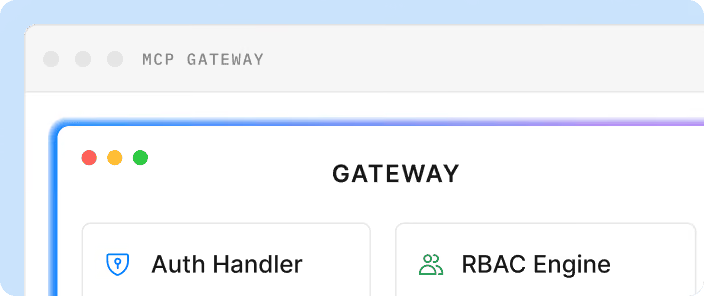
DigitalAPI.ai includes Arelio API Gateway, a plug-and-play API gateway built to design, secure, and deploy APIs with zero DevOps overhead. Arelio supports the full API lifecycle and runs as a fast, lightweight gateway with a zero learning curve.
It is AI-ready by default and includes out-of-the-box Model Context Protocol (MCP) server support, which enables APIs to be used by AI agents within the same governance and management platform.
- Plug & Play Gateway: Launch APIs quickly without complex setup.
- Out-of-the-box MCP Server: Make APIs accessible to AI agents.
- Unified internal catalog: Discover APIs through the platform service hub.
- Built-in marketplace: Publish, share, or monetize APIs.
- Built-in analytics: Track API usage and adoption.
The ecosystem approach
DigitalAPI.ai does not force a choice between speed and platform features; it manages both while adding the AI layer.
| Feature | DigitalAPI.ai | Tyk | Gravitee |
|---|---|---|---|
| Core role | Unified Control Plane. Manages Tyk, Gravitee, and native Arelio traffic in one view. | Performance Proxy. Fast request routing for internal microservices. | Event Mediator. Bridges backend message brokers to frontend clients. |
| AI capability | Agent-Native. Converts APIs into MCP tools for seamless use by AI agents. | Traffic Control. Rate limits AI usage but lacks semantic understanding. | Policy-based. Enforces standard security policies on AI calls without context. |
| Visibility | Global Catalog. Centralizes APIs from all gateways into a single semantic search index. | Instance Level. Visibility is limited to traffic flowing through Tyk nodes. | Platform Level. Visibility is limited to APIs managed within the Gravitee ecosystem. |
| Architecture | Hybrid Manager. Combines a federation layer with the ultra-fast Arelio micro-gateway. | Go Binary. Single executable designed for low-latency performance. | Java/Vert.x. Reactive engine designed for long-lived concurrent connections. |
Preparing your infrastructure for AI agents
The next generation of traffic will come from autonomous agents that need more than just Swagger documentation. DigitalAPI.ai provides the semantic layer that legacy gateways lack.
- Intent-Based Search: An AI agent can search for "check inventory" and find the correct endpoint across any connected gateway.
- Bot Governance: It enforces specific guardrails for non-human actors to prevent loops and hallucinations.
- Contextual Bridging: It translates complex JSON responses into clean context that models like GPT-4 can process efficiently.
If you’re running multiple gateways or planning for AI-driven consumption, talk to a DigitalAPI.ai expert to see how a unified control plane would fit.
Frequently asked questions (FAQs)
1. Can Tyk natively expose Kafka as WebSockets?
No, Tyk natively focuses on REST and GraphQL proxying. For exposing Kafka streams, Gravitee is the better option because it includes native protocol mediation to convert backend events into frontend-friendly WebSockets or Server-Sent Events (SSE) automatically.
2. Is the Management UI open source?
Gravitee offers a fully open-source Management UI under the Apache 2.0 license. Tyk, however, keeps its Dashboard proprietary. You can use Tyk’s open-source gateway freely, but you must pay for a commercial license to access the official visual console.
3. Which is better for GraphQL federation?
Tyk wins this category with its Universal Data Graph. It allows you to unify multiple upstream services, including REST and gRPC, into a single GraphQL schema. This lets you "stitch" data sources together easily without writing complex glue code.
4. Does Gravitee require a JVM?
Yes, Gravitee runs on the Java Virtual Machine (JVM) using the Vert.x reactive toolkit. While this enables high concurrency for streaming, it does require more system resources and has a slower cold-start time compared to Tyk’s lightweight Go binary.
Rajanish GJ is Chief Technology Officer at DigitalAPI, the multi-gateway API management platform that helps large enterprises consolidate API discovery, governance, monetization, and AI agent enablement across heterogeneous gateway environments, including Apigee, AWS API Gateway, Azure API Management, Kong, and MuleSoft.
Rajanish brings 20+ years of engineering leadership to the role. He spent formative years at Apigee, the API management platform now part of Google Cloud and widely regarded as the category’s foundational product, and at Google itself, where he worked on developer-facing infrastructure at scale. That operator background informs DigitalAPI’s architectural bets around gateway abstraction, MCP-ready APIs, and agent-native developer experience.
He writes regularly on API architecture, developer infrastructure, and AI-native API management, with particular focus on how engineering teams can future-proof their API platforms for the agent era.
One email a fortnight. Worth opening.
A short digest of what we're writing, what we're learning from customers, and the handful of links you'd actually want from us. No tracking pixels.

.avif)