




Top 10 SOAP Monitoring Tools in 2026: Pick Your Best Fit
This blog explores the top 10 SOAP monitoring tools, helping you navigate the options to find the best fit for your specific needs.


TL;DR
1. SOAP services remain critical in many enterprise environments, necessitating robust monitoring despite the rise of REST.
2. Effective SOAP monitoring tools offer real-time visibility into performance, availability, and error rates of these complex XML-based APIs.
3. Key features to look for include transaction tracing, synthetic monitoring, detailed XML payload inspection, and alert customization.
4. Choosing the right tool depends on your existing infrastructure, budget, and the specific depth of insight required for your SOAP endpoints.
5. A blend of dedicated APM, API monitoring platforms, and robust testing tools often provides the most comprehensive coverage for your SOAP landscape.
Gain unparalleled visibility into your SOAP services. Book a demo with DigitalAPI!
While modern architectures often lean towards RESTful APIs, many foundational enterprise systems continue to rely heavily on SOAP web services. These XML-based interfaces are the backbone of countless critical business operations, from financial transactions to intricate supply chain management. Ensuring their continuous performance, availability, and integrity is paramount, making robust SOAP monitoring an indispensable practice.
Neglecting the health of these services can lead to cascading failures, significant downtime, and severe business disruption. The right monitoring tool offers deep insights into these complex interactions, allowing organizations to proactively identify bottlenecks, debug errors, and maintain the reliability that their operations demand. This blog explores the top 10 SOAP monitoring tools, helping you navigate the options to find the best fit for your specific needs.
Top 10 SOAP Monitoring Tools in 2026: Pick Your Best Fit
1. DigitalAPI
DigitalAPI is a unified API intelligence and governance platform built for enterprises running business-critical SOAP services across fragmented environments. Instead of focusing only on runtime performance, DigitalAPI solves a broader problem: SOAP APIs often exist across multiple gateways and teams with no single source of truth for visibility, ownership, usage, or governance.
By sitting above existing gateways and monitoring tools, DigitalAPI discovers and catalogs SOAP services, correlates usage and performance signals, and applies governance consistently across the API lifecycle. This makes it especially valuable for large organizations where SOAP APIs are stable, long-lived, and essential, but difficult to manage at scale.
Key Features
- Centralized discovery and cataloging of SOAP services across multiple API gateways and environments
- Unified analytics for SOAP usage, consumers, error trends, and performance signals
- Governance and policy visibility for SOAP APIs (ownership, access controls, lifecycle status)
- Correlation of SOAP APIs with documentation, specs, and consumer activity
- Enterprise-ready access intelligence for internal, partner, and external SOAP consumers
- Designed to coexist with APM tools, gateways, and legacy SOAP infrastructure
Pros
- Solves the visibility and governance gap that traditional SOAP monitoring tools miss
- Ideal for enterprises with fragmented SOAP estates across multiple gateways
- Enables platform teams to manage SOAP APIs as products, not just endpoints
- Improves trust, adoption, and control without disrupting existing tooling
- Strong fit for regulated industries with long-lived SOAP dependencies
Cons
- Not a replacement for low-level code instrumentation or packet-level APM
- Best value realized in medium to large enterprises with complex API landscapes
- Requires integration with existing gateways and monitoring tools for full context
.png)
2. Dynatrace
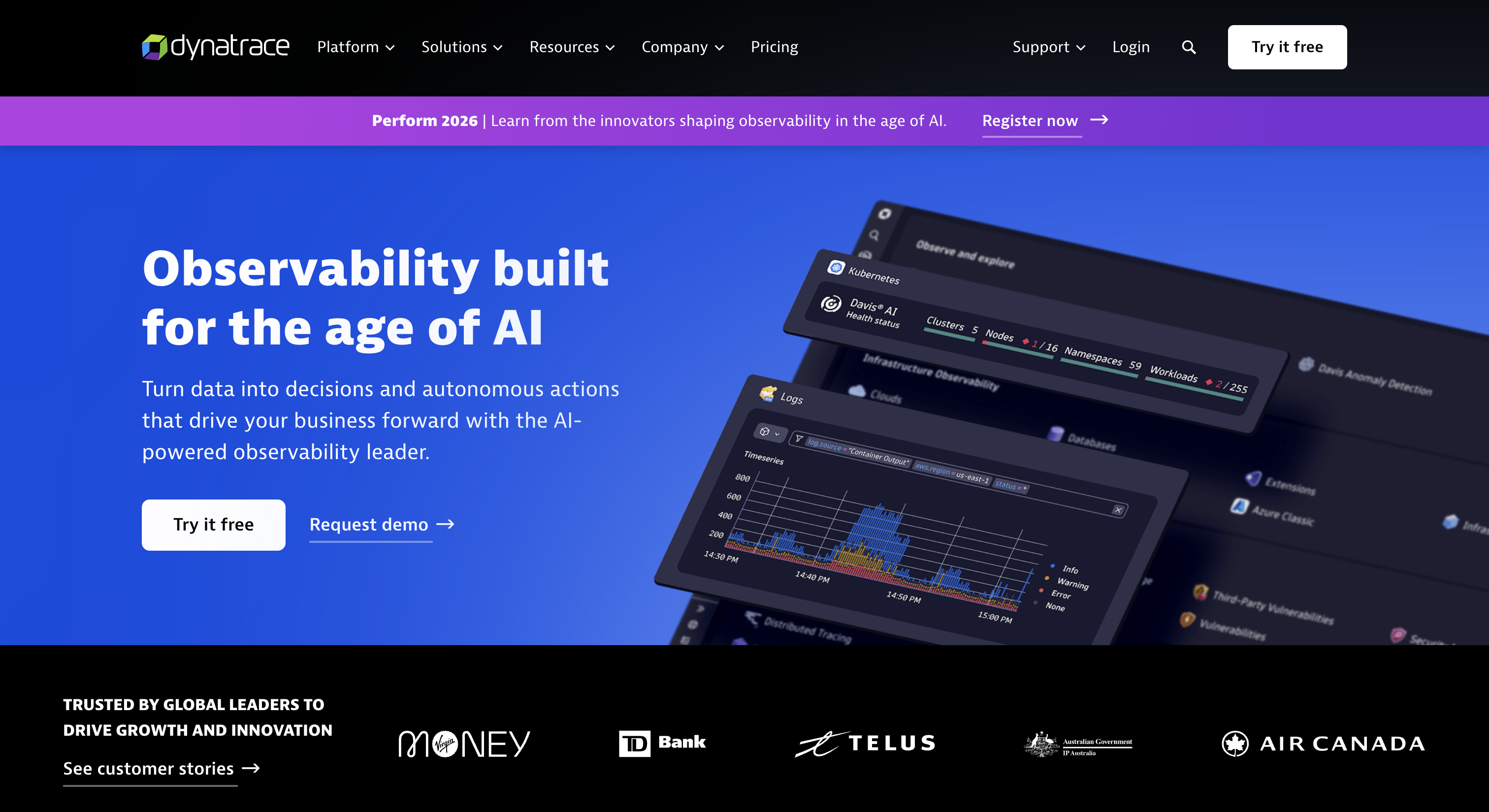
Dynatrace stands as a comprehensive full-stack observability platform, leveraging AI to provide automatic and intelligent monitoring across your entire application landscape. It offers deep insights into complex enterprise environments, making it particularly adept at handling traditional and modern application stacks, including those heavily reliant on SOAP web services.
With its OneAgent technology, Dynatrace automatically discovers and maps all dependencies, services, and transactions, offering an unparalleled view into how SOAP calls traverse your infrastructure. This allows for pinpoint accuracy in identifying performance bottlenecks or errors within SOAP interactions, even across highly distributed systems.
Key Features
- Automatic discovery and mapping of SOAP services and their dependencies.
- End-to-end distributed tracing for individual SOAP transactions.
- AI-powered root cause analysis for rapid issue identification in SOAP failures.
- Real-time performance metrics (response times, error rates) for SOAP endpoints.
- Synthetic monitoring to proactively test SOAP service availability and performance.
- Deep code-level visibility for troubleshooting SOAP-related issues.
Pros
- Exceptional auto-discovery and dependency mapping for complex SOAP ecosystems.
- Powerful AI-driven insights significantly reduce MTTR for SOAP-related problems.
- Comprehensive full-stack monitoring provides context beyond just the SOAP service.
- Strong capabilities for large, enterprise-grade deployments with diverse technologies.
Cons
- Can be complex to set up and configure for smaller environments or less experienced teams.
- Pricing can be on the higher side, reflecting its comprehensive feature set.
- Resource-intensive due to its deep data collection and analysis capabilities.
3. AppDynamics
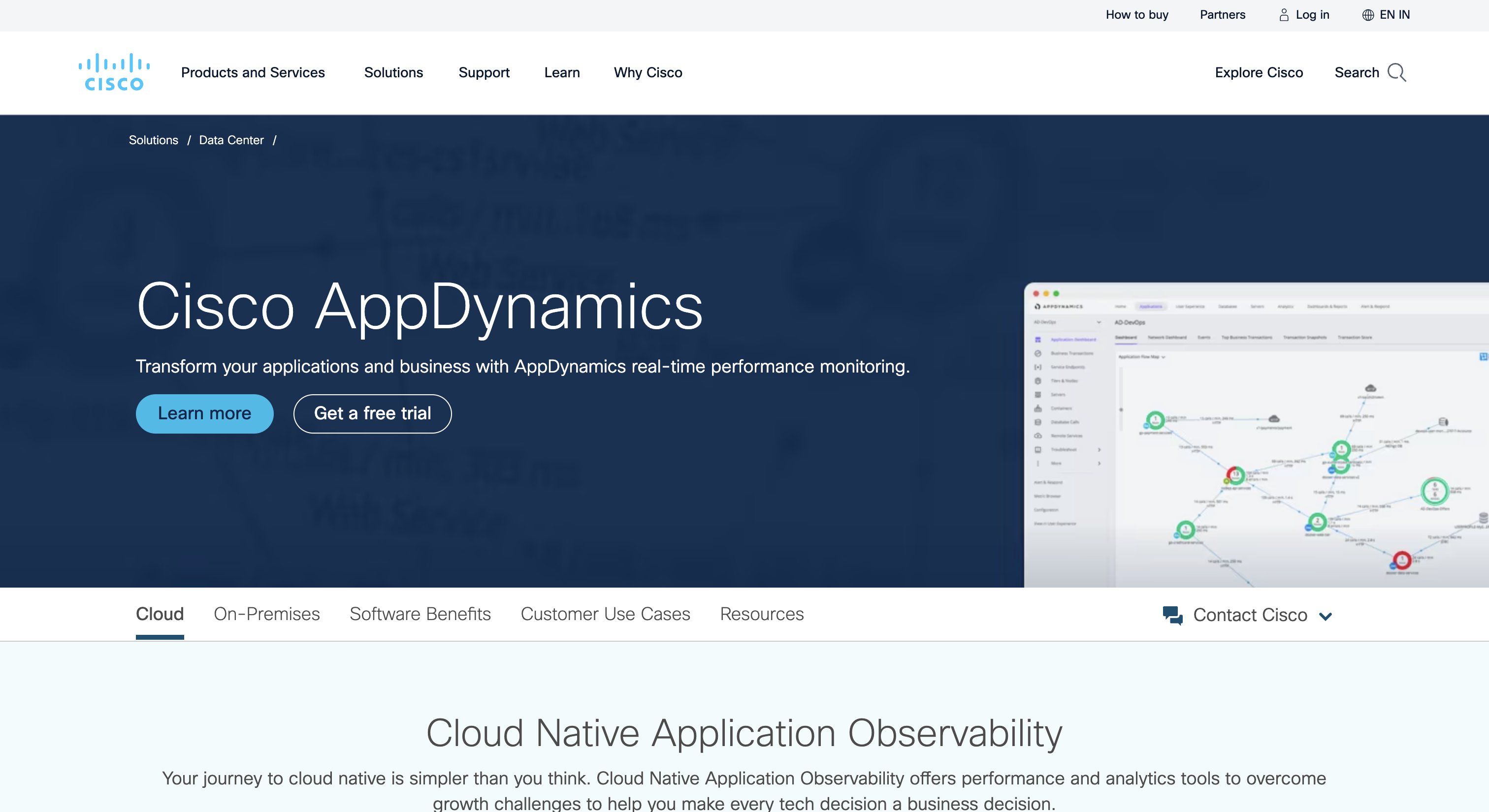
AppDynamics, part of Cisco, offers a powerful application performance monitoring (APM) solution with a strong focus on business transaction monitoring. It provides deep visibility into the performance of applications and infrastructure components, allowing organizations to link application performance directly to business outcomes.
For SOAP monitoring, AppDynamics excels at tracing complex transactions that involve SOAP calls, providing a granular view of how these services impact the user experience and business processes. It helps pinpoint issues within the SOAP layer that might otherwise be hidden in a maze of interconnected services.
Key Features
- Business transaction monitoring that includes SOAP service calls.
- End-to-end transaction tracing across distributed systems.
- Code-level diagnostics for identifying performance bottlenecks within SOAP implementations.
- Automatic baselining and anomaly detection for SOAP service metrics.
- Real-time performance dashboards and customizable alerts for SOAP endpoints.
- Integration with various enterprise technologies and cloud platforms.
Pros
- Excellent for understanding the business impact of SOAP service performance.
- Deep transaction tracing helps in isolating issues within multi-tier SOAP interactions.
- Strong analytics and reporting capabilities for performance trends.
- Good for complex, distributed applications with critical SOAP dependencies.
Cons
- Can be resource-intensive and require significant configuration for optimal use.
- Pricing can be a barrier for smaller organizations or those with limited budgets.
- May require a learning curve to fully leverage its advanced features.
4. New Relic
New Relic provides an observability platform that encompasses APM, infrastructure monitoring, log management, and more, offering a unified view of your entire software stack. It's designed to give developers and operations teams comprehensive insights into application health and performance, irrespective of the underlying technology.
Its capabilities extend effectively to SOAP web services, allowing users to monitor the performance of individual SOAP requests, track error rates, and analyze the impact of SOAP calls on overall application responsiveness. New Relic helps ensure that your critical SOAP services are always performing optimally.
Key Features
- APM for monitoring individual SOAP transactions and their performance.
- Detailed error tracking and stack traces for SOAP failures.
- Customizable dashboards and alerting for SOAP service metrics.
- Distributed tracing to visualize SOAP call flows across microservices.
- Synthetic monitoring to proactively test SOAP endpoint availability.
- NRQL (New Relic Query Language) for deep data analysis of SOAP interactions.
Pros
- Unified platform simplifies monitoring across diverse application components, including SOAP.
- Flexible querying with NRQL allows for tailored insights into SOAP data.
- Good community support and extensive documentation.
- Offers a generous free tier for getting started, making it accessible.
Cons
- The breadth of features can be overwhelming for new users.
- Advanced features and higher data ingestion can lead to increased costs.
- Configuration for very specific SOAP scenarios might require custom instrumentation.
5. SolarWinds APM
SolarWinds APM provides full-stack visibility, combining application performance monitoring, infrastructure monitoring, and distributed tracing into a single solution. It's designed to help IT teams quickly identify and resolve performance issues across hybrid and cloud environments, offering a clear picture of application health.
For SOAP monitoring, SolarWinds APM helps track the performance and availability of SOAP APIs, allowing users to see how SOAP calls contribute to overall application response times and error rates. It simplifies the process of monitoring these critical backend services within a broader application context.
Key Features
- Distributed tracing for end-to-end visibility of SOAP transactions.
- Real-time metrics for SOAP service response times, throughput, and errors.
- Automatic code-level insights for troubleshooting SOAP method performance.
- Customizable dashboards and alerting for SOAP-specific thresholds.
- Infrastructure monitoring contextualized with application (SOAP) performance.
- Integration with other SolarWinds IT operations management tools.
Pros
- Provides a good balance of APM and infrastructure monitoring in one tool.
- Relatively straightforward setup and user interface compared to some competitors.
- Affordable pricing model for comprehensive monitoring capabilities.
- Effective for quickly identifying the source of performance issues, including those in SOAP services.
Cons
- May not offer the same depth of AI-powered analysis as some market leaders.
- Can sometimes require more manual configuration for highly custom SOAP environments.
- User interface might feel less modern than some newer platforms.
6. SmartBear AlertSite
SmartBear AlertSite is a dedicated external monitoring platform focused on ensuring the uptime and performance of websites, web applications, and APIs. It offers global monitoring from over 300 locations, providing synthetic transaction monitoring to proactively detect performance and availability issues before they impact end-users.
For SOAP monitoring, AlertSite excels at testing and verifying the availability and performance of your SOAP web services from various geographical locations. It can simulate complex multi-step SOAP transactions, providing crucial insights into the user experience and service health outside your firewall.
Key Features
- Synthetic transaction monitoring for multi-step SOAP API calls.
- Global monitoring from a vast network of nodes (over 300 locations).
- Detailed performance metrics including response time, DNS, connect, and receive times for SOAP.
- Customizable alerts via various channels (email, SMS, PagerDuty, Slack) for SOAP failures.
- Ability to validate XML responses for correctness and content.
- Integration with other SmartBear tools like ReadyAPI and SoapUI.
Pros
- Excellent for external monitoring and understanding global SOAP service performance.
- Robust synthetic transaction capabilities for complex SOAP workflows.
- Clear and actionable alerts help prevent downtime.
- No agents required, making deployment simple for external endpoint monitoring.
Cons
- Primarily focused on external synthetic monitoring, less on internal code-level APM.
- May not provide deep internal root cause analysis beyond what’s visible externally.
- Costs can add up with increased monitoring locations and frequency.
7. Site24x7
Site24x7 is a unified cloud monitoring solution that offers APM, server monitoring, website monitoring, network monitoring, and real user monitoring from a single console. It's designed to provide comprehensive visibility into the performance of applications and infrastructure hosted across various environments, including hybrid and cloud.
Site24x7 provides robust monitoring for SOAP web services, enabling users to keep a close eye on their availability, performance, and functionality from different global locations. Its ability to mimic user interactions with SOAP endpoints makes it an effective tool for ensuring business continuity for services that rely on these traditional APIs.
Key Features
- Synthetic transaction monitoring for SOAP/WSDL APIs from global locations.
- Ability to send custom SOAP requests and validate XML responses.
- Performance metrics including response time, content length, and error codes for SOAP.
- Threshold-based alerts via email, SMS, voice calls, and push notifications.
- Root cause analysis reports with screenshots and network diagnostics for SOAP failures.
- Integration with major cloud providers and third-party services.
Pros
- All-in-one monitoring platform simplifies IT operations.
- Cost-effective pricing suitable for small to medium-sized businesses and enterprises.
- Easy to set up and configure synthetic monitors for SOAP APIs.
- Global monitoring presence helps ensure worldwide availability and performance.
Cons
- Deep code-level insights may not be as granular as some dedicated APM solutions.
- User interface can feel a bit busy due to the breadth of features.
- Custom scripting for very complex SOAP interactions might have limitations.
8. ReadyAPI (SmartBear)
ReadyAPI is SmartBear's comprehensive API testing platform, consolidating functional testing, performance testing, security testing, and API virtualization. While primarily a testing tool, its robust capabilities naturally extend to continuous monitoring, especially when integrated with other tools like AlertSite.
ReadyAPI's strength in SOAP monitoring lies in its ability to create highly detailed and complex test cases for SOAP services, which can then be automated and run continuously. This allows for rigorous validation of SOAP endpoint functionality and performance over time, moving beyond simple uptime checks to ensure data integrity and business logic correctness.
Key Features
- Advanced functional testing for complex SOAP requests and XML validation.
- Load testing capabilities to assess SOAP service performance under stress.
- Security testing to identify vulnerabilities in SOAP endpoints.
- API monitoring setup through integration with AlertSite for continuous external checks.
- Data-driven testing for varying SOAP input payloads.
- Generation of comprehensive reports on SOAP test results and performance.
Pros
- Unmatched capability for creating detailed and complex SOAP test cases.
- Excellent for ensuring the functional correctness and data integrity of SOAP services.
- Integration with AlertSite provides robust external monitoring capabilities.
- Comprehensive reporting helps in understanding SOAP service quality over time.
Cons
- Primarily a testing tool, requiring additional configuration or integrations for true continuous APM.
- Can have a steep learning curve due to its extensive feature set.
- Licensing costs can be significant, especially for the full suite of features.
9. Postman
Postman is widely recognized as a collaborative platform for API development, testing, and documentation. While it started as a simple HTTP client, it has evolved into a comprehensive suite that supports the entire API lifecycle, including a robust monitoring solution that extends to SOAP services.
Postman Monitoring allows users to run collections of SOAP requests at scheduled intervals from various global regions. This provides a straightforward way to check the availability, performance, and correctness of SOAP endpoints, making it accessible even for teams without dedicated APM expertise but who still need proactive alerts on their critical services.
Key Features
- Scheduled execution of SOAP requests from Postman collections.
- Global monitoring locations to check SOAP service availability and latency.
- Ability to assert and validate XML responses for specific content or structure.
- Customizable alerts for failures, high response times, or specific response content.
- Integration with CI/CD pipelines for automated SOAP service checks.
- Detailed reporting on monitor runs, response times, and failure reasons.
Pros
- Extremely easy to set up monitoring for existing SOAP requests in Postman.
- Cost-effective, especially for teams already using Postman for API development.
- Flexible assertions allow for thorough validation of SOAP responses.
- Good for quick checks and proactive alerts for critical SOAP endpoints.
Cons
- Less comprehensive than dedicated APM solutions for deep internal code-level insights.
- Scalability for very high-volume, complex transaction tracing is limited.
- Monitoring is primarily external synthetic, not real user monitoring or full-stack observability.
10. Datadog
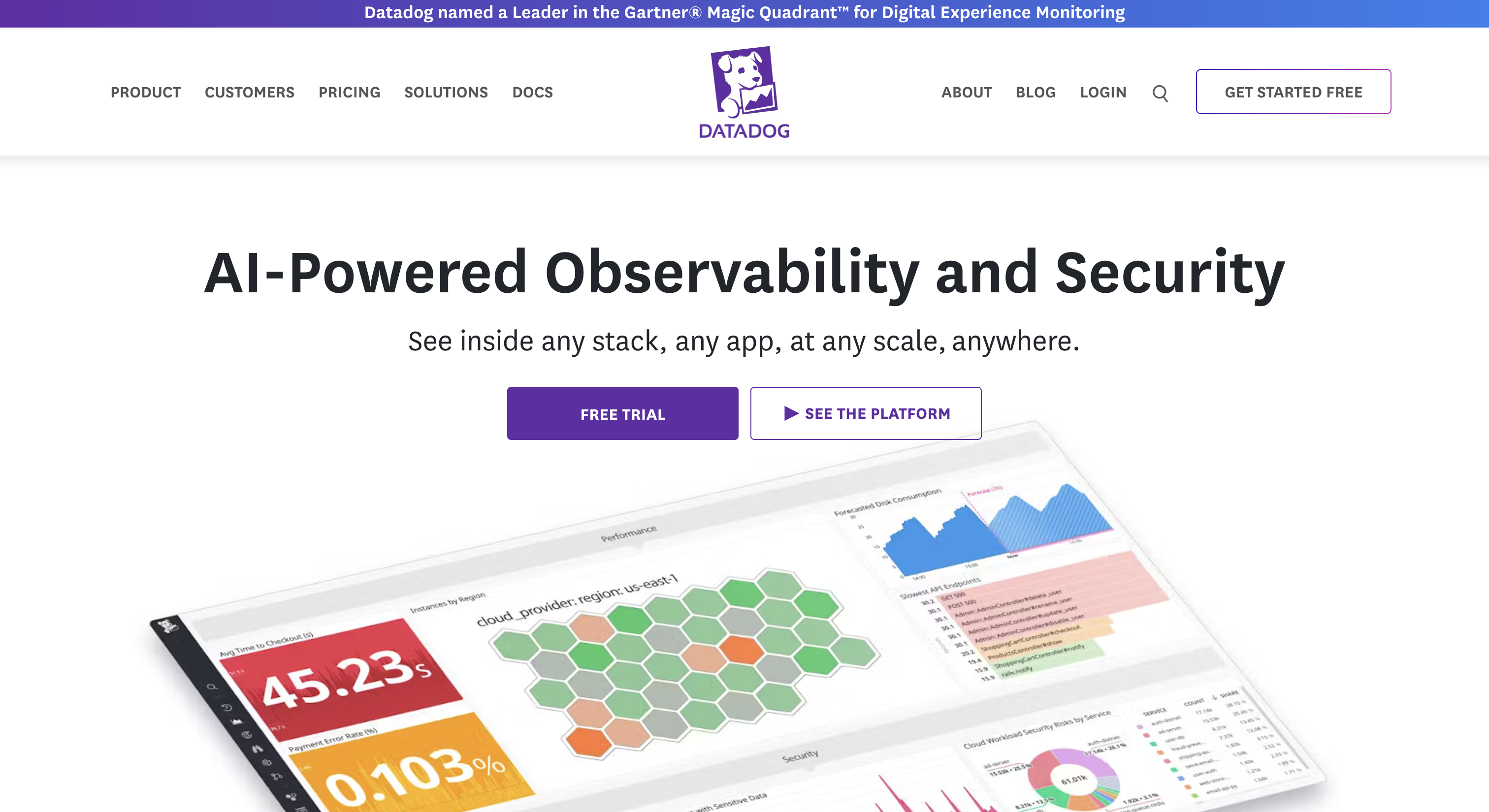
Datadog is a leading monitoring and analytics platform for cloud-scale applications, servers, databases, tools, and services. It provides end-to-end visibility across your entire technology stack, offering a unified view of metrics, traces, and logs. Its comprehensive approach makes it highly adaptable to various environments.
For SOAP monitoring, Datadog's APM can trace requests through services that interact with SOAP APIs, providing performance metrics and error rates. Additionally, its Synthetic Monitoring capabilities allow for proactive testing of SOAP endpoints from various global locations, ensuring their availability and responsiveness before issues impact users.
Key Features
- APM with distributed tracing to track SOAP calls within your application.
- Real-time performance metrics (latency, error rates) for SOAP-interacting services.
- Synthetic monitoring to proactively test SOAP endpoint availability and validate responses.
- Log management capabilities to aggregate and analyze SOAP service logs.
- Customizable dashboards and anomaly detection for SOAP-related metrics.
- Wide range of integrations with cloud providers and other development tools.
Pros
- Excellent for monitoring complex, cloud-native environments that may include SOAP.
- Unified platform for metrics, logs, and traces simplifies troubleshooting.
- Strong synthetic monitoring capabilities for proactive SOAP service checks.
- Scalable and flexible for growing infrastructure and diverse workloads.
Cons
- Can become expensive as data ingestion and feature usage increase.
- May require more agent-based setup for deep APM insights compared to agent less tools.
- The breadth of features might present a learning curve for new users.
Final Thoughts
The SOAP monitoring landscape is broad, spanning everything from deep, full-stack APM platforms like Dynatrace and AppDynamics, to external synthetic monitoring tools such as SmartBear AlertSite, and developer-friendly options like Postman. Each plays an important role, depending on whether your priority is runtime performance, availability, testing, or diagnostics.
However, as SOAP services continue to power critical enterprise workflows, monitoring alone is no longer enough. Organizations increasingly struggle with fragmented visibility, unclear ownership, inconsistent governance, and limited insight into how SOAP APIs are actually consumed across teams and gateways. This is where platforms like DigitalAPI complement traditional monitoring tools, by providing a unified layer of discovery, governance, and intelligence across the entire SOAP API estate.
When choosing the right solution, teams should look beyond uptime and response times. Consider the scale and sprawl of your SOAP APIs, how many gateways and teams are involved, and whether you have a single source of truth for visibility, access, and lifecycle management. The right approach combines monitoring with centralized intelligence, helping enterprises not just detect issues, but sustainably operate, govern, and evolve their SOAP services with confidence.
Dhayalan Subramanian is Associate Director, Product Growth at DigitalAPI, where he leads go-to-market and product growth for the company’s multi-gateway API management platform. His work focuses on helping large enterprises and mid-market cloud companies consolidate APIs across AWS, Azure, Apigee, Kong, MuleSoft, and other gateways into a single control plane for governance, discovery, monetization, and agent consumption.
Dhayalan brings 14+ years of experience across product strategy, enterprise architecture, and engineering leadership. Earlier in his career, he held senior roles at Encora (as Associate Architect and Technical Manager), Mindtree (Technology Lead), Tech Mahindra (Technical Lead), and Primus Analytics, where he designed integration frameworks and delivered enterprise-grade digital platforms for global customers.
At DigitalAPI, he works directly with platform, integration, and developer experience leaders at Fortune 500 organizations to operationalize unified API catalogs, developer portals, and MCP-ready APIs. He writes regularly on API developer experience, API governance, and AI agent architectures.


One email a fortnight. Worth opening.
A short digest of what we're writing, what we're learning from customers, and the handful of links you'd actually want from us. No tracking pixels.

.avif)