



MuleSoft vs Kong: The heavyweight vs. the featherweight in 2026
A comparison of MuleSoft and Kong requires looking beyond marketing claims to understand their fundamental architectural differences.

MuleSoft and Kong both claim to manage APIs. That's where the similarity ends.
MuleSoft is an integration engine. It connects systems that don't speak the same language pulling data from a mainframe, transforming COBOL to JSON, and exposing it as a REST API. It is a factory that manufactures clean APIs out of messy backends.
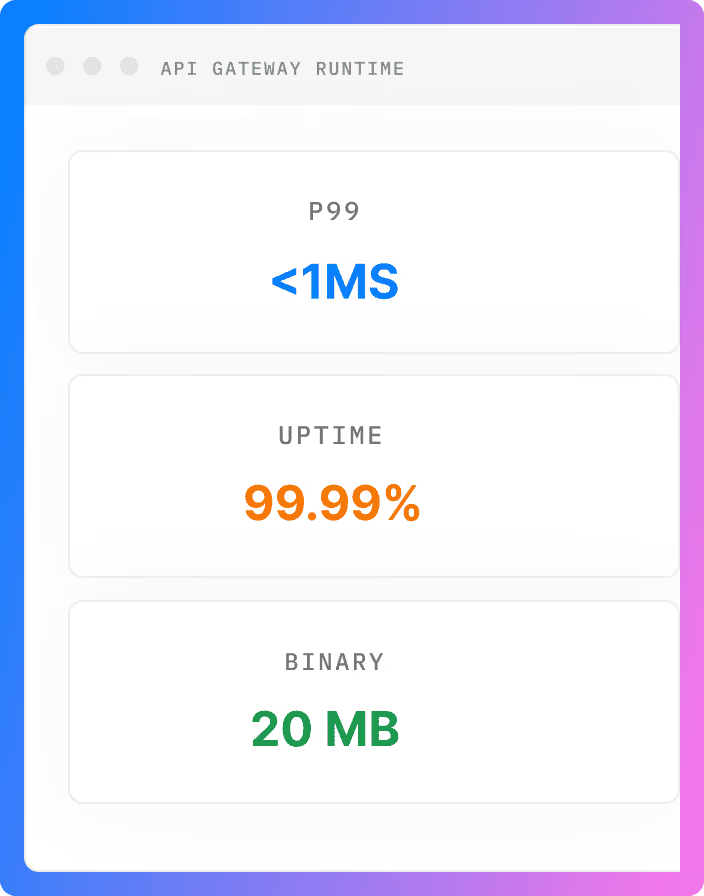
Kong is a traffic proxy. It manages requests for APIs that already exist, sitting in front of microservices to handle authentication, rate limiting, and routing at sub-millisecond speed. It is a traffic cop that keeps high-speed roads safe without ever opening the packages passing through.
The conflict arises when organisations try to use one tool for the other's job. Using Kong for deep data transformation requires writing large amounts of custom Lua or Go code to handle what MuleSoft does natively. Using MuleSoft to proxy simple HTTP traffic is like sending a freight train to deliver a pizza slow, expensive, and structurally wrong. MuleSoft production deployments run $150,000–$250,000+ per year; Kong Enterprise starts at approximately $50,000/year. Paying integration platform prices for gateway tasks is the most common and most expensive mistake in enterprise API architecture.
This guide covers what each platform actually does, where each wins, how their costs compare, and what the right strategy looks like when you genuinely need both.
TL;DR
1. MuleSoft is an iPaaS and integration engine: legacy connectivity, data transformation, and complex orchestration. Not a gateway.
2. Kong is a high-performance API gateway: traffic proxying, rate limiting, authentication, and Kubernetes-native deployment. Not an integration platform.
3. Using MuleSoft as a gateway means paying $150K–$250K+/year for compute you don't need. Using Kong for complex ETL means writing transformation logic MuleSoft handles natively.
4. Most enterprises in 2026 need both MuleSoft for legacy system integration, Kong for modern microservice traffic.
5. MuleSoft's Gold tier starts at $1,250/month per vCore; a realistic 4-vCore Platinum contract runs $210,000/year. Kong Enterprise starts at ~$50,000/year with per-service pricing.
6. DigitalAPI sits above both: a unified control plane that governs MuleSoft APIs and Kong services from one interface, exposes both as MCP tools for AI agents, and enables a phased migration from heavy integration runtime to lightweight gateway.
7. Gartner predicts over 30% of new API demand will come from AI and LLM tools neither platform natively exposes APIs as MCP tools without additional tooling.
The Fundamental Difference: Engine vs Proxy
Before comparing features, the architecture has to be right. These tools process requests in fundamentally different ways.
MuleSoft runs on the Mule Runtime: a Java-based engine that fully processes each request, applies DataWeave transformation logic, orchestrates calls to multiple backends, and returns a composed response. It inspects the full payload. It enriches and reformats data. It handles complex routing based on content. For connecting a Salesforce CRM to a Siebel legacy system via an API-led three-tier architecture, this processing depth is precisely what you need.
The cost of that depth is latency and compute. MuleSoft adds 10–50ms of variable latency per request depending on the policies applied acceptable for a backend integration that runs once per business event, but structurally wrong for a consumer-facing API handling tens of thousands of requests per second.
Kong runs on NGINX: a C-based web server built for non-blocking I/O at extreme throughput. It treats API requests as sealed packages: it inspects headers and security tokens, enforces rate limits, and routes traffic without opening or transforming the payload. A single Kong node handles approximately 16,000 requests per second at 3.5ms p99 latency. It deploys as a lightweight sidecar container next to each microservice in a Kubernetes cluster and spins up in milliseconds.
What Kong does not do: DataWeave-style payload transformation, complex multi-system orchestration, or legacy protocol bridging. Custom Kong plugins can handle basic transformations, but complex ETL logic written in Lua is a maintenance liability no platform team wants.
Feature Comparison (scroll to view full table)
| Dimension | MuleSoft Anypoint | Kong Gateway |
|---|---|---|
| Core engine | Java-based Mule Runtime | NGINX-based proxy |
| Primary purpose | Integration (iPaaS) and API lifecycle | Traffic management and API gateway |
| Data handling | Full payload transformation via DataWeave | Header inspection; treats body as sealed package |
| Latency profile | 10–50ms variable (policy-dependent) | Sub-millisecond; ~3.5ms p99 at scale |
| Throughput | Lower: compute-heavy per-request processing | ~16,000 RPS per node under load |
| Developer workflow | Anypoint Studio (GUI), DataWeave, specialised skills | YAML configuration, VS Code, standard GitOps skills |
| Protocol support | HTTP, SOAP, JMS, EDI, file-based; legacy-first | HTTP/S, gRPC, GraphQL, TCP, WebSocket; modern-first |
| Kubernetes fit | Heavy: not designed as a Kubernetes-native sidecar | Native: Kubernetes Ingress Controller included |
| Open source | No | Yes (OSS core under Apache 2.0) |
| Pricing model | vCore-based (Gold: ~$1,250/vCore/month) | Per-service (Konnect Plus: $105/service/month) |
| Enterprise cost | $150K–$250K+/year typical production deployment | $50K+/year enterprise; OSS free for self-hosted |
| AI / MCP readiness | No native MCP support | MCP support through Kong AI Gateway (developing) |
| Best for | Legacy system integration, SAP/Salesforce connectivity | Microservices, Kubernetes, high-volume API traffic |
Dimension 1: Architecture
MuleSoft uses a hub-and-spoke model. Traffic routes to a central Mule runtime, which processes it, applies transformation logic, and routes the result. This centralisation is deliberate it gives architects a single point of governance and policy enforcement across all connected systems. It is excellent for regulated industries where every data transformation must be auditable and every integration point must be governed.
The trade-off is latency and infrastructure cost. The Mule runtime is a Java process that requires significant memory and CPU per deployed application. At CloudHub pricing, that compute is charged as vCores and every pass-through proxy, however simple, consumes vCore capacity at the same rate as a complex SAP integration. You pay integration prices for gateway tasks.
Kong uses a decentralised sidecar model. A small Kong container sits next to each service in your Kubernetes cluster, handling traffic at the service boundary without a central hub. There are no hops through a centralised runtime. Configuration propagates via the Kong Admin API or declarative YAML. Scaling means adding more lightweight containers, not purchasing more vCores.
Verdict on architecture: MuleSoft wins for centralised governance of complex integration flows. Kong wins for distributed, high-throughput traffic management at scale. They serve different architectural patterns and the choice should match the workload, not the preference.
Dimension 2: Data Handling
MuleSoft's most powerful differentiator is DataWeave a functional programming language designed specifically for data transformation. It handles XML to JSON mapping, complex field transformations across legacy data formats, merging response payloads from multiple backend calls into a single composed response, and conditional logic across data structures. If your organisation has mainframe data in COBOL format that needs to become a clean REST API response, DataWeave does this natively with purpose-built connector libraries for SAP, Oracle, Salesforce, Siebel, and 1,500+ other systems.
The lock-in risk is real. DataWeave is proprietary to MuleSoft. Every transformation written in DataWeave is tied to the Mule runtime. DataWeave specialists command $150,000–$200,000 annually in the US. When the DataWeave developer leaves, the institutional knowledge goes with them.
Kong treats payloads as opaque. It routes, rate-limits, and authenticates without inspecting the body of requests. Custom transformation plugins exist you can write them in Lua, Go, or Python but Kong was not designed to be a transformation engine. Teams that use Kong for complex ETL are maintaining custom plugin code that MuleSoft handles declaratively.
Verdict on data handling: MuleSoft wins for complex legacy data transformation. Kong wins for speed and simplicity when your data is already well-structured JSON or gRPC. The question to ask is: does my API need transformation before it can be exposed, or is it already in the right format?
Dimension 3: Developer Experience
MuleSoft developers work in Anypoint Studio a GUI-based IDE where integration flows are built by dragging and dropping connectors onto a canvas. Complex logic is written in DataWeave and configured via property sheets. This low-code approach reduces the barrier for integration specialists who are not full-stack engineers. The trade-off: "MuleSoft Developer" is a specific certification and job title. A standard platform engineer cannot simply join a MuleSoft project without specific training. MuleSoft consultants charge $150–$250 per hour as of March 2026.
Kong developers work in their existing editor. Gateway configuration is YAML declarative, Git-committable, and reviewable via standard pull requests. Custom plugin development uses standard languages (Go, Python, Lua). Any developer who understands HTTP and YAML can configure and maintain a Kong deployment. This fits modern GitOps workflows naturally: the gateway configuration lives in the same repository as the service it protects.
Verdict on developer experience: Kong wins for modern platform engineering teams running GitOps workflows. MuleSoft wins for integration specialists who need a visual design tool and pre-built connectors for legacy system work. The skills pool for Kong is orders of magnitude larger, which has real hiring implications for enterprise teams.
Dimension 4: Cost
MuleSoft's Gold tier starts at approximately $1,250/month per vCore. A realistic production deployment needs 2–4 vCores. Add non-production environments, premium SAP or Salesforce connectors, implementation costs through a certified partner, and DataWeave developer salaries, and a mid-market deployment routinely crosses $350,000–$600,000 in year one. A Platinum contract with 4 vCores across 3 environments has been reported at $210,000/year in licensing alone, before implementation.
The critical problem for gateway workloads: the vCore model charges for compute capacity whether that capacity is running a complex SAP transformation or simply proxying an HTTP request. Every simple pass-through gateway function consumes the same vCore capacity as complex integration logic.
Kong's pricing is structurally different. The open-source core is free to self-host. Konnect Plus charges $105/service/month with additional request-volume charges. Kong Enterprise starts at approximately $50,000/year for dedicated support, advanced security, and SSO. For organisations that only need gateway capabilities routing, rate limiting, authentication Kong delivers the same functionality at a fraction of MuleSoft's compute-based cost.
Verdict on cost: Kong wins decisively for gateway workloads. MuleSoft's vCore model is justified for complex integration but uneconomic for traffic management. Teams that use MuleSoft as a gateway are paying integration prices for gateway functionality. Moving high-volume, low-complexity traffic from MuleSoft to Kong or DigitalAPI's Arelio API Gateway immediately reduces infrastructure spend.
How to Choose: Which Platform Fits Your Situation
The decision matrix is simpler than the feature comparison suggests. The question is not "which tool is better" it is "which problem do I actually have."
Choose MuleSoft when:
Your primary problem is legacy system connectivity. You are integrating SAP, Oracle EBS, Siebel, Workday, or a mainframe with modern APIs. Your data is in non-standard formats (COBOL, EDI, XML proprietary schemas) that need transformation before they can be exposed. Your team has MuleSoft expertise already. The governance model of a centralised hub matches your organisation's compliance requirements.
Choose Kong when:
Your primary problem is traffic management. You are running microservices on Kubernetes and need a gateway that fits your GitOps workflow. Your APIs already expose well-structured JSON. You need sub-millisecond latency at scale. Your team writes in standard languages and you want to avoid proprietary tool lock-in. Cost predictability matters more than a pre-built connector library.
Choose both when:
Most enterprises in 2026 are in this category. You have legacy integration work that requires MuleSoft's DataWeave and connector library, and you have modern microservice traffic that requires Kong's performance and lightweight footprint. The mistake is trying to force one tool to do both jobs. The right architecture uses each for its intended purpose, with a unified control plane above both.
The Unified Architecture: Using Both Without Creating New Silos
When you run MuleSoft and Kong simultaneously, you have two separate governance surfaces. MuleSoft has its own API catalog, its own policy engine, its own developer portal. Kong has its own. Developers don't know which gateway a given API runs on or how to find it. Security policies applied in one gateway don't automatically apply in the other. You have solved the technical problem and created an operational one.
This is the problem DigitalAPI addresses. The API management platform sits above both gateways as a unified control plane. It connects to MuleSoft Anypoint and Kong via read-only credentials, indexes every API across both systems into a single searchable catalog, and applies governance policies consistently across both. A developer searching for a payment API finds it regardless of which gateway it runs on. A security policy change propagates to both systems from one interface.
The AI readiness layer matters here too. MuleSoft was built for humans and legacy systems it has no native mechanism for exposing its APIs as MCP tools that AI agents can invoke. Kong's MCP support is developing but requires additional configuration. DigitalAPI's MCP Gateway converts any API in the catalog whether it runs on MuleSoft, Kong, Arelio, AWS API Gateway, or Apigee into an agent-callable MCP server in one click, with governance policies applied automatically. Your legacy MuleSoft payment integration becomes callable by an AI agent on the same day you connect it to DigitalAPI, without rewriting a line of integration logic.
If you're running MuleSoft for legacy integration and Kong for microservice traffic and need a unified view across both, DigitalAPI connects to both in under 24 hours and surfaces every API from both systems in one searchable catalog your developers, partners, and AI agents can access from day one.
Migration Playbook: The Strangler Fig Pattern
Most enterprises don't need to choose between MuleSoft and Kong. They need a strategy to move new workloads off MuleSoft which was never designed for high-volume API proxying onto a lightweight gateway, without disrupting the legacy integration work MuleSoft actually does well.
The Strangler Fig pattern does this safely. You gradually peel functionality off the monolith while keeping it running, until enough has moved that the legacy runtime can be decommissioned. DigitalAPI acts as the traffic controller throughout: developers and consumers see a consistent API contract at every stage, with no awareness of the infrastructure migration happening beneath.
Step 1: The overlay:
Connect DigitalAPI to your MuleSoft Anypoint account. The platform ingests your RAML and OpenAPI specifications and creates a shadow catalog of your legacy API estate. You now have complete API discovery across every MuleSoft-managed API without touching any live traffic. This step takes under 24 hours.
Step 2: The facade:
Deploy a lightweight gateway Kong or Arelio and configure it as a simple pass-through proxy in front of MuleSoft. All traffic flows: Client → New Gateway → MuleSoft → Backend. No logic changes. You have established a control point over traffic without disrupting any existing integrations. This is where you begin applying consistent authentication and rate limiting policies from the DigitalAPI control plane.
Step 3: The slice:
Identify a high-volume, low-complexity API typically a read-only endpoint like GET /products or GET /customers. Build a new microservice that serves this endpoint directly from the source database, bypassing Mule processing entirely. Deploy it behind the new gateway without routing public traffic to it yet.
Step 4: The switch:
Update the routing logic in DigitalAPI to direct traffic for /products to the new microservice while all other routes continue to flow to MuleSoft. Consumers see no change in the API contract. DigitalAPI pushes the configuration change to both gateways simultaneously. The immediate effect: the high-traffic endpoint is now served at Kong's sub-millisecond latency instead of MuleSoft's 10–50ms, and the vCores consumed by that endpoint are freed from your MuleSoft contract.
Step 5: Deprecation:
Once the new microservice is stable, decommission the corresponding flow in your MuleSoft application. Repeat this pattern for each API endpoint prioritising the highest-volume, lowest-complexity APIs first, since these deliver the fastest cost reduction. MuleSoft continues running the complex integration flows it is genuinely well-suited for, while simple traffic routes through a lightweight gateway at a fraction of the cost.
FAQs
1. Can Kong fully replace MuleSoft?
Not entirely. Kong replaces API gateway functions security, rate limiting, traffic routing faster and cheaper than MuleSoft. It cannot handle MuleSoft's deep integration logic: DataWeave transformations, legacy system connectors, or complex multi-system orchestration. Most enterprises need both tools for different workloads. See the MuleSoft alternatives guide for a full breakdown of what the replacement landscape looks like.
2. Why is MuleSoft so expensive for gateway workloads?
MuleSoft's vCore pricing model charges for compute capacity allocated to the Mule runtime, regardless of what that runtime is actually doing. A simple pass-through proxy consumes vCores at the same rate as a complex SAP integration. The Gold tier starts at approximately $1,250/month per vCore, which means teams using MuleSoft primarily as a gateway are paying iPaaS prices for gateway tasks. Moving that traffic to Kong or Arelio reduces cost without reducing capability for those workloads.
3. Is DataWeave available outside MuleSoft?
No. DataWeave is proprietary to MuleSoft. Transformation logic written in DataWeave cannot be migrated to another platform without rewriting it in a standard language like Python or Java. This is the source of MuleSoft's switching cost every DataWeave transformation is tied to the Mule runtime. When planning an exit strategy, the DataWeave rewrite scope is the most accurate measure of migration effort.
4. Which is better for microservices on Kubernetes?
Kong. Its NGINX architecture, lightweight container footprint, Kubernetes Ingress Controller, and GitOps-native YAML configuration make it purpose-built for Kubernetes environments. MuleSoft's centralised, heavy Java runtime is an architectural mismatch for Kubernetes-first microservice deployments — it adds latency, cost, and centralisation to a pattern designed for decentralisation.
5. How do I run MuleSoft and Kong together without creating two separate governance silos?
A unified control plane above both gateways solves this. DigitalAPI connects to both systems, creates a single API catalog across both, and applies consistent governance policies without requiring you to manage two separate policy engines. You can compare how the platforms relate to DigitalAPI's approach at DigitalAPI vs MuleSoft and DigitalAPI vs Kong.
Dhayalan Subramanian is Associate Director, Product Growth at DigitalAPI, where he leads go-to-market and product growth for the company’s multi-gateway API management platform. His work focuses on helping large enterprises and mid-market cloud companies consolidate APIs across AWS, Azure, Apigee, Kong, MuleSoft, and other gateways into a single control plane for governance, discovery, monetization, and agent consumption.
Dhayalan brings 14+ years of experience across product strategy, enterprise architecture, and engineering leadership. Earlier in his career, he held senior roles at Encora (as Associate Architect and Technical Manager), Mindtree (Technology Lead), Tech Mahindra (Technical Lead), and Primus Analytics, where he designed integration frameworks and delivered enterprise-grade digital platforms for global customers.
At DigitalAPI, he works directly with platform, integration, and developer experience leaders at Fortune 500 organizations to operationalize unified API catalogs, developer portals, and MCP-ready APIs. He writes regularly on API developer experience, API governance, and AI agent architectures.
One email a fortnight. Worth opening.
A short digest of what we're writing, what we're learning from customers, and the handful of links you'd actually want from us. No tracking pixels.

.avif)