



How to launch a branded API developer portal for monetization, analytics, and growth?
Launching a branded developer portal that bundles usage-based billing, subscription plans, and analytics unlocks a new revenue stream while empowering developers with transparency and self-serve workflows.

In 2025, the global market for API monetization platforms is growing rapidly, with estimates forecasting a near quadruple expansion in the next decade. As businesses increasingly embrace the API-first model, more companies are exposing internal capabilities as public interfaces and charging for access.
Launching a branded developer portal that bundles usage-based billing, subscription plans, and analytics unlocks a new revenue stream while empowering developers with transparency and self-serve workflows. In this shift, a well-built developer portal becomes the gateway to transforming APIs from technical tools into monetizable products.
What is an API developer portal?
An API developer portal is a dedicated, self-serve platform where developers discover, learn, test, and consume APIs. It acts as the front door to your API ecosystem, bringing together everything a developer needs in one place: API documentation, onboarding guides, authentication keys, sandbox access, SDKs, sample requests, and support resources.
Instead of APIs living in disconnected gateways, repos, or internal teams, a developer portal creates a single, structured experience for both internal and external users. Beyond documentation, modern API developer portals are built to support productization and monetization. They enable self-service signup, API key management, usage tracking, subscription plans, and analytics.
For businesses, this turns APIs into measurable digital products with clear adoption, performance, and revenue visibility. For developers, it removes friction, shortens time-to-first-call, and provides clarity on how to use, scale, and pay for APIs, making integration faster and more predictable.
Why developer portals are the engine of API monetization?
API monetization doesn’t start with billing; it starts with discovery, trust, and self-serve access. A developer portal is where APIs become real products with pricing, plans, and measurable revenue. Without a portal, monetization remains fragmented across gateways, finance tools, and manual workflows.
1. Turns APIs into Sellable Products
Developer portals package raw APIs into clearly defined products with features, limits, and pricing. Instead of exposing endpoints in isolation, you present bundled API plans that developers can actually understand and buy. This shift, from endpoints to products, is the foundation of sustainable API revenue.
2. Enables Self-Serve Subscriptions and Upgrades
The fastest-growing API businesses reduce sales friction with self-serve onboarding. A monetization-ready developer portal lets users sign up, choose plans, upgrade, downgrade, and cancel without human involvement. This directly increases conversion rates while lowering customer acquisition costs.
3. Connects Usage Directly to Revenue
Monetization only works when API usage is accurately metered and mapped to pricing plans. Developer portals act as the bridge between API traffic, billing systems, and revenue dashboards. This tight loop enables real-time visibility into which APIs, customers, and endpoints are actually making money.
4. Makes Pricing and Limits Transparent
Hidden rate limits and unclear overage rules kill trust. A good developer portal surfaces pricing tiers, quotas, and throttling rules upfront. This transparency not only reduces support overhead but also increases developer confidence to scale usage and spend.
5. Powers Data-Driven Monetization Decisions
With built-in API analytics, portals give product teams insight into adoption, churn, feature usage, and revenue per API. This data fuels smarter pricing experiments, tier optimization, and lifecycle decisions. Without a portal, monetization becomes guesswork instead of strategy.
6. Creates a Scalable Revenue Channel Across Teams
APIs are used by partners, third-party developers, and internal teams alike. A centralized developer portal allows you to monetize across all audiences from one control plane, without duplicating gateways, billing logic, or access workflows. This is what allows API programs to scale beyond pilot revenue.
Developer portal for monetization: Definition and core capabilities
A developer portal for monetization is a branded, self-serve platform that allows businesses to package, publish, price, and monetize their APIs as commercial products. Unlike traditional developer portals that focus mainly on documentation, a monetization-first portal integrates pricing plans, subscription management, usage tracking, billing, and revenue analytics directly into the developer experience.
It becomes the commercial front door of your API program, where developers discover APIs, subscribe to plans, generate keys, track usage, and pay for access. For businesses, it transforms APIs from technical assets into scalable digital revenue channels.
- API productization & catalog management: The portal must support grouping raw endpoints into well-defined API products with clear use cases, versions, and lifecycle stages. This helps position APIs as commercial offerings rather than just technical interfaces.
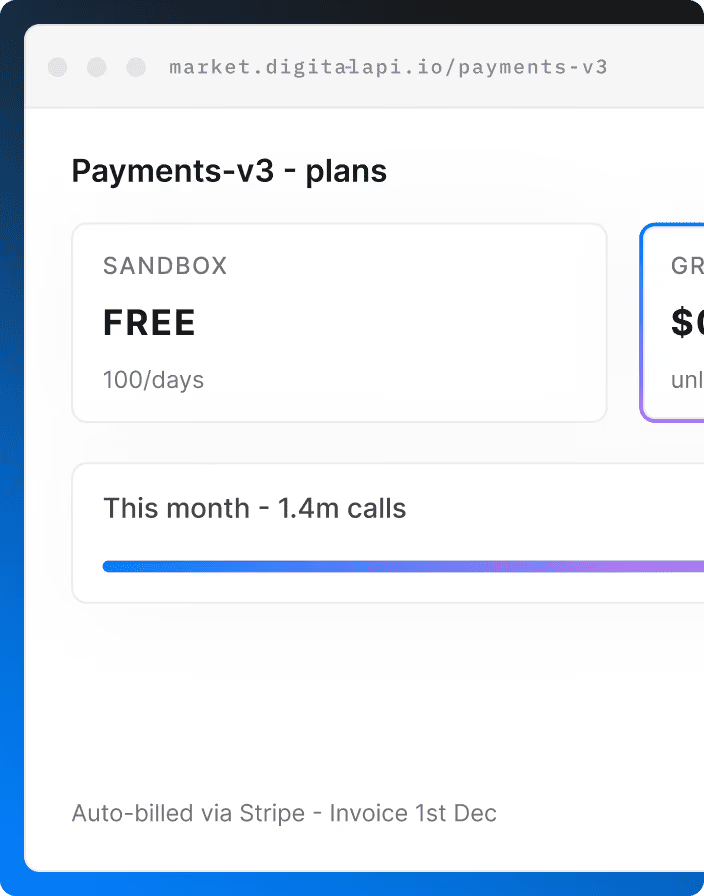
- Built-in pricing plans & monetization models: Support for freemium, tiered, pay-as-you-go, prepaid credits, and enterprise contracts is essential. Pricing should be configurable at the product and plan level without engineering changes.
- Self-serve subscriptions & access control: Developers should be able to sign up, choose a plan, generate API keys or tokens, and gain access instantly. Plans must map directly to rate limits, quotas, and scopes enforced at the gateway level.
- Usage tracking & API analytics: Real-time visibility into API calls, consumption by customer, endpoint usage, errors, and performance is critical. These analytics drive both billing accuracy and product growth decisions.
- Billing & payments integration: Native or seamless integrations with billing platforms like Stripe, Chargebee, or Zuora enable automated invoicing, metering, taxes, overages, and revenue recognition.
- Branded, white-label developer experience: A monetization portal must look and feel like an extension of your brand, with custom domains, UI theming, onboarding flows, and developer journeys designed for conversion, not just documentation.
How do monetization, analytics, and branding fit together?
A high-performing developer portal for monetization is not built by stitching together random tools for billing, analytics, and documentation. These three layers, branding, monetization, and analytics, must work as one connected system. When they are unified, the portal becomes a growth engine that attracts developers, converts usage into revenue, and continuously optimises itself using real data.
1. Branding is what drives discovery and trust
Branding is the first conversion layer of API monetization. A branded developer portal establishes credibility, reduces perceived risk, and signals that your APIs are production-ready. Clear positioning, intuitive UX, and consistent visual identity directly influence whether developers sign up, explore pricing, and commit to integration.
2. Monetization is what turns usage into revenue
Monetization sits at the transactional core of the portal. Pricing plans, subscriptions, quotas, and overages transform API usage into predictable revenue streams. Without native monetization workflows inside the portal, billing becomes Manual, error-prone, and disconnected from real consumption.
3. Analytics is what connects product, growth, and revenue
Analytics is the intelligence layer that links branding and monetization to outcomes. Usage data, conversion rates, churn, feature adoption, and revenue per API reveal what’s actually working. These insights power smarter pricing decisions, developer journey optimisation, and long-term monetization strategy.
4. The feedback loop that powers scale
When branding drives adoption, monetization captures value, and analytics inform optimisation, a continuous feedback loop is created. Each layer reinforces the next; more developers lead to more data, better data leads to smarter pricing, and stronger pricing improves revenue performance.
5. Why siloed tools break this system
When branding lives in a CMS, monetization in a billing tool, and analytics in a separate dashboard, teams lose visibility and velocity. Data becomes fragmented, decision-making slows down, and monetization performance suffers due to blind spots between product, engineering, and finance.
6. The unified portal advantage
A modern monetization-ready developer portal unifies branding, billing, and analytics into a single experience. Developers get clarity and self-serve control, while businesses gain real-time visibility into adoption, performance, and revenue, unlocking scalable, product-led API growth.
Step-by-step: Best way to launch a branded developer portal for monetization
Launching a monetization-ready developer portal is not a one-time technical project; it is a structured product, business, and growth initiative. The most successful API programs treat their portal as a revenue platform from day one. These steps outline the proven path to building a branded, scalable, and analytics-driven developer portal for monetization.
- Define your api monetization strategy and target audience: Start by deciding what you are monetizing, who you are monetizing for, and how revenue will be generated. Identify whether your APIs serve internal teams, partners, third-party developers, or all three. Then choose your core monetization mode, such as freemium, pay-as-you-go, tiered subscriptions, or enterprise contracts based on usage patterns and business goals.
- Inventory and productize your APIs: List all available APIs across teams, gateways, and environments. Group related endpoints into clear API products with defined use cases, versions, and lifecycle stages. This step is critical because monetization works at the product level, not at the raw endpoint level.
- Choose the right developer portal platform: Decide whether to build your own portal, extend a gateway-native portal, or use a dedicated monetization-ready developer portal platform. Evaluate options based on branding control, multi-gateway support, built-in analytics, billing integrations, security, and scalability. The platform you choose will determine how fast and how far your monetization program can grow.
- Design the branded developer experience for conversion: Your portal should guide developers from discovery to their first successful API call within minutes. Design intuitive navigation, clear documentation, interactive API explorers, and transparent pricing pages. Strong branding, simple onboarding, and frictionless key generation directly impact signup and paid conversion rates.
- Configure pricing plans, quotas, and billing workflows: Set up your pricing tiers, usage limits, rate limits, and overage rules at the plan level. Integrate your billing provider to automate metering, invoicing, payments, taxes, and revenue tracking. This ensures API usage maps cleanly to revenue without manual intervention.
- Implement api analytics and revenue dashboards: Instrument your APIs to track usage by customer, endpoint, product, and plan. Enable dashboards for adoption, churn, error rates, performance, and revenue metrics. These insights allow product, finance, and engineering teams to make data-driven monetization decisions.
- Launch, validate, and optimize continuously: Release the portal first to internal teams and select partners before a full public launch. Monitor developer activation, time to first call, plan conversions, and early revenue signals. Use analytics feedback to refine pricing, onboarding flows, and API packaging on an ongoing basis.
Common mistakes when launching a monetization-ready developer portal
Most API monetization initiatives fail not because the APIs are weak, but because the portal is treated as a side project instead of a revenue platform. Small execution gaps in onboarding, pricing, analytics, or governance quickly turn into stalled adoption and lost revenue. Avoiding these common mistakes can dramatically improve your chances of building a scalable monetization engine.
- Treating the developer portal as a documentation site instead of a revenue product
- Launching pricing without validating the developer's willingness to pay
- Hiding rate limits, quotas, and overage rules until after signup
- Relying on manual billing and usage reconciliation
- Lacking real-time api analytics and revenue visibility
- Overcomplicating pricing with too many tiers and rules
- Ignoring internal and partner monetization use cases
- Locking the portal to a single api gateway too early
- Designing onboarding without optimizing for time to first api call
- Shipping without clear api ownership, lifecycle, and governance
Evaluation checklist: Choosing the right developer portal for monetization & analytics
Not all developer portals are built for monetization at scale. Many platforms handle documentation well but fall short when it comes to billing, analytics, and revenue operations. This checklist helps you evaluate whether a developer portal can truly support long-term API monetization and data-driven growth.
- Branded, white-label developer experience: The portal should fully reflect your brand with custom domains, UI theming, and configurable onboarding flows. A strong branded experience builds trust, improves developer conversion, and positions your APIs as enterprise-grade products rather than experimental tools.
- Native support for API monetization models: The platform must support freemium, tiered subscriptions, pay-as-you-go, prepaid credits, and enterprise contracts out of the box. Flexible pricing models allow you to adapt to different customer segments without rebuilding billing logic every time.
- Built-in usage tracking and api analytics: Real-time visibility into API usage by customer, product, endpoint, and plan is critical. The portal should provide dashboards for adoption, churn, performance, and revenue so that monetization decisions are based on data, not assumptions.
- Seamless billing and payments integration: The portal should integrate cleanly with billing platforms like Stripe, Chargebee, or Zuora. This enables automated metering, invoicing, tax handling, overages, and revenue recognition without manual reconciliation.
- Strong access control, security, and governance: The platform must support role-based access control, single sign-on, token management, rate limiting, and audit logs. These capabilities ensure that monetized APIs remain secure and compliant as usage scales.
- Multi-gateway and multi-environment support: Enterprises rarely operate on a single gateway. The right portal should unify APIs across APIs deployed on platforms like Apigee, Kong, AWS, and Azure into a single monetization and analytics layer.
- Scalability across teams, partners, and public ecosystems: Your monetization portal should work for internal teams, partners, and external developers from the same control plane. This allows you to scale revenue without duplicating onboarding flows, billing logic, or governance frameworks.
How Digitalapi’s branded developer portal helps you launch faster?
DigitalAPI turns what is usually a slow, multi-tool build into a streamlined, ready-made ecosystem, helping you go from “idea” to “live monetized APIs” far more quickly. By unifying gateways, governance, monetization, and analytics under one roof, it reduces fragmentation and drastically shortens your launch timeline.
- Unified, gateway-agnostic control plane for all APIs: With DigitalAPI you don’t need to juggle multiple gateways or bolt-on tools. It enables you to connect APIs across different gateways and clouds into a single consolidated catalog and control layer. This means you can publish APIs, manage lifecycle, governance, and monetization from one interface, saving weeks that would otherwise go into integration and custom wiring.
- Built-in monetization, subscription, and billing flows: DigitalAPI offers native support for subscription management, usage tracking, and monetization, so you don’t need to build billing logic or stitch with external tools. This drastically reduces engineering overhead and lets you treat your APIs as products from day one, rather than retrofitting monetization later.
- Integrated analytics, usage tracking, and real-time visibility: With DigitalAPI, you get out-of-the-box dashboards for traffic, performance, usage by customer or endpoint, and business-usage metrics all in one place. This gives your product, finance, and engineering teams immediate clarity on adoption, performance, and revenue vital for pricing, scaling, and optimization decisions.
- White-label branded developer portal and self-serve onboarding experience: DigitalAPI allows you to present APIs under your brand, with custom theming, onboarding flows, documentation, and developer UX, giving external partners or customers a polished, production-ready feel. That means you don’t start with a prototype or internal-only portal; you get a production-ready “storefront” for external consumption from day one.
- Faster time-to-market and lower operational risk compared to custom builds: Rather than spending 6–12 months building, integrating, testing, and securing a bespoke portal, DigitalAPI’s pre-built platform lets you go live in weeks. Because governance, security, analytics, and monetization are baked in, you reduce the chances of misconfigurations, making launch predictable, repeatable, and scalable.

FAQs
1. What is a developer portal for monetization?
A developer portal for monetization is a branded, self-serve platform that lets businesses publish APIs as paid products. It combines documentation, plans, subscriptions, access control, usage tracking, and billing in one experience. Developers can sign up, choose plans, generate keys, monitor usage, and pay for consumption, while businesses gain centralized control over revenue, access, and product performance today at enterprise scale.
2. How does an API developer portal help with API monetization and analytics?
An API developer portal connects monetization and analytics by linking every API call to a customer, plan, and price. It tracks who is using which APIs, at what volume, and under which subscription. This data feeds real-time dashboards for usage, revenue, churn, and growth, allowing teams to optimise pricing, detect abuse, forecast revenue, and improve the developer journey using consumption signals.
3. Do I need a separate API monetization platform, or can my developer portal handle billing?
You do not always need a separate API monetization platform if your developer portal has native billing, metering, and subscription management. Modern monetization-ready portals can handle plan creation, usage tracking, overages, invoicing, and revenue dashboards directly. A separate platform is mainly required when you need very advanced financial reporting, complex revenue sharing, or regulatory-grade billing workflows for large global enterprise programs.
4. What are the best pricing models for monetized APIs (freemium vs pay-as-you-go vs tiered)?
Freemium works best for driving adoption by lowering entry barriers and encouraging experimentation. Pay-as-you-go suits variable workloads where customers want to pay strictly for consumption. Tiered pricing fits predictable usage with clear upgrade paths. Many successful APIs combine all three by offering a free tier for testing, usage-based billing for scale, and tiered plans for enterprise commitments and long-term revenue predictability.
5. How do I integrate Stripe or Chargebee with my API developer portal?
Stripe or Chargebee integration typically happens at the monetization layer of your developer portal. Your portal sends metered API usage, customer identity, and plan data to the billing system, which handles invoices, taxes, payments, and overages. Most modern portals provide native connectors or webhooks for this flow, allowing you to automate subscriptions, upgrades, downgrades, refunds, and revenue reporting without finance engineering.
6. Can I use one developer portal for multiple API gateways like Apigee, Kong, and AWS?
Yes, a modern developer portal can unify APIs across multiple gateways like Apigee, Kong, AWS API Gateway, and Azure under one branded interface. Instead of duplicating onboarding and billing for each gateway, the portal acts as a central control plane for discovery, access, plans, and analytics. This is essential for enterprises operating across clouds, teams, and acquired platforms at a global scale.
7. What metrics should I track to measure API monetization success?
To measure API monetization success, track both product and revenue metrics together. Key indicators include developer activation rate, time to first API call, active paid customers, usage per customer, and conversion from free to paid. On the business side, monitor monthly recurring revenue, average revenue per API, churn, overage revenue, and revenue concentration across customers and products by segment, region, and channel.
Bharath Kumar is the Founder and CEO of DigitalAPI, the multi-gateway API management platform helping organizations unify API discovery, governance, monetization, and AI agent enablement across Apigee, AWS, Azure, Kong, and MuleSoft.
Bharath founded DigitalAPI in 2015 after several years as a Solutions Architect at Apigee, the platform now part of Google Cloud and widely regarded as the foundational product of the modern API management category. At Apigee, he worked across pre-sales, product evangelism, and customer architecture, designing API programs for Fortune 100 customers. Earlier in his career, he held engineering roles at IBM, GalaxE Solutions, and Infinite Computer Solutions.
Under his leadership, DigitalAPI has grown into a globally recognized API management platform and caters to multiple Fortune 500 customers. His perspective on APIs, AI, and developer experience has been featured in Forbes, and he is a recurring speaker at Apidays and other API industry events.
One email a fortnight. Worth opening.
A short digest of what we're writing, what we're learning from customers, and the handful of links you'd actually want from us. No tracking pixels.

.avif)