
AI and MCP
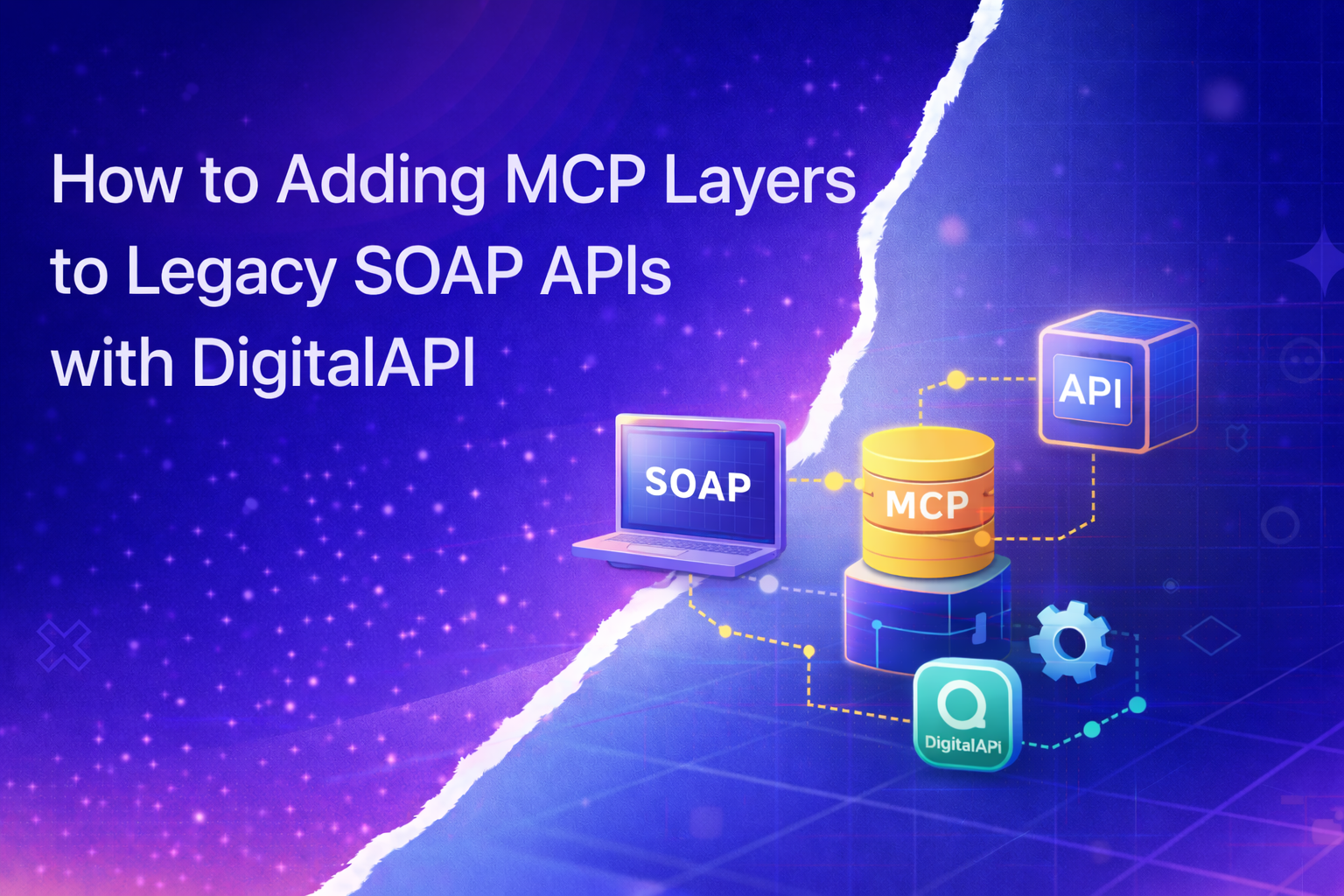
How to adding MCP Layers to Legacy SOAP APIs with DigitalAPI

Updated on:
May 27, 2026
TL;DR
1. Legacy SOAP APIs, while robust, lack the agility and machine-readability needed for modern AI-driven applications and integrations.
2. Adding an MCP (Machine-Readable API Catalog & Protocol) layer transforms SOAP into an AI-ready asset without full rewrites.
3. The process involves first converting SOAP to RESTful interfaces, then enriching these with structured, semantic metadata for MCP.
4. Key steps include comprehensive inventory, designing RESTful equivalents, robust data transformation, and publishing to a machine-readable catalog.
5. DigitalAPI.ai streamlines this complex journey, enabling a one-click conversion from SOAP to REST and seamlessly layering MCP for instant AI readiness.
Future-proof your legacy APIs with DigitalAPI today. Book a Demo!
Organizations often grapple with a vast estate of legacy SOAP APIs, foundational to their operations yet increasingly out of step with the demands of modern, agile development and the burgeoning era of AI. Bridging this chasm requires more than just exposing existing services; it demands a strategic layer that not only modernizes access but also makes these critical assets intelligible to machines and AI agents. This guide delves into the practical strategies and essential steps for adding a Machine-Readable API Catalog and Protocol (MCP) layer on top of your existing SOAP APIs, unlocking their true potential in today's digital landscape.
The Enduring Challenge: Legacy SOAP APIs in a Modern World
SOAP (Simple Object Access Protocol) APIs have been the backbone of enterprise integration for decades, known for their strict contracts, robust security, and reliability. Utilizing XML for messages and often paired with WSDL (Web Services Description Language) for formal interface definitions, SOAP APIs are prevalent in industries requiring high transactional integrity, such as finance, healthcare, and government.
However, their verbosity, XML-centric nature, and often complex tooling make them cumbersome for modern developers accustomed to the simplicity and flexibility of RESTful (Representational State Transfer) APIs and JSON data formats. Furthermore, the explicit, human-readable documentation of SOAP, while thorough, falls short when it comes to the implicit, semantic understanding required by autonomous AI agents.
The challenge isn't merely a preference for JSON over XML; it's about agility, developer experience, and the ability to integrate seamlessly with cloud-native applications and empowering AI agents. Ripping and replacing these deeply embedded SOAP services is often impractical, costly, and high-risk. The goal, therefore, is to modernize access and interaction without undertaking a full-scale migration, turning a legacy asset into a future-ready one.
Introducing the MCP (Machine-Readable API Catalog & Protocol) Layer
The MCP layer represents the next evolution in API management, extending beyond human-readable documentation to a structured, semantic, and machine-interpretable format. It's not just an API catalog; it's a protocol for machine understanding and interaction, particularly vital for the rise of AI agents and automated workflows.
An MCP layer comprises:
- Structured Metadata: Rich, standardized data about the API, its owner, lifecycle, domain, security, and usage policies.
- Semantic Descriptions: Beyond syntax, the MCP layer describes the meaning and intent of API operations, entities, and data models using taxonomies or ontologies.
- Action Schemas: Explicitly defines the actions an API can perform, their inputs, outputs, and any preconditions or post-conditions, enabling AI agents to reason about API capabilities.
- Discoverability: A robust, searchable catalog where machine agents can autonomously find and understand relevant APIs.
By providing this layer, APIs become self-describing in a way that machines can consume directly, enabling automated API discovery, invocation, and composition. This is the crucial bridge for connecting traditional systems to the AI-driven future.
Why Add MCP Layers to Legacy SOAP APIs?
Integrating an MCP layer on top of your existing SOAP APIs delivers multifaceted benefits, transforming legacy assets into strategic enablers:
- AI Readiness: The most significant driver. AI agents require more than just an OpenAPI spec; they need semantic understanding of what an API does and how to use it safely and effectively. An MCP layer provides this machine-interpretable context, allowing AI to discover, evaluate, and invoke SOAP services indirectly.
- Enhanced Developer Experience: While the MCP layer is primarily for machines, the prerequisite RESTful abstraction makes SOAP services accessible via modern, developer-friendly REST endpoints. This significantly improves adoption for internal and external developers.
- Improved Governance and Security: By exposing SOAP services through a controlled, standardized MCP layer, organizations can apply unified governance model, consistent security policies, and better enforce access controls across all legacy integrations.
- Future-Proofing: Adding an MCP layer allows organizations to incrementally modernize their API estate without disruptive, expensive, and risky "rip and replace" projects. It provides a strategic pathway for API modernization strategies while preserving the stability of core systems.
- Unlocking Data and Capabilities: Many critical business processes and valuable data reside within legacy SOAP services. An MCP layer makes these capabilities discoverable and consumable by new applications, microservices, and AI workflows, unlocking their value.
.png)
The Transformation Journey: SOAP to REST to MCP
Adding an MCP layer to SOAP APIs is typically a two-stage process:
Stage 1: RESTful Abstraction (Wrapping SOAP)
Before an MCP layer can be built effectively, legacy SOAP APIs first need to be exposed as RESTful interfaces. This step translates the complex, XML-based interactions of SOAP into simpler, resource-oriented REST calls, typically using JSON for data exchange. This transformation usually happens at an API gateway or a dedicated proxy layer.
- Why RESTful Abstraction? REST is the de facto standard for modern APIs. It offers statelessness, resource-centric design, and leverage of standard HTTP methods (GET, POST, PUT, DELETE), making APIs easier to consume and more flexible for a wider range of applications. AI agents are also primarily designed to interact with RESTful patterns.
Why RESTful Abstraction? REST is the de facto standard for modern APIs. It offers statelessness, resource-centric design, and leverage of standard HTTP methods (GET, POST, PUT, DELETE), making APIs easier to consume and more flexible for a wider range of applications. AI agents are also primarily designed to interact with RESTful patterns.
Key Considerations:
- Operation Mapping
- Data Transformation
- Error Handling
- Security Translation
Stage 2: Building the MCP Layer on Top of REST
Once your SOAP APIs are exposed as RESTful endpoints, you can then build the MCP layer. This isn't just about generating an OpenAPI specification for your new REST APIs. It's about enriching that specification with semantic metadata and action schemas that enable machine understanding.
What an MCP Layer Entails:
- Extended OpenAPI Specifications
- Semantic Annotations
- Action-Oriented Descriptions
- Structured Governance Metadata
Tools and Approaches: This often involves a specialized API management platform or a dedicated MCP system that can ingest your OpenAPI specs and allow for the addition of this rich, machine-readable metadata.
Practical Steps: How to Add MCP Layers on Top of Legacy SOAP APIs
Implementing an MCP layer requires a structured approach. Here's a step-by-step guide:
1. Identify and Inventory Legacy SOAP Services
Begin by creating a comprehensive inventory of all your existing SOAP APIs. Document their WSDLs, endpoints, security mechanisms, dependencies, and business functions. Prioritize services based on business criticality, frequency of use, and potential for modernization impact.
2. Define Use Cases and Data Requirements for Modern Consumers
Determine why you're adding an MCP layer. What new applications, microservices, or AI agents will consume these services? What data do they need, and in what format? This informs your designing RESTful interfaces and the semantic richness of your MCP layer.
3. Design RESTful Equivalents
For each prioritized SOAP operation, design a corresponding RESTful endpoint. This involves:
- Mapping SOAP operations to appropriate HTTP methods (GET for retrieval, POST for creation, PUT for updates, DELETE for removal).
- Identifying natural resources (e.g., `/customers`, `/orders`) instead of RPC-style operations.
- Defining JSON request and response schemas that correspond to the underlying XML structures.
4. Implement the RESTful Gateway/Proxy
Deploy an API gateway or develop a custom proxy that sits in front of your SOAP services. This layer is responsible for:
- Receiving RESTful requests.
- Transforming JSON payloads into XML for the SOAP service.
- Invoking the SOAP service.
- Transforming the SOAP XML response back into JSON.
- Applying robust security measures (authentication, authorization) for the REST endpoint.
- Handling error translation.
5. Create Machine-Readable Descriptions (MCP Layer)
Once your RESTful wrappers are in place, generate OpenAPI specifications for them. Then, enrich these specifications with MCP-specific metadata:
- Semantic Annotations: Add `x-` extensions to define the business domain, purpose, and semantic meaning of each operation and data field. Link to internal ontologies or industry standards where applicable.
- Action Schemas: Clearly define the actions the API performs, using keywords or structured objects to describe preconditions, effects, and examples of usage for AI agents.
- Governance & Policy Metadata: Embed metadata about data sensitivity, compliance requirements (e.g., GDPR, HIPAA), and service level agreements (SLAs).
6. Publish and Catalog the MCP-Enabled APIs
Publish your newly MCP-enabled APIs to a centralized developer portal and a machine-readable API catalogs. Ensure the catalog is searchable by semantic terms, business functions, and relevant metadata, making it easy for both human developers and AI agents to discover and understand them.
7. Implement Monitoring and Governance
Establish comprehensive monitoring and analytics for your new RESTful and MCP layers. Track usage patterns, performance metrics, and error rates. Continuously enforce your governance policies to ensure the MCP layer remains accurate, secure, and compliant as the underlying SOAP services evolve. Also, plan for API lifecycle management to manage versioning and deprecation.
Leveraging DigitalAPI.ai for a Seamless SOAP to MCP Transition
The manual process of wrapping SOAP, transforming data, and then adding a comprehensive MCP layer can be complex and time-consuming. This is where platforms like DigitalAPI.ai offer a transformative advantage. DigitalAPI.ai is engineered to simplify and accelerate the journey from legacy SOAP to AI-ready MCP endpoints, providing a true "one-click" experience for much of the heavy lifting.
Here’s how DigitalAPI.ai streamlines this critical modernization:
- Automated SOAP to REST Conversion: DigitalAPI.ai intelligently ingests your WSDLs and automatically generates RESTful endpoints. It handles the intricate mapping of SOAP operations to REST resources and methods, significantly reducing manual configuration. This automated layer provides a modern, developer-friendly interface to your existing SOAP services without requiring code changes to the backend.
- Simplified Data Transformation: The platform offers robust capabilities for data transformation, effortlessly converting XML payloads from your SOAP services into JSON for RESTful consumers, and vice-versa. This eliminates the need for custom coding to manage complex data structure mappings, ensuring data integrity and consistency.
- Integrated MCP Layer Generation: Beyond basic OpenAPI generation, DigitalAPI.ai is built with MCP in mind. It allows you to easily enrich your newly generated REST APIs with the semantic metadata, action schemas, and structured governance information essential for AI agents. This includes defining business context, preconditions, and effects, making your APIs truly machine-interpretable and AI-ready from the start.
- Centralized API Catalog and Governance: DigitalAPI.ai provides a unified API catalog that centralizes all your APIs, including the newly MCP-enabled legacy services. This catalog serves as the single source of truth for both human developers and AI systems, complete with rich metadata, automated documentation, and advanced search capabilities. The platform also embeds continuous governance checks, ensuring consistency, compliance, and security across your entire API estate, helping you avoid technical debt.
- AI-Ready API Ecosystem: By standardizing and enriching your legacy APIs with MCP, DigitalAPI.ai helps you build an AI-ready API ecosystem. This ensures your critical business capabilities are discoverable, understandable, and safely invocable by AI agents, enabling advanced automation and intelligent applications to interact seamlessly with your foundational systems.
With DigitalAPI.ai, the formidable task of migrating from legacy systems and transforming them for the AI era becomes manageable, allowing enterprises to unlock the full value of their investments while preparing for future innovation.
Common Pitfalls and How to Avoid Them
Adding MCP layers to legacy SOAP APIs is not without its challenges. Being aware of common pitfalls can help you navigate this journey more effectively:
1. Underestimating Data Transformation Complexity
- Pitfall: Assuming XML to JSON mapping is trivial. Complex nested structures, namespaces, and data types can lead to significant development effort.
- Avoidance: Invest in robust data transformation tools or platforms like DigitalAPI.ai that handle these complexities automatically. Start with simpler SOAP services to gain experience.
2. Ignoring Security in the New Layer
- Pitfall: Focusing only on functional transformation and neglecting to apply modern security practices (OAuth 2.0, API keys) to the new REST/MCP endpoints.
- Avoidance: Design security into the API gateway/proxy layer from day one. Ensure proper authentication, authorization, and rate limiting are in place.
3. Lack of Clear Ownership for the New Layers
- Pitfall: The new RESTful wrapper and MCP layer fall into an ownership gap between the legacy SOAP team and new API teams.
- Avoidance: Clearly define ownership, responsibilities, and maintenance protocols for the new abstraction layers. Integrate them into your existing API lifecycle management.
5. Failing to Keep Documentation/Catalog Updated
- Pitfall: The MCP layer, while machine-readable, still needs to reflect changes in the underlying SOAP service. Manual updates inevitably lead to drift.
- Avoidance: Automate the synchronization of your MCP catalog with source control and CI/CD pipelines. Use platforms that detect and flag discrepancies.
6. Over-engineering the MCP Layer
- Pitfall: Trying to semantically describe every single detail of every API operation from the outset, leading to analysis paralysis.
- Avoidance: Start with essential semantic metadata (core entities, primary actions). Iterate and enrich the MCP layer based on actual AI agent and application consumption needs.
Conclusion
Adding MCP layers on top of legacy SOAP APIs is no longer a futuristic concept; it's a strategic imperative for enterprises looking to thrive in an AI-driven world. By systematically wrapping SOAP services with RESTful interfaces and then enriching them with machine-readable, semantic metadata, organizations can unlock invaluable business capabilities, enhance developer experience, strengthen governance, and future-proof their foundational systems. While the journey involves careful planning and execution, powerful platforms like DigitalAPI.ai offer an accelerated, simplified path to achieving this crucial transformation, empowering your legacy APIs to become dynamic, intelligent participants in the modern digital ecosystem.
FAQs
1. What is an MCP Layer in the context of APIs?
An MCP (Machine-Readable API Catalog & Protocol) layer is a standardized way to describe API capabilities semantically and programmatically. It goes beyond traditional API documentation by providing structured metadata, semantic descriptions, and action schemas that allow machines and AI agents to discover, understand, and safely interact with APIs autonomously.
2. Why is it important to add an MCP layer to legacy SOAP APIs?
Adding an MCP layer to legacy SOAP APIs is crucial for modernization and AI readiness. It allows organizations to expose the valuable data and business logic locked within SOAP services to modern applications and AI agents in a machine-understandable format, without performing costly "rip and replace" migrations. This enhances discoverability, improves developer experience, strengthens governance, and future-proofs legacy systems.
3. What are the main steps involved in adding an MCP layer to SOAP APIs?
The process typically involves several key steps: 1) Inventorying legacy SOAP services, 2) Designing and implementing RESTful wrappers for these services, 3) Transforming data between XML (SOAP) and JSON (REST), 4) Enriching the RESTful API descriptions with semantic metadata and action schemas to create the MCP layer, 5) Publishing these MCP-enabled APIs to a centralized, machine-readable catalog, and 6) Implementing continuous monitoring and governance.
4. Can DigitalAPI.ai help with adding MCP layers to SOAP APIs?
Yes, DigitalAPI.ai is specifically designed to streamline this process. It offers automated tools for converting SOAP WSDLs into RESTful API endpoints, handling complex XML-to-JSON data transformations. Furthermore, it provides the framework to easily add rich, semantic metadata and action schemas to these APIs, effectively creating an MCP layer that makes your legacy services immediately AI-ready and governable within a unified API catalog.
5. What are the key benefits of having an MCP layer for AI agents?
For AI agents, an MCP layer provides the structured context and semantic understanding necessary for autonomous interaction. It enables AI to discover APIs by their business function, understand their preconditions and effects, and safely invoke them without human intervention. This capability is foundational for building intelligent automation, smart applications, and enhancing AI agent orchestration within the enterprise.

.svg)

.avif)