



10 Best API Lifecycle Management Tools in 2026
As the number and variety of APIs grow, so does the challenge of maintaining consistency, quality, and governance.

TL;DR
1. Effective API lifecycle management is critical for preventing sprawl, ensuring quality, and accelerating development in complex enterprise environments.
2. Tools range from specialized design platforms to comprehensive enterprise suites, each offering distinct strengths for different stages of the API lifecycle.
3. Key considerations for selection include ecosystem compatibility, governance capabilities, developer experience, and scalability.
4. No single tool fits all; the best choice depends on organizational size, existing infrastructure, and specific API strategy.
5. Investing in robust API lifecycle management streamlines operations, enhances security, and maximizes the business value of your APIs.
Ready to streamline your API lifecycle journey? Get Started with DigitalAPI today!
The digital landscape is increasingly powered by APIs, making them the lifeblood of modern applications and business processes. As the number and variety of APIs grow, so does the challenge of maintaining consistency, quality, and governance. This is where API lifecycle management tools become indispensable, providing frameworks and platforms to orchestrate the journey of every API.
These tools help teams collaboratively design robust APIs, automate testing, govern usage, monitor performance, and ensure a smooth deprecation process. Selecting the right tool, however, requires a clear understanding of its capabilities, strengths, and ideal use cases.
This comprehensive blog dives into the top 10 API lifecycle management tools, offering a detailed breakdown of each. We'll explore their core functionalities, highlight their unique advantages and potential drawbacks.
Quick comparision of our top 5 picks on best API Lifecycle Management tools
| Tool | Key features (short) | Ideal for |
|---|---|---|
| DigitalAPI |
|
Businesses with multiple gateways looking to unify, govern, and prepare APIs for AI and scale |
| Google Apigee |
|
Large enterprises needing strong security, analytics, and monetisation on a single gateway |
| Kong Enterprise |
|
Platform teams building cloud-native, Kubernetes-first architectures |
| MuleSoft Anypoint Platform |
|
Enterprises with complex integration and Salesforce-centric ecosystems |
| Azure API Management |
|
Organisations operating primarily within the Microsoft Azure ecosystem |
The 10 Best API Lifecycle Management Tools Reviewed
1. DigitalAPI
DigitalAPI is the layer that brings order to an organisation with one or multiple gateways by streamlining the entire API lifecycle management. Instead of replacing what teams already run, it sits above existing gateways and tools to unify discovery, governance, and visibility. For me, that shift, from managing gateways to managing the entire API estate is where real scale begins.
What makes DigitalAPI different is that it’s not trying to be just another gateway or portal. It focuses on how APIs are discovered, governed, adopted, and consumed by developers today and by AI agents tomorrow. It’s built for enterprises that already have complexity and want control without slowing teams down.
Key Features
- Unified API discovery & catalog: Automatically discovers APIs across gateways, clouds, and teams into one searchable catalog with ownership and context.
- Cross-gateway governance: Define governance, access, and lifecycle rules once and apply them consistently across all gateways.
- Enterprise developer portal: A self-serve portal for internal and external developers to discover APIs, request access, and test quickly.
- API lifecycle & ownership controls: Clear workflows for onboarding, versioning, deprecation, and retirement to prevent API sprawl.
- Unified analytics & adoption insights: Consolidated usage and adoption analytics across gateways to identify business-critical APIs.
- AI & agent-ready APIs (MCP & API GPT): Makes APIs consumable by AI agents through MCP enablement, automated docs, and governed tool access.
Pros
- Works with existing gateways, no replatforming
- Brings visibility to fragmented API estates
- Balances governance with developer experience
- Scales across teams, regions, and business units
- Improves API adoption and time-to-value
- Reduces platform sprawl and operational drag
- Prepares APIs for AI and agent-based consumption
Cons
- Delivers maximum value in organisations with scale and complexity
- Requires cross-team alignment to fully succeed
- Shifts how teams think about API ownership and accountability
.png)
2. Postman
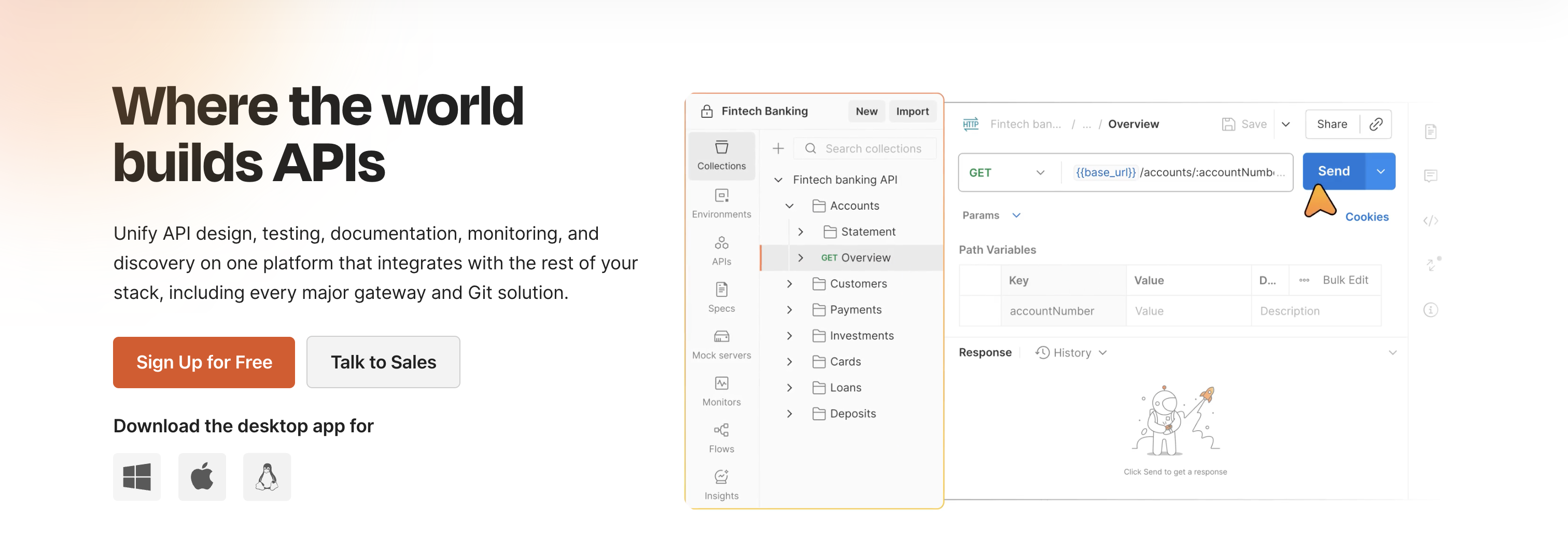
Postman is a popular collaboration platform for API development, enabling users to design, test, document, and monitor APIs. It provides a comprehensive suite of tools that support every stage of the API lifecycle, with a strong focus on developer experience. From sending API requests and inspecting responses to generating code snippets and creating detailed documentation, Postman streamlines the API workflow for individual developers and large teams alike, making it a go-to for rapid API prototyping and testing.
Key features
- API request testing: Build, send, and inspect API requests and responses.
- Collections & environments: Organise APIs and variables for reuse across teams.
- Mock servers: Simulate API responses before backend implementation.
- Auto documentation: Generate API documentation from collections.
- Team collaboration: Share APIs, tests, and workflows in shared workspaces.
Pros
- Best-in-class developer experience
- Extremely fast for prototyping and debugging
- Easy onboarding for individuals and teams
- Strong collaboration and sharing workflows
- Massive community and ecosystem
Cons
- Not an API management or runtime platform
- No real governance or lifecycle enforcement
- Limited security and policy controls
- Breaks down at enterprise scale
- Becomes fragmented when used across large orgs
3. SwaggerHub (SmartBear)
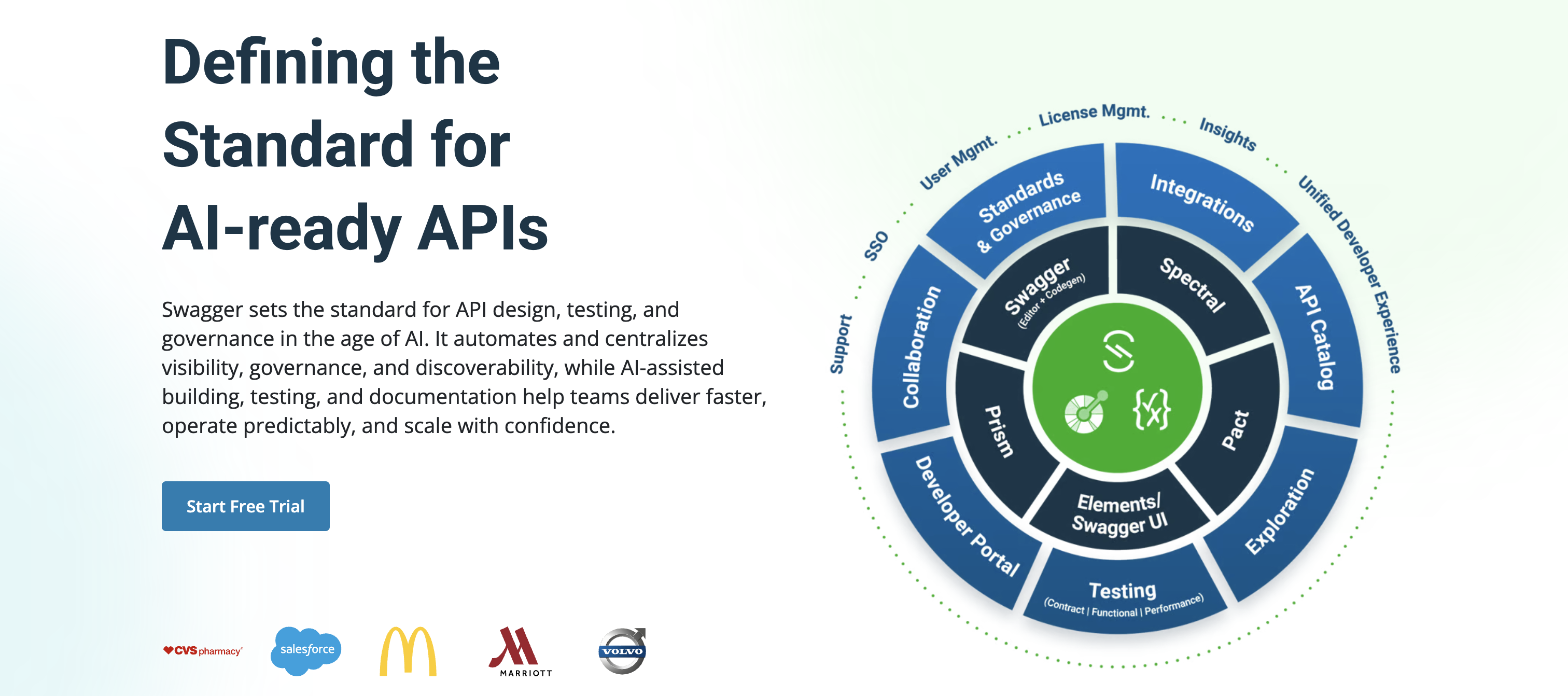
SwaggerHub is an integrated API design and documentation platform built on the OpenAPI Specification (OAS). It centralizes API definitions, enabling collaborative design, standardized documentation, and automated code generation. By providing a single source of truth for API contracts, SwaggerHub facilitates consistency across development teams and ensures that all stakeholders are working from the same, up-to-date specifications, greatly improving API quality and accelerating development cycles.
Key features
- OpenAPI-first design: Create and manage API contracts using the OpenAPI specification as the source of truth.
- Centralised API definitions: Maintain shared, versioned API specifications across teams.
- Versioning & change tracking: Track API evolution and manage breaking and non-breaking changes.
- Auto-generated documentation: Publish standardised API reference docs directly from specs.
- Code generation: Generate client and server stubs from OpenAPI definitions.
Pros
- Strong API contract governance
- Enforces consistency across teams
- Reduces design-time errors
- Clear single source of truth
- Fits well into design-first workflows
Cons
- No runtime or gateway capabilities
- Stops at design and documentation
- Limited operational visibility
- Requires other tools for full lifecycle
- Not suitable as a standalone platform
4. Google Apigee
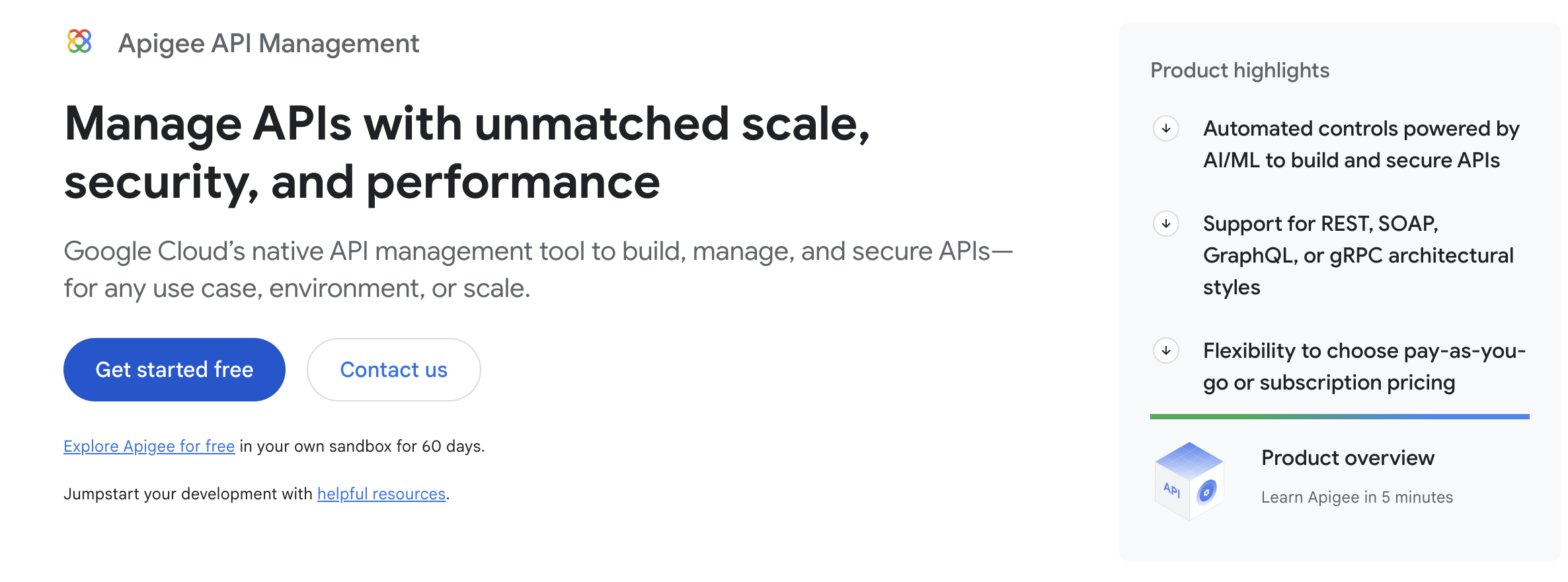
Google Apigee is a comprehensive, enterprise-grade API management platform that enables organizations to design, secure, deploy, monitor, and scale APIs. It provides advanced features for API proxies, traffic management, security policies, developer portals, and analytics. Apigee helps enterprises unlock the value of their data and services by transforming them into consumable APIs, fostering innovation, and driving digital transformation at scale.
Key features
- Enterprise API gateway & proxying: Acts as a secure façade for backend services, managing traffic flow and request mediation.
- Traffic management & rate limiting: Controls API consumption using quotas, throttling, and spike arrest policies.
- Security policy enforcement: Supports OAuth, JWT, API keys, and threat protection to secure APIs at runtime.
- Developer portal: Enables publishing APIs for partners and external developers with onboarding workflows.
- Analytics & monetisation: Provides insights into API usage and supports API product plans and billing models.
Pros
- Extremely mature and battle-tested
- Strong security and governance controls
- Excellent analytics and monetization
- Proven at global enterprise scale
- Trusted by regulated industries
Cons
- High cost of ownership
- Operationally complex
- Strong GCP dependency
- Slower innovation compared to newer platforms
- Not designed for multi-gateway federation
5. MuleSoft Anypoint Platform
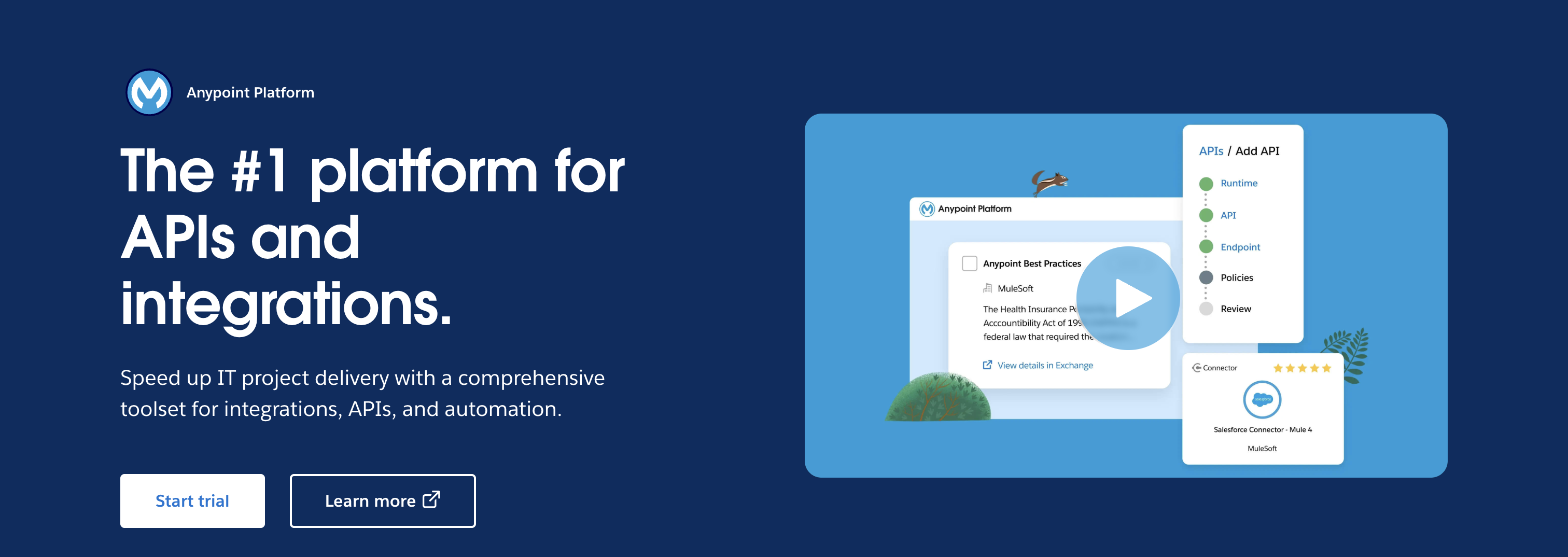
MuleSoft Anypoint Platform is a leading integration platform that combines API management, integration capabilities, and a unified development environment. It allows organizations to build application networks by connecting applications, data, and devices, whether on-premises or in the cloud. With its API-led connectivity approach, MuleSoft enables businesses to design, build, deploy, manage, and govern APIs and integrations, accelerating digital transformation initiatives and improving organizational agility.
Key features
- API management & gateway: Design, deploy, and manage APIs across environments.
- Integration platform (iPaaS): Connect applications, data sources, and systems.
- API-led connectivity: Structure APIs into reusable system, process, and experience layers.
- Centralised governance: Apply security, policies, and lifecycle controls across APIs and integrations.
Pros
- Excellent for integration-heavy enterprises
- Strong governance and lifecycle controls
- Scales well for complex system landscapes
- Deep Salesforce ecosystem alignment
- Mature enterprise platform
Cons
- Expensive licensing model
- Steep learning curve
- Heavyweight for API-only use cases
- Slower developer velocity
- Can feel over-engineered
6. Kong Enterprise
Kong Enterprise is a cloud-native, open-source-based API gateway and service connectivity platform designed for modern architectures like microservices and Kubernetes. It provides high performance, extensibility, and a rich set of features for traffic management, security, and analytics. Kong enables organizations to manage their APIs and services at scale, ensuring reliability, performance, and security across hybrid and multi-cloud environments, making it a popular choice for developer-centric organizations.

Key features
- High-performance API gateway: Handles API routing and security with low latency and high throughput.
- Kubernetes and microservices support: Designed to run natively in cloud-native and containerised environments.
- Plugin-based extensibility: Allows teams to add authentication, security, observability, and traffic policies.
- Hybrid and multi-cloud deployments: Supports consistent API runtime across on-prem, cloud, and hybrid setups.
- Service connectivity: Helps manage communication between microservices and APIs.
Pros
- Extremely fast and lightweight
- Cloud-native and Kubernetes-friendly
- Flexible and extensible
- Strong open-source roots
- Popular with platform engineering teams
Cons
- Weak native governance and lifecycle tools
- Basic analytics and portal capabilities
- Requires stitching multiple tools together
- Enterprise visibility is limited
- Governance at scale is hard
7. Red Hat 3scale API Management
Red Hat 3scale API Management is a comprehensive platform for controlling access, ensuring security, and analyzing API usage. Integrated with the Red Hat ecosystem, it provides a flexible and scalable solution for managing APIs across public, private, and hybrid clouds. 3scale empowers businesses to open up their data and services securely, with features including traffic control, authentication, rate limits, analytics, and a customizable developer portal, often favored by users of OpenShift and Kubernetes.
Key features
- API access management: Control consumer access to APIs using credentials and plans.
- Traffic control & rate limiting: Enforce quotas, limits, and usage tiers.
- Authentication & authorisation: Secure APIs using standard auth mechanisms.
- Developer portal: Onboard internal and partner developers to APIs.
- OpenShift integration: Deploy and operate APIs within Red Hat Kubernetes environments.
Pros
- Strong fit for Red Hat/OpenShift users
- Reliable traffic and access management
- Good security fundamentals
- Works well in hybrid environments
- Open-source foundation
Cons
- Limited API design and discovery
- Developer experience lags behind peers
- Weak lifecycle management
- Not ideal for multi-gateway estates
- Best only within Red Hat ecosystems
8. Stoplight
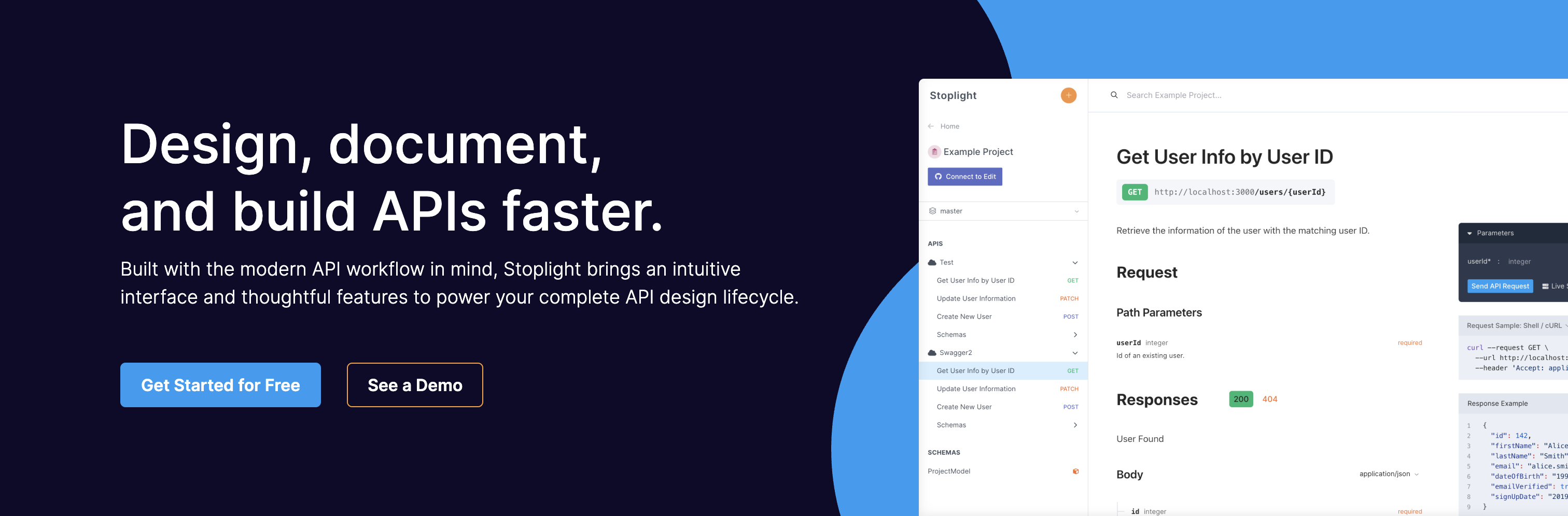
Stoplight offers a modern, collaborative platform for API design, documentation, and governance, primarily focused on the OpenAPI Specification. It emphasizes a design-first approach, providing visual editing tools, style guides, mocking, and automated documentation. Stoplight helps teams build consistent, high-quality APIs faster by streamlining the design process, ensuring compliance with standards, and improving communication between developers and consumers, making it a favorite for teams pushing design excellence.
Key features
- Design-first API development: Create APIs using OpenAPI before implementation.
- Visual API editors: Design and review APIs without writing raw specifications.
- Style guides & linting: Enforce API standards and consistency.
- Mock servers: Test and validate APIs early in the lifecycle.
- Auto-generated documentation: Publish reference docs directly from designs.
Pros
- Excellent API design governance
- Improves API quality early
- Encourages standardisation
- Lightweight and modern UX
- Fits well into CI/CD pipelines
Cons
- No runtime or gateway
- Limited operational capabilities
- Requires integration with management tools
- Not suitable alone for enterprises
- Narrow focus on design only
9. Azure API Management (Microsoft)
Azure API Management is a fully managed service that allows organizations to publish, secure, transform, maintain, and monitor APIs within the Microsoft Azure ecosystem. It provides a scalable, cloud-based platform for managing both internal and external APIs, offering features like authentication, authorization, caching, rate limiting, and analytics. Seamlessly integrated with other Azure services, it enables businesses to expose backend services as modern API endpoints, accelerating cloud adoption and digital innovation.
Key features
- Managed API gateway: Publishes and secures APIs using a fully managed Azure service.
- Policy engine: Applies transformations, security rules, throttling, and caching at runtime.
- Authentication & authorisation: Integrates with Azure AD, OAuth, and API keys.
- Developer portal: Provides onboarding and documentation for internal and external developers.
- Monitoring & analytics: Tracks usage, performance, and reliability within Azure.
Pros
- Seamless Azure ecosystem integration
- Managed and scalable
- Strong enterprise security
- Reliable for internal and external APIs
- Familiar for Microsoft-centric teams
Cons
- Strong Azure lock-in
- Limited multi-cloud flexibility
- Customization constraints
- Slower iteration cycles
- Portal UX can feel rigid
10. Gravitee.io
Gravitee.io is an open-source, API management platform offering a full suite of features including an API Gateway, API Designer, API Management Console, and a Developer Portal. It empowers organizations to design, secure, publish, and monitor their APIs with flexibility and control. Gravitee.io's open-source nature provides transparency and customization, while its enterprise features cater to the needs of larger organizations seeking advanced capabilities and professional support for their API strategies.
Key features
- API gateway: Routes and secures API traffic using policy-based controls.
- API design & publishing: Create, version, and expose APIs to consumers.
- Developer portal: Share APIs and documentation with internal and external users.
- Policy-based security: Apply authentication, rate limiting, and access rules.
- Async & event APIs: Support event-driven and asynchronous API patterns.
Pros
- Open-source and transparent
- Strong async/event API support
- Flexible deployment options
- Faster innovation than legacy platforms
- Good alternative to proprietary tools
ConsSmaller ecosystem and community
Choosing the Right API Lifecycle Management Tool
Navigating the diverse landscape of API lifecycle management tools can be challenging, but selecting the right platform is pivotal for your organization's digital strategy. Consider your specific needs across the entire API journey – from initial design and development to robust security, efficient deployment, continuous monitoring, and eventual deprecation. Evaluate how well a tool integrates with your existing technology stack, its scalability for future growth, and its alignment with your team's development methodologies, such as design-first or API-first approaches.
Focus on features that address your most pressing challenges: do you need advanced analytics for monetization, stringent governance for regulatory compliance, or a developer-friendly portal for rapid adoption? The ideal tool should not only solve current pain points but also future-proof your API ecosystem, enabling seamless innovation and sustainable growth. By carefully assessing these factors, you can invest in a solution that empowers your teams, secures your assets, and maximizes the long-term value of your APIs.
FAQs
1. What is API Lifecycle Management?
API Lifecycle Management refers to the entire process of overseeing an API from its initial conception and design through development, testing, deployment, versioning, security, monitoring, and eventual retirement. It encompasses all stages an API goes through to ensure its quality, security, governance, and effectiveness in meeting business and technical requirements.
2. Why is API Lifecycle Management important?
Effective API Lifecycle Management is crucial for several reasons: it prevents API sprawl, ensures consistent quality and performance, enhances security, improves developer experience, accelerates time-to-market, and facilitates compliance with regulations. By providing a structured approach, it helps organizations manage complexity, reduce costs, and maximize the business value derived from their API initiatives.
3. What are the key stages of API Lifecycle Management?
The key stages typically include: Design & Build (defining requirements, specifications, and development), Test (functional, performance, security testing), Deploy & Publish (making APIs available through gateways and developer portals), Manage & Secure (governance, access control, monitoring, analytics), Version & Evolve (handling changes, new features, and updates), and Retire (deprecating and removing outdated APIs).
4. How do I choose the right API Lifecycle Management tool?
To choose the right tool, assess your organization's specific needs, budget, existing infrastructure, and development practices. Consider factors such as: your primary use cases (design, integration, security), scalability requirements, ecosystem compatibility (cloud providers, CI/CD tools), governance needs, developer experience, and cost. Evaluate vendors based on their features, support, and alignment with your long-term API strategy.
5. What's the difference between an API Gateway and API Lifecycle Management?
An API Gateway is a component focused on handling incoming API requests by routing them to appropriate backend services, enforcing policies (security, rate limiting), and performing transformations. API Lifecycle Management, on the other hand, is a broader discipline that encompasses all aspects of an API's journey, including design, development, testing, deployment through a gateway, and ongoing management, monitoring, and retirement. The gateway is a critical part of the 'Deploy & Publish' and 'Manage & Secure' stages of the lifecycle, but not the entire lifecycle itself.
5. What's the difference between an API Gateway and API Lifecycle Management?
An API Gateway is a component focused on handling incoming API requests by routing them to appropriate backend services, enforcing policies (security, rate limiting), and performing transformations. API Lifecycle Management, on the other hand, is a broader discipline that encompasses all aspects of an API's journey, including design, development, testing, deployment through a gateway, and ongoing management, monitoring, and retirement. The gateway is a critical part of the 'Deploy & Publish' and 'Manage & Secure' stages of the lifecycle, but not the entire lifecycle itself.
Dhayalan Subramanian is Associate Director, Product Growth at DigitalAPI, where he leads go-to-market and product growth for the company’s multi-gateway API management platform. His work focuses on helping large enterprises and mid-market cloud companies consolidate APIs across AWS, Azure, Apigee, Kong, MuleSoft, and other gateways into a single control plane for governance, discovery, monetization, and agent consumption.
Dhayalan brings 14+ years of experience across product strategy, enterprise architecture, and engineering leadership. Earlier in his career, he held senior roles at Encora (as Associate Architect and Technical Manager), Mindtree (Technology Lead), Tech Mahindra (Technical Lead), and Primus Analytics, where he designed integration frameworks and delivered enterprise-grade digital platforms for global customers.
At DigitalAPI, he works directly with platform, integration, and developer experience leaders at Fortune 500 organizations to operationalize unified API catalogs, developer portals, and MCP-ready APIs. He writes regularly on API developer experience, API governance, and AI agent architectures.
One email a fortnight. Worth opening.
A short digest of what we're writing, what we're learning from customers, and the handful of links you'd actually want from us. No tracking pixels.

.avif)