



10 Best API Gateway Tools in 2026: Reviewed and Compared
This lineup highlights leading API gateway platforms across open-source, commercial, and cloud-managed models, with concise snapshots of capabilities, deployment choices, and ecosystem strengths.

The best API gateway in 2026 is determined by your existing stack. For multi-gateway estates, DigitalAPI Arelio provides a unified control plane. For cloud-native builds, Kong and Apache APISIX lead on performance and throughput. For AWS-only workloads, AWS API Gateway stays the default choice.
Most teams don't have a single-gateway problem. They have a Apigee-plus-Kong-plus-AWS problem. A gateway they inherited, one a team standardised on two years ago, and a third that came in with an acquisition. Each has its own admin panel, its own policy model, its own way of issuing keys.
The question isn't "which gateway is best" in the abstract. It's which platform lets you operate what you already have, add what you actually need, and prepare for AI agent traffic without rebuilding everything.
That's the lens this review uses.
TL;DR
1. Most roundups treat API gateways as interchangeable traffic proxies. They're not. The right gateway depends on whether you're building from scratch, running a fragmented estate, or preparing for AI agent traffic.
2. The biggest shift in 2026 is MCP readiness: AI agents need structured, tool-shaped API surfaces, not raw REST endpoints. Most legacy gateways treat this as a future roadmap item.
3. If you run more than one gateway today, the missing piece is a control plane layer that unifies governance, catalog, and developer experience across all of them.
4. Open-source gateways (Kong, APISIX, Tyk) cover the runtime layer well. Where they fall short: lifecycle management, monetization, and multi-gateway visibility.
5. DigitalAPI's Arelio API Gateway and API Gateway Manager are built for teams that need both a modern runtime and a federated control plane above it.
If you're managing APIs across multiple gateways and need unified governance, developer portal, and MCP readiness without a migration project, talk to us.
How We Evaluated These API Gateways
Six criteria, weighted toward what platform engineers and API product managers actually care about at scale:
- Multi-gateway control: Can it govern and observe more than one gateway from a single plane? This is the deciding factor for any team running a heterogeneous estate.
- Performance: Throughput and p99 latency under production load with auth and rate-limiting active. Passthrough numbers are meaningless.
- Deployment flexibility: Managed SaaS, self-hosted, hybrid, Kubernetes-native, and bare-metal options.
- Developer experience: Portal quality, time to first API key, self-serve onboarding capability.
- AI and MCP readiness: Native Model Context Protocol support, agent-grade credentials, token-aware rate limits, and AI traffic governance, not a checkbox on a roadmap.
- Security and compliance: OAuth 2.0/OIDC, mTLS, RBAC, OWASP coverage, and certifications like SOC 2, GDPR, and HIPAA where relevant.
Rankings draw on vendor documentation, published third-party benchmarks, and hands-on testing. Updated July 2026.
Top API Gateways: Quick Comparison:
(scroll to view full table)
How we evaluated these API gateways
We assessed each platform on six criteria that matter to enterprise teams running APIs at scale:
- Governance and multi-gateway control: how well the platform discovers, governs, and applies policy across more than one gateway.
- Performance: throughput and latency under production load.
- Deployment flexibility: managed SaaS, self-hosted, hybrid, and Kubernetes-native options.
- Developer experience: portal quality, configuration model, and time to first API.
- AI and MCP readiness: native Model Context Protocol support and AI traffic governance.
- Security and compliance: authentication, rate limiting, and certifications such as SOC 2 and GDPR.
Rankings draw on vendor documentation, published third-party benchmarks, and hands-on testing. Last updated June 2026.
Top API Gateways: Quick Comparison
Compare the key capabilities of the best API gateways in 2026.
| Gateway | Enterprise Governance | Developer Portal | Monetization | Multi-Gateway Visibility | Best For |
|---|---|---|---|---|---|
| Arelio API Gateway by DigitalAPI | Strong | Yes (Integrated Marketplace) | Yes (Built-in plans & metering) | Yes (Unified catalog across gateways) | Businesses looking for a highly scalable and lightweight gateway |
| Kong Gateway | Strong (Enterprise) | Yes (Enterprise) | Limited | No | Cloud-native teams needing extensibility |
| Apigee | Very Strong | Yes | Yes | No | Large enterprises needing analytics & monetization |
| AWS API Gateway | Moderate | No full native portal | No native billing | No | AWS-centric serverless workloads |
| MuleSoft Anypoint | Very Strong | Yes | Yes | No | Enterprises with deep integration needs |
| WSO2 API Manager | Strong | Yes | Limited | No | Customizable hybrid environments |
| Gravitee | Strong | Yes | Limited | No | Event-driven API ecosystems |
| Tyk | Strong | Yes | No native billing | No | Kubernetes-native teams |
| Apache APISIX | Policy-based | No native | No | No | High-performance Kubernetes workloads |
| NGINX | Basic | No | No | No | Performance-focused proxy layer |
API gateway selection checklist: critical features
The right API gateway must excel across security, performance, governance, developer experience, and deployment flexibility to support modern architectures at scale. The checklist below helps quickly validate zero‑trust enforcement, stable latency under load, deep visibility, streamlined onboarding and monetisation, and fit for cloud, hybrid, and on‑prem environments.
| Selection pillar | Must-have criteria |
|---|---|
| Security and zero‑trust | OAuth/OIDC, mTLS, WAF, schema validation, threat detection, policy‑as‑code |
| Performance and scale | Low‑latency data planes, resilient clustering, global distribution, cache and throttling controls |
| Governance and observability | Consistent policies, metrics, tracing, analytics, and audit trails across environments |
| Developer experience & monetisation | Portals, documentation, SDKs, subscription plans, and billing workflows |
| Deployment flexibility | Self‑hosted, managed, hybrid/multi‑cloud, service‑mesh awareness, and on‑prem data residency |
Top 10 Best API Gateways in 2026 (API Gateway Comparison)
This lineup highlights leading API gateway platforms across open-source, commercial, and cloud-managed models, with concise snapshots of capabilities, deployment choices, and ecosystem strengths. Use it to compare governance depth, performance, portability, and pricing at a glance, then align candidates to target architectures and compliance requirements.
1. Arelio API Gateway by DigitalAPI
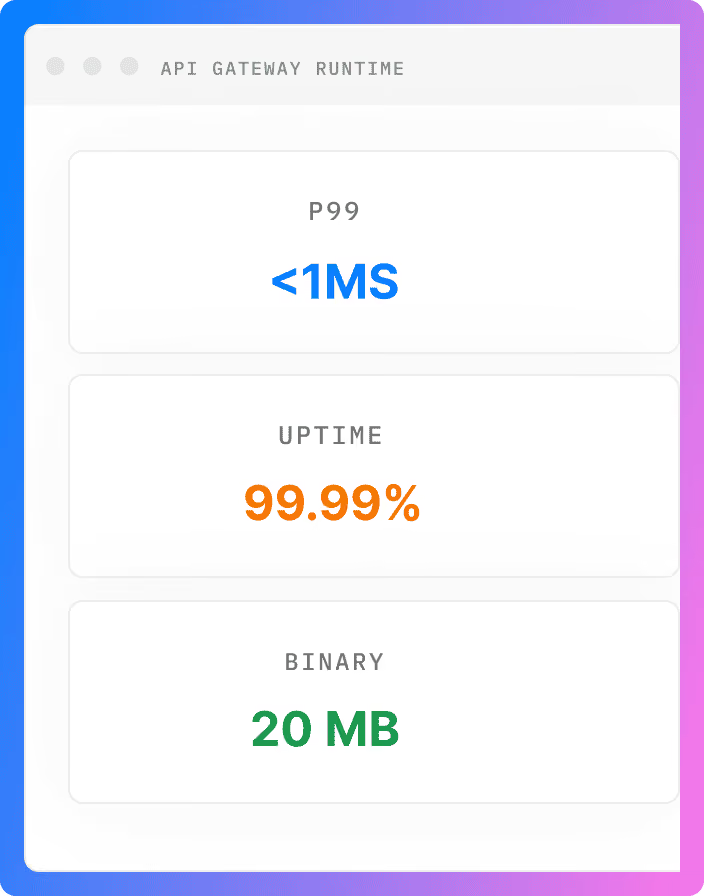
Arelio API Gateway is a lightweight, enterprise-ready API gateway designed for simplicity and speed. It is intuitive to use, with virtually no learning curve, while still delivering strong governance, native AI capabilities, and deep analytics.
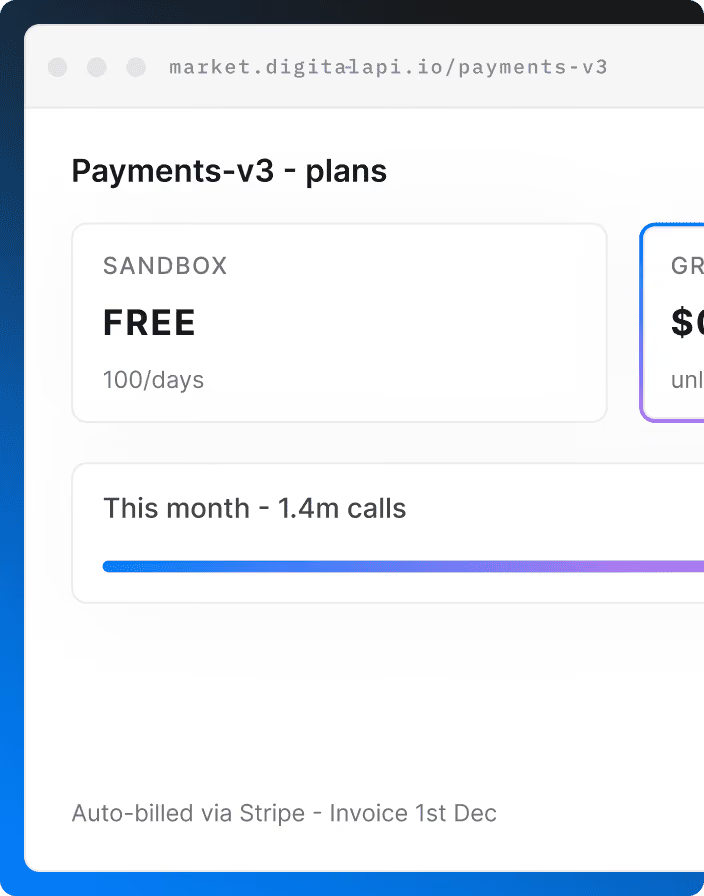
What truly sets Arelio apart is that it goes beyond traditional gateway functionality. It unifies traffic management, an API catalog, a white-labelled developer portal, and API monetization within a single platform. Built for fragmented API estates, Arelio works seamlessly across multiple environments while remaining easy to deploy, operate, and scale.
Key Features
- Plug-and-play setup: Secure, configure, and publish APIs in minutes without complex infrastructure overhead.
- Zero learning curve: Lightweight, easy to use and launch APIs faster with zero developer overhead.
- Rate limiting, quota enforcement, and metering: Apply granular traffic controls with built-in usage tracking.
- Org-wide security policies: Enforce JWT, OAuth2, CORS, and rate limits consistently across environments.
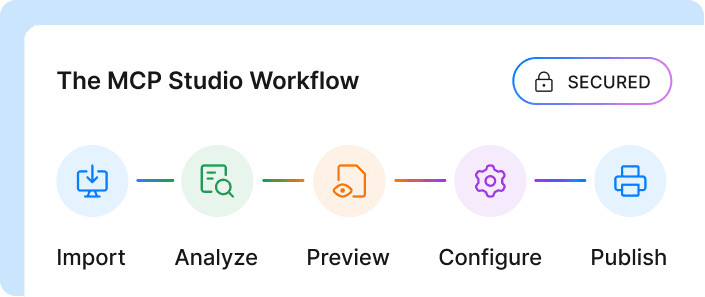
- AI-ready by default: Convert any API into an MCP-compliant, agent-consumable format in one click.
| Pros | Cons |
|---|---|
|
|
Who Is It For?
Businesses looking to scale their APIs and want to manage their entire API lifecycle with built in developer portal, api catalog, governance, API-to-MCP support and monetization capabilities.
Get Started with Arelio API Gateway today, Book a Demo 30-minute personalized demo!
2. Kong
Kong Gateway is one of the most widely adopted API gateways, known for its open-source roots and powerful plugin ecosystem. It is built for high performance, cloud-native deployments, and extensibility across hybrid environments.
Key Features
- Plugin-based architecture: Extend functionality using a large ecosystem of authentication, transformation, and logging plugins.
- Kubernetes-native deployment: Integrates seamlessly with Kubernetes and service meshes.
- Traffic control policies: Apply rate limiting, authentication, and routing rules through configurable plugins.
- Multi-protocol support: Supports REST, gRPC, GraphQL, and more.
| Pros | Cons |
|---|---|
|
|
Who Is It For?
Organizations that want a highly extensible, cloud-native gateway with strong open-source backing.
3. NGINX
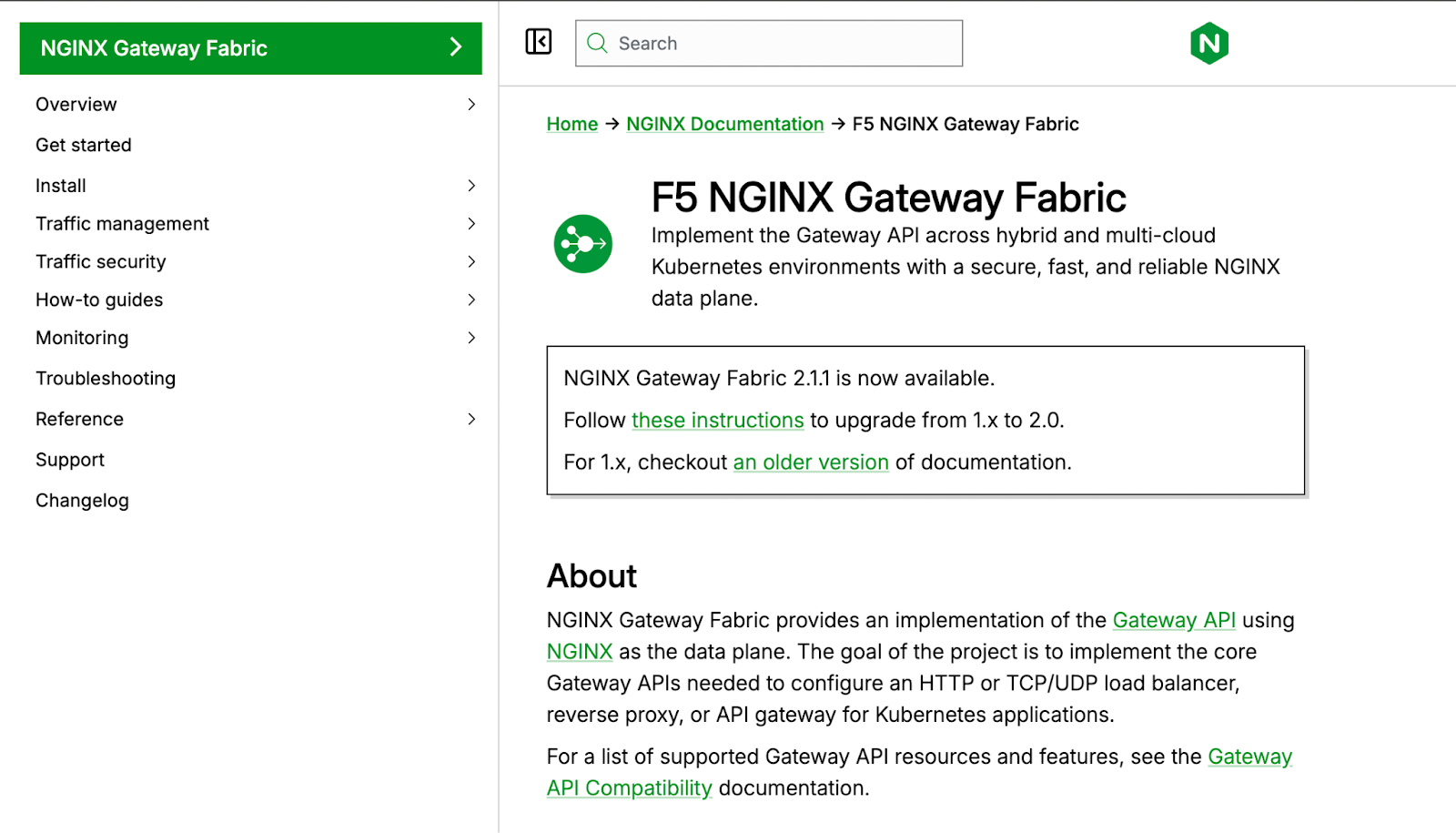
NGINX is primarily known as a high-performance web server and reverse proxy, but it is widely used as a foundation for API gateway implementations. With NGINX Plus, organizations can add advanced load balancing, security, and monitoring capabilities. It is often chosen for performance-critical environments.
Key Features
- Reverse proxy and load balancing: Distribute API traffic across backend services efficiently.
- Traffic routing and rewriting: Define rules for URL rewriting and upstream routing.
- Security controls: Implement TLS termination, IP filtering, and request limiting.
- High-performance core: Event-driven architecture optimized for concurrency.
- Monitoring with NGINX Plus: Real-time dashboard and health checks in the commercial edition.
| Pros | Cons |
|---|---|
|
|
Who Is It For?
Organizations that need a highly customizable, performance-focused gateway layer without full lifecycle tooling.
4. Tyk
Tyk API Gateway is an open-source API gateway with enterprise extensions for analytics, RBAC, and developer portal features. It is known for performance and Kubernetes-native deployment support. It provides flexible gateway configuration with hybrid control plane options.
Key Features
- High-performance gateway runtime: Lightweight and optimized for low-latency API traffic.
- Granular policy management: Apply quotas, rate limits, and authentication policies.
- Hybrid control plane: Manage distributed gateways centrally.
- Developer portal support: Enable API discovery and key generation.
- Kubernetes integration: Native support for containerized deployments.
| Pros | Cons |
|---|---|
|
|
Who Is It For?
Cloud-native teams that want an open-source gateway with enterprise upgrade paths.
5. Apigee
Apigee is a full‑featured API management platform with a robust policy layer for security, traffic management, mediation, analytics, and monetization across cloud and hybrid environments. It provides API proxies, a developer portal, monetisation workflows, and advanced API security with deep analytics to govern large API estates.
Key Features
- API proxy management: Create and manage API proxies with advanced policy control.
- Advanced analytics: Deep insights into API usage, performance, and developer engagement.
- Monetization capabilities: Build API products with usage-based billing.
- Security policies: OAuth2, JWT, spike arrest, and threat protection policies.
- Hybrid deployment model: Run control plane in cloud and data plane on-prem.
| Pros | Cons |
|---|---|
|
|
Who Is It For?
Large enterprises that need deep analytics, monetization, and global-scale API management.

6. AWS API Gateway
AWS API Gateway is a fully managed service that enables developers to create, publish, secure, and monitor APIs at scale. It integrates deeply with the AWS ecosystem, making it a natural choice for cloud-native workloads. It supports REST, HTTP, and WebSocket APIs and is optimized for serverless architectures.
Key Features
- Fully managed infrastructure: No servers to provision or maintain, with automatic scaling built in.
- Deep AWS integrations: Native connectivity with Lambda, IAM, Cognito, DynamoDB, and other AWS services.
- Traffic management and throttling: Define usage plans, quotas, and rate limits per API key.
- Authorization controls: Supports IAM roles, JWT authorizers, Lambda authorizers, and Cognito.
- Monitoring and logging: Integrated with CloudWatch for metrics, logging, and alerting.
| Pros | Cons |
|---|---|
|
|
Who Is It For?
Organizations building primarily on AWS that want a managed, serverless-friendly API gateway.
7. MuleSoft (Anypoint)
MuleSoft Anypoint API Gateway is part of the broader Anypoint Platform, combining API management with enterprise integration capabilities. It enables organizations to manage APIs while orchestrating complex backend systems. It is often positioned for enterprises with heavy integration requirements.
Key Features
- Unified API lifecycle management: Design, deploy, manage, and monitor APIs from a central control plane.
- Policy enforcement engine: Apply security, throttling, and transformation policies consistently.
- Integration-first architecture: Connect APIs with legacy systems, SaaS apps, and databases.
- Developer portal capabilities: Publish APIs with documentation and subscription workflows.
- Hybrid deployment support: Deploy across cloud, on-prem, or hybrid models.
| Pros | Cons |
|---|---|
|
|
Who Is It For?
Large enterprises that need deep system integration combined with API management.
8. WSO2
WSO2 API Manager is an open-core API management platform offering gateway, publisher, and developer portal capabilities. It is known for flexibility and customization, especially in hybrid and on-prem deployments. It provides full API lifecycle support with strong security controls.
Key Features
- API publishing and lifecycle management: Design, version, and manage APIs across environments.
- Built-in gateway runtime: Enforce policies, rate limits, and security at the gateway layer.
- Developer portal support: Enable discovery, subscription, and key management.
- Comprehensive security policies: OAuth2, JWT, threat protection, and access control.
- Analytics integration: Monitor API performance and usage patterns.
| Pros | Cons |
|---|---|
|
|
Who Is It For?
Organizations that want flexible, customizable API management with hybrid deployment control.
9. Gravitee
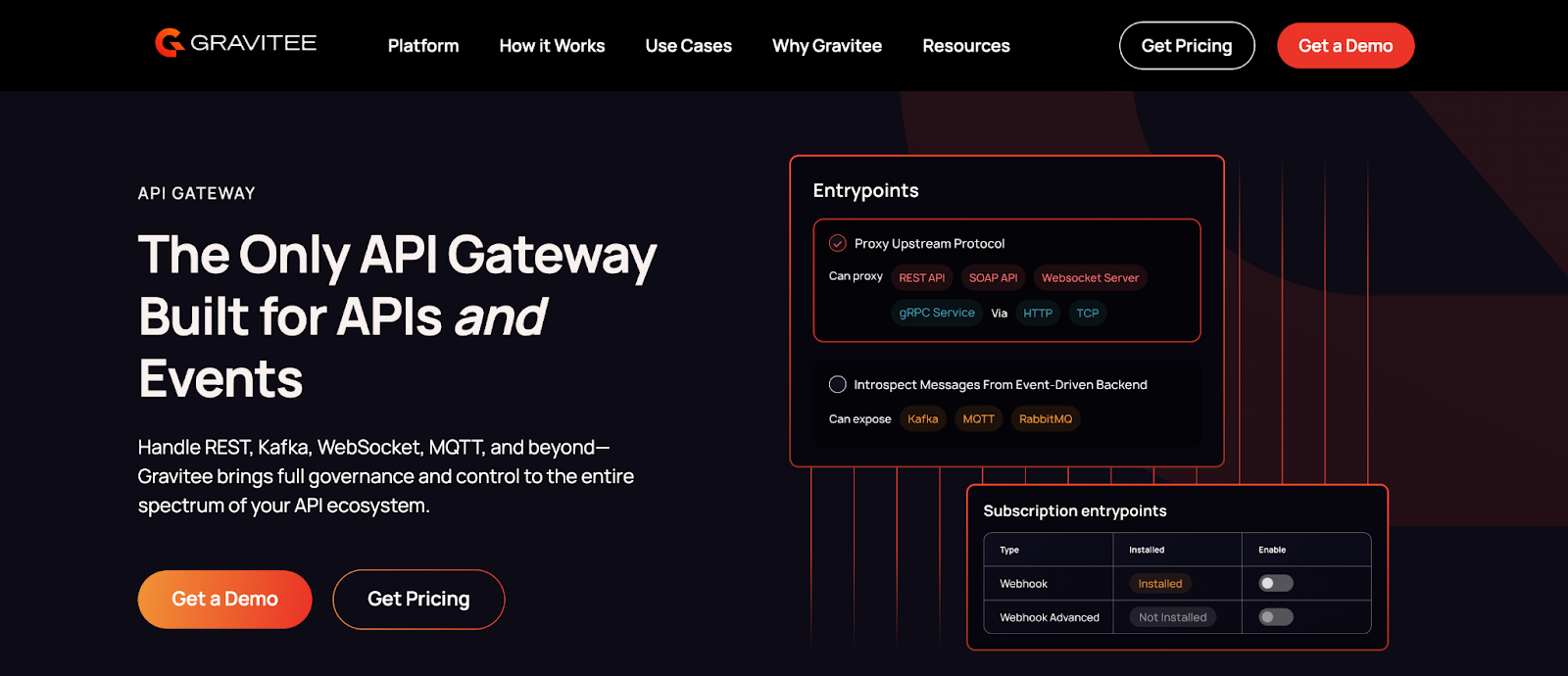
Gravitee API Gateway is an open-source, event-native API management solution designed to handle both synchronous and asynchronous APIs. It supports REST, GraphQL, Kafka, and event-driven architectures. It is often chosen for organizations adopting event streaming patterns.
Key Features
- Policy-driven gateway engine: Apply authentication, rate limiting, and transformation policies.
- Event-native API support: Manage REST, GraphQL, WebSocket, Kafka, and async APIs.
- Developer portal integration: Publish APIs with subscription workflows.
- Analytics and monitoring: Track API traffic and performance metrics.
- Flexible deployment: Deploy on-prem, in cloud, or containerized environments.
| Pros | Cons |
|---|---|
|
|
Who Is It For?
Teams building event-driven or hybrid API ecosystems that require flexibility.
10. Apache APISIX
Apache APISIX is a high-performance, open-source API gateway built on NGINX and etcd. It is designed for dynamic routing, plugin extensibility, and cloud-native environments. It is widely adopted in Kubernetes and microservices architectures where performance and flexibility are priorities.

Key Features
- Dynamic routing engine: Update routes and upstreams in real time without restarting services.
- Rich plugin ecosystem: Extend functionality with authentication, rate limiting, observability, and transformation plugins.
- Kubernetes ingress support: Acts as an ingress controller for containerized deployments.
- Multi-protocol support: Handles HTTP, HTTPS, gRPC, WebSocket, and TCP traffic.
- High-performance architecture: Built on NGINX with low-latency request processing.
| Pros | Cons |
|---|---|
|
|
Who Is It For?
Engineering teams that need a high-performance, open-source gateway for cloud-native or Kubernetes-heavy environments.
Best Open-Source API Gateways Compared
Open-source API gateways give engineering teams full control over customization, deployment, and cost. If your organization prefers transparency, community-driven innovation, or needs to avoid vendor lock-in, these are the best open-source API gateway options in 2026:
- Kong Gateway: The most widely adopted open-source API gateway. Extensible through a rich plugin ecosystem, Kubernetes-native via Kong Ingress Controller, and backed by strong community support. Best for teams that want flexibility with an enterprise upgrade path.
- Apache APISIX: High-performance, cloud-native gateway built on NGINX and etcd. Supports dynamic routing, gRPC, and Kubernetes-native deployment. Ideal for teams prioritizing raw throughput and low latency.
- Tyk: Open-source gateway with built-in analytics, rate limiting, and a developer portal. Offers a clear path from community edition to enterprise with RBAC and federation. Best for teams that want API management features out of the box.
- Gravitee: Event-native API gateway supporting REST, WebSocket, and async protocols. Strong for organizations adopting event-driven architectures alongside traditional API traffic.
- WSO2 API Manager: Full-lifecycle open-core platform with built-in identity management (WSO2 Identity Server). Best for enterprises in regulated industries that need on-premise deployment with deep customization.
For enterprises running multiple open-source gateways, DigitalAPI provides a federated control plane that unifies governance, analytics, and lifecycle management across Kong, Tyk, APISIX, and other gateways without requiring migration.
API Gateway Performance Benchmarks: What to Expect
Performance is a critical factor when choosing the best API gateway software. Here is what enterprise teams should benchmark when comparing API gateway platforms:
- Latency overhead: The best API gateways add less than 1–2ms of latency per request. NGINX and Apache APISIX consistently deliver sub-millisecond overhead in controlled tests. Kong and Tyk typically add 1–3ms depending on plugin load.
- Throughput (requests per second): Cloud-native gateways like APISIX and KrakenD can handle 50,000–70,000+ RPS on a single node. Managed gateways like AWS API Gateway and Apigee scale horizontally but may introduce higher per-request latency.
- Cold start time: Serverless-backed gateways (AWS API Gateway with Lambda) can experience cold starts of 100–500ms. Self-hosted gateways avoid this entirely.
- Connection pooling and keep-alive: Gateways that support HTTP/2 and connection reuse (Kong, NGINX, APISIX) significantly outperform those that don't in high-concurrency scenarios.
When running your own API gateway benchmark, test under realistic conditions: enable authentication plugins, rate limiting, and logging, as these add measurable overhead compared to passthrough mode.
Best API gateway for cloud-native architecture
Cloud-native architectures require an API gateway that handles dynamic routing, traffic control, and per-service authentication across distributed environments. The best API gateway for cloud-native teams in 2026 should support:
- Dynamic service discovery: Auto-detect upstream services via DNS, Consul, or Kubernetes service registry
- gRPC and HTTP/2 support: Essential for inter-service communication performance
- Circuit breaking and retries: Prevent cascading failures across dependent services
- Per-route authentication: Apply different auth policies (OAuth, JWT, mTLS) per service
- Canary and blue-green deployments: Route a percentage of traffic to new service versions for safe rollouts
Top picks for cloud-native teams: Kong (plugin-based flexibility), Tyk (built-in analytics per service), and Apache APISIX (lowest latency). For teams managing APIs across multiple gateway vendors, DigitalAPI provides unified observability and governance from a single control plane.
Best API Gateway for Kubernetes
Kubernetes-native API gateways integrate directly with the Kubernetes Gateway API and Ingress controllers, making them the best choice for container-orchestrated environments. Key capabilities to look for:
- Kubernetes Gateway API support: The new standard replacing legacy Ingress, offering richer routing rules and role-based configuration.
- Helm chart deployment: One-command installation and configuration via Helm.
- CRD-based configuration: Define routes, rate limits, and auth policies as Kubernetes custom resources.
- Service mesh integration: Work alongside Istio, Linkerd, or Consul Connect for east-west traffic management.
Top picks for Kubernetes: Kong Ingress Controller (most mature K8s integration), Apache APISIX Ingress (high performance with etcd-based config), and Gloo Gateway (Envoy-based with AI gateway capabilities). AWS API Gateway is not Kubernetes-native and requires additional tooling for K8s deployments.
AI-Powered API Gateways and MCP Support in 2026
The biggest shift in the API gateway landscape for 2026 is AI readiness. As AI agents and large language models (LLMs) consume APIs autonomously, gateways need new capabilities beyond traditional request routing:
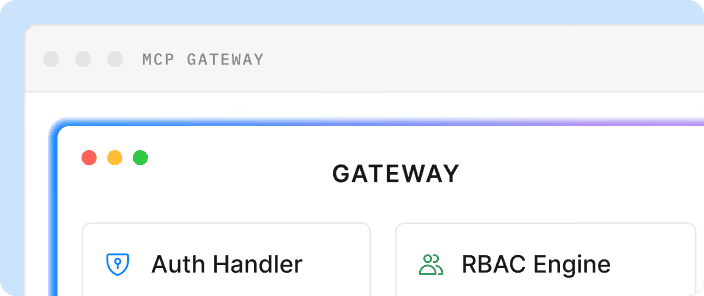
- Model Context Protocol (MCP) support: MCP turns any API into a tool that AI agents can discover and invoke. Gateways with native MCP support let teams expose existing APIs to AI workflows without rebuilding them.
- Token-based rate limiting: Traditional rate limiting counts requests; AI workloads need token-aware metering to manage LLM API costs.
- Prompt and response guardrails: Inspect and filter AI-generated content at the gateway layer before it reaches downstream services.
- Multi-model routing: Route requests to different LLM providers (OpenAI, Anthropic, Google) based on cost, latency, or capability requirements.
AI gateway leaders: Arelio API Gateway by DigitalAPI offers native MCP gateway support, enabling enterprises to expose APIs to AI agents through a unified control plane. Gloo Gateway supports streaming prompt guardrails. Apache APISIX integrates with multiple LLM providers. Most legacy gateways (Apigee, MuleSoft, AWS API Gateway) are adding AI features but lag behind purpose-built AI API gateway solutions.
API Gateway Pricing Comparison
API gateway pricing varies significantly based on deployment model, traffic volume, and feature tier. Here is a high-level comparison of API gateway pricing in 2026:
- Open-source (free tier): Kong Community, Apache APISIX, Tyk Community, and Gravitee Community editions are free to self-host. Infrastructure costs (compute, networking, monitoring) typically run $500–2,000/month for production workloads.
- Usage-based: AWS API Gateway charges $1–3.50 per million requests with no upfront commitment. Cost-effective for low-to-moderate traffic but expensive at scale.
- Enterprise subscription: Kong Enterprise, Tyk Enterprise, and Apigee use annual contracts based on environments, nodes, or API call volume. Expect $50,000–500,000+/year depending on scale.
- Platform bundled: MuleSoft Anypoint and Azure API Management are typically sold as part of broader platform deals. Pricing is opaque and heavily negotiated.
For a detailed breakdown of enterprise API gateway pricing, including hidden costs and TCO analysis, see our API gateway pricing guide for enterprise teams.
[fs-toc-omit]Federated control: Manage multiple gateways with DigitalAPI
To operationalise the federated approach recommended above, DigitalAPI provides a gateway‑agnostic control plane that standardises policy, catalogue, and analytics across heterogeneous gateways without migrations, aligning with this guide’s emphasis on centralised governance and multi‑cloud flexibility.
Teams can keep Kong, NGINX, Apigee, or cloud‑native gateways where they fit best while unifying access, developer experience, and compliance in one place.
See DigitalAPI’s API gateway manager in action
Book a personalised 30-minute walkthrough
[fs-toc-omit] FAQs
[fs-toc-omit]1. What are API gateway tools?
API gateway tools route and secure API traffic between clients and backend services. They manage authentication, rate limits, caching, and monitoring, acting as a single control point to improve performance, simplify management, and enforce consistent policies across APIs.
[fs-toc-omit]2. What are the best API gateway management tools?
Top API gateway tools include DigitalAPI Arelio, AWS API Gateway, Kong, Apigee, Azure API Management, NGINX, Tyk, and 3scale. These platforms handle routing, security, analytics, and scaling so organizations can manage APIs reliably across cloud and hybrid environments.
[fs-toc-omit]3. Which API gateway is best suited for cloud-native workloads?
Gateways built for cloud-native workloads support dynamic routing, gRPC, mTLS, and Kubernetes-native deployment. Kong, NGINX, and Tyk cover traffic control, per-service authentication, and resilient scaling across clusters and hybrid environments with minimal operational overhead.
[fs-toc-omit]4. How does an API gateway improve security and scalability?
An API gateway centralizes authentication, authorization, rate limiting, and WAF protection to secure requests. It improves scalability with load balancing, caching, retries, and traffic shaping, reducing pressure on backend services while improving reliability and uptime.
[fs-toc-omit]5. Are open-source API gateways reliable for enterprise use?
Yes, open-source gateways can be enterprise ready with strong security, patching, monitoring, and SLAs. With high availability, disaster recovery, and policy controls, they can meet uptime, compliance, and scaling needs, especially when backed by vendor or community support.
[fs-toc-omit]6. What's the difference between an API gateway and a service mesh?
An API gateway manages traffic at the edge between clients and services, handling auth and routing. A service mesh operates inside the cluster, managing service-to-service traffic with mTLS, retries, and telemetry. Gateways handle ingress, while meshes enhance internal reliability.
[fs-toc-omit]7. Which API gateways support real-time observability across multiple clouds?
Kong Konnect, Tyk Enterprise, Apigee Hybrid, and DigitalAPI provide real-time logs, metrics, tracing, and dashboards across clouds, helping teams debug faster, enforce SLAs, and optimize performance for distributed and hybrid workloads.
[fs-toc-omit]8. Can DigitalAPI unify APIs across different cloud gateways?
Yes, DigitalAPI centralizes APIs from AWS, Azure, GCP, Apigee, Kong, and others into one catalog. It enables unified governance, lifecycle management, and analytics, making multi-gateway environments easier to operate without vendor lock in.
[fs-toc-omit]9. Is DigitalAPI suitable for enterprises migrating from Apigee, MuleSoft, or AWS API Gateway
Yes, DigitalAPI supports phased migration and federation, allowing existing gateways to run while transitioning. It avoids lock-in, reduces disruption, and helps modernize API ecosystems without downtime, making it suitable for enterprise-scale needs.
[fs-toc-omit]10. What is the fastest API gateway in 2026?
Apache APISIX and NGINX consistently deliver the lowest latency in API gateway benchmarks, with sub-millisecond overhead per request. For managed services, AWS API Gateway offers auto-scaling throughput but higher per-request latency. Performance depends heavily on enabled plugins—always benchmark with your actual configuration.
[fs-toc-omit]11. What is the difference between an API gateway and a service mesh?
An API gateway manages north-south traffic (client-to-service) at the network edge, handling authentication, rate limiting, and routing. A service mesh manages east-west traffic (service-to-service) inside the cluster using sidecar proxies for mTLS, retries, and observability. Most cloud-native architectures use both: an API gateway for ingress and a service mesh like Istio or Linkerd for internal communication.
[fs-toc-omit]12. Which API gateways support AI agents and MCP?
Arelio API Gateway by DigitalAPI provides native MCP (Model Context Protocol) gateway support, enabling AI agents to discover and invoke APIs autonomously. Gloo Gateway offers AI gateway features including prompt guardrails and LLM routing. Apache APISIX integrates with multiple LLM providers. Legacy platforms like Apigee and AWS API Gateway are adding AI capabilities but do not yet support MCP natively.
[fs-toc-omit]13. Is an on-premise API gateway better than cloud-managed?
On-premise API gateways (Kong, WSO2, Tyk self-hosted) provide full control over data residency, compliance, and customization, making them ideal for regulated industries. Cloud-managed gateways (AWS API Gateway, Apigee) reduce operational overhead but limit flexibility. Hybrid deployment, where the control plane is cloud-hosted but the data plane runs on-premise, is increasingly the preferred approach for enterprise API gateway deployments.
Dhayalan Subramanian is Associate Director, Product Growth at DigitalAPI, where he leads go-to-market and product growth for the company’s multi-gateway API management platform. His work focuses on helping large enterprises and mid-market cloud companies consolidate APIs across AWS, Azure, Apigee, Kong, MuleSoft, and other gateways into a single control plane for governance, discovery, monetization, and agent consumption.
Dhayalan brings 14+ years of experience across product strategy, enterprise architecture, and engineering leadership. Earlier in his career, he held senior roles at Encora (as Associate Architect and Technical Manager), Mindtree (Technology Lead), Tech Mahindra (Technical Lead), and Primus Analytics, where he designed integration frameworks and delivered enterprise-grade digital platforms for global customers.
At DigitalAPI, he works directly with platform, integration, and developer experience leaders at Fortune 500 organizations to operationalize unified API catalogs, developer portals, and MCP-ready APIs. He writes regularly on API developer experience, API governance, and AI agent architectures.
One email a fortnight. Worth opening.
A short digest of what we're writing, what we're learning from customers, and the handful of links you'd actually want from us. No tracking pixels.

.avif)