



Best API Documentation Tools in 2026 (Reviewed and Compared)
Discover the best API documentation tools for 2026. Compare 10 leading platforms, from Swagger to Postman to DigitalAPI — and find the right fit for your team.

The best API documentation tools in 2026 are DigitalAPI, ReadMe, Mintlify, Swagger, GitBook, Redocly, and Bump. Each serves a different documentation profile, from single-product developer portals to multi-gateway enterprise catalogues with AI-agent-readable output.
Quick picks best API documentation tools in 2026
1. Best overall: DigitalAPI - multi-gateway, self-serve portal, MCP-ready
2. Best for polished design: Mintlify - Git-native, llms.txt, free tier
3. Best try-it console: ReadMe - analytics-instrumented, mature UX
4. Best open-source: Swagger UI - widest OpenAPI baseline, self-hostable
5. Best for API governance: Redocly - linting, CI integration, spec-first
6. Best for unified docs: GitBook - API refs + guides + internal knowledge
7. Best for changelog: Bump - spec diffing, breaking change detection
Why API documentation tooling changed in 2026
Three shifts have made the documentation tool decision harder than it was two years ago.
First, developer self-service has become the baseline expectation. Developers who encounter documentation that requires emailing a team to get an API key, access a sandbox, or understand pricing will leave. The question is no longer whether your documentation is accurate it is whether developers can go from reading to calling in under ten minutes without speaking to anyone.
Second, AI agents now read and evaluate API documentation alongside human developers. Tools such as Claude, ChatGPT, Cursor, and enterprise AI procurement platforms query your documentation catalogue to assess whether your APIs are worth integrating. Documentation that is not machine-readable or agent-consumable is invisible to this audience.
Third, most API teams manage APIs across more than one gateway. Documentation that lives inside a single gateway's tooling creates silos. A team running Apigee for partner APIs and AWS API Gateway for internal services ends up with two separate documentation surfaces, two sets of developer credentials, and two onboarding flows.
Not every team needs a tool that solves all three problems. Many teams need a clean, well-maintained documentation surface for a single product. This review covers both ends of that spectrum.
How we evaluated these tools
We assessed each platform against five criteria that consistently shape the API documentation tool decision for engineering and product teams:
- OpenAPI spec ingestion and sync - does the tool ingest specs automatically, or does it require manual upload on each change?
- Interactive try-it console - can developers test live calls directly from the documentation page?
- Self-serve credential generation - can an external developer obtain API keys without contacting your team?
- AI-agent readiness - does the tool produce llms.txt output, MCP-compatible endpoints, or structured machine-readable documentation?
- Total cost of ownership - what does the tool cost for a ten-person team managing between one and ten API products?
Where we had direct access, we tested each tool. Where we did not, we referenced published documentation, G2 reviews, and verified customer references.
Quick Comparison: Best API Documentation Tools
(scroll to view full table)
The 7 Best API Documentation Tools
1. DigitalAPI
DigitalAPI is a gateway-agnostic API management platform that generates documentation automatically from existing gateway specs, publishes it through a self-serve developer portal with live sandbox access, and exposes every catalogued API as an MCP tool for AI agents. Where every other tool on this list solves the documentation publishing problem, DigitalAPI solves the three problems that follow it: developer self-service, multi-gateway catalogue sprawl, and AI-agent readiness.
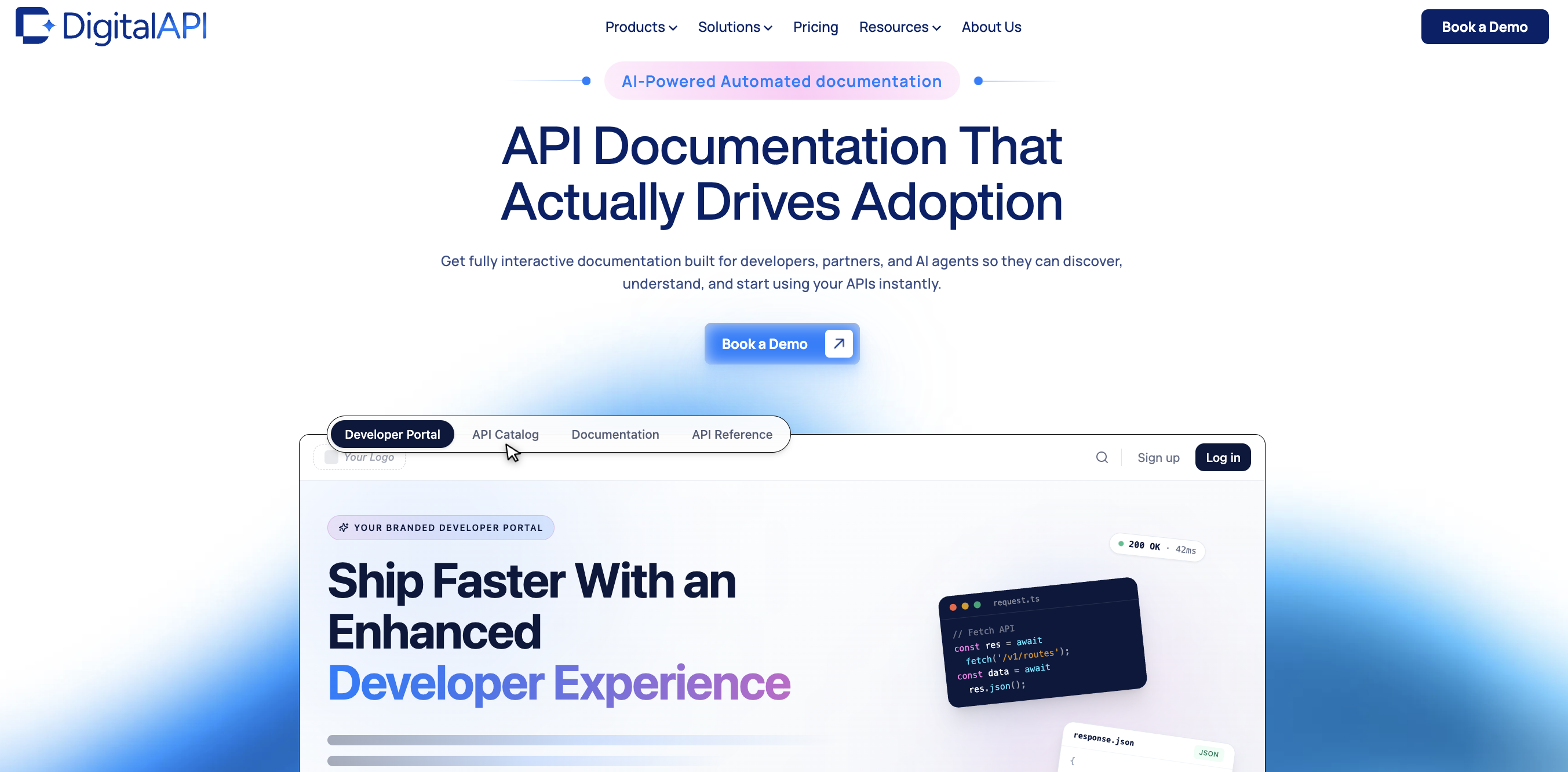
The documentation generation process is automatic. Connect Apigee, Kong, AWS API Gateway, or Azure APIM via read-only credentials. DigitalAPI indexes every API spec across those gateways into a unified catalogue within 24 hours. If a spec is missing documentation, the platform generates it on the fly using AI so no API remains undocumented or a black box to the developers trying to consume it.
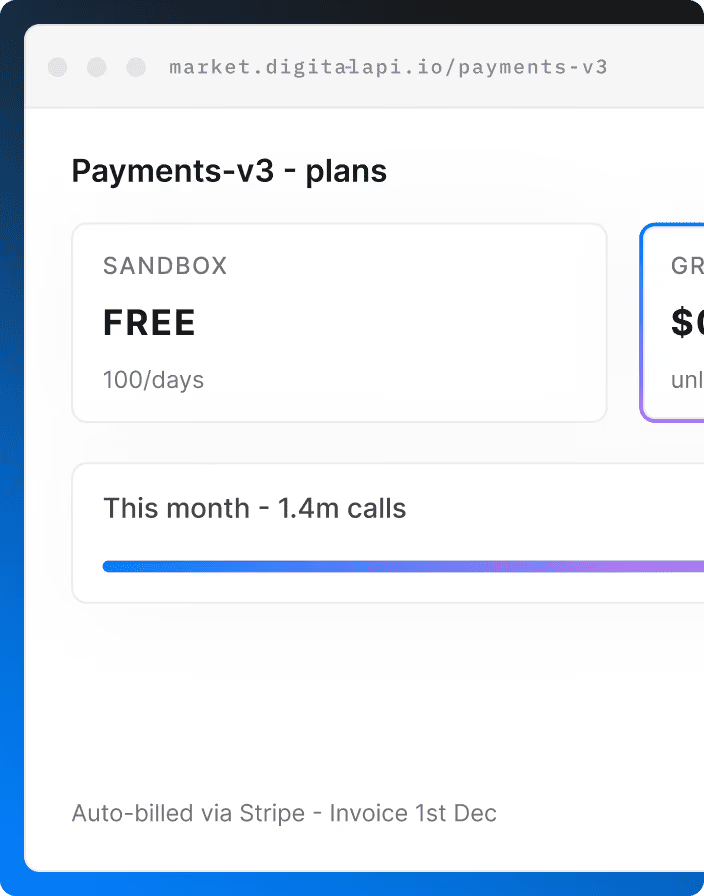
From that catalogue, the API Developer Portal publishes documentation, live sandbox testing, and self-serve credential generation to internal teams, external partners, and public audiences simultaneously through RBAC-controlled access tiers. An external developer reads the documentation, tests the API in the live sandbox, generates their own scoped API key, and subscribes to a pricing plan without contacting anyone on your team. That full journey happens within the same platform that generated the documentation.
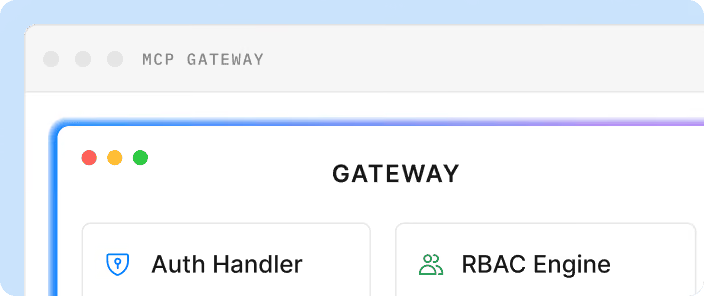
The MCP Gateway converts every catalogued API into an AI-callable tool with agent-grade credentials, per-call policies, and audit logging. For teams whose documentation audience now includes Claude, ChatGPT, Cursor, and enterprise AI procurement tools, every API in the catalogue becomes machine-readable and agent-consumable without a separate tool or configuration step.
AI-powered semantic search across the catalogue, branded "API-GPT," allows developers to query the catalogue in natural language. A developer asking "find me a payments API that handles refunds" gets a ranked result from the actual catalogue rather than a keyword-match list.
Fiserv, Canara Bank, and Zurich Insurance run DigitalAPI in production across regulated, multi-gateway environments where documentation sprawl across Apigee, Kong, and AWS was the pre-migration state.
Fits best when: You manage APIs across multiple gateways, need documentation generation without manual spec maintenance, want external developers to self-serve credentials after reading docs, and need every documented API to be callable by AI agents.
Does not fit when: You need only a standalone documentation publishing tool for a single API product with no self-service or multi-gateway requirements.
2. ReadMe
ReadMe is a developer documentation platform built for API-first companies that want a polished, interactive developer portal with analytics, versioning, and a try-it console, without managing hosting or build pipelines.
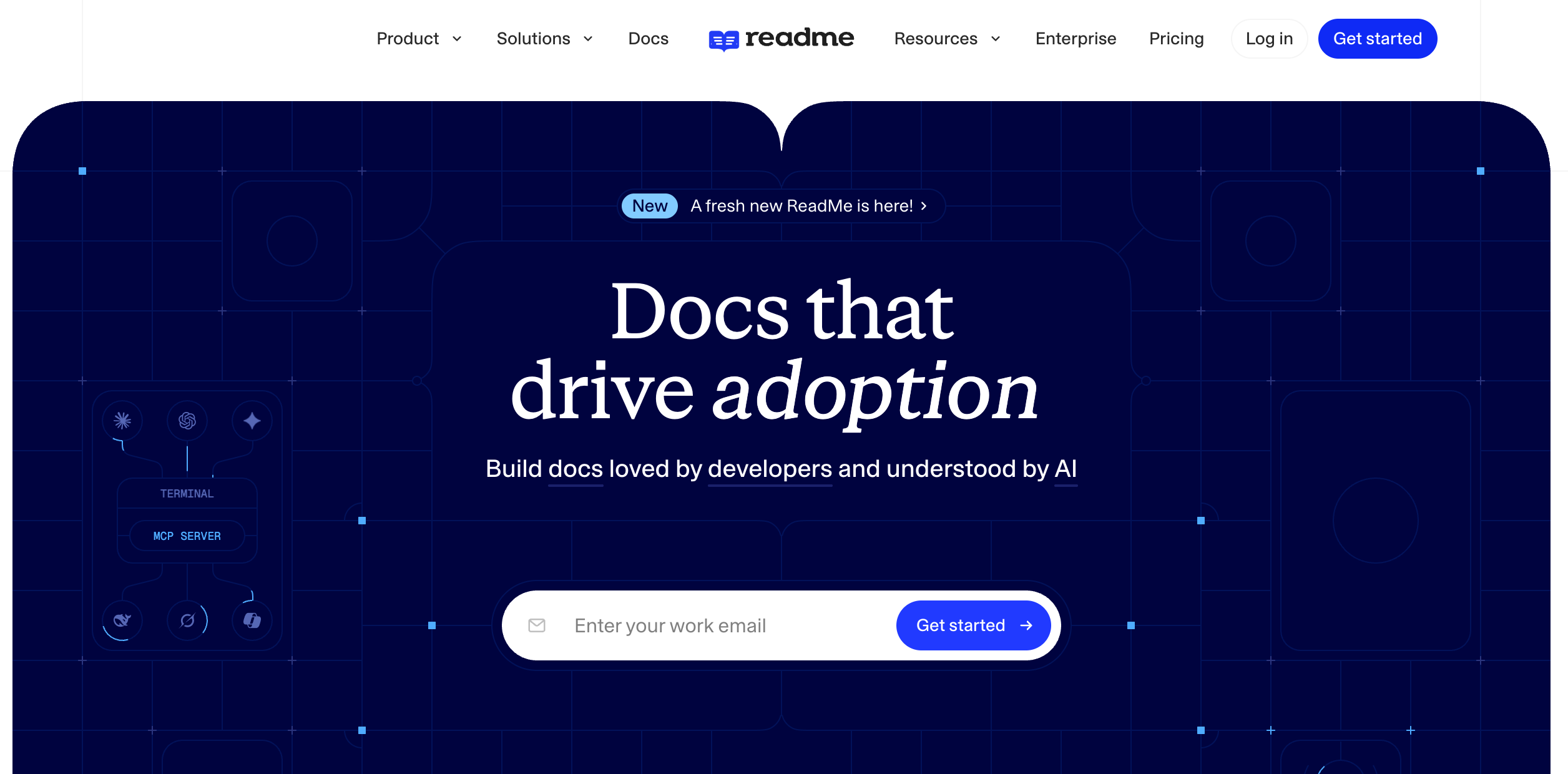
ReadMe's core strength is the developer experience layer it wraps around documentation. The try-it console is one of the most mature on this list: developers can test API calls directly from the documentation page using their own credentials, with request and response displayed in real time. The changelog feature tracks API changes with structured release notes developers can subscribe to, which reduces the support overhead that breaking changes create without communication.
The API metrics and analytics dashboard surfaces which endpoints developers are hitting, where they fail, and how long time-to-first-call takes. For API product managers who treat developer adoption as a measurable metric rather than a lagging indicator, this data layer is genuinely useful. Teams at Notion, Square, and Intercom use ReadMe as their external documentation surface.
The honest limitation is self-service depth. ReadMe publishes documentation and provides a try-it console, but it does not issue API credentials natively. External developers still need to obtain keys through a separate system before the try-it console becomes fully functional without pre-population. For teams whose developer onboarding requires a self-serve credential step, ReadMe needs a complementary credential management layer.
Fits best when: You are an API-first company that wants a polished, analytics-instrumented developer portal with an excellent try-it console and changelog management, and your credential issuance is handled separately.
Does not fit when: You need multi-gateway federation, native self-serve credential generation within the docs surface, or MCP-native AI agent consumption.
3. Mintlify
Mintlify is a Git-native documentation platform for developer-facing products that want polished design, AI-powered assistant functionality, and llms.txt-ready output without a designer or a documentation engineering team.

Mintlify's reputation is built on making documentation look genuinely good without CSS effort. Dark mode, clean typography, and responsive layout ship out of the box. The MDX-based authoring model keeps documentation next to the codebase in Git, which means docs update on the same merge cycle as the code they describe. That workflow discipline reduces the documentation drift that makes API docs unreliable within weeks of a release.
The AI features are meaningful rather than cosmetic. The AI assistant does not just search docs by keyword: it uses tool calling to understand intent and retrieves relevant content from the right section. For developer portals where the question "how do I authenticate?" needs to surface the right guide across versioned API content, intent-based retrieval matters. The llms.txt generation is automatic, which makes the documentation surface readable by AI agents without additional configuration.
Mintlify's free Hobby tier became fully functional, covering custom domains, API playground, and custom components. This changes the cost comparison for small teams and open-source projects significantly. The jump from free to paid is steep: the Pro plan starts at $150 per month and covers five editor seats, with additional seats at $20 each. Enterprise features including SSO, SOC 2 compliance, and white-labelling require a custom tier.
Fits best when: You want a Git-native, design-polished documentation platform with an AI assistant, llms.txt support, and a low-overhead publishing workflow for a single developer-facing product.
Does not fit when: You need multi-gateway API catalogue management, native self-serve credential issuance, or a white-label portal serving multiple external audience types at enterprise scale.
4. Swagger
Swagger is the original OpenAPI toolchain. Swagger UI renders OpenAPI specs as interactive HTML documentation. Swagger Editor provides a browser-based editor for writing and validating OpenAPI specs. SwaggerHub combines both with team collaboration, version control, and a hosted publishing layer.
The open-source tools remain the widest baseline in the market. Swagger UI is installed on more developer environments than any other documentation renderer. Its recognisable interface means developers who encounter it already know how to use it. For teams self-hosting their documentation within an existing developer portal or internal tooling environment, Swagger UI provides the interactive reference layer without a SaaS dependency.
SwaggerHub, the commercial product from SmartBear, adds collaborative editing, API versioning across environments, standardisation rules, and integrations with GitHub, Azure DevOps, and CI/CD pipelines. The spec-first workflow encourages design review before implementation, which reduces breaking change incidents in teams that otherwise update specs after the fact.
The honest limitation is the design ceiling. Swagger UI is functional and universally recognised, but it does not produce the polished developer portal experience that Mintlify or ReadMe deliver out of the box. Teams that want documentation to serve as a product surface rather than a utility reference typically layer Swagger UI inside a custom portal rather than using it as the complete developer experience.
Fits best when: You want the widest OpenAPI toolchain baseline, open-source licensing, self-hosting flexibility, and a universally recognised interactive console that requires no developer education to use.
Does not fit when: You want a polished, branded developer portal out of the box, native self-serve credential generation, or multi-gateway catalogue management.
5. GitBook
GitBook is a documentation platform that unifies API reference documentation, product guides, SDK docs, and internal knowledge in a single system, targeting teams that want one tool for all documentation types rather than separate tools for each layer.
The consolidation value is real for teams that currently maintain API docs in one tool, product guides in another, and internal knowledge in a third. GitBook's OpenAPI sync generates and updates API references automatically, the visual editor is accessible to non-technical contributors, and Git Sync keeps the system aligned with code changes for developer-led teams that prefer Markdown workflows.
The AI features cover reader-facing assistance: GitBook's AI answers questions from the documentation content, which reduces support ticket volume for teams whose documentation is the primary support channel. The "Test it" functionality is embedded directly within endpoint documentation, giving developers an interactive console without leaving the reference page.
GitBook's pricing is accessible. The free tier is functional for small teams, and the paid tiers price per user rather than per seat on a fixed plan, which makes cost scaling more predictable than per-seat SaaS models with fixed seat counts.
The documentation-focused scope means GitBook does not provide native developer credential issuance, multi-gateway catalogue federation, or MCP server generation. For teams that need documentation as one part of a larger developer experience platform rather than documentation as the entire product, a complementary layer is required.
Fits best when: You need a unified documentation system covering API references, product guides, and internal knowledge in one place, with accessible tooling for both technical and non-technical contributors.
Does not fit when: You need native self-serve credential generation, multi-gateway API catalogue federation, or MCP-native AI agent consumption of documented APIs.
6. Redocly
Redocly is a docs-as-code API documentation platform for teams that want spec-first workflows, OpenAPI governance, linting, and CI/CD pipeline integration as first-class features alongside documentation publishing.
Where most documentation tools take your spec and render it, Redocly treats the spec as the source of truth for the entire API governance workflow. The linting engine checks specs against configurable rules before documentation is published. Breaking changes are flagged in the CI pipeline before they reach developers. The portal renderer produces clean, three-panel reference documentation with a try-it console. The command-line tooling lets documentation deploy on the same pipeline as the API itself.
This approach suits platform engineering teams and API governance leads who need documentation to enforce standards rather than just present them. A team that finds its OpenAPI specs inconsistent across 15 services can use Redocly's lint rules to standardise them before publication, which improves documentation quality and AI-readability simultaneously.
Redocly's enterprise tier adds multi-version management, SSO, RBAC, and white-label portal capabilities. The llms.txt support means documented APIs are readable by AI agents without additional configuration.
The scope boundary is documentation and governance. Redocly does not provide self-serve credential issuance, multi-gateway federation across existing cloud gateways, or API monetization.
Fits best when: You want docs-as-code workflows, OpenAPI governance with linting and CI integration, and polished three-panel reference documentation published at the spec-first stage.
Does not fit when: You need native developer credential generation, multi-gateway catalogue federation, API monetization, or a white-label portal with subscription management at enterprise scale.
7. Bump
Bump is a changelog-first API documentation platform that specialises in continuous spec diffing, breaking change detection, and structured changelog generation for teams that treat API change communication as a first-class developer experience requirement.
Bump's core capability is changelog-first documentation. Every time an API spec updates, Bump detects the diff, classifies each change as non-breaking or breaking, generates a human-readable changelog entry, and notifies subscribers. For teams whose APIs change frequently and whose developer support overhead spikes every time a breaking change is undercommunicated, Bump solves the specific problem that every other tool on this list treats as secondary.
The reference documentation is clean and navigable. Bump ingests OpenAPI and AsyncAPI specs and renders them into structured reference pages. The documentation is not as visually polished as Mintlify or as feature-rich as ReadMe, but the changelog infrastructure it wraps around the reference layer is more mature than any other tool on this list.
The honest scope limitation: Bump is a reference documentation and changelog tool, not a full developer portal. There is no try-it console, no self-serve credential generation, and no AI-agent consumption path. Teams that need the change communication layer Bump provides alongside a full developer portal typically pair it with another tool rather than using it as a complete solution.
Fits best when: Your APIs change frequently, breaking change communication is a recurring developer support issue, and you need a structured changelog and spec diffing system as the primary documentation capability.
Does not fit when: You need an interactive try-it console, self-serve credential generation, multi-gateway catalogue management, or AI-agent-readable output as primary requirements.
How to Choose: Four Questions That Narrow the Field
1. Is your primary problem publishing documentation or delivering a complete developer experience?
Every tool on this list solves documentation publishing. ReadMe, Mintlify, Redocly, GitBook, Swagger, and Bump all render OpenAPI specs into navigable, interactive reference pages. The question is what happens after a developer reads the documentation. If they still need to contact your team for credentials, the documentation tool solved only half the problem. DigitalAPI covers the full journey: documentation, sandbox, credentials, and subscription, within one platform. See how that journey works on the API sandboxing solution page.
2. Do you manage APIs across one product or multiple gateways?
For a single API product with one gateway, ReadMe, Mintlify, or Redocly are the strongest standalone documentation tools depending on whether you prioritise portal polish, Git-native workflow, or spec governance. For teams managing APIs across Apigee, Kong, AWS, and Azure APIM simultaneously, a multi-gateway catalogue is a prerequisite before documentation publishing becomes meaningful. DigitalAPI handles that federation as the foundation, not an add-on.
3. Do AI agents need to consume your documentation?
Mintlify and Redocly both support llms.txt, which makes documentation readable by AI assistants. DigitalAPI goes further: the MCP Gateway converts every catalogued API into an AI-callable tool with scoped credentials and per-call policies, not just readable documentation. For teams where AI agents are current or near-term API consumers, the distinction between AI-readable docs and AI-callable APIs is the relevant evaluation criterion.
4. How frequently does your API change, and how do you communicate breaking changes?
If breaking changes are a recurring developer support issue, Bump's changelog-first model is the strongest specialist tool. ReadMe and Redocly both handle versioning and changelogs with maturity. DigitalAPI's AI affinity feature goes further, detecting duplicate APIs across a multi-gateway estate before documentation inconsistency compounds across teams.
Industry Use Cases
Financial services: A bank managing payment APIs across Apigee and Kong has three separate documentation surfaces maintained by three separate teams. Developers searching for the right API waste time navigating each portal independently. DigitalAPI indexes both gateways, generates missing documentation automatically, and publishes everything through a single branded portal where external fintech developers self-serve sandbox credentials. This is the pattern Canara Bank and Fiserv use in production.
SaaS platforms: A cloud-native SaaS company with a public API programme uses Mintlify for its external-facing documentation. The Git-native workflow keeps docs aligned with every release, the AI assistant reduces developer support tickets, and the polished design communicates product quality before a developer makes their first API call. When AI-agent consumption of their API becomes a requirement, the llms.txt support handles readability without a separate configuration step.
API-first startups: A startup publishing its first public API uses Redocly's docs-as-code workflow to enforce OpenAPI linting rules in the CI pipeline before any spec reaches the documentation stage. Breaking changes are caught before external developers encounter them. The three-panel reference documentation publishes cleanly from the same pipeline that deploys the API. As the programme scales, the governance foundation Redocly established makes multi-version management tractable rather than chaotic.
Enterprise platform teams: A platform engineering team managing 200 internal APIs across multiple business units uses GitBook to consolidate API references, integration guides, and internal documentation into one searchable system. Non-technical product owners contribute content through the visual editor without needing Markdown expertise. The AI reader assistant reduces the time internal developers spend on "where is the authentication guide" questions that previously routed to the platform team.
What Good API Documentation Actually Achieves
The business case for investing in documentation tooling is not documentation quality for its own sake. It is the measurable outcomes that good documentation drives.
Time-to-first-call is the clearest metric. A developer who finds clear documentation, tests the API in a sandbox, and generates their own credentials without external help can call your API the same day they discover it. A developer who reads incomplete documentation, waits for sandbox access, and emails three people for an API key might take weeks to reach the same point. That gap shows up in developer adoption rates, not documentation review scores.
Support ticket deflection is the second metric that documentation tooling directly affects. Changelogs that communicate breaking changes before they cause integration failures prevent support volume that compounds after every release cycle. Interactive consoles that let developers validate their integration against real responses reduce the "why is this returning 403" tickets that consume platform team time.
AI agent adoption is the third, and newest, metric. In 2026, humans are not the only audience for API docs. Developers increasingly ask AI assistants to read documentation and write integration code for them. If an AI agent cannot parse your docs, you lose developers before they ever reach your dashboard. Documentation that is readable only by humans now serves half its potential audience.
FAQs
1. What is the best API documentation tool in 2026?
DigitalAPI is the strongest choice if you manage multiple gateways and need automated documentation generation, self-serve developer credentials, and AI-agent readiness in one platform. ReadMe and Mintlify lead for standalone developer portal publishing with polished design and interactive consoles.
2. What is the difference between API documentation and a developer portal?
API documentation is the reference layer: endpoints, parameters, authentication, and response schemas. A developer portal is the full developer experience layer: documentation, self-serve credentials, sandbox access, subscription management, and analytics. Every tool on this list provides documentation. Only DigitalAPI provides the complete portal layer with native credential generation and multi-gateway catalogue management.
3. Which API documentation tool is best for AI-agent readiness?
DigitalAPI leads here. The MCP Gateway converts every catalogued API into an AI-callable tool with scoped credentials and per-call audit logging. Mintlify and Redocly both support llms.txt, making documentation readable by AI assistants. The distinction is between AI-readable documentation and AI-callable APIs with governance.
4. What is the cheapest API documentation tool?
Swagger UI is free and open-source with no hosting cost beyond your own infrastructure. GitBook and Mintlify both have free tiers that are genuinely functional for small teams and open-source projects. SwaggerHub starts at $30 per user per month for the collaborative commercial layer.
5. How do I keep API documentation in sync with my API?
Every tool on this list supports OpenAPI spec ingestion. The key distinction is between one-time import, which goes stale as the API changes, and continuous sync, which updates documentation on every spec change. Redocly and Bump both treat continuous sync as a first-class feature. DigitalAPI's API gateway manager syncs documentation from connected gateways automatically, so documentation reflects the live state of every managed API without manual updates.
The Bottom Line
The best API documentation tool depends entirely on what problem you are actually trying to solve.
For standalone developer portal publishing with excellent design and an interactive console, ReadMe and Mintlify are the strongest tools. For spec-first governance and docs-as-code CI integration, Redocly leads. For the widest open-source baseline with self-hosting flexibility, Swagger covers the requirement. For unified documentation across API references, product guides, and internal knowledge, GitBook fits teams that need one system for all content types. For changelog-first breaking change communication, Bump solves the specific problem no other tool on this list addresses with the same depth.
For teams managing APIs across multiple gateways, those tools address documentation publishing without touching the three problems that follow it: developer self-service after reading the docs, multi-gateway catalogue sprawl, and AI-agent readiness above just llms.txt. DigitalAPI addresses all three alongside automatic documentation generation, within one platform that sits above the gateways you already run.
Fiserv, Canara Bank, and Zurich Insurance use DigitalAPI in production across regulated, multi-gateway environments where documentation sprawl across Apigee, Kong, and AWS was the state before the platform centralised it.
If your developers can read your API documentation but still need to contact your team to get started, see how DigitalAPI's developer portal closes that gap.
Dhayalan Subramanian is Associate Director, Product Growth at DigitalAPI, where he leads go-to-market and product growth for the company’s multi-gateway API management platform. His work focuses on helping large enterprises and mid-market cloud companies consolidate APIs across AWS, Azure, Apigee, Kong, MuleSoft, and other gateways into a single control plane for governance, discovery, monetization, and agent consumption.
Dhayalan brings 14+ years of experience across product strategy, enterprise architecture, and engineering leadership. Earlier in his career, he held senior roles at Encora (as Associate Architect and Technical Manager), Mindtree (Technology Lead), Tech Mahindra (Technical Lead), and Primus Analytics, where he designed integration frameworks and delivered enterprise-grade digital platforms for global customers.
At DigitalAPI, he works directly with platform, integration, and developer experience leaders at Fortune 500 organizations to operationalize unified API catalogs, developer portals, and MCP-ready APIs. He writes regularly on API developer experience, API governance, and AI agent architectures.
One email a fortnight. Worth opening.
A short digest of what we're writing, what we're learning from customers, and the handful of links you'd actually want from us. No tracking pixels.

.avif)