



B2C Portals: What They Are and How to Build One for Your Business
Slow B2C portals kill customer trust. Build a fast, compliant customer portal with a unified API management layer** that powers real-time self-service for banking, insurance, and healthcare.

Your customer logs in to check a policy. The page loads slowly. They can't find their renewal date. They call support. That call costs you money, and it costs them time neither of you had to spend.
That moment is not a customer service failure. It is an infrastructure failure. The policy data lives in a legacy system. The portal can't pull it fast enough because the API layer between the backend and the front end was never properly managed. The customer experience breaks at the seam where your systems connect.
A B2C portal is the digital front door between your business and your end customers. It is where they log in, transact, self-serve, and form their opinion of your brand. But most organizations focus entirely on the front end and treat the API infrastructure underneath it as an afterthought. That is the mistake. This guide explains what a B2C portal is, what it needs to do well, and how to build one that actually performs at scale.
TL;DR
- A B2C (business-to-consumer) portal is a customer-facing digital platform that lets end users access services, manage accounts, make transactions, and self-serve without contacting support.
- The front end of a B2C portal is only as good as the API layer powering it. Slow, fragmented, or undocumented APIs create poor customer experiences regardless of how polished the UI looks.
- Core B2C portal components include account management, self-service tools, secure payment flows, personalization, real-time data access, and mobile-first design.
- In regulated industries like banking, insurance, and healthcare, the API infrastructure must meet compliance requirements (PSD2, HIPAA, GDPR) while still delivering real-time, seamless experiences.
- DigitalAPI's API Management Platform provides the unified API layer that B2C portals in banking, insurance, and healthcare need to deliver fast, governed, and scalable customer experiences.
- AI is reshaping what B2C portals can do, from personalized recommendations to agentic workflows that serve customers without human intervention.
What Is a B2C Portal?
A B2C portal is a digital platform that enables a business to interact directly with individual consumers at scale, providing self-service access to accounts, products, services, transactions, and support through a single, branded interface.
Unlike B2B portals that serve organizational buyers through structured procurement workflows, B2C portals are built for high volumes of individual users with diverse needs, varying levels of technical confidence, and very low tolerance for friction. A single poor experience sends them elsewhere.
The term covers a wide range: an online banking dashboard, a patient health portal, an insurance self-service hub, a retail account management interface. What they share is the same underlying architecture. A customer-facing layer powered by APIs that connect to backend systems, databases, payment gateways, and third-party services.
Why the API Layer Determines B2C Portal Quality
Most conversations about B2C portals focus on UX, design, and feature sets. Those matter. But the customer experience you can actually deliver is a direct function of your API infrastructure.
If account data lives in one system, transaction history in another, and policy documents in a third, the portal can only be as fast and reliable as the APIs stitching those systems together. A fragmented or poorly governed API estate means slow page loads, stale data, inconsistent experiences across devices, and failed transactions. The customer never sees your architecture. They just know the portal feels broken.
This is the operational reality for enterprises in banking, insurance, and healthcare. A leading global bank that worked with DigitalAPI had 11,700 APIs spread across internal teams with no unified catalog and no consistent governance. External developers and customers faced inconsistent experiences because the backend was fragmented.
After deploying a unified API management layer, the bank onboarded 6,800 external developers through a single portal and handled approximately 700,000 annual API calls across commercial banking services. The customer experience improvement was a downstream result of fixing the API infrastructure first.
Core Features Every B2C Portal Needs
Here are the components that define a functional, high-performing B2C portal. Below are the features that separate portals customers trust and return to from ones they abandon after a single session.
1. Self-Service Account Management
Customers expect to manage their own accounts without calling anyone. This means viewing account status, updating contact details, downloading statements, changing subscription plans, and resetting credentials, all independently and instantly.
The quality of this experience depends entirely on how quickly your APIs can pull the right data from the right systems and surface it in the portal. Slow APIs mean loading spinners. Fragmented APIs mean missing data. A clean, well-governed API layer means the account page loads in under a second with complete, accurate information.
2. Secure Authentication and Identity Management
B2C portals handle sensitive personal and financial data. Authentication cannot be an afterthought. OAuth 2.0, multi-factor authentication, and role-based access controls are the baseline. In regulated sectors, you also need compliance with GDPR, HIPAA, and PSD2, depending on the market.
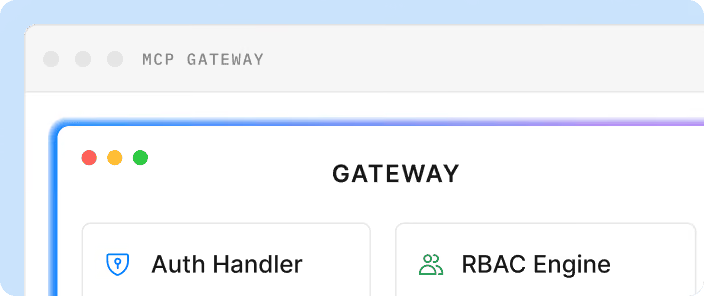
Every authentication event is an API call. The speed, reliability, and security of those calls determine whether customers get in quickly or abandon the login flow entirely. Well-managed API security at the gateway level (automated OWASP checks, rate limiting, token validation) is what keeps that flow secure without making it slow. DigitalAPI's API Governance layer enforces these controls continuously across every API endpoint in the estate.
3. Real-Time Transaction and Data Access
Customers checking a bank balance, an insurance claim status, or a lab result want the current answer, not yesterday's cached version. Real-time data access requires APIs that connect to backend systems with low latency and high reliability.
This is where multi-gateway environments create problems. An enterprise with APIs split across AWS, Azure, and legacy on-premise systems often has no unified view of what's running, what's performing, and what's failing. DigitalAPI's API Management Platform unifies all of those sources into a single catalog, giving platform teams visibility and control over every API that feeds the B2C portal.
4. Personalization and Contextual Recommendations
Generic portals lose customers. Personalized ones keep them. The difference between a portal that shows a customer their account balance and one that shows them their balance, a relevant product offer, and a prompt to renew their expiring policy is an AI and API question, not just a design question.
Personalization at scale requires real-time access to customer behavior data, purchase history, and contextual signals, all surfaced through APIs. Managing that API layer well means faster, more accurate personalization with lower latency. DigitalAPI's API Analytics gives teams visibility into which APIs are driving the most engagement, helping them prioritize investment in the integrations that matter most to customer outcomes.
5. Mobile-First Access
Most B2C portal sessions happen on a phone. Mobile-first isn't a design consideration anymore. It is a default requirement. Every API powering the portal needs to perform under mobile network conditions, handle intermittent connectivity gracefully, and return lightweight payloads that don't strain bandwidth or battery.
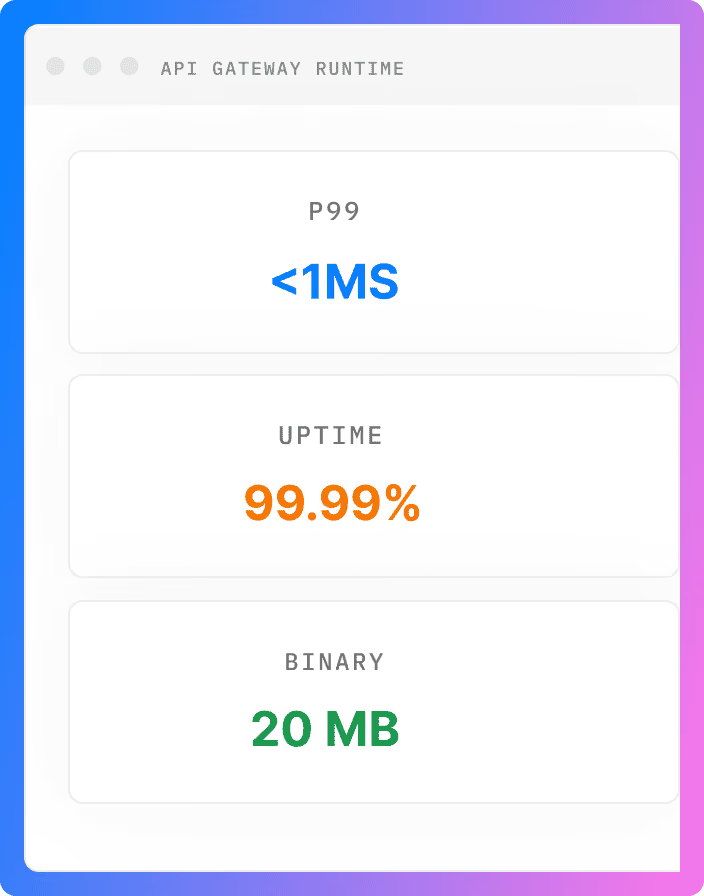
API rate limiting and traffic management at the gateway level is how you protect portal performance during peak mobile usage. DigitalAPI's Arelio API Gateway provides configurable rate limiting that can be tuned to support high-demand services without degrading the experience for other users.
6. Payment Processing and Billing
Transactions are the revenue moment for most B2C portals. Whether a customer is paying an insurance premium, settling a hospital bill, or purchasing a subscription, the payment flow must be fast, secure, and frictionless.
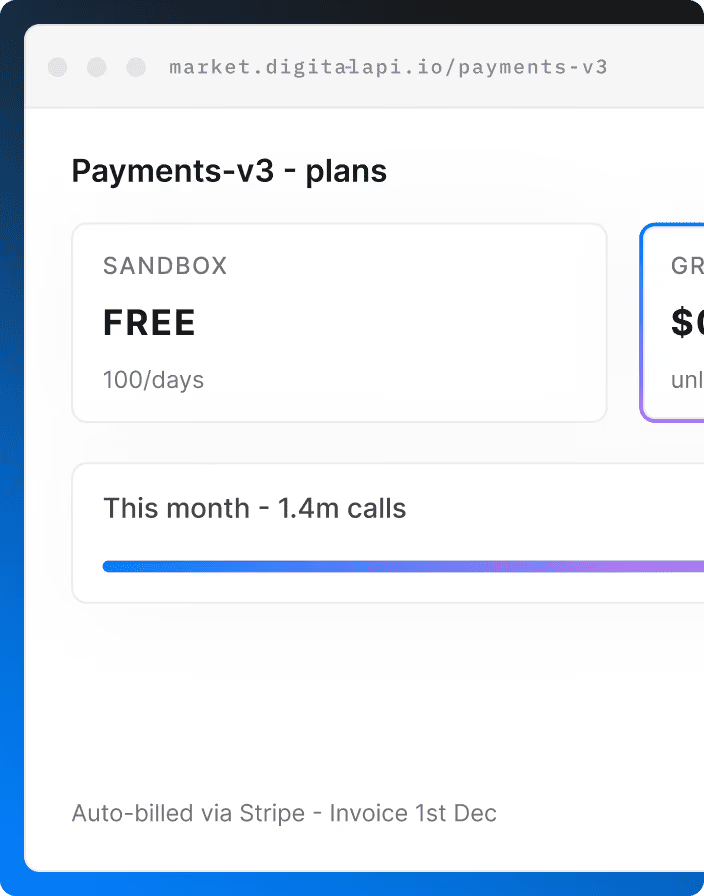
Payment APIs connect the portal to payment gateways, fraud detection systems, and billing platforms. DigitalAPI's API Marketplace supports integration with payment providers like Stripe and Braintree, alongside tiered billing and subscription management for organizations that monetize services through their portal.
B2C Portals by Industry: Where the API Layer Matters Most
The functional requirements of a B2C portal shift significantly by sector. Here is how the API infrastructure challenge looks across three of DigitalAPI's core industries.
Banking
A banking B2C portal handles account queries, payments, loan applications, fraud alerts, and open banking integrations simultaneously. Regulatory mandates like PSD2 require banks to expose customer data to licensed third parties through secure APIs. That means the API layer must be both externally accessible and tightly governed.
DigitalAPI's Banking solution provides the API management infrastructure banks need to deliver consumer experiences that are fast enough for retail customers while compliant enough for regulators. The global bank case referenced earlier engaged 6,800 external developers through a unified external portal and enabled open banking across the UK, EU, Bahrain, and Hong Kong on a single platform.
Insurance
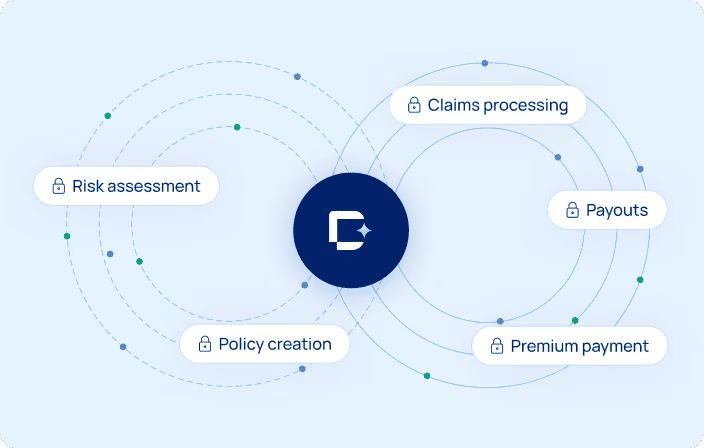
A policyholder portal is a B2C interface connecting customers to policy data, claims workflows, renewal reminders, and document downloads. Every one of those experiences calls a different backend system. Without a well-managed API layer, claims processing stalls, policy data shows inconsistencies, and customers lose confidence.
Zurich Insurance used DigitalAPI's marketplace and API management infrastructure to build a branded, professional portal experience that handles millions of API transactions. The underlying API governance meant the portal stayed reliable and compliant while delivering a seamless customer-facing experience. DigitalAPI's Insurance solution addresses these cross-system integration and compliance requirements directly.
Healthcare
A patient portal is one of the most API-dependent B2C experiences in existence. Appointment scheduling, lab results, prescription management, billing, and insurance verification each require calls to different systems, often governed by HIPAA and FHIR compliance requirements.
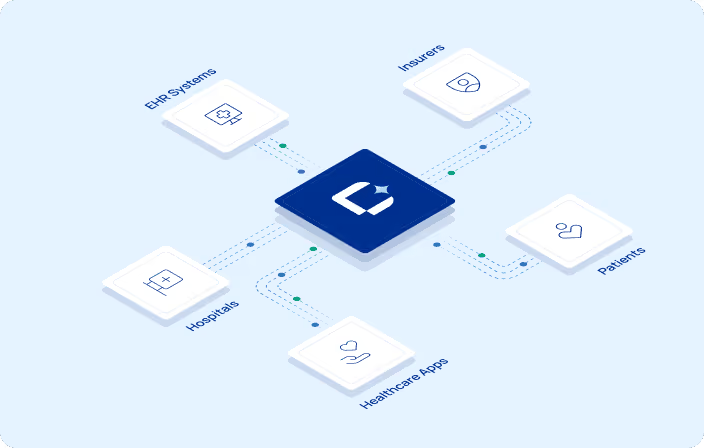
DigitalAPI's HealthApix platform aggregates patient data from multiple sources into a governed, FHIR-compliant API layer, giving patients fast access to their information while maintaining the security and compliance the sector demands. The result is a portal that reduces appointment delays, speeds up insurance claims, and gives patients the real-time visibility they expect.
How to Build a B2C Portal: The Right Sequence
Many organizations build the front end first and then try to connect the APIs afterward. That sequence creates rework, delays, and a portal that never quite delivers what the customer experience team promised. Here is the sequence that actually works.
1. Start with your API estate:
Before designing a single screen, catalog every backend system the portal will need to access. Map which APIs exist, which are documented, which are reliable, and which will need to be built or integrated. This audit prevents the most common B2C portal failure: launching a beautiful portal powered by APIs that can't support it.
2. Unify your API management layer:
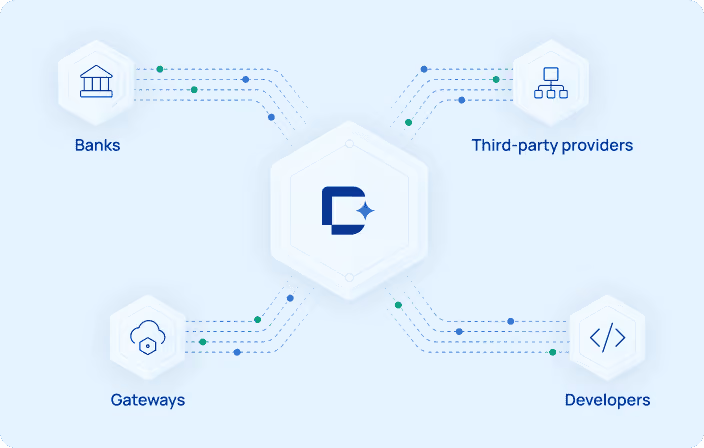
If your data sits across multiple gateways and cloud environments, consolidate visibility before you build. DigitalAPI connects to Kong, AWS, Azure, Apigee, and MuleSoft simultaneously, normalizing API definitions into one searchable catalog without requiring you to decommission existing infrastructure.
3. Define access and governance policies:
Decide which APIs will power public-facing portal features and which will remain internal. Configure authentication, rate limiting, and security policies at the gateway level. Run automated governance checks so that every API serving the portal meets your security and compliance standards before it goes live.
4. Build the self-service experience:
With a solid API foundation in place, the front-end portal can be built with confidence that the data layer will support it. Use DigitalAPI's API Sandboxing to test the portal experience against realistic mock data before connecting to production systems.
5. Instrument and iterate:
Once live, use analytics to track where customers drop off, which API calls are slowest, and which features drive the most engagement. DigitalAPI's analytics layer gives platform teams the data they need to prioritize improvements and catch degradation before customers notice.
B2C vs B2B Portals: Key Differences
Understanding where these portals diverge helps clarify what your B2C portal specifically needs to get right.
| Dimension | B2C Portal | B2B Portal |
|---|---|---|
| Primary audience | Individual consumers | Businesses, procurement teams, partners |
| Volume | High (thousands to millions of users) | Lower (hundreds to thousands of accounts) |
| Session behavior | Frequent, short, mobile-heavy | Less frequent, longer, desktop-heavy |
| Authentication | Consumer-grade (social login, MFA) | Enterprise-grade (SSO, SAML, RBAC) |
| Personalization | Essential for retention | Secondary to workflow efficiency |
| Compliance focus | GDPR, HIPAA, PCI-DSS | SOC 2, enterprise SLAs, procurement rules |
| Support tolerance | Very low, expects immediate self-service | Moderate, expects account management support |
The fundamental technical challenge is different too. B2C portals need to scale to handle traffic spikes, deliver sub-second response times, and maintain security across millions of authenticated sessions simultaneously. The API management layer is what makes that possible.
The Bottom Line
A B2C portal is only as good as the infrastructure powering it. You can invest in beautiful design, smart personalization, and an intuitive user journey. But if the APIs connecting your portal to your backend are slow, undocumented, fragmented, or insecure, the customer experience will fail at the exact moment it matters.
The organizations delivering the best B2C experiences in banking, insurance, and healthcare are the ones that treat their API layer as a strategic asset, not a technical dependency. They govern it centrally, monitor it in real time, and build on top of it with confidence.
DigitalAPI gives enterprises the unified API management infrastructure to make that possible, from multi-gateway consolidation and automated governance to sandboxing, analytics, and AI-ready MCP conversion. Whether you are building a new B2C portal from scratch or modernizing an existing one, the API foundation is where the work starts.
Book a demo with DigitalAPI to see how a unified API management layer powers high-performing B2C experiences in banking, insurance, and healthcare. Or explore the API Management Platform to understand how leading enterprises manage their full API estate on one platform.
Frequently Asked Questions
1. What is a B2C portal?
A B2C (business-to-consumer) portal is a digital platform that allows a business to serve individual customers directly through self-service features such as account management, transactions, real-time data access, and support. It removes the need for customers to contact support for routine tasks and acts as the primary digital interface between a brand and its end users.
2. What is the difference between a B2B and B2C portal?
A B2B portal serves businesses and organizational buyers, typically supporting procurement workflows, contract management, and partner collaboration with a smaller number of high-value accounts. A B2C portal serves individual consumers at high volume, prioritizing fast load times, personalized experiences, mobile-first access, and minimal friction for self-service tasks.
3. What APIs does a B2C portal need?
A B2C portal typically needs APIs for authentication and identity management, account and profile data retrieval, payment processing, real-time transaction history, notifications, and any domain-specific functionality such as claims processing in insurance or lab results in healthcare. Each of these API connections must be fast, secure, governed, and reliably available.
4. How do you ensure a B2C portal is secure and compliant?
Security starts at the API layer. Implementing OAuth 2.0, multi-factor authentication, automated OWASP security scanning, rate limiting, and RBAC at the gateway level protects both the portal and the customer data it handles. In regulated industries, compliance with GDPR, HIPAA, or PSD2 is enforced through API governance policies that run continuously across every endpoint serving the portal.
5. How long does it take to build a B2C portal?
Timeline varies with complexity, but most enterprise B2C portals take six months to over a year when built from scratch. Using a platform like DigitalAPI to consolidate the API management layer significantly reduces build and integration time, with organizations typically going live within 4 to 8 weeks on the API infrastructure that powers the portal experience.
Dhayalan Subramanian is Associate Director, Product Growth at DigitalAPI, where he leads go-to-market and product growth for the company’s multi-gateway API management platform. His work focuses on helping large enterprises and mid-market cloud companies consolidate APIs across AWS, Azure, Apigee, Kong, MuleSoft, and other gateways into a single control plane for governance, discovery, monetization, and agent consumption.
Dhayalan brings 14+ years of experience across product strategy, enterprise architecture, and engineering leadership. Earlier in his career, he held senior roles at Encora (as Associate Architect and Technical Manager), Mindtree (Technology Lead), Tech Mahindra (Technical Lead), and Primus Analytics, where he designed integration frameworks and delivered enterprise-grade digital platforms for global customers.
At DigitalAPI, he works directly with platform, integration, and developer experience leaders at Fortune 500 organizations to operationalize unified API catalogs, developer portals, and MCP-ready APIs. He writes regularly on API developer experience, API governance, and AI agent architectures.
One email a fortnight. Worth opening.
A short digest of what we're writing, what we're learning from customers, and the handful of links you'd actually want from us. No tracking pixels.

.avif)